Complimentary FedEx 2-Day on orders over $250 Complimentary Overnight shipping on orders over $400 Live Arrival Guarantee on every order Family-owned insect farm - Houston, Texas

Shop

Showing 353–368 of 499 resultsSorted by latest

  • Sale! Isopoda sp. Tarragona isopods on damp leaf litter

    Isopoda sp. Tarragona

    $6.99 - $69.99

    Pronounced: Tah-rah-GOH-nah

    Care Level: Intermediate

    Adult Size: 4 to 6 mm

    Reproductive Rate: Slow to moderate

    Temperature: 70 to 80°F

    Humidity: Medium to medium-high with a reliable moist side

    Scientific Name: Isopoda sp. “Tarragona” (exact species not confirmed)

    Appearance: Small dwarf-style isopod with pale, tan, or grayish coloration that blends into leaf litter and bark


    Tarragona Isopods for Sale: Live Isopoda sp. “Tarragona,” an unusual play-dead dwarf isopod kept for naturalistic terrarium cultures, behavior interest, and collector projects.

    Best For: Collectors of unusual hobby isopods, naturalistic terrarium cultures, keepers who already understand basic isopod husbandry, and small supplemental feeder cultures.

    One of the more unusual dwarf isopods in the hobby. Isopoda sp. “Tarragona” plays dead when disturbed, curling, freezing, or remaining still as a defensive response rather than scattering like most isopod species. The exact genus and species are not confirmed in the hobby trade, so this is sold under the locality designation “Tarragona” (associated with Tarragona, Spain). Reproduction runs slow to moderate, so this is a collector and behavior-interest culture rather than a working cleanup crew.
    Select optionsLoading Done This product has multiple variants. The options may be chosen on the product page
  • Sale! Porcellio scaber Lava isopods with orange and dark mottled patterning

    Porcellio scaber 'lava'

    $19.99 - $324.99
    • Pronounced: Por-SEL-ee-oh SKAY-ber “Lava”
    • Care Level: Beginner
    • Adult Size: 14 to 18 mm
    • Reproductive Rate: Moderate to high once established
    • Temperature: 65 to 78°F
    • Humidity: 50 to 70% with a moist retreat (handles drier conditions than most isopods)
    • Scientific Name: Porcellio scaber “Lava”
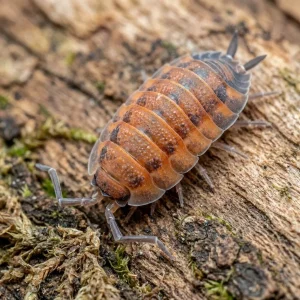
    • Appearance: Vivid orange to reddish-orange body with a rough textured dorsal surface, larger than typical hobby isopods

    Porcellio scaber Lava Isopods for Sale: Live Porcellio scaber “Lava,” a vivid orange-red color morph used as a visible cleanup crew, supplemental feeder for mid-size reptiles, and collector display species in moderately humid bioactive setups.

    Best For: Display vivariums, moderately humid reptile enclosures (crested gecko, juvenile bearded dragon, mantella), and keepers who want a larger visible isopod than dwarf cleanup species.

    A selectively bred orange-red color morph of the common rough woodlouse Porcellio scaber. Specifically, “Lava” shows vivid orange to reddish-orange coloration across a rough textured exoskeleton (scaber means “rough” in Latin, referring to the bumpy dorsal surface). At 14 to 18 mm adult size, this species is noticeably larger than Powder morphs or dwarf cleanup isopods. As a result, it suits keepers who want a visible display isopod rather than a hidden microfauna layer. The species also handles drier conditions better than most hobby isopods.

    Select optionsLoading Done This product has multiple variants. The options may be chosen on the product page
  • Sale! Powder Orange Cream isopods for sale bioactive

    Porcellionides Pruinosus 'Orange Cream'

    $10.00 - $249.99

    Pronounced: Por-sell-ee-on-EYE-deez proo-ih-NO-sus

    Care Level: Beginner

    Adult Size: 1 to 1.25 cm

    Reproductive Rate: Very high once established

    Temperature: 70 to 85°F

    Humidity: 45 to 80% with a humid retreat

    Scientific Name: Porcellionides pruinosus “Orange Cream”

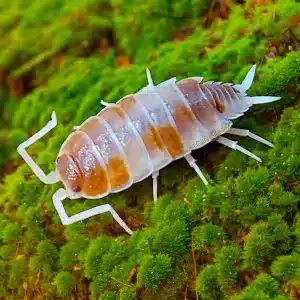
    Appearance: Creamy orange dorsal wash with paler cream edges, soft exoskeleton, long-legged and quick on the surface

    Best For: Display vivariums, collector cultures, and breeding projects

    A two-tone designer morph of Porcellionides pruinosus with a creamy orange dorsal wash bordered by a paler cream edge, often called a “creamsicle” look in the hobby. Unlike the solid Powder Orange morph, Orange Cream shows a clear color split across the back, which is why most customers pick it for display and collector lineups rather than general cleanup work. Smaller starter pack sizes also make it a practical choice for breeders building a new culture from scratch.

    Select optionsLoading Done This product has multiple variants. The options may be chosen on the product page
  • Sale! Porcellio laevis Milkback isopods on bark and moss in a bioactive terrarium setup

    Porcellio Laevis "Milkback"

    $9.99 - $149.99
    • Pronounced: por-SELL-ee-oh LEE-vis
    • Care Level: Beginner-friendly
    • Adult Size: Up to about 20 mm
    • Reproductive Rate: Moderate to fast once established
    • Temperature: 68 to 78°F preferred
    • Humidity: Moderate with a moist retreat and drier ventilated side
    • Scientific Name: Porcellio laevis Latreille, 1804
    • Appearance: Pale cream to milky white back against darker side edges — the only two-tone laevis morph in the catalog

    Milkback Isopods for Sale: Live captive-bred Porcellio laevis “Milkback” from TC INSECTS, the two-tone morph with a pale creamy back and darker side edges — a distinct visual effect found in no other laevis morph in this range.

    Best For: Display cultures where the two-tone pale-back effect against darker sides is the visual goal, keepers who want something between the stark all-over white and the natural gray-brown of Wild Type, bioactive cleanup crews at the most accessible laevis price point, and collectors completing the TC INSECTS laevis morph collection.

    Milkback shares every care, behavior, and husbandry trait with Dairy Cow, Orange, White, and Wild Type laevis. The difference is color expression: partial pale pigmentation on the back only, creating a two-tone effect the solid morphs cannot. On the smooth, glossy laevis shell, that pale cream back reads almost pearlescent in good lighting.

    Select optionsLoading Done This product has multiple variants. The options may be chosen on the product page
  • Sale! Armadillidium vulgare Japanese Magic Potion isopods on bark and moss in a bioactive terrarium setup

    Armadillidium vulgare "Japanese Magic Potion"

    $18.99 - $99.99

    Pronounced: Ar-ma-dill-IDD-ee-um vul-GAH-ray

    Care Level: Beginner to intermediate

    Adult Size: About 12 to 18 mm (smaller than the American line)

    Reproductive Rate: Prolific once established; faster than the American line

    Temperature: 68 to 77°F

    Humidity: Moderate with strong ventilation and a moist retreat

    Substrate Depth: 3 to 4 inches (this line burrows)

    Scientific Name: Armadillidium vulgare Latreille, 1804 “Japanese Magic Potion”

    Mutation: Simple recessive dalmatian gene, Japanese line

    Armadillidium vulgare Japanese Magic Potion Isopods: A live Japanese-line dalmatian A. vulgare culture sold for keepers who want the bright white-yellow-black high-contrast pattern of the dalmatian mutation in the smaller, faster-breeding Japanese stock.

    Best For: Display colonies, collector cultures, planted vivariums with strong ventilation, keepers already running standard A. vulgare husbandry, and buyers who want the visual signature of the dalmatian mutation in the Japanese hobby line specifically.

    Armadillidium vulgare “Japanese Magic Potion” is the Japanese line of the dalmatian color mutation in A. vulgare. The dalmatian gene affects only dark pigment, so animals show a white-to-cream base with naturally occurring yellow speckles and added pronounced black spots. The Japanese line was produced by a breeder in Japan about a year after the American line was isolated from Savannah, Georgia stock. Specifically, the Japanese line is distinguished by dainty yellow speckles, pronounced black spots only (no orange), smaller body size, and faster breeding than the American line.

    Select optionsLoading Done This product has multiple variants. The options may be chosen on the product page
  • Sale! Giant Canyon isopods for sale on leaf litter and bark

    Porcellio dilatatus "Giant Canyon Isopod"

    $8.99 - $69.99

    Pronounced: Por-SELL-ee-oh dye-luh-TAH-tus

    Care Level: Beginner to intermediate

    Adult Size: Around 15 mm at adult size, with hobby reports up to 20 mm

    Reproductive Rate: Moderate once established

    Temperature: 68 to 80°F

    Humidity: Low to medium overall (roughly 40 to 60 percent) with one always-moist retreat zone

    Scientific Name: Porcellio dilatatus Brandt, 1833

    Appearance: Broad, flattened body in brown to grey-brown tones with subtle darker striping

    Giant Canyon Isopods for Sale: A live Porcellio dilatatus culture sold for drier bioactive setups, larger-bodied cleanup crew use, and keepers who want a hardy beginner-friendly species that tolerates lower humidity than most.

    Best For: Drier reptile bioactive enclosures, terrariums with low to medium humidity, larger-bodied cleanup crew roles, and beginner keepers who want a forgiving species with documented biology.

    Giant Canyon isopods are a hardy European species, Porcellio dilatatus, sold as a captive-bred starter culture for drier bioactive setups and cleanup crew use. Adults grow to around 15 mm with a broad, flattened, brown-and-striped body that does not fully roll into a ball. The species is drought-tolerant in captivity, which makes it one of the more forgiving larger isopods for keepers who struggle with high-humidity species.

    Select optionsLoading Done This product has multiple variants. The options may be chosen on the product page
  • Sale! Cubaris murina Glacier isopods on moss and bark in a humid bioactive terrarium setup

    Cubaris Murina 'Glacier'

    $15.99 - $84.99
    • Pronounced: kyoo-BAR-iss myoo-REE-nuh “GLAY-shur”
    • Care Level: Beginner — same care as Little Sea and Papaya; wider humidity tolerance than either
    • Adult Size: About 10 to 16 mm; slow grower from juvenile to adult
    • Breeding Rate: Moderate to fast once established
    • Temperature: 70 to 80°F
    • Humidity: 55 to 80% — the widest tolerance range of all three C. murina morphs in this catalog
    • Origin: Color morph first collected in Florida, USA
    • Scientific Name: Cubaris murina Brandt, 1833 — “white out” morph
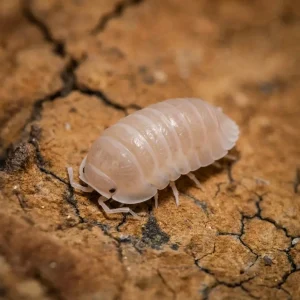
    • Appearance: Completely white throughout — body, legs, antennae, and eyes. The most total pigment removal of the C. murina morph range.

    Cubaris Murina Glacier Isopods for Sale: Live captive-bred Cubaris murina “Glacier” from TC INSECTS — the “white out” morph of the species, with white eyes rather than the pink eyes of the Papaya, the widest humidity tolerance of the three C. murina morphs, and a semi-transparent body that lets you watch what the colony eats.

    Best For: Collectors completing the C. murina morph trio alongside Little Sea and Papaya, display vivariums where a pure white isopod contrasts against green moss and dark substrate, keepers who want a beginner-accessible Cubaris that tolerates more humidity variation, and anyone who wants the most adaptable of the three C. murina forms.

    Glacier and Papaya are both white morphs — but not the same. Papaya shows a pink-to-peach body with pink eyes. Glacier shows a fully white body with white eyes. The white eyes are the immediate visual tell. For species background, see the Little Sea product page.

    Select optionsLoading Done This product has multiple variants. The options may be chosen on the product page
  • Sale! Armadillidium peraccae isopods on bark and moss in a bioactive terrarium setup

    Armadillidium peraccae

    $14.99 - $39.99

    Pronounced: ar-ma-dill-IH-dee-um per-AK-kay

    Care Level: Beginner to intermediate

    Adult Size: About 15 to 18 mm

    Reproductive Rate: Moderate to fast once established

    Temperature: 68 to 77°F

    Humidity: Low to medium with a clearly defined moist retreat and steady ventilation

    Scientific Name: Armadillidium peraccae Tua, 1900

    Appearance: Bulky conglobating body with a heavily textured, tuberculate (bumpy) dorsal surface in shades of bluish-gray, silver-gray, and beige

    Armadillidium peraccae Isopods for Sale: Live cultures of this Italian and Greek pill bug, suited to intermediate keepers building an Armadillidium shelf or a semi-arid Mediterranean-themed bioactive vivarium.

    Best For: Semi-arid bioactive vivariums, Mediterranean-themed display setups, collector Armadillidium shelves featuring Tua’s 1900 Italian descriptions, and keepers who want a drought-tolerant pill bug with distinctive texture.

    Armadillidium peraccae is an Italian-described pill bug with a distinctive bumpy, tuberculate body texture and a bluish-gray to silver-gray color cast. The species was formally described by Italian zoologist Paolo Tua in

    1900, the same year and the same journal in which Tua described Armadillidium gestroi, and is named in honor of Italian herpetologist Mario Giacinto Peracca (1861-1923). Native to Italy and Greece, it is one of the more

    drought-tolerant Armadillidium in the hobby and works well in semi-arid bioactive setups with a moist refuge.

    Select optionsLoading Done This product has multiple variants. The options may be chosen on the product page
  • Sold Out Sale! Yellow Dot Isopod

    Porcellio ornatus 'Yellow Dot'

    $11.99 - $99.99
    • Pronounced: Por-SEL-ee-oh or-NAY-tus
    • Care Level: Intermediate
    • Adult Size: 19 to 25 mm (0.75 to 1 inch)
    • Reproductive Rate: Moderate once established
    • Temperature: 68 to 78°F
    • Humidity: Mostly dry with a small moist retreat
    • Scientific Name: Porcellio ornatus “Yellow Dot”
    • Appearance: Discrete bright yellow dots on a gray-to-dark base body, the largest and most affordable Spanish Porcellio species in the catalog

    Porcellio ornatus Yellow Dot Isopods for Sale: Live Porcellio ornatus “Yellow Dot,” a drier-tolerant Spanish species used as a bold display isopod and an accessible starter species for keepers building Mediterranean Porcellio experience.

    Best For: Drier bioactive setups, display vivariums where bold yellow-on-dark dot patterning appeals, intermediate keepers stepping up from P. scaber, and accessible entry into Spanish Porcellio collecting.

    A selectively bred yellow-spotted line of the Spanish species Porcellio ornatus, originally described by Panzer in 1801. Specifically, “Yellow Dot” shows discrete bright yellow dots on a gray-to-dark base body. As a result, the spotting reads as clearly defined rather than the diffuse yellow shading of other Mediterranean morphs.

    This is the largest Spanish Porcellio in the TC INSECTS catalog at 19 to 25 mm, and the most affordable at $11.99 to $74.99. Therefore, “Yellow Dot” is the natural starting point for keepers stepping up from P. scaber morphs into drier-tolerant Spanish species.

    Select optionsLoading Done This product has multiple variants. The options may be chosen on the product page
  • Sale! Orange Dalmatian isopods for sale on natural bark and leaf litter

    Porcellio scaber 'Orange Dalmation'

    $6.99 - $449.99
    • Pronounced: Por-SEL-ee-oh SKAY-ber
    • Care Level: Beginner
    • Adult Size: 12 to 17 mm
    • Reproductive Rate: Moderate to high once established
    • Temperature: 68 to 78°F
    • Humidity: Moderate, with a damp moss area and drier retreat
    • Scientific Name: Porcellio scaber “Orange Dalmatian”
    • Appearance: Pale to light body base with orange spots or patches in a Dalmatian-style pattern, rough textured dorsal surface

    Orange Dalmatian Isopods for Sale: Live Porcellio scaber “Orange Dalmatian” used as a visible cleanup crew, beginner-friendly display species, and supplemental feeder for mid-size reptiles in moderately humid bioactive setups.

    Best For: Display vivariums where pattern variation matters, moderately humid bioactive setups, first-time isopod keepers, and keepers building a varied P. scaber lineup.

    A selectively bred pattern morph of the common rough woodlouse Porcellio scaber. Specifically, “Orange Dalmatian” (also spelled “Orange Dalmation” in the hobby) shows bright orange spotting or patching over a pale to light body base. As a result, the pattern varies across individuals like a Dalmatian dog, with some animals showing heavy orange coverage and others showing scattered spots. The body still carries the rough textured dorsal surface that defines scaber. At 12 to 17 mm adult size, this morph suits keepers who want bold pattern over solid color.

    Select optionsLoading Done This product has multiple variants. The options may be chosen on the product page
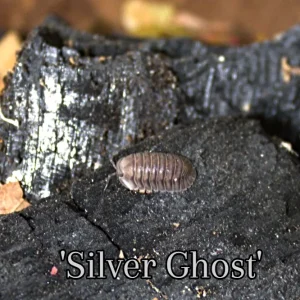
  • Sale! Nesodillo Arcangelii Silver Ghost for sale

    Nesodillo Arcangellii 'Silver Ghost'

    $24.99 - $94.99

    Pronounced: neh-soh-DEE-loh ar-kan-JEL-ee-eye

    Care Level: Beginner to intermediate

    Adult Size: About 15 to 20 mm

    Reproductive Rate: Prolific once established

    Temperature: 70 to 80°F

    Humidity: High (75 to 95%) with consistent moisture throughout

    Scientific Name: Nesodillo arcangelii Verhoeff, 1928 (formerly traded as Cubaris sp. “Silver Ghost”)

    Appearance: Semi-translucent silvery-gray body with a broad, flatter shape than Cubaris species, conglobates loosely when disturbed

    Silver Ghost Isopods for Sale: Live cultures of this Taiwanese Nesodillo arcangelii morph, ideal for high-humidity tropical bioactive setups and collectors interested in modern taxonomic reclassifications.

    Best For: Tropical bioactive vivariums, dart frog enclosures, planted tropical setups, and collectors building an Asian pill bug shelf with documented taxonomy.

    Silver Ghost is a Taiwanese tropical pill bug in the genus Nesodillo, formerly traded in the hobby as Cubaris sp. “Silver Ghost” before being properly reclassified. Specifically, the species Nesodillo arcangelii was described by Karl Wilhelm Verhoeff in 1928 in a paper titled “Isopods from Formosa” (Formosa is the old name for Taiwan). Notably, the species name honors Giuseppe Arcangeli, an Italian zoologist who worked on Armadillidae taxonomy. The genus Nesodillo belongs to the family Armadillidae, which is distinct from the European Armadillidiidae. Importantly, this is a high-humidity tropical species rather than a Mediterranean one. As a result, husbandry needs differ substantially from the more commonly kept Armadillidium pill bugs.

    Select optionsLoading Done This product has multiple variants. The options may be chosen on the product page
  • Sale! Nesodillo arcangelii Purple Ghost isopods on moss and bark in a humid terrarium setup

    Nesodillo Arcangelii Sp. 'Purple Ghost'

    $24.99 - $219.99

    Pronounced: neh-so-DILL-oh ar-kan-JEL-ee-eye

    Care Level: Intermediate

    Adult Size: Small to medium, often around 8 to 12 mm

    Reproductive Rate: Moderate once established

    Temperature: 72 to 78°F

    Humidity: Moderate to high with a clear moisture gradient

    Scientific Name: Nesodillo arcangelii sp. “Purple Ghost” (sold in the hobby trade; taxonomy is debated)

    Appearance: Pale lavender-gray to soft ghost-toned body, rounded and compact, with subtle color that shifts under different lighting

    Purple Ghost Isopods for Sale: Live Nesodillo arcangelii sp. “Purple Ghost” cultures from TC INSECTS, sold for display, breeding, and tropical bioactive use in stable, leaf-litter-rich setups.

    Best For: Collector shelves, tropical display cultures, planted vivariums, and intermediate keepers who can hold steady humidity and resist the urge to dig through the colony too often.

    Purple Ghost isopods are a collector-tier tropical morph with a soft lavender-gray, ghost-toned body that shows up best against dark bark, moss, and damp leaf litter. They breed at a moderate pace once settled and tend to stay hidden during the day, so buyers should think of them as a slow-build display and breeder culture rather than a fast cleanup crew. Color is subtle and lighting-dependent, not bright purple.

    Select optionsLoading Done This product has multiple variants. The options may be chosen on the product page
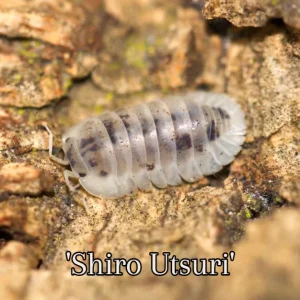
  • Sale! Cubaris Shiro Utsuri for sale

    Nesodillo Arcangellii 'Shiro Utsuri'

    $34.99 - $109.99

    Pronounced: SHE-roh oot-SOO-ree (nay-soh-DEE-loh ar-kan-JEL-ee-eye)

    Care Level: Intermediate

    Adult Size: Approximately 2 cm

    Reproductive Rate: Moderate once established

    Temperature: 70 to 80 F

    Humidity: High, with a consistently moist zone

    Scientific Name: Nesodillo arcangelii “Shiro Utsuri”

    Appearance: White to off-white base with irregular black blotches, broad flatter body shape, and a pale skirt along the body margin.

    Shiro Utsuri Isopods for Sale: A koi-patterned collector morph in the Armadillidae family that works best as a display species in a humid bioactive setup rather than a heavy-duty cleanup crew.

    Best For: Keepers building a display vivarium, collectors filling out the Armadillidae shelf, and intermediate hobbyists ready to step beyond Porcellio and Porcellionides species.

    Shiro Utsuri Isopods are a Japanese-isolated morph of Nesodillo arcangelii, named after the koi fish pattern they resemble. The body carries a creamy white base broken by bold black blotches and a clean white skirt around the edge. They are active above the substrate, more visible than many Armadillidae morphs, and better suited to humid display setups than to dry or heavily disturbed enclosures.

    Select optionsLoading Done This product has multiple variants. The options may be chosen on the product page
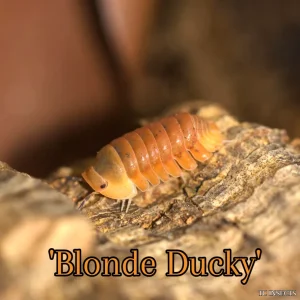
  • Sale! Cubaris sp. Blonde Ducky isopods on moss and bark in a humid bioactive terrarium setup

    Cubaris Sp. 'Blonde Ducky'

    $119.99 - $349.99
    • Pronounced: Koo-BARE-iss sp. Blond DUCK-ee
    • Care Level: Intermediate to advanced
    • Adult Size: Up to about 20 mm — slightly larger and wider-bodied than the Rubber Ducky
    • Reproductive Rate: Slow — colony establishment can take up to a year under ideal conditions
    • Temperature: 72 to 80°F preferred
    • Humidity: High — 70 to 80% with strong ventilation maintained simultaneously
    • Origin: A separate Southeast Asian collection locality from the Rubber Ducky; exact region not confirmed across hobby sources
    • Scientific Name: Cubaris sp. “Blonde Ducky” (formally undescribed)
    • Appearance: Light yellow face and tail against a vivid orange central body — the face is the pale area, not the most saturated

    Blonde Ducky Isopods for Sale: Live captive-bred Cubaris sp. “Blonde Ducky” from TC INSECTS — a larger, wider-bodied Southeast Asian Cubaris from a different collection locality than the Rubber Ducky, with an inverted face-to-body color relationship and a colony establishment timeline measured in months to a year.

    Best For: Experienced isopod keepers and dedicated collectors who want the larger, structurally distinct ducky-form Cubaris, keepers who already maintain a Rubber Ducky culture and want the complementary second form, and anyone building a serious ducky-type Cubaris collection who can manage a genuinely long establishment phase.

    The Blonde Ducky is commonly sold alongside the Rubber Ducky but the two are not the same. The Blonde Ducky comes from a different locality, has a wider flatter body, and shows a reversed color relationship — the face is the lightest area, while the central body is vivid orange. Care requirements are essentially the same as the Rubber Ducky, but colony establishment is slower and patience is the defining requirement.

    Select optionsLoading Done This product has multiple variants. The options may be chosen on the product page
  • Sale! Live Cubaris sp. Platinum Ducky isopods showing metallic platinum sheen on smooth polished exoskeleton, captive-bred from TC INSECTS

    Cubaris Sp. 'Platinum Ducky'

    $89.99 - $299.99
    • Care Level: Intermediate — more accessible than Rubber Ducky after establishment
    • Adult Size: Up to about 18 to 20 mm
    • Reproductive Rate: Moderate to fast once established — significantly more prolific than Rubber or Blonde Ducky
    • Temperature: 72 to 80°F preferred
    • Humidity: High — approximately 70% moist to 30% dry, with strong ventilation
    • Origin: Thailand
    • Scientific Name: Cubaris sp. “Platinum Ducky” (formally undescribed; genus placement tentative)
    • Appearance: Smooth, highly polished exoskeleton with a cool metallic platinum sheen — an optical quality, not a standard color

    Platinum Ducky Isopods for Sale: Live captive-bred Cubaris sp. “Platinum Ducky” from TC INSECTS — the metallic ducky-form Cubaris from Thailand, a wood-hide specialist known for being significantly more prolific than the Rubber Ducky or Blonde Ducky once a colony establishes.

    Best For: Collectors who want the metallic visual at the top tier of the ducky range, experienced keepers ready to invest in an establishment phase that pays off with much faster colony growth than the other ducky types, display vivarium builds where the platinum optical sheen against dark substrate is the design goal, and ducky-range completists who already keep Rubber Ducky and Blonde Ducky.

    The “Platinum” name describes an optical quality — the extremely smooth, polished exoskeleton reflects light like metal. It is not pale yellow, orange, or white. It is the metallic fourth character in the TC INSECTS ducky range. Care follows the same high-humidity, warm, limestone-calcium framework as all ducky-type Cubaris. The key setup difference is wood: quality rotting hardwood on the underside is where this species lives, not just what it eats. For full genus care background, see the Rubber Ducky page.

    Select optionsLoading Done This product has multiple variants. The options may be chosen on the product page
  • Sale! LT Text Cubaris murina Papaya isopods on moss and bark in a humid bioactive terrarium setup

    Cubaris Murina 'Papaya'

    $19.99 - $699.99
    • Pronounced: koo-BAIR-iss mur-EE-nuh puh-PIE-yuh
    • Care Level: Beginner — same care as the standard Little Sea
    • Adult Size: About 10 mm
    • Breeding Rate: Prolific once established — medium to large broods
    • Temperature: 70 to 80°F
    • Humidity: Medium-high — 60 to 80% with a moisture gradient
    • Origin: Color morph isolated in the United States (North Dakota)
    • Scientific Name: Cubaris murina Brandt, 1833 — albino morph
    • Appearance: Pink-to-peach body, pink eyes, white lateral edging, semi-transparent back — the three signatures of a true albino isopod

    Cubaris Murina Papaya Isopods for Sale: Live captive-bred Cubaris murina “Papaya” from TC INSECTS — the only pink isopod in captive breeding and one of the very few true albino isopods in the hobby, isolated in North Dakota from the standard “Little Sea” C. murina.

    Best For: Collectors who want the most visually distinctive Cubaris murina color line, display vivariums where a pink albino isopod contrasts against dark substrate and green moss, keepers who want beginner-level care with premium-level visual impact, and anyone building a complete Cubaris murina morph collection alongside the standard Little Sea.

    Papaya and the standard Little Sea share identical care. The difference is entirely in the albino phenotype — a genetic change that removes all dark pigment, producing the pink body, pink eyes, and semi-transparent back.

    For full species background, see the Little Sea product page.

    Select optionsLoading Done This product has multiple variants. The options may be chosen on the product page