

Blonde Ducky Isopods for Sale
TC INSECTS ships live captive-bred Cubaris sp. “Blonde Ducky” for dedicated collectors, experienced keepers, and display vivarium projects. This is the larger, wider-bodied ducky-form Cubaris in the TC INSECTS range. It differs from the Rubber Ducky in origin, color relationship, body structure, and establishment timeline. Buyers who want the full picture should read this page before ordering.
Overview
Cubaris sp. “Blonde Ducky” is a formally undescribed species in the genus Cubaris Brandt, 1833, family Armadillidae. It shares the same high-humidity tropical care framework and conglobation capability as the Rubber Ducky. However, it comes from a different collection locality in Southeast Asia. Structural and color differences lead many keepers to treat it as a distinct species rather than a color morph.
For full background on the Cubaris genus, cave-origin care context, and slow breeding biology, see the Rubber Ducky product page.
Is Blonde Ducky a Color Morph of Rubber Ducky?
Specialist keepers widely treat Blonde Ducky as a separate collection form — not a selectively bred color morph of the Rubber Ducky. Collectors found Blonde Ducky individuals in a different locality than the Rubber Ducky collection site. Those animals showed consistent orange coloring from the start, with little selective breeding needed to maintain it.
Hobby breeders have also documented structural differences. Blonde Ducky shows a wider, flatter body with a more prominent lateral skirt. Its tail segment shapes differ noticeably from the Rubber Ducky’s narrower, more cylindrical form. Until formal taxonomy resolves the question, TC INSECTS describes this as a separate collection form from a different locality.
Honest Note: Origin Is Uncertain
The exact collection locality of the Blonde Ducky is not confirmed consistently across the hobby trade. Some sources report Thailand — specifically a different region from the Rubber Ducky’s site. At least one source reports Vietnam. Because accounts vary and no formal scientific description exists, TC INSECTS does not assign a confirmed wild locality.
Care should be based on what the animal needs in captivity. The same high-humidity, warm, limestone-calcium framework that applies to all cave-origin ducky-type Cubaris applies here. An unverified locality claim does not change that.
Honest Note: Colony Establishment Takes Time
The Blonde Ducky’s establishment timeline is the most important honest note on this page. Colony establishment can take up to a year under ideal conditions. This is longer than the already-slow Rubber Ducky. A new culture that appears quiet for weeks or months is not necessarily failing. It is establishing.
Patience, stable conditions, and minimal disturbance are the keys. Consequently, this is not the right product for keepers who expect visible results within a month. Plan for a long quiet phase before the first consistent juvenile output appears.
The Color Relationship — Face vs. Body
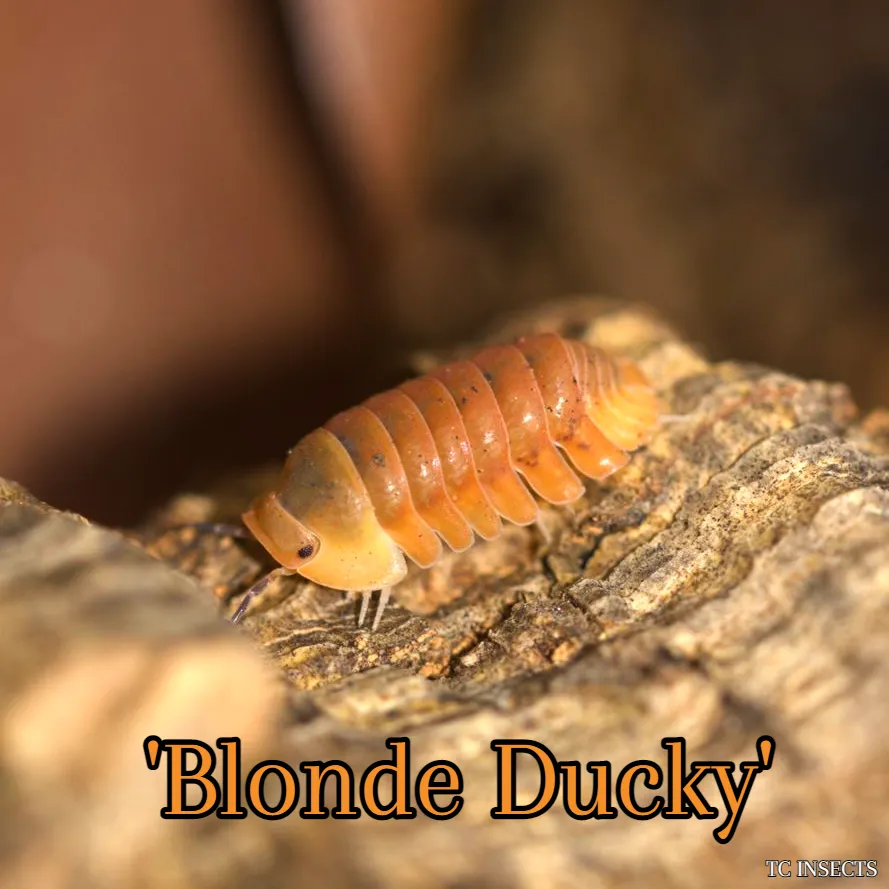
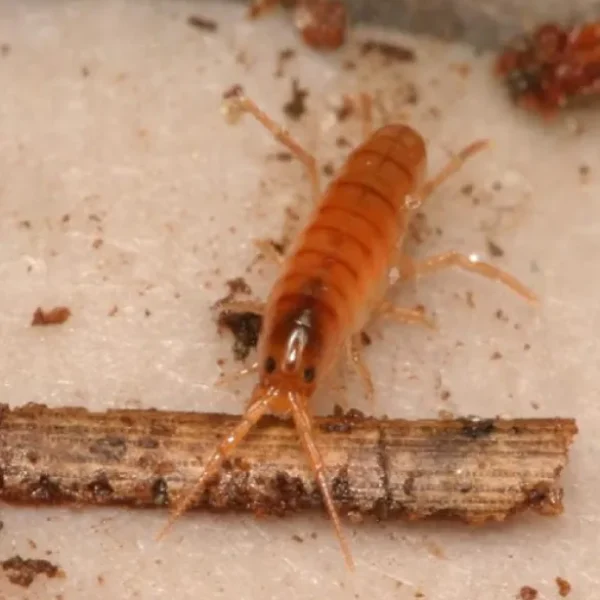
The Blonde Ducky’s color pattern is an inversion of the Rubber Ducky’s. In the Rubber Ducky, the entire body shows deep, saturated yellow-orange. In the Blonde Ducky, the face and tail are pale yellow to cream, while the central body is vivid orange. The “blonde” name describes the lighter face, not an all-over paler tone.
When adults face the viewer, the pale yellow face and rounded cephalon still create the duck-bill silhouette. The contrast between the light face and the vivid orange body adds visual depth. The Rubber Ducky’s more uniform coloring does not produce this same effect.
This color development is gradual. Juveniles may appear more uniformly colored at first. As adults mature, the pale yellow on the face and tail becomes more pronounced, creating the full two-tone effect. A fresh colony will show a range of coloring stages simultaneously — this is normal and expected.
Size and Body Form
Adults reach up to 20 mm — slightly larger than the Rubber Ducky’s 15 to 18 mm. The Blonde Ducky also has a noticeably wider, flatter body profile. Its lateral skirt is more prominent than the Rubber Ducky’s, and the tail segment shapes differ distinctly. Specialty keepers cite these structural differences as the primary reason to treat Blonde Ducky as its own form rather than a color variant.
Care
Care for the Blonde Ducky is essentially identical to the Rubber Ducky. The Rubber Ducky product page covers the cave-origin rationale, humidity biology, limestone calcium preference, deep substrate needs, and conglobation behavior. The summary below covers the key parameters only.
Setup Framework
Use a ventilated enclosure with 6 or more inches of organic substrate. Keep approximately one-third of the floor space moist, with leaf litter and rotting white wood throughout. Provide both limestone and a secondary calcium source simultaneously. Maintain 72 to 80°F and 70 to 80% humidity with good cross-ventilation. Keep the enclosure warm, humid, and well-aired.
Calcium
Provide limestone as the primary calcium source alongside TC Calcium Ultra Fine or cuttlebone as secondary. Multiple calcium sources available simultaneously outperform a single source. As with all cave-origin ducky-type Cubaris, colonies improve visibly with limestone present versus cuttlebone alone.
Food
Keep TC INSECTS Assorted Hardwood Leaf Litter and rotting white wood available at all times as the base diet. Offer protein twice per week through TC INSECTS Isopod Food, dried shrimp, or fish flakes. Some keepers find that vegetables high in carotenoids — carrot, sweet potato, pumpkin — support coloring.
Feed small portions and remove uneaten fresh food within 24 to 48 hours. Overfeeding in a high-humidity environment creates rapid mold and mite problems.
Springtails
Pair with Springtails. In this high-humidity enclosure, springtails handle mold control in the moist zone. The isopods cannot fully manage that layer alone. A springtail culture is not optional for a stable Blonde Ducky setup.
Breeding Notes
Females carry developing young in a marsupium. Expect a long, quiet establishment phase before the first mancae appear. Minimal disturbance, consistent temperature, consistent humidity, and steady calcium access are the breeding conditions. Once the colony settles, it breeds with steady — if slow — production throughout the year.
True Blonde Ducky breeds true for the lighter-faced coloring. If dark-colored individuals appear, they may indicate mixing with Rubber Ducky. Alternatively, a small number of breeders have documented a rare dark color form native to the Blonde Ducky line. These individuals do not disqualify the culture, but monitor them if color-line purity matters.
Best For
- Experienced keepers and dedicated collectors who want the larger, structurally distinct ducky-form Cubaris alongside or instead of the Rubber Ducky
- Keepers already managing a Rubber Ducky culture who want the second distinct form to complement it
- Display vivarium builds where the two-tone pale-face-against-orange-body coloring is the visual goal
- Serious breeding projects where the extended establishment timeline is planned for and managed over months
- Collectors building a complete ducky-type Cubaris range
Not Best For
- Keepers expecting results within a month. Colony establishment can take up to a year.
- Beginner isopod keepers. The Blonde Ducky shares the demanding care needs of the Rubber Ducky and adds a longer establishment phase.
- Keepers who cannot maintain 72 to 80°F and 70 to 80% humidity consistently. Temperature drops and low humidity slow breeding and stress the colony.
Receiving and Acclimation
Open the package in a calm, warm indoor area soon after delivery. Some animals may be conglobated after shipping — leave them undisturbed for several minutes before moving them. Place all packing material directly into the prepared enclosure. Position the animals near the moist zone under bark or leaf litter. Leave the culture undisturbed for at least two weeks.
First Week Priorities
Reach target temperature and humidity before the animals arrive. For the first two weeks, feed very lightly — a small vegetable piece, a protein offering, and leaf litter. Check whether the colony has eaten before increasing portions. Hiding, minimal surface activity, and occasional conglobation are all normal after arrival. Stability and minimal intervention support establishment best.
Recommended Add-Ons
- TC Calcium Ultra Fine as a secondary calcium source alongside limestone — both simultaneously for best results.
- TC INSECTS Assorted Hardwood Leaf Litter as the primary grazing surface and base diet.
- TC INSECTS Isopod Food for the protein rotation twice per week.
- TC INSECTS Ultra Isopod Habitat Kit for a richer starting substrate suited to a premium cave-origin species.
- Springtails — required for mold control in the high-humidity enclosure this species needs.
Frequently Asked Questions
How is Blonde Ducky different from Rubber Ducky?
The two are not the same form. Blonde Ducky comes from a different Southeast Asian locality. It is slightly larger — up to 20 mm vs. the Rubber Ducky’s 15 to 18 mm. Its body is wider and flatter with a more prominent lateral skirt.
The color relationship is inverted. Rubber Ducky shows deep yellow-orange throughout. Blonde Ducky shows a pale yellow face and tail against a vivid orange central body. Colony establishment also takes longer. Many specialty keepers treat them as distinct species, though formal taxonomy has not yet resolved this.
Is Blonde Ducky a color morph of Rubber Ducky?
The hobby consensus leans toward no. Collectors found Blonde Ducky individuals in a different locality than Rubber Ducky. Those animals showed structural differences too — not just color variation. However, neither form has a formal species description. TC INSECTS therefore treats Blonde Ducky as a separate collection form from a different Southeast Asian locality.
Why is Blonde Ducky so much more expensive than Rubber Ducky?
Two factors drive the price: rarity and the establishment timeline. The Blonde Ducky is less widely available than the Rubber Ducky. Its colony establishment can take up to a year — meaning breeders carry long-term care costs before a culture is sellable. Additionally, the structural distinction from Rubber Ducky makes it a separate collector target, not an interchangeable substitute.
Can I keep Blonde Ducky and Rubber Ducky together?
You can keep them in the same enclosure without harm — the care requirements are essentially identical. However, mixed pairings may eventually produce animals with intermediate coloring. Any dark-colored offspring from the Blonde Ducky side would gradually obscure the pale-face characteristic. If maintaining each form as a distinct visual line matters, keep them in separate dedicated cultures.
My Blonde Ducky isopods are hiding and not active. Is something wrong?
Cubaris species are naturally shy, particularly in new setups. Conglobation and hiding for days or weeks after arrival is entirely normal. The Blonde Ducky’s establishment phase can last months before visible colony growth appears.
Check temperature and humidity first. Both should hold stable at 72 to 80°F and 70 to 80% humidity. If conditions are correct, continue stable care and minimize disturbance. Surface activity typically increases during low-light periods or after food is added.
Learn More About Blonde Ducky and Cubaris
These sources give useful context on the genus, family biology, and Southeast Asian distribution behind this species.
- GBIF: Cubaris Brandt, 1833. The Global Biodiversity Information Facility record for the genus, showing observation records concentrated across Southeast Asia — Thailand, Vietnam, and surrounding regions. Different collection localities in this zone produce Cubaris forms with distinct morphologies. This explains why Blonde Ducky and Rubber Ducky may represent geographically separate populations rather than a single collection.
- Wikipedia: Armadillidae. The family article covering ~80 genera and 700 species, including Cubaris. It notes the strongly convex body shape that enables conglobation and the family’s concentration in tropical regions. Armadillidae body structure varies meaningfully across species. This context explains why structural differences between ducky-form Cubaris — wider skirt, flatter body, different segment shapes — carry weight as potential species indicators.
- PMC / NCBI: Water conservation in terrestrial isopods. Peer-reviewed research on how terrestrial isopod gill structures manage water loss. Cave-dwelling Southeast Asian Cubaris evolved in continuously humid environments. Their gill biology reflects that origin directly. Reducing humidity significantly impairs water balance and accelerates molting failures — explaining why the 70 to 80% requirement is not negotiable.


Reviews
There are no reviews yet.