

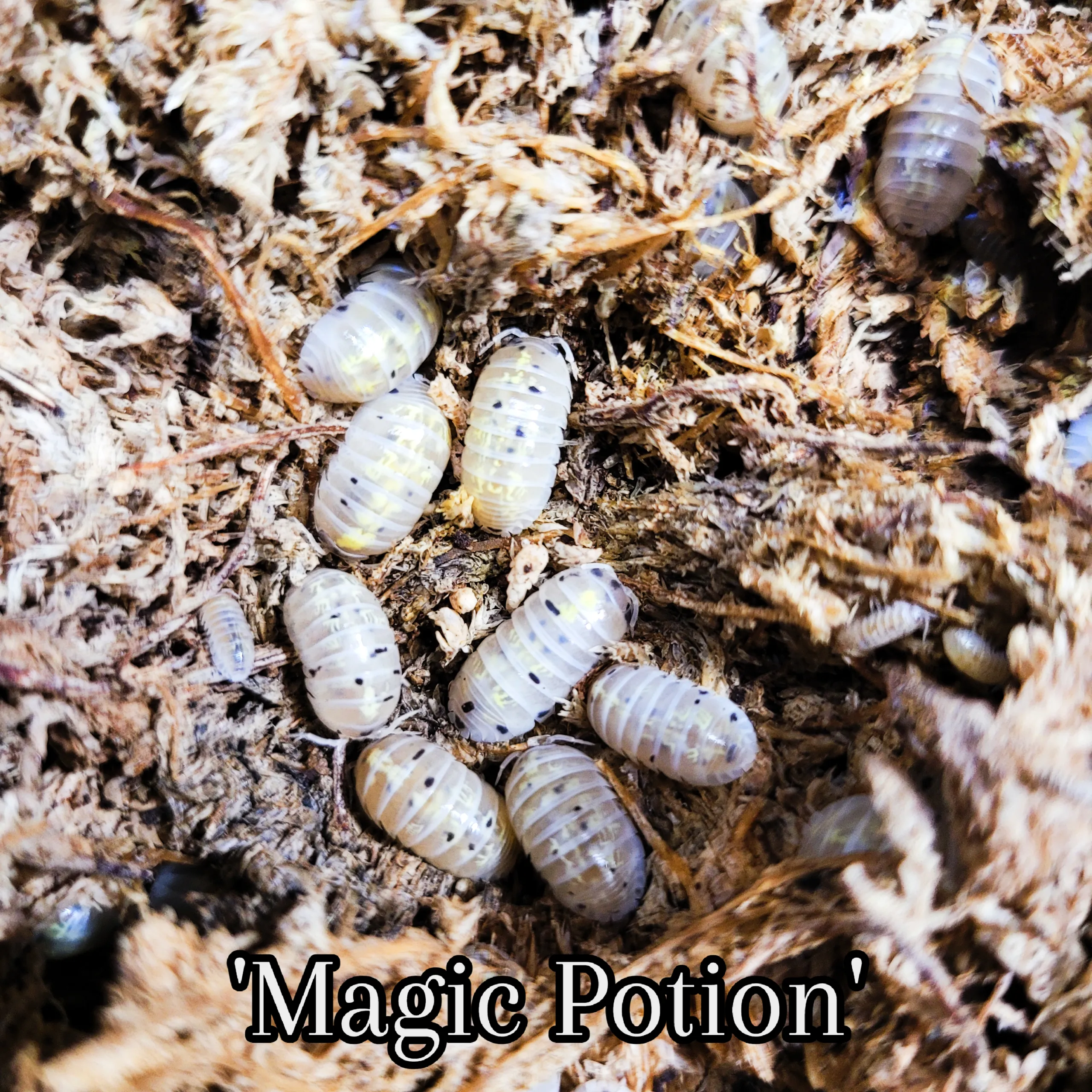
Armadillidium vulgare Japanese Magic Potion Isopods for Sale
Overview
Armadillidium vulgare “Japanese Magic Potion” is the Japanese line of the dalmatian color mutation in A. vulgare. Specifically, the species itself is the same A. vulgare described by Latreille in 1804. Additionally, we cover
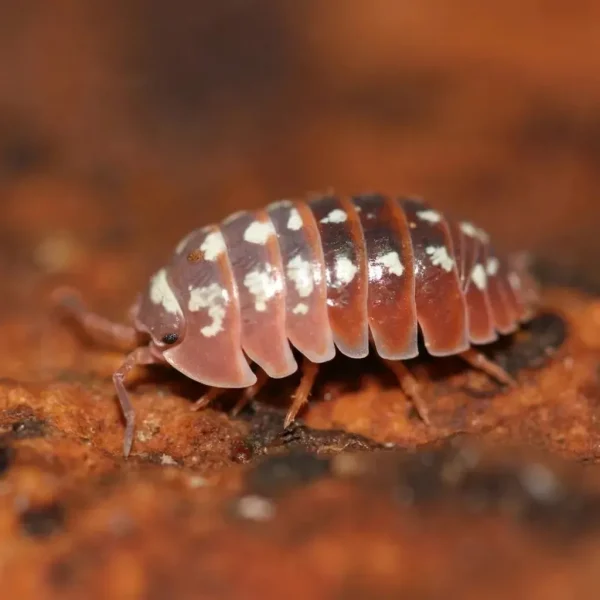
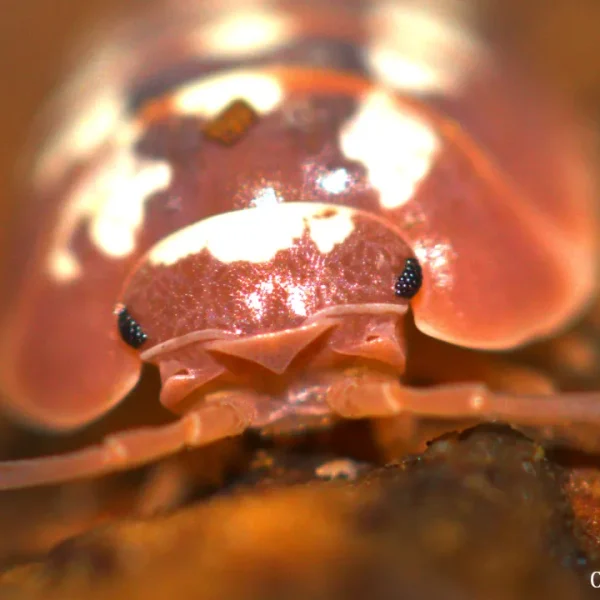
the wild-type form on our wild-type page. However, the Japanese line carries a simple recessive dalmatian gene. As a result, animals show a white-to-cream base with yellow and black speckling.
First, the Japanese line was produced by a breeder in Japan. Specifically, this happened about a year after the American line was isolated. Additionally, the American line traces to stock from a Savannah, Georgia backyard.
As a result, the two lines share the dalmatian mutation. However, they have different genetic backgrounds, body sizes, and breeding rates. Furthermore, Japanese line adults reach 12 to 18 mm. In contrast, this is smaller
than the famously massive American line stock.
Why Keep Armadillidium vulgare “Japanese Magic Potion”?
- High-contrast dalmatian pattern: First, the Japanese line shows a bright white-to-cream base with dainty yellow speckles and pronounced black spots. Specifically, this is one of the most striking expressions of the dalmatian gene in A. vulgare.
- Faster breeder than the American line: Additionally, multiple breeder sources describe this line as a prolific producer once established. As a result, colony growth follows a normal vulgare timeline.
- Smaller, more manageable body size: Furthermore, the Japanese line reaches 12 to 18 mm. Therefore, this fits standard culture bin setups without oversized enclosures.
- Same care framework as wild-type vulgare: In addition, husbandry is identical to our wild-type page. As a result, keepers can add this line without changing their routine.
- Full conglobation: Finally, the species seals completely when rolled. Therefore, this preserves the classic Armadillidium defensive display.
Honest Note: The Mutation Is Called “Dalmatian,” Not “Magic Potion”
First, this is a real terminology issue in the hobby. Specifically, the simple recessive mutation creates the white-and-spotted pattern. Additionally, the mutation is called the dalmatian gene. Furthermore, it has been called
that for many years. However, “Magic Potion” is a separate line designation. In particular, Roach Crossing applied this name to the American line from Savannah, Georgia stock. As a result, “Magic Potion” is not the name of
the mutation itself.
First, Roach Crossing isolated the original American Magic Potion line. Additionally, they argue that the Japanese dalmatian vulgare are unrelated to “true” Magic Potion stock. Therefore, they prefer the name “Japanese
dalmatians” for this line. However, the hobby has settled on “Japanese Magic Potion” as the standard market name. As a result, we use that name on this product page. Furthermore, the underlying terminology dispute is
disclosed honestly here.
In summary, this product is technically a Japanese line of the dalmatian color mutation in A. vulgare. However, it is marketed under the established hobby name “Japanese Magic Potion.”
Honest Note: Japanese Line vs. American Line
First, the two lines share the dalmatian mutation. However, they have several documented visual and behavioral differences. Specifically, the Japanese line shows:
- Dainty, smaller yellow speckles on a white-to-cream base. In contrast, the American line shows large splatters of yellow spotting.
- Pronounced black spots only with no orange. However, the American line sometimes produces orange spots. Specifically, the theory is an “orange vigor” outcross at some point.
- Smaller adult body size at 12 to 18 mm. In contrast, the American line reaches massive adult sizes through its slower growth curve.
- Faster breeding once established. In contrast, the American line is famously slow to mature.
As a result, the Japanese line suits keepers who want visible colony growth on a normal timeline. Additionally, the compact body size fits standard culture bins. In contrast, the American line suits keepers who want maximum body size. Furthermore, it carries the original Roach Crossing Magic Potion lineage. In summary, both are documented dalmatian color expressions of A. vulgare.
Honest Note: How the Dalmatian Gene Works
First, the dalmatian gene is a simple recessive mutation. Specifically, it affects only dark pigment in A. vulgare. As a result, the gene produces a white-to-cream base instead of the wild-type gray. However, the species’
naturally occurring yellow pterdine pigment is unaffected. Therefore, dalmatian animals show a white base with yellow speckles and black spots.
Additionally, this is the same two-pigment-cell biology covered on our A. vulgare St. Lucia page. Specifically, ommochrome pigment expresses black. Furthermore, pterdine pigment expresses yellow. In effect, the dalmatian
mutation lifts the dark pigment expression in most of the body. However, it leaves the dark pigment concentrated in scattered spots. Therefore, the visual signature comes from how the gene rearranges existing pigment
expression.
Honest Note: Different from A. depressum “Magic Potion”
Additionally, we carry an Armadillidium depressum “Magic Potion” in this catalog. However, this is a completely different species. Specifically, the two products share only the “Magic Potion” trade name. In particular, the
A. depressum Magic Potion is the Southern Pill Woodlouse. Furthermore, it is a British and Western European synanthropic species described by Brandt in 1833.
In contrast, the A. vulgare Japanese Magic Potion is the common pillbug described by Latreille in 1804. Specifically, it carries the Japanese line of the dalmatian gene. Additionally, the two species do not interbreed.
Furthermore, they have different body shapes, care needs, and origins. As a result, do not assume the two Magic Potion products are related. In summary, the trade-name overlap reflects how the hobby applies “Magic
Potion” across multiple species.
Care and Setup
Generally, A. vulgare “Japanese Magic Potion” follows the standard vulgare husbandry framework. Specifically, this line is known for burrowing behavior. As a result, substrate depth matters more than it does for surface-active vulgare lines.
Temperature
First, target 68 to 77°F across most of the year. Specifically, normal indoor temperatures work fine for this line. However, avoid sustained heat above 80°F. Additionally, avoid cold rooms consistently below 60°F.
Humidity
First, aim for moderate humidity overall with strong ventilation. Additionally, keep one consistently moist retreat zone. Specifically, hydrate that side with sphagnum moss and damp substrate. Then let the rest of the
enclosure run drier. As a result, the colony can self-select between zones. Furthermore, strong ventilation matters more than humidity level for this line.
Substrate
First, use 3 to 4 inches of moisture-holding substrate. Specifically, this line burrows actively. As a result, deeper substrate gives the colony room to dig. Additionally, use a mix of organic topsoil, rotted hardwood, and flake
soil. Then add a generous layer of TC INSECTS Assorted Hardwood Leaf Litter on top. Furthermore, the added depth helps retain moisture between mistings.
Food
First, lead with leaf litter and decaying hardwood as the base diet. Then supplement with TC INSECTS Isopod Food for added protein and minerals. Additionally, add a calcium source like TC Calcium Ultra Fine. Specifically, calcium supports the bright white base color across molts. Furthermore, the dorsal plates incorporate calcium carbonate as a structural layer.
Ventilation
First, use strong cross-ventilation or a well-ventilated lid. Specifically, this line prefers more airflow than humidity-dependent tropical species. As a result, undersized ventilation causes problems faster than undersized humidity here.
Bioactive Use
Generally, this line works well in moderate-humidity bioactive enclosures with strong ventilation. Additionally, the burrowing behavior keeps the colony active below the leaf litter line. As a result, this helps process organic matter throughout the substrate layer. However, run a backup culture in a dedicated bin first. Therefore, the backup protects the line’s genetics from display tank predation.
Breeding Notes
Generally, the Japanese line is a prolific breeder once established. Specifically, broods are typically medium to large. In contrast, this is faster than the American line. Additionally, the American line is famously slow to mature. As a result, expect visible colony growth within a few months of stable conditions.
For best results, leave the colony undisturbed during the first six to eight weeks. Then add fresh leaf litter before the existing layer is fully consumed. Additionally, avoid frequent digging through the substrate. Specifically, the dalmatian gene is a simple recessive. As a result, the pattern stays consistent within the line if not cross-bred with wild-type stock.
Best For
- Collector display cultures focused on high-contrast dalmatian-pattern isopods
- Keepers who want the Japanese line specifically (smaller body, faster breeder, black spots only)
- Planted vivariums with strong ventilation and deep substrate
- Keepers already running standard A. vulgare husbandry
- Hobbyists building a multi-line A. vulgare set across Wild Type, locality lines, and morph lines
- Display setups where colony visibility and visual signature matter
Not Best For
- Keepers who want the original American Magic Potion line specifically
- Sealed wet tropical setups suited to high-humidity Cubaris species
- Mixed cultures with wild-type A. vulgare, since cross-breeding dilutes the dalmatian gene expression
- Feeder use, since per-animal value is too high for that role
- Hot tropical setups running consistently above 80°F
- Shallow substrate setups, since this line burrows and needs depth
Origin and Locality Notes
First, the Japanese Magic Potion line was produced by a breeder in Japan. Specifically, this happened about a year after the American Magic Potion line was isolated. Additionally, Roach Crossing established the American
line. Furthermore, the original stock came from a backyard in Savannah, Georgia. Initially, wild-type A. vulgare were collected there. Later, dalmatian animals appeared in a millipede enclosure. In contrast, the Japanese
line is a separate isolation of the same dalmatian mutation in different stock.
As a result, “Japanese Magic Potion” is a hobby line designation. Specifically, it is not a geographic locality designation. Additionally, the species A. vulgare is native to Mediterranean Europe and is naturalized worldwide.
Therefore, the Japanese line reflects captive breeding rather than a wild Japanese collection record. Furthermore, the dalmatian mutation has been isolated separately in multiple countries. Specifically, the gene appears
spontaneously in established vulgare cultures over time.
Receiving and Acclimation
First, open your package promptly when it arrives. Then inspect the cup calmly before moving anything. Specifically, rolling isopods often arrive curled up or hidden in moss and shipping paper. As a result, check slowly
rather than dumping the culture.
Additionally, prepare the enclosure before opening the cup. Specifically, the habitat should already have 3 to 4 inches of substrate. Furthermore, include one moist retreat zone, deep leaf litter, bark, and a calcium source.
Then place the shipping material into the enclosure. After that, let the isopods move out on their own. Finally, keep the setup quiet for the first week while the colony settles.
Generally, it is normal for new arrivals to stay curled or hidden for several days. Specifically, this line burrows actively. As a result, some animals may dig into the substrate within hours of arrival. Therefore, judge culture
health by leaf litter activity and surface trails. However, do not rely on constant visible body counts.
Recommended Add-Ons
- TC INSECTS Ultra Isopod Habitat Kit — a premium starter setup recommended for this burrowing collector line. Specifically, it provides deeper substrate volume and more complete cover from day one.
- TC INSECTS Assorted Hardwood Leaf Litter — the core food and cover layer that should never run out in a Japanese Magic Potion culture.
- TC INSECTS Isopod Food — supplemental protein and minerals beyond leaf litter. Additionally, feed small portions to support the colony’s prolific breeding rate.
- TC Calcium Ultra Fine — supports the bright white dorsal plates that define the dalmatian pattern. Specifically, calcium carbonate is a structural layer in the exoskeleton.
- Springtails — pair with Japanese Magic Potion in moderate-humidity bioactive setups. Specifically, springtails manage mold around the moist retreat zone.
Frequently Asked Questions
What is the difference between Japanese Magic Potion and American Magic Potion?
First, the two lines share the dalmatian gene. However, they have several documented differences. Specifically, the Japanese line is smaller at 12 to 18 mm. In contrast, the American line reaches massive adult sizes. Additionally, the Japanese line breeds faster once established. In contrast, the American line is famously slow to mature. Furthermore, the Japanese line shows dainty yellow speckles. In contrast, the American line shows large yellow splatters. Finally, the Japanese line produces black spots only. However, the American line sometimes produces orange spots from an “orange vigor” outcross theory.
Is “Magic Potion” the name of the mutation?
No. Specifically, the mutation is called the dalmatian gene. Additionally, it has been called that for many years in the broader isopod hobby. In contrast, “Magic Potion” is a line designation. Furthermore, Roach Crossing applied this name to the American line they established. As a result, “Japanese Magic Potion” is technically the Japanese line of the dalmatian gene marketed under the “Magic Potion” trade name.
How is this different from your A. depressum “Magic Potion”?
Specifically, they are different species entirely. In particular, the A. depressum “Magic Potion” is the Southern Pill Woodlouse. Additionally, it is a British and Western European synanthropic species described by Brandt in 1833. In contrast, the A. vulgare Japanese Magic Potion is the common pillbug described by Latreille in 1804. Furthermore, it carries the Japanese line of the dalmatian gene. As a result, the two species share only a trade name.
Why do they burrow so much?
Specifically, burrowing is documented for this dalmatian vulgare line. Additionally, the behavior shows in both the Japanese and American lines. As a result, we recommend 3 to 4 inches of substrate depth. Furthermore, that depth is more than standard vulgare setups need. Therefore, expect the colony to disappear into the substrate during the day. However, they surface more actively at night or during low-light periods.
Are they easy to breed?
Yes. Specifically, the Japanese line is a prolific breeder once established. Additionally, broods are medium to large. As a result, expect visible colony growth within a few months of stable conditions. In summary, this is one of the easier A. vulgare morph lines to maintain in captivity.
Will the pattern stay consistent in offspring?
Yes, as long as the culture is not cross-bred with wild-type or non-dalmatian A. vulgare. Specifically, the dalmatian gene is a simple recessive. As a result, the pattern breeds true within an isolated culture. Therefore, keep this line separate from wild-type vulgare. Furthermore, this preserves the dalmatian color expression long-term.
Learn More About Armadillidium vulgare
Generally, A. vulgare is the most extensively studied terrestrial isopod species. Additionally, peer-reviewed and educational resources cover the species at multiple depth levels. Therefore, the following non-competitor references give keepers solid background.
-
Wikipedia: Armadillidium vulgare. Specifically, the main species reference covering Latreille’s 1804 description and the pigment cell biology behind the dalmatian color expression. As a result, this is useful for understanding the Japanese Magic Potion pattern mechanism.
-
Animal Diversity Web: Armadillidium vulgare. Additionally, a university-hosted educational species account covering habitat, food habits, reproduction, and behavior. Therefore, this is useful for keepers who want a structured overview of the species.
-
Molecular Biology and Evolution: A. vulgare genome paper. Furthermore, the 2019 peer-reviewed publication of the complete A. vulgare genome. As a result, this is useful for science-minded keepers who want the primary research source on this model organism.


Reviews
There are no reviews yet.