Feeder Insect Price Index: Cost Per Insect by Cup Size

Per-insect price from a 25-count to a 1,000-count cup
About a penny each by the thousand
Short-lived feeders cost more per insect and are bought small
Compare the cost per insect, not only the cup price
The price of a feeder insect depends far more on the cup you buy it in than on the insect: a small dubia roach costs about 24 cents each in a 25-count cup and about 7 cents each in a 1,000-count, and the same three-to-one spread shows up for mealworms, black soldier fly larvae, and superworms. The table below, built from current shop prices and refreshed when the shop changes, shows every staple feeder at the three counts people actually buy. Read it two ways: down a column to compare feeders at the count you buy, and across a row to see what a bigger cup does to the per-insect price. This guide explains the pattern, the exceptions, and how to use the index with the monthly cost calculator.
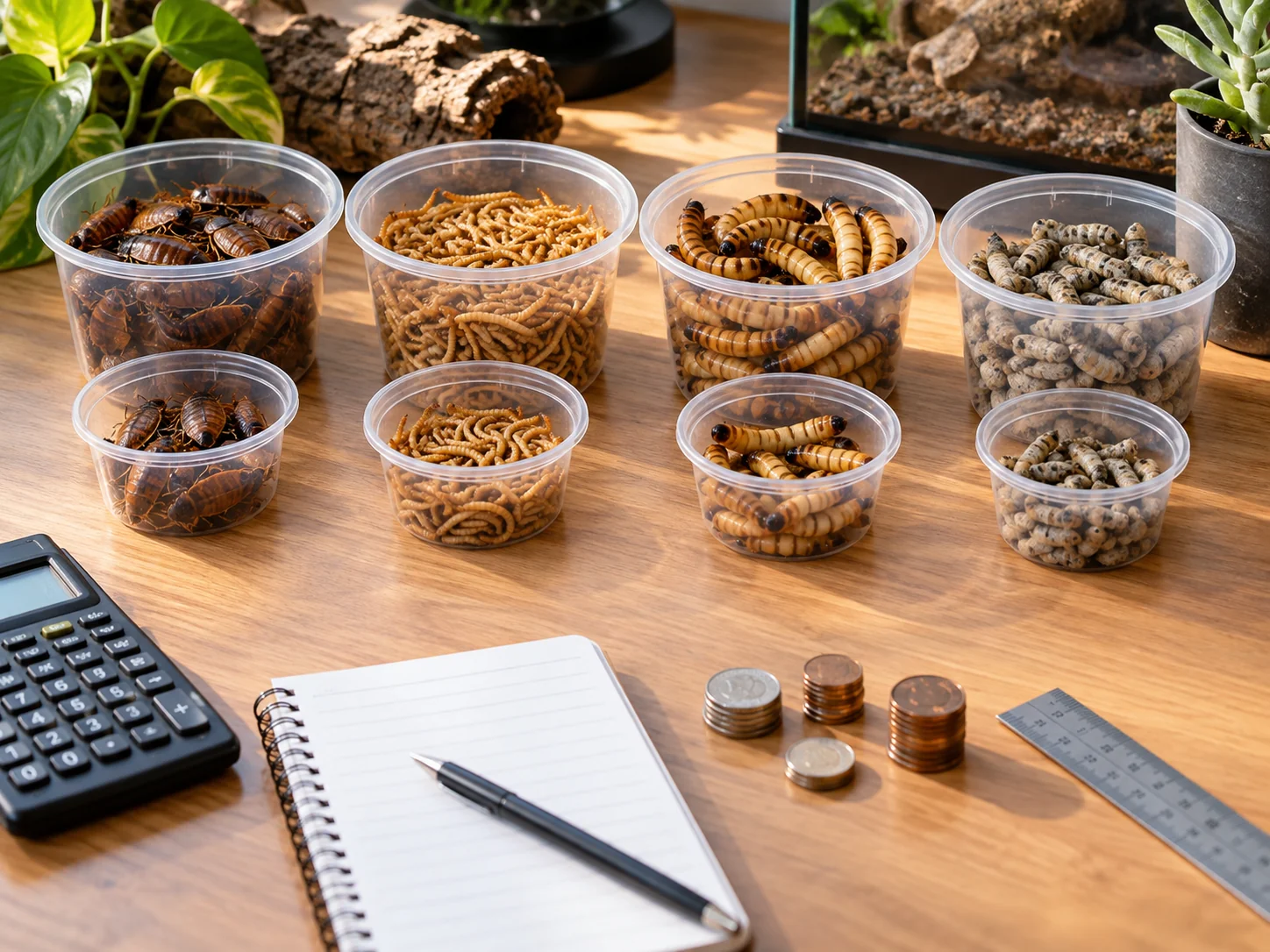
The best value is the count you can keep alive
Bulk counts lower the price per insect, but storage life, feeder size, and shipping determine whether the larger cup truly saves money.
Cost per insect by cup size
| Feeder and size | At 25 | At 100 | At 1,000 |
|---|---|---|---|
| Dubia roaches | |||
| Extra small, 1/4 in | 16¢ each | 9.0¢ each | 4.0¢ each |
| Small, 1/2 in | 24¢ each | 13¢ each | 7.0¢ each |
| Medium, 3/4 in | 32¢ each | 18¢ each | 13¢ each |
| Large, 1 in | 38¢ each | 23¢ each | 21¢ eachat 500 |
| Black soldier fly larvae | |||
| Small | 16¢ each | 6.0¢ each | 2.8¢ each |
| Medium | 16¢ each | 6.0¢ each | 2.8¢ each |
| Large | 16¢ each | 6.0¢ each | 2.8¢ each |
| Mealworms | |||
| Mini, 1/4 in | 4.0¢ eachat 50 | 3.0¢ each | 3.0¢ eachat 100 |
| Small, 1/2 in | 4.0¢ eachat 50 | 3.0¢ each | 1.2¢ each |
| Medium, 3/4 in | 4.0¢ eachat 50 | 3.0¢ each | 1.2¢ each |
| Large, 1 in | 4.0¢ eachat 50 | 3.0¢ each | 1.3¢ each |
| Superworms | |||
| Medium | 14¢ each | 7.5¢ each | 3.4¢ each |
| Large | 14¢ each | 7.5¢ each | 7.2¢ eachat 200 |
| Hornworms (by the cup) | |||
| Small cup | 47¢ eachat 15 | 47¢ eachat 15 | 47¢ eachat 15 |
| Large cup | 66¢ each | 66¢ eachat 25 | 66¢ eachat 25 |
| Silkworms | |||
| Small, 1/2 in | 44¢ each | 30¢ each | 20¢ each |
| Medium, 3/4 in | 60¢ each | 60¢ eachat 25 | 60¢ eachat 25 |
Why the cup size sets the price
Packing, labeling, a cup, and the labor to count and ship it cost about the same whether the cup holds 25 insects or 500. At 25, those fixed costs are most of the price; at 1,000, the insects are. That is why a small dubia goes from roughly 24 cents each at 25 to about 13 cents at 100 and about 7 cents at 1,000, and why a keeper who buys a 25-count cup every week is paying the packing cost 52 times a year. The monthly feeder cost calculator turns this into a bill for your animal.
The pattern holds for every staple. Medium mealworms run about 4 cents each at 50 and about a penny each at 1,000. Black soldier fly larvae run about 16 cents each at 25 and under 3 cents at 1,000. Superworms run about 14 cents each at 25 and about 3 cents at 1,000. The exact figures move with the shop, and the live table below carries the current ones; the ratio does not move much.
The staples, per insect
Dubia roaches are priced by size as well as count, and the larger the roach the more it costs: extra small runs from about 16 cents each at 25 to 4 cents at 1,000, small from about 24 to 7, medium from about 32 to 13, and large from about 38 cents to around 21 cents at 500. A juvenile dragon on extra small eats a lot of cheap roaches; an adult on large eats a few expensive ones, and the monthly bill lands in the same place. The dubia sizes guide explains which size is which.
Black soldier fly larvae are priced the same for small, medium, and large, which makes them the simplest line in the index and one of the cheapest calcium sources by the thousand. Mealworms are the cheapest insect on the page at every count. Superworms sit between mealworms and dubia. All four are in the live insects shop at every count in the table.
The treats: priced by the cup, not the thousand
Hornworms and silkworms are the exceptions. They live only a week or two, they need food in the cup, and they are shipped in small counts, so a hornworm costs about a dollar each in a 5-count cup and about 66 cents each in a 25-count, and a small silkworm costs about 55 cents each at 10 and about 20 cents at 1,000. Nobody buys 1,000 silkworms for one chameleon; the useful comparison for treats is the cost per week of use, and a 25-count cup is a week of treats for most animals.
That is not a reason to skip them. A hornworm that gets a dehydrated gecko drinking, or a silkworm that gets a picky chameleon eating, is cheap at any price. It is a reason to buy them for the week you will use them rather than by the hundred, which the hornworms versus silkworms post explains.
The cheapest cup is the one you can store
A 1,000-count cup only saves money if the insects are alive when you feed them. Mealworms keep for months in the refrigerator in bran, dubia keep for months at room temperature with egg flats and a vegetable slice, superworms keep for weeks in bran, and BSFL keep a few weeks refrigerated, so all four can be bought at the biggest count a collection eats in that window. Hornworms and silkworms cannot, and that is the whole reason for the cup pricing above.
The rule for reading the index: find the count that your animals eat in the storage window for that feeder, and buy that cup. For one leopard gecko that is a 100-count of small dubia and a 100-count of mealworms; for a juvenile dragon it is a 500 or 1,000 of extra small; for a chameleon it is a 100-count of medium dubia and BSFL plus a weekly silkworm cup. The refrigerator list gives the storage window for each.
Shipping and the free-shipping list
Per-insect price is only half the bill. A feeder that ships free with no minimum costs what the index says; a feeder that needs a shipping charge on a small cup can double in effective price. Many of the staples in the table ship free with no minimum on the free shipping list, and a cold pack or heat pack in extreme weather is free on FedEx 2-Day and Overnight orders, and a paid add-on on USPS and other shipping options. Fold those into the per-insect number for the honest cost.
A recurring order at the Subscribe and Save price takes 10 percent off the index for anything you buy on a schedule, which for a keeper on a 1,000-count of mealworms a month is a small saving on an already small number, and for a keeper on 500 medium dubia a month is a real one.
How to use the index
Pick your feeder and size, read across to the count you buy now, and then read one column to the right. If the per-insect price drops by a third and you can store that count, move up a cup. If you feed two or more animals, add their monthly counts and buy for the total rather than a cup each. If a treat feeder is more than a quarter of the monthly bill, it has drifted from treat to staple, and a cheaper staple should take its place.
The table refreshes from the shop, so the numbers on this page are the numbers at checkout. When the shop moves a price, the index moves with it, and the pattern stays the same: the cup size, not the species, is the biggest lever on what it costs to feed an animal.
The Best-Value Staples
The four staples with the lowest cost per insect by the hundred and the thousand, each of which stores for weeks or months.
Frequently Asked Questions
What is the cheapest feeder insect per insect?+
Mealworms, at about a penny each by the thousand and about 4 cents each at 50. Black soldier fly larvae and superworms are next at around 3 cents each by the thousand. Dubia cost more per insect and rise with size, from about 4 cents for extra small to over 20 cents for large by the hundreds.
How much cheaper is a 1,000-count cup than a 25-count?+
Usually about three times cheaper per insect. A small dubia runs about 24 cents each at 25 and about 7 cents at 1,000; BSFL run about 16 cents at 25 and under 3 cents at 1,000. Packing and shipping cost the same for any cup, so the fixed cost is spread over more insects.
Why are hornworms and silkworms so expensive per insect?+
They live only a week or two, need food in the cup, and ship in small counts, so a hornworm costs about a dollar each in a 5-count and about 66 cents in a 25-count. Treat them as a weekly cup rather than a per-thousand feeder and buy them for the week you will use them.
Should I always buy the biggest cup?+
Only if you can store it. Mealworms, dubia, superworms, and BSFL keep for weeks or months, so buy the count your animals eat in that window. Hornworms and silkworms do not keep, so buy small. Add up the monthly counts for every animal and buy for the total.
Do the prices on this page update?+
Yes. The table is built from current shop prices and refreshes when the shop changes, so the numbers here are the numbers at checkout. The pattern of about three to one from a 25-count to a 1,000-count stays the same even when individual prices move.
Does shipping change the real cost per insect?+
A lot on a small cup. Many staples ship free with no minimum on the free shipping list, and a heat or cold pack in extreme weather is free on FedEx 2-Day and Overnight orders, and a paid add-on on USPS and other shipping options. A recurring order at the Subscribe and Save price takes 10 percent off anything bought on a schedule.
More helpful guides
Have a care question? Ask our community.
Join Reptile Keepers USA, our free Facebook group for reptile, amphibian and invert keepers. Share your setups, get care help and swap feeder tips.
Join the free group