
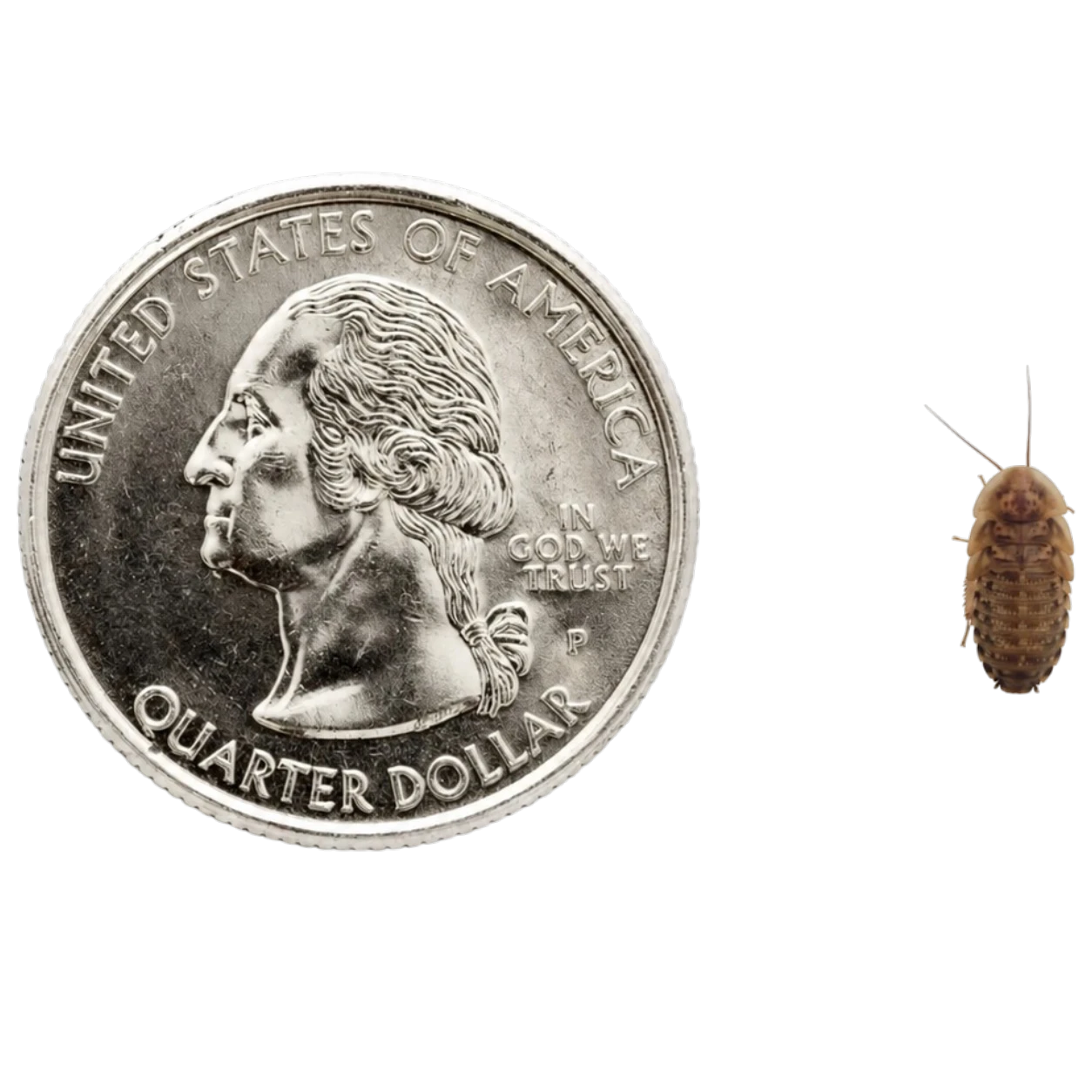
Extra Small Dubia Roaches for Sale
Extra Small Dubia Roaches are early-instar nymphs of Blaptica dubia, measured at roughly 1/4 inch when they leave our facility. They are quiet, slow-moving, and unable to climb smooth glass or acrylic, which makes feeding a lot less stressful than chasing crickets around a viv. This page is specifically for the 1/4 inch feeder size. If you need larger nymphs, sub-adults, or retired breeders, check the other size SKUs in the Live Dubia Roaches category.
Overview
Dubia roaches are a popular feeder for small and mid-sized insectivores because they offer a solid protein-to-chitin ratio, stay where you put them, and tolerate gut-loading well. At the 1/4 inch size class, these nymphs match the prey-size guideline most keepers follow: nothing wider than the space between the animal’s eyes. Generally that means animals like hatchling bearded dragons, juvenile chameleons, young leopard geckos, smaller frogs, mantid nymphs, and tarantula slings that have outgrown fruit flies but cannot yet handle larger feeders.
Adults of this species grow to roughly 1.6 to 1.8 inches and are sexually dimorphic, with winged males and short-winged females. The nymphs in this listing are far smaller and have not yet developed those adult traits.
Why Keep Extra Small Dubia Roaches?
- Sized for young insectivores. At 1/4 inch they fit the prey-size rule for hatchlings and juveniles without overwhelming the animal.
- Quiet and contained. Unlike crickets, Dubia do not chirp, and they cannot climb smooth surfaces or jump, so escapees are rare.
- Gut-load friendly. They readily accept dry feeds, fresh produce, and hydration gels, which means you can load them with calcium and vegetables before offering.
- Lower odor than many feeders. Compared with crickets, Dubia produce relatively little smell when kept in clean conditions.
- Predictable behavior at feeding time. They tend to sit still or move slowly, which helps shy or slow-striking animals like chameleons and mantids actually catch them.
Honest Note on Weight vs Count
All of our feeder insects ship by weight, not by exact count. The count on the dropdown is a reference number based on average nymph weight at this size. In practice, an order of 100 might arrive as 95 or 105 because individual nymph weights vary, especially when more females than males end up in the scoop. The weight you pay for is consistent, even when the headcount drifts a few bugs in either direction. We generally aim slightly over the listed count rather than under.
Care and Setup
Care for this size is short-term holding rather than long-term husbandry. The goal is to keep the nymphs alive, hydrated, and gut-loaded between arrival and feed-out.
Temperature
Anywhere from 70 to 85°F works for short-term holding. Warmer temperatures (around 80 to 90°F) speed metabolism and growth, but for a feeder order you usually want them at room temperature so they last longer before molting up a size class.
Humidity
Moderate humidity is fine. A small dish of water crystals or a water gel cube prevents dehydration without flooding the bin. Avoid open standing water, since small nymphs can drown.
Substrate
None needed. A clean plastic tub with vertical egg flat sections gives them surface area to climb and hide. Smooth-walled bins prevent escapes.
Food
Offer a dry roach chow such as Supreme Feed Dubia, along with small amounts of fresh vegetables, leafy greens, or fruit. Remove uneaten produce before it molds. Gut-loading for 24 to 48 hours before feeding boosts the nutritional value delivered to your reptile or amphibian.
Ventilation
Use a vented lid or a mesh top. Stagnant air with high humidity and feces buildup is the fastest way to crash a holding bin.
Calcium Dusting
Dust nymphs with a fine calcium powder like TC Calcium Ultra Fine right before feeding. Combined with appropriate UVB and a balanced diet, this supports healthy bone development in growing reptiles. Calcium dusting does not replace UVB exposure or a balanced diet, but it is a foundational step.
Best For
- Hatchling and juvenile bearded dragons
- Young veiled, panther, and Jackson’s chameleons
- Juvenile leopard geckos and crested geckos that have outgrown fruit flies
- Small frogs and toads, including young Pacman frogs and dart frogs that accept Dubia
- Mantid nymphs past the first few instars
- Jumping spiders large enough to take a 1/4 inch prey item
- Small to mid-sized tarantula slings
Not Best For
- Adult bearded dragons, adult monitors, or adult tegus, which need much larger feeders
- Customers in Florida, Louisiana, or Hawaii, where Dubia cannot legally be shipped
- Keepers who want a quiet, hands-off breeder colony, since this size is far too young
- Picky eaters that strike only at fast-moving prey, since Dubia move slowly
- Very tiny prey-size needs like first-instar mantids, which often do better on flightless fruit flies
Origin and Locality Notes
Dubia roaches are native to Central and South America and are commonly associated with Argentina, Brazil, and surrounding regions in the published literature. They are tropical and do not establish in colder, drier climates, which is part of why USDA permits allow interstate shipment outside specific restricted states. Our stock is captive-bred and has been maintained as a feeder line.
Receiving and Acclimation
Orders ship with ventilation and a moisture source appropriate for short transit. On arrival, open the package in a clean, contained area in case any nymphs are near the lid. Transfer them to a smooth-walled holding bin with egg flats, a dry feed, and a hydration source. Let them settle for a few hours at room temperature before feeding any out, since shipping stress can briefly affect activity.
TC INSECTS holds USDA permits to ship Dubia roaches within the continental United States, with the exception of Florida, Louisiana, and Hawaii. Customers in Florida and Louisiana can legally receive Discoid roaches instead. A copy of the permit is available by email to proper authorities on request. Do not release any feeder insect into the wild.
Recommended Add-Ons
- Supreme Feed Dubia 5lb for cost-effective dry feed to hold and gut-load nymphs.
- Supreme Feed Dubia 1lb for smaller orders or test runs before committing to the 5lb size.
- TC Calcium Ultra Fine for dusting feeders before offering to growing reptiles.
- Jumbo Dubia Roaches, Retired Breeders for keepers who also need adult-size feeders for larger animals.
- Feeder Insect Mix Packs for adding variety beyond a single feeder type.
Frequently Asked Questions
Are Extra Small Dubia Roaches the right size for my hatchling bearded dragon?
Generally yes, as long as the nymph is not wider than the space between your dragon’s eyes. For most hatchlings, 1/4 inch fits that rule. For very small or very young hatchlings, you may want even smaller nymphs or fruit flies first.
Can I use this size to start a breeding colony?
It is not the most efficient choice. These nymphs need several months and several molts before they reach breeding age. A mix of sub-adults and adults is a faster path to a producing colony. We sometimes offer larger sizes and retired breeders that work better as colony starters.
How long can I hold them before feeding them off?
At room temperature with food and a hydration source, you can hold extra small nymphs for several weeks. They will molt up over time, so the longer you hold them, the larger they will grow. Plan to feed out within a few weeks if you specifically need the 1/4 inch size.
Do I really need to dust them with calcium?
For most growing reptiles, yes. Captive insectivores rely on dusted feeders plus appropriate UVB to maintain calcium balance. Without that combination, animals can develop metabolic bone disease over time. Use a fine calcium powder like TC Calcium Ultra Fine right before feeding.
Why can’t you ship to Florida, Louisiana, or Hawaii?
State and federal regulations restrict shipment of Blaptica dubia into those states. Florida and Louisiana customers can typically receive Discoid roaches as a legal alternative. Hawaii has broader live-animal import restrictions. Contact us by email if you are unsure what applies to your state.
What if the count is off when my order arrives?
Our feeders ship by weight rather than exact count, so the headcount can drift slightly above or below the listed number depending on how many heavier females are in the scoop. The weight you pay for stays consistent, and we generally aim slightly over rather than under.
Learn More About Dubia Roaches and Reptile Nutrition
These references give keepers background on Dubia biology and reptile calcium health, which both inform how you use this feeder.
- Auburn University: Biology of Blaptica dubia (Hao Wu thesis). A peer-reviewed academic look at Dubia reproduction, parental care, and lifecycle. Useful for keepers who want to understand why this species breeds the way it does and how environmental conditions shape colony output.
- PubMed: A Fresh Look at Metabolic Bone Diseases in Reptiles and Amphibians. A veterinary review covering the role of UVB, calcium, phosphorus, and vitamin D3 in reptile bone health. Helpful background on why dusting and gut-loading feeders actually matters.
- PetMD: Metabolic Bone Disease in Reptiles. A keeper-friendly overview of MBD signs, causes, and prevention. Good for first-time reptile owners who want a plain-language summary of the same nutritional concepts.

Reviews
There are no reviews yet.