

Large Dubia Roaches for Sale
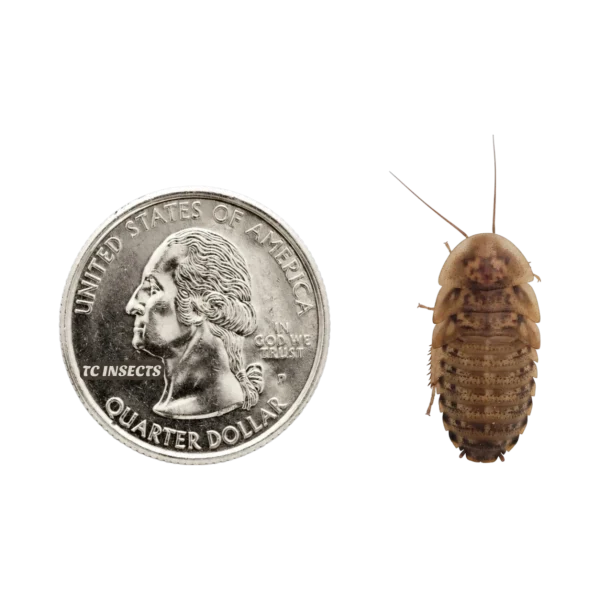
Large Dubia Roaches are 1 inch Blaptica dubia, the biggest standard feeder size we offer before fully mature adults. At this size sexual dimorphism is usually visible, so you can often tell males from females at a glance. They carry serious per-bug weight, which means a handful makes a full meal for a large animal. This size is built for big insectivores. For smaller animals, step down through the Live Dubia Roaches size range.
Overview
1 inch is where Dubia approach their final body size and begin showing clear adult traits. Males develop wings that cover the body, while females retain short wing stubs and a broader, heavier abdomen. The size suits large reptiles that would burn through smaller feeders too quickly to be practical. For animals smaller than a large adult bearded dragon, the Medium 3/4 inch size is usually the safer staple.
Because these are near-adult, holding them warm will finish the final molts and tip some into full adulthood. That is fine for feeding, and useful if you want to pick out a few to seed a colony.
Published Nutritional Content (TC INSECTS Reference Values)
- Protein: 22.9%
- Fat: 7.1%
- Fiber: 2.8%
- Calcium: 275 mg
- Phosphorus: 2,510 mg
These values reflect Dubia before dusting or gut-loading. The phosphorus-heavy ratio means calcium dusting and gut-loading still matter, even though a large feeder delivers more total nutrition per bug than a smaller one.
Why Keep Large Dubia Roaches?
- Built for big animals. 1 inch feeders make sense for large adult reptiles that need a substantial meal without huge feeder counts.
- High per-bug weight. Fewer feeders deliver a full meal, which cuts feeding time and handling for large collections.
- Usually sexable. Visible wing development lets you separate males and females, useful for feeding choices or colony seeding.
- Strong gut-load capacity. Near-adult digestive volume carries calcium, greens, and produce efficiently into the reptile.
- Quiet and contained. No chirping, no smooth-surface climbing, no jumping, even at this size.
Honest Note on Overshooting Prey Size
1 inch is large. For many keepers, it is actually too large. The widely taught prey-size rule says a feeder should be no wider than the space between the animal’s eyes, and a 1 inch Dubia exceeds that gap for a lot of common pets. If you keep a standard adult bearded dragon, a chameleon, or a mid-sized reptile, the Medium 3/4 inch size is usually the better staple. Reserve this size for genuinely large animals.
Honest Note on Visible Sexing
At 1 inch you can usually distinguish the sexes. Males show developing or full wings that reach toward the rear of the body, while females have short wing stubs and a wider, heavier build. Sexing is not perfectly reliable on every individual, since the very latest nymphs can still be ambiguous. If you want guaranteed mature adults for colony work, the Adult Dubia or Jumbo Retired Breeders are clearer choices.
Care and Setup
Care is short-term holding, not breeding husbandry, though at this size a warm holding bin will push some bugs into adulthood within weeks.
Temperature
Room temperature holds them well. Cooler (70 to 75°F) slows the final molts and keeps them at the 1 inch stage longer. Warmer (80 to 85°F) finishes molts faster and matures some into full adults.
Humidity
Moderate. A water gel cube or dish of water crystals covers hydration. Avoid standing water, which is unnecessary at this size and risky for any smaller bugs in the bin.
Substrate
None needed. A smooth-walled tub with vertical egg flats gives surface area and hiding space.
Food
Offer a quality dry feed such as Dubia Superfood or Supreme Feed Dubia, plus small portions of fresh vegetables, greens, or fruit. Remove uneaten produce before it spoils. Gut-load for 24 to 48 hours before feeding.
Ventilation
Use a vented or mesh lid. The heavier biomass of large nymphs produces more frass and humidity, so airflow matters even more than it does with smaller sizes.
Calcium Dusting
Dust with a fine calcium powder like TC Calcium Ultra Fine right before feeding. A larger feeder carries more dusted calcium per bug, but dusting and proper UVB are still both required for healthy bone development.
Breeding Notes
Because these are near-adult, you can pick out males and females to seed a colony if you prefer hand-selecting your own stock. That said, a prebuilt 100 Count Dubia Colony Starter arrives with an adult-to-nymph ratio already balanced for output, which most keepers find faster than sorting feeders. For dedicated breeding females, the Jumbo Retired Breeders are the largest mature stock we offer.
Best For
- Large adult bearded dragons that genuinely clear the prey-size rule at 1 inch
- Monitors and tegus that take invertebrates
- Large adult chameleons such as big male panthers and veileds
- Large frogs and toads, including big Pacman frogs
- Large tarantulas and other sizable predatory invertebrates
- Keepers who want to hand-pick larger feeders or sex their own colony stock
Not Best For
- Standard adult bearded dragons, which usually do better on Medium 3/4 inch
- Juveniles, hatchlings, and small insectivores, where 1 inch overshoots prey size
- Customers in Florida, Louisiana, or Hawaii, where Dubia cannot legally be shipped
- Keepers wanting a turnkey breeding colony, where a colony starter is more efficient
- Animals prone to impaction when fed prey larger than the space between the eyes
Origin and Locality Notes
Dubia roaches are native to Central and South America and are commonly associated with Argentina, Brazil, and surrounding regions in the published literature. They are tropical and do not establish in cooler, drier climates, which underpins the USDA permit-controlled interstate shipment within the continental United States. Our stock is captive-bred and maintained as an established feeder line.
Receiving and Acclimation
Each order ships with ventilation and a hydration source sized for transit. On arrival, open the package in a clean, contained area. Move the bugs into a smooth-walled bin with egg flats, dry feed, and water crystals. Let them settle at room temperature for several hours before feeding any out. Larger Dubia handle shipping well, but cold weather can briefly slow them, so warm them gently to room temperature rather than near a heat source.
TC INSECTS holds USDA permits to ship Dubia roaches within the continental United States, excluding Florida, Louisiana, and Hawaii. Customers in Florida and Louisiana can legally receive Discoid roaches as an alternative. A copy of the permit is available by email to proper authorities on request. Do not release any feeder insect into the wild.
Recommended Add-Ons
- Dubia Superfood 1lb for a nutrient-focused dry feed to gut-load before feeding.
- TC Calcium Ultra Fine for pre-feeding calcium dusting.
- Jumbo Dubia Retired Breeders for the largest mature feeders or breeding females.
- 100 Count Dubia Colony Starter for keepers ready to produce their own large feeders.
- Medium Dubia Roaches for size variety or for any smaller animals in the collection.
Frequently Asked Questions
Is 1 inch too big for my adult bearded dragon?
Often, yes. For a standard adult dragon, 1 inch can exceed the space between the eyes, which is the guideline most keepers use to avoid impaction risk. Unless your dragon is unusually large, the Medium 3/4 inch size is the safer everyday choice.
Can I tell males from females at this size?
Usually. Males show wings developing toward the rear of the body, while females have short wing stubs and a heavier, wider abdomen. A few of the latest nymphs may still be hard to call. For guaranteed mature stock, look at Adult Dubia.
Can I start a colony from a large feeder order?
You can hand-pick males and females from this size to seed a colony. Many keepers prefer the prebuilt 100 Count Colony Starter, which arrives with a balanced adult-to-nymph ratio and reaches production faster than sorting feeders yourself.
Which large reptiles actually need this size?
Genuinely big animals: large monitors, tegus, large adult chameleons, big frogs, and large tarantulas. These animals would otherwise need impractical numbers of smaller feeders to reach a full meal.
Does feeding larger prey raise impaction risk?
Prey that is too large relative to the animal is a commonly cited factor in feeding problems, which is why the space-between-the-eyes rule exists. Matching feeder size to the animal, dusting with calcium, and maintaining proper temperatures all support safe digestion.
How are these different from Jumbo Retired Breeders?
Large Dubia are near-adult feeders sold by count and weight. The Jumbo Retired Breeders are fully mature adults, often large females retired from breeding, sold as the biggest mature stock available rather than as a standard feeder grade.
Learn More About Dubia Roaches and Reptile Feeding
These references give keepers background on Dubia biology and on safe feeder sizing, both of which matter most at the large end of the size range.
- Auburn University: Biology of Blaptica dubia (Hao Wu thesis). A peer-reviewed academic study of Dubia growth, reproduction, and lifecycle. Useful background for keepers picking near-adult stock to seed a colony.


Reviews
There are no reviews yet.