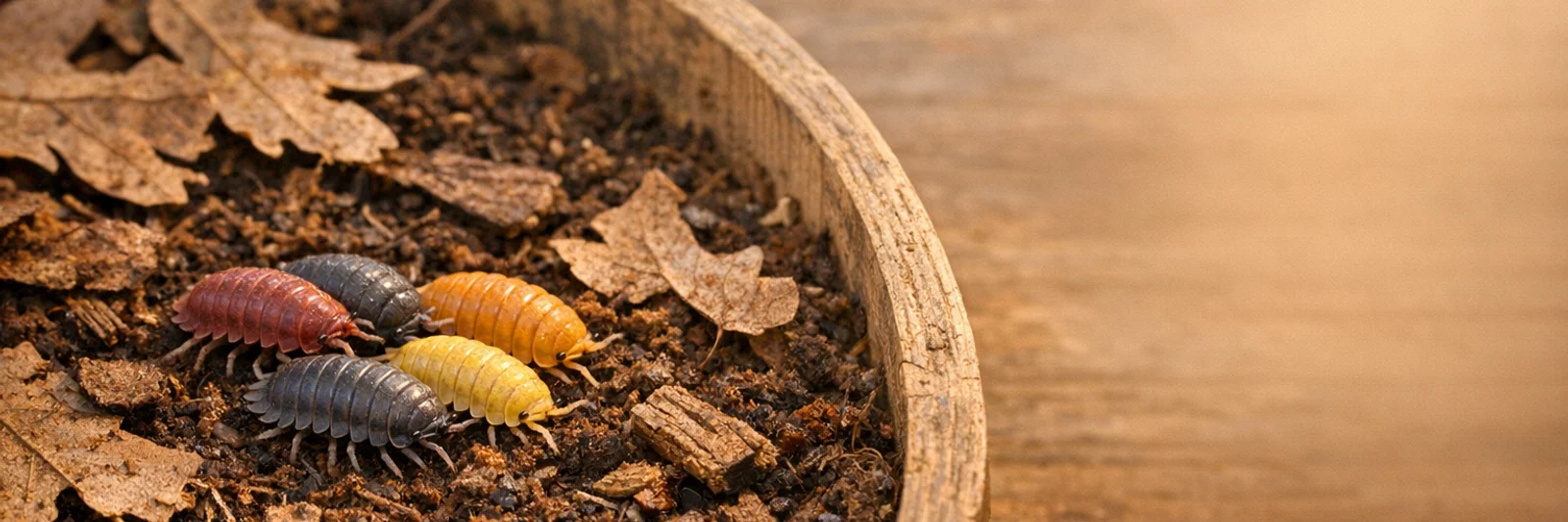
The Jelly Bean isopod is the hobby nickname for Armadillidium vulgare 'St. Lucia,' a Caribbean locality line of the common pillbug whose broods carry burgundy, orange, yellow, gray blue, brown, black, tan and peach individuals side by side in a single colony. Keep it exactly like a standard vulgare culture: 65 to 78 F, a moist retreat with a drier main area, leaf litter as the staple food, and a steady calcium source. The one real difference is pace: St. Lucia breeds slower than typical Wild Type vulgare, which makes it a better display animal than a fast cleanup crew.
Hobby nickname for Armadillidium vulgare 'St. Lucia'
Same range as standard Armadillidium vulgare, no heat mat needed
Burgundy, orange, yellow, gray blue, brown, black, tan and peach together
What is a Jelly Bean isopod?
Jelly Bean isopod is the hobby name for Armadillidium vulgare 'St. Lucia,' a documented Caribbean locality line of the ordinary backyard pillbug. It is not a separate species and not a formally recognized subspecies. A. vulgare is native to Mediterranean Europe, but the species has naturalized across much of the world, including a population on the volcanic island of Saint Lucia in the eastern Caribbean that this line traces back to. Hobbyists nicknamed it Jelly Bean for the mix of colors a single colony produces, and both names are used interchangeably on most seller listings, including ours.
For the ventilated, drier-than-Cubaris setup that applies across the whole genus, temperature, substrate depth and the moisture gradient, our Armadillidium isopod care guide covers the basics once and for all. This page sticks to what actually makes St. Lucia different from a plain vulgare culture: the color, the pace, and how to keep the line pure.
Why does one colony show eight different colors at once?
Most named isopod morphs are a single color bred to be consistent. St. Lucia does the opposite: one brood routinely produces burgundy, orange, yellow, gray blue, brown, black, tan and peach individuals together, and that mix is the actual selling point rather than a breeding inconsistency. A. vulgare carries two separate pigment systems in its shell, a dark pigment and a yellow one, and published research on the species confirms both exist side by side in its integument. TC's own breeding notes on this line describe both systems staying switched on across the population at once, instead of one crowding out the other the way it does in most single-color morphs. The result reads like a handful of jelly beans rather than a uniform gray pillbug.
That variation is genetic, not a fluke of lighting or age. A colony fed and housed the same way keeps producing the same spread of colors generation after generation, rather than settling toward one shade over time the way an environmental or diet-based explanation would predict.
Should you buy it for the colors, or breed for just one?
St. Lucia is not the right pick for every vulgare keeper, and the difference comes down to what you actually want from the colony. Some buyers want the mixed-color display exactly as it comes; others see the variety and assume a little selective pairing will settle it into one favorite shade. Only one of those expectations matches how this line actually works.
Buy Jelly Bean if you want the mixed colony
If the appeal is a display culture where every isopod looks a little different, Jelly Bean delivers that straight out of the cup, and it stays that way generation after generation as long as you do not cross it with another vulgare line. Mixing named isopod lines in one bin is the fastest way to muddy a pure St. Lucia culture, so give it a dedicated bin rather than a shared one.
Look elsewhere if you want to isolate a single color
Breeders have tried pairing only burgundy adults, or only orange adults, hoping to lock in one shade, and the offspring keep coming out mixed anyway. The polychromatic trait persists across generations regardless of which colors the parents are, so treat the variety as the whole point of the line rather than a starting point for a single-color project. For one predictable, consistent color, a different named Armadillidium vulgare morph is the better fit.
Setting up a St. Lucia colony
Setup matches any other vulgare culture. Use 2 to 3 inches of a coco fiber and topsoil blend mixed with rotted hardwood, then top it with a generous layer of leaf litter. Build a moisture gradient rather than an evenly damp bin, one clearly moist retreat zone and a drier main area, and keep the enclosure cross-ventilated so it never turns stagnant. Hold the temperature at 65 to 78 F; sustained heat above 80 F and cold rooms under 60 F both stress the colony. A lighter-colored substrate and background also help the polychromatic pattern actually show once the colony is established.
One honest caution: like other A. vulgare lines, St. Lucia will browse soft moss and tender new plant growth. Pair it with sturdy, established vivarium plants, or keep it in a dedicated culture bin rather than a delicate planted display if you want to protect the greenery. If you want to compare it against the rest of the lineup first, our Armadillidium isopods page has the full group in one place.
Feeding and calcium
Leaf litter and decaying hardwood do most of the work as the everyday staple, so a well-stocked bin rarely needs much hands-on feeding. Supplement lightly with a protein-and-mineral isopod feed and keep a calcium source such as cuttlebone available at all times, since molting is calcium-hungry work for any isopod. St. Lucia animals are reported to be bold, visible feeders and more active during the day than typical vulgare stock, which makes feeding response easy to monitor.
How fast does a St. Lucia colony grow?
Expect a slow-to-moderate pace rather than an explosive one. Leave a new culture undisturbed for the first six to eight weeks so it can settle, then look for visible juveniles within a few months of stable conditions. That is noticeably slower than a true workhorse species, so if the goal is a fast-multiplying bioactive crew rather than a display colony, a faster-breeding beginner species will get you there sooner.
The slower pace is actually an advantage for a display tank, since the population stays more stable and predictable rather than booming past what the enclosure can support. Run a small backup culture in its own bin before adding St. Lucia to a larger bioactive setup, so a predation or die-off event in the display tank does not risk the whole line.
The Jelly Bean Colony Starter Kit
Everything to start a St. Lucia culture and keep its polychromatic colors true across generations.
Frequently Asked Questions
Written by the TC INSECTS breeding team · Porter, Texas · Live Arrival Guarantee on every order
Have a care question? Ask our community.
Join Reptile Keepers USA, our free Facebook group for reptile, amphibian and invert keepers. Share your setups, get care help and swap feeder tips.
Join the free group