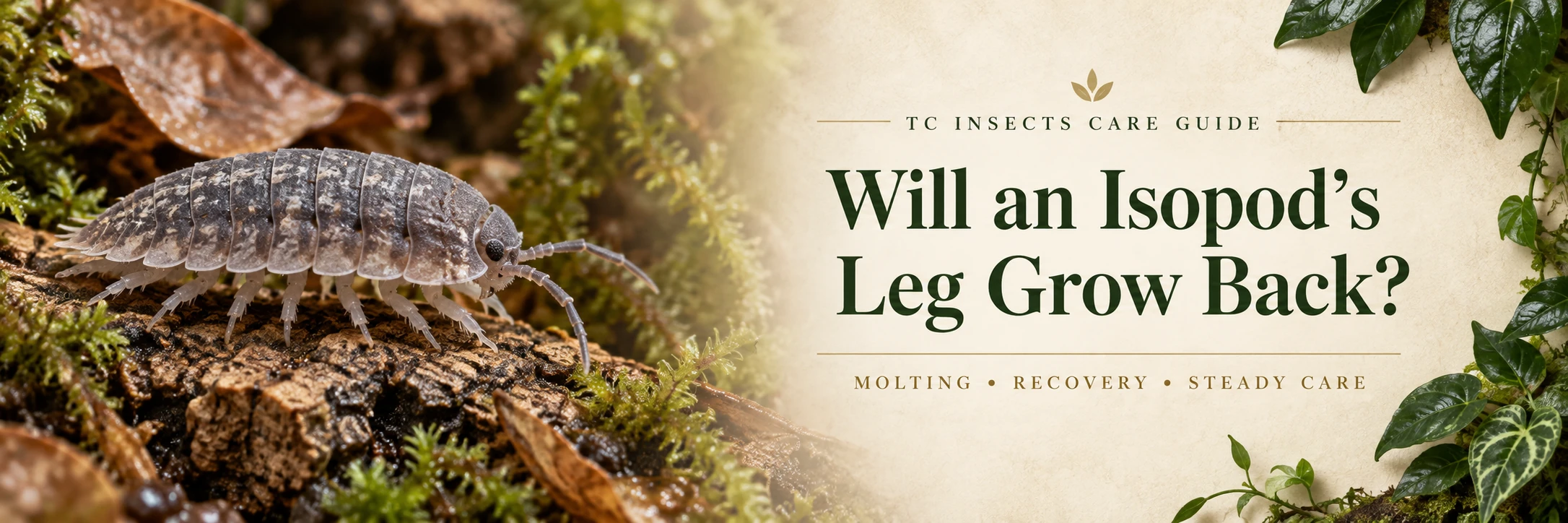
Will an Isopod's Leg Grow Back?
The limb grows a little larger with each molt, not all at once
The front half follows about 2 to 3 days later
Supports a clean molt and steady recovery
A lost leg grows back through successive molts
Yes, an isopod can regrow a lost leg, because they regenerate the limb gradually over successive molts rather than all at once, so a missing or stubby leg usually fills back in over a few molt cycles as long as the animal is otherwise healthy. The new leg starts small and looks a little short right after the injury, then grows a bit more with each molt until it matches the others. It is one of the more reassuring things about keeping isopods (Oniscidea), a lost limb is rarely the emergency it looks like at first glance.

Support recovery with steady basic care
Keep calcium available, maintain consistent moisture and provide shelter for undisturbed molts.
How Regeneration Actually Works
Isopods, like many crustaceans, can regenerate a lost limb, but not in one dramatic step. Instead, the new leg forms gradually and grows a little bigger with each molt, so right after an injury you will usually see a short stub or bud where the leg used to be, not a full-length replacement.
That stub is normal and is not itself a sign of a problem. Over the next several molts, the regenerating leg lengthens and fills out closer to full size, and most keepers find that a healthy isopod with steady access to food, humidity, and calcium gets a fully usable leg back within a handful of molt cycles.
Why an Injury Can Look Lopsided for a While
Isopods molt in two halves rather than all at once, shedding the back half of the exoskeleton first, then following with the front half about 2 to 3 days later. This staggered process is part of how isopods manage calcium and stay protected while molting, since only half the body is vulnerable at any one time.
Because of this two-step molt, an injury near the front or back can look uneven or lopsided compared to the rest of the body for a stretch, especially right after a molt when one half has refreshed and the other has not caught up yet. If half the body also looks a different color or texture than the other for a while, that is normal molting too, not a separate problem, see our why is my isopod half white guide for what that looks like.
Common Causes of a Lost Leg
A lost or damaged leg usually traces back to one of a few everyday causes. A rough or incomplete molt can leave a leg stuck in the old exoskeleton, and the isopod may lose it working free. Crowding is another common cause, in a packed bin isopods bump, climb over, and occasionally grab each other, especially around feeding time.
Handling is a frequent cause too, isopods are more fragile than their armor suggests, and a leg can come off if one is pinched or if the animal is dropped a short distance. A tankmate can also be responsible, since some larger or more protein-driven isopods will nip a molting or slow-moving colony member. None of these causes are usually cause for alarm on their own, a healthy isopod copes with an occasional lost leg just fine.
When It Is Not Just a Lost Leg
A missing leg by itself is rarely serious, but a few other signs point to something more going on. An isopod stuck mid-molt for days, unable to finish shedding, is a real concern, as is a pale, unmoving body that does not right itself or respond to gentle disturbance.
Repeated failed molts are another warning sign, and in our experience they usually point back to low calcium or inconsistent humidity rather than the injury itself. If an animal looks stuck or distressed for more than a day or two, it is worth a call to an exotics vet, though for most colonies the fix is simpler: steady humidity and a calcium source the whole colony can reach at any time.
Supporting Recovery
A few habits make regeneration go smoothly. Keep humidity steady rather than letting the bin swing between soaked and bone dry, since a stable molt cycle depends on consistent moisture. Keep a calcium source, such as crushed oyster shell or cuttlebone, available in the bin at all times rather than offering it occasionally, since isopods rebuild lost tissue and shell material using that calcium, and our do isopods need calcium guide covers why this matters for every molt, not just recovery from an injury.
Give the colony plenty of hides, cork bark, leaf litter, or bark pieces, so a recovering isopod has somewhere to retreat and molt undisturbed. Avoid handling an injured animal while it heals, since picking it up adds stress right when it can least afford another mishap. For the full rundown on humidity, hides, and feeding, our isopod care for beginners guide covers the basics that make regeneration go smoothly in the first place.
The Honest Limit
Regeneration in isopods is reliable, but it is not unlimited. A very old isopod nearing the end of its natural lifespan, or one that has suffered a severe injury beyond a single leg, may not fully recover the way a younger, otherwise healthy animal would. Multiple lost legs at once, or an injury paired with other stress like illness or a recent move, generally slows recovery.
The honest takeaway is that most single-leg losses in an otherwise healthy colony resolve on their own within a few molts, no intervention needed beyond good basic care. If an animal seems to be struggling beyond that, our why are my isopods dying guide covers the wider list of things that can go wrong in a colony, and it is always worth a look before assuming the worst.
Keep reading: How Often Do Isopods Molt? Frequency by Life Stage
The Healthy Molt Kit
Calcium, humidity support, and hides, everything a molting or recovering colony needs.
Frequently asked questions
Can an isopod regrow a lost leg?
Yes. Isopods regenerate a lost leg gradually, growing it a little larger with each molt rather than replacing it all at once. A missing or stubby leg on a healthy animal usually fills back in within a handful of molt cycles.
How long does it take an isopod's leg to grow back?
There is no exact timeline since it depends on the animal's molt frequency, but most healthy isopods regrow a lost leg gradually over several molts, with the new limb getting a little bigger each time until it matches the others.
Why does my isopod have a short or stubby leg?
A short, stubby leg is almost always a regenerating leg partway through the process. It started as a bud after an injury and lengthens with each successive molt, so a short leg today is not a permanent injury, it is a leg still growing back.
What causes an isopod to lose a leg?
A rough or incomplete molt, crowding in the bin, handling, or an occasional nip from a tankmate are the most common causes. Isopods are more fragile than their armor suggests, and a lost leg on its own is rarely a sign of a bigger problem.
When is a missing leg a sign of something more serious?
Watch for an isopod stuck mid-molt for days, a pale body that will not move or respond, or repeated failed molts. Those point to low calcium or inconsistent humidity rather than the leg itself, and are worth addressing at the colony level.
Do isopods need calcium to regrow a leg?
Yes. Isopods rebuild shell and tissue using calcium, so a steady source like crushed oyster shell or cuttlebone available at all times supports both a clean molt and steady limb regeneration.
Keep learning
Have a care question? Ask our community.
Join Reptile Keepers USA, our free Facebook group for reptile, amphibian and invert keepers. Share your setups, get care help and swap feeder tips.
Join the free group