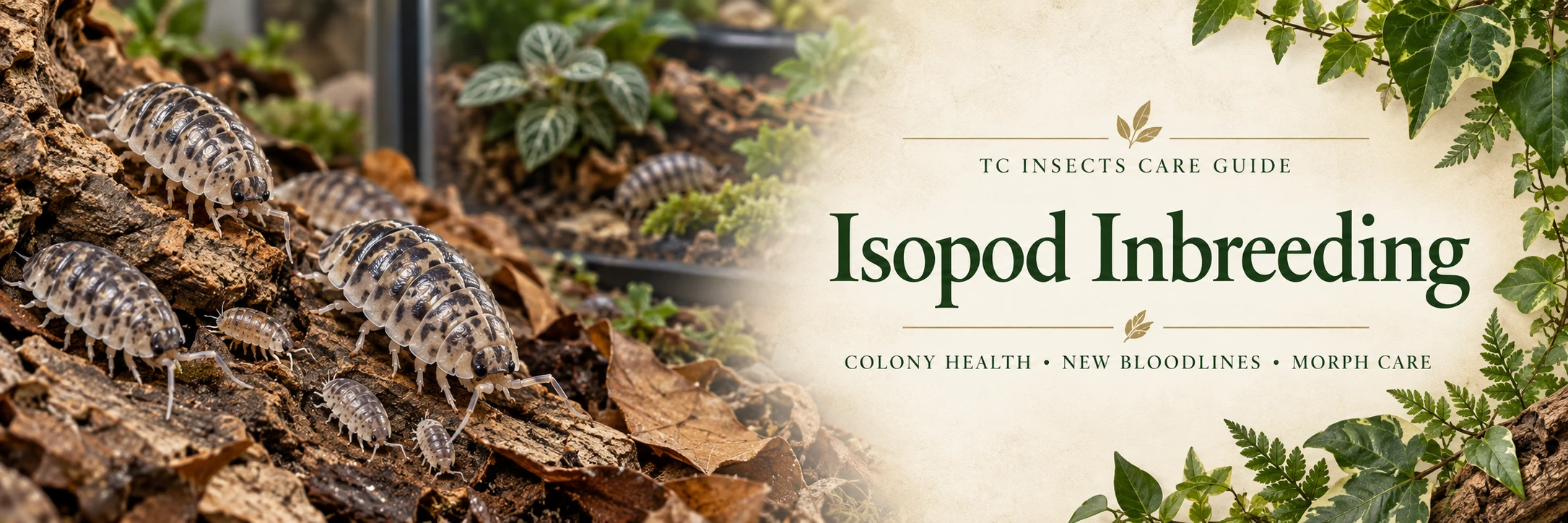
Isopod Inbreeding
Founders in a hobby colony, and for most keepers that group stays enough
Fewer surviving young in inbred crosses, no hit to growth after birth
Smaller adults, fewer mancae, slower growth, color washing out
Healthy colonies first, bloodlines second
Isopod colonies tolerate inbreeding far better than vertebrates do, and most hobby colonies run for years from a single founding group with no obvious problem, so adding new bloodlines is optional maintenance rather than a rule. Where it starts to matter is when you are breeding for something specific, a morph color, a size, a fast-producing line, and you begin to notice adults getting smaller, broods getting thinner, or color washing out over several generations. Here is what the actual evidence says, what experienced keepers report, and how to bring in unrelated stock the right way if you decide you need it.
Keep separate lines and clear records
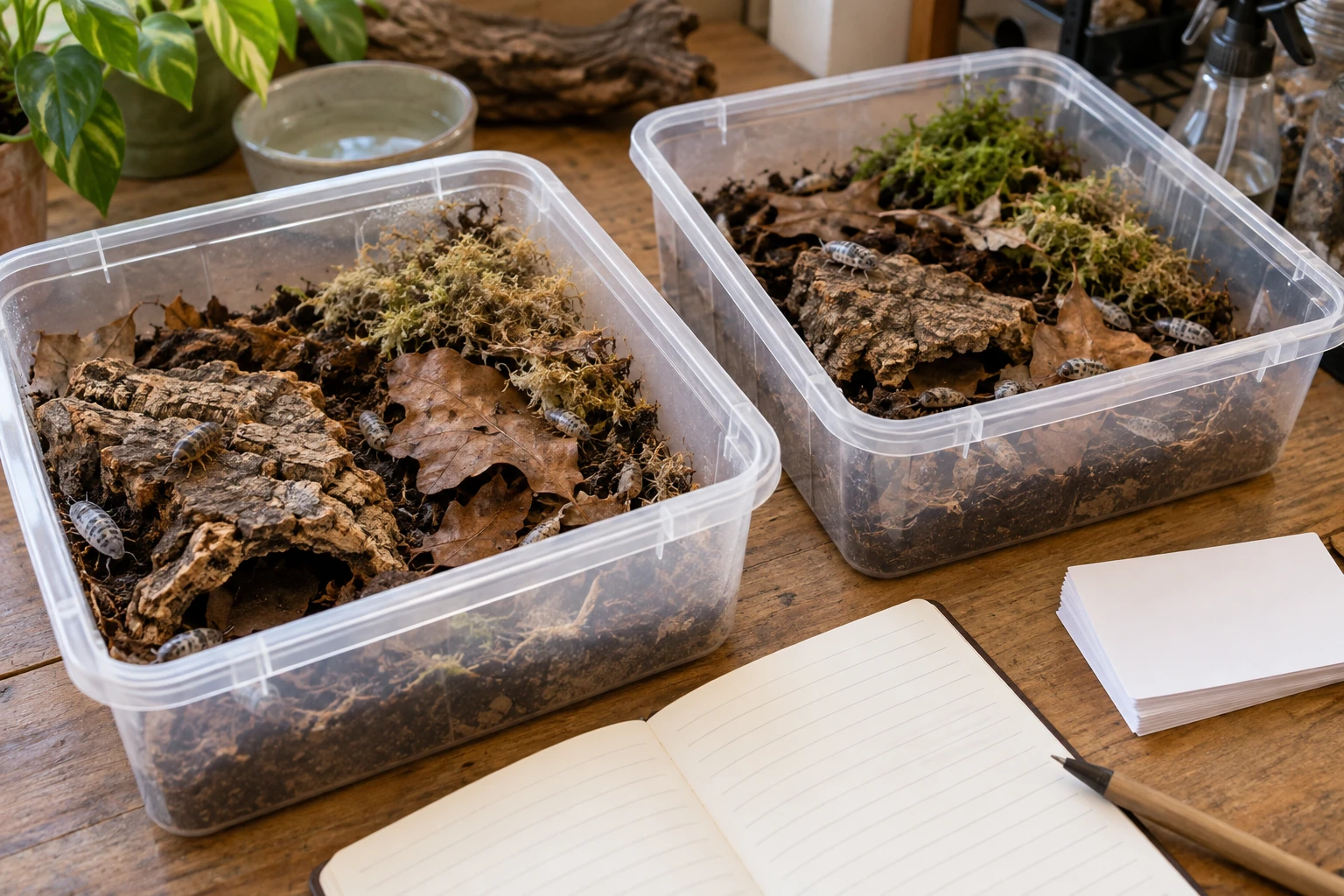
Check husbandry before blaming genetics. Quarantine new stock separately and record its source before combining same-species groups.
Why isopods handle inbreeding so well
Three things work in their favor. Broods are large, with published counts for the common pillbug (Armadillidium vulgare) running anywhere from under twenty young to a hundred or more in a single brood depending on how big the female is, and a female often carrying more than one brood in a good year. Generations also turn over fast, since many Porcellio and Armadillidium species reach breeding size inside their first year, and often within a few months in a warm, well fed bin. Big broods plus quick turnover means selection gets a lot of chances to quietly weed out bad gene combinations before they ever spread through a bin.
The other reason is that the hobby has already been running this experiment for years. A large share of the isopods in circulation trace back to very small founding imports, sometimes a handful of animals or a single gravid female, and those lines have been passed breeder to breeder ever since. On our farm we have run colonies for years off one original group and kept pulling healthy, full-size animals out of them. That is not proof that inbreeding never matters, but it does mean the disaster people picture from mammal breeding does not show up the same way here. Worth noting too, Dwarf White (Trichorhina tomentosa) is parthenogenetic and all female, so that culture is essentially clones already and the whole bloodline question does not really apply to it.
The honest state of the evidence
Here is the part most care sheets skip. Hard published data on inbreeding depression in hobby isopods is thin. The most directly relevant work we could find is a 2018 laboratory study on the common pillbug that compared inbred and non-inbred crosses. It found that inbred pairings ended up with fewer surviving young, apparently from mortality right around birth rather than from any drop in egg count or fertilization, and it found no detectable effect on how the surviving offspring grew or survived after that. More genetically diverse females also tended to be bigger and to produce more young.
That is one species, in a lab, over a limited window. It does not tell you what a Cubaris line looks like after ten generations in a shoebox, and there is no good hobby-scale dataset that does. So nearly everything you will read about isopod bloodlines, including what we write here, is experienced-keeper observation rather than measured science, and it should be treated that way. Keepers who breed for a specific morph generally believe fresh stock helps. Keepers running a plain cleanup crew mostly never think about it and mostly never run into a problem.
The warning signs keepers actually report
Four things come up again and again. Adults get visibly smaller than the ones you started with. Fewer mancae show up in each brood. The young grow more slowly. And on a color morph, the color washes out or drifts back toward wild type. Any of these appearing gradually across several generations, in a bin whose care never changed, is the pattern that makes experienced breeders start hunting for unrelated stock.
Now the honest caveat, because it is a big one. Every single one of those signs is also what a husbandry problem looks like. A bin that is too cold, too dry, short on calcium or protein, harvested too hard, or simply too new will produce exactly the same picture, and those causes are far more common than genetics. Rule them out first with our guide on why an isopod colony will not breed, then work through the levers in how to make isopods breed faster. Genetics should be the last suspect you reach for, not the first.
How to add a new bloodline the right way
Source a second group of the same species from a different seller or a different known line. Be realistic about what that buys you, though, since much of the hobby stock in circulation shares ancestors anyway, so a different seller is not a guarantee of unrelated animals. If it matters to your project, ask where the line came from. Bring in a real group rather than a pair. The same starting counts we recommend in how many isopods to start a colony apply here, roughly 10 to 25 depending on how big the species is.
Quarantine before you combine anything. New stock can arrive carrying grain mites, phorid flies, or other hitchhikers, and tipping it straight into a healthy colony is one of the faster ways to lose that colony, so run the new group in its own container and watch it for a few weeks first, the way we lay out in should you quarantine new isopods. When they do go together, add the new arrivals into your established bin rather than moving your existing animals into the new one, because the established bin already has stable moisture, broken-down substrate, and a food base built up. Then leave it alone and let them settle, and keep notes: date, source, species, count, and what the adults looked like going in. A dated index card taped to the lid beats memory every time, and honestly it is the only way you will ever know whether the addition changed anything at all.
When it barely matters, and the morph trade-off
If your isopods exist to eat waste and mold in a bioactive enclosure, this is close to a non-issue. You are not judging them on size or color, the colony is being cropped and replenished by its own reproduction, and if the numbers ever thin out you simply add more of the same species and move on. Most keepers in that situation will never need to think about bloodlines at all, and we would rather tell you that than sell you a worry you do not have.
Line-bred morphs are the real trade-off, because they are deliberately inbred. That is how a trait gets locked in so it breeds true, and it is a big part of why a rare morph costs what it does. Our guide to isopod morph abbreviations covers how those lines get labeled. Outcrossing to unrelated stock can undo years of that work in a single generation, so the common workaround is to keep two or three separate bins of the same morph from the start and cross between them when one line starts looking tired. That buys back some diversity without pulling in outside color. If you are shopping for a second line to pair with something you already keep, our rare and specialty isopods are where most of those projects start.
Keep reading: How Many Babies Do Isopods Have? Brood Size by Genus and Why Are Most of My Isopods Female? Parthenogenesis, Wolbachia and More
Keep reading: What to Do With Extra Isopods: Rehoming Comes First
The New Bloodline Kit
A second unrelated group of the same species, ready to freshen up a tired line.
Frequently asked questions
Do isopods suffer from inbreeding?
Far less than vertebrates do. Most hobby colonies run for years from one founding group of 10 to 25 animals with no obvious decline. Published data is thin, but a 2018 laboratory study on the common pillbug found that inbred crosses produced fewer surviving young while showing no detectable effect on how those survivors grew or lived afterward.
Do I need to add new isopods to my colony?
Usually not, and for a cleanup crew almost never. Keepers who breed for a specific morph or size do add unrelated stock every so often, but the trigger is what they see in the bin rather than the calendar: smaller adults, fewer babies, or color fading across several generations.
How often should you add new bloodlines to an isopod colony?
There is no proven schedule, and anyone who gives you an exact number of generations is guessing. Add unrelated stock when you see a real decline you cannot explain with husbandry, not on a timer. Most keepers who do it work off observation, not a fixed interval.
What are the signs of inbreeding in isopods?
The signs keepers report are adults getting smaller over generations, fewer mancae per brood, slower growth, and morph color washing out. All four are also symptoms of a bin that is too cold, too dry, or underfed, so check temperature, moisture, calcium, and protein before blaming genetics.
Can you mix isopods from two different sellers?
Yes, as long as it is the same species, and quarantine the new group in its own container for a few weeks first so you do not import grain mites or other pests into a healthy colony. Adding a second unrelated group of the same species is the standard way keepers bring in a new bloodline. Do not mix two different species into one bin and expect both to thrive, and do not mix two different morphs unless you are willing to lose both looks.
Does inbreeding make isopod morphs fade?
Keepers commonly report color washing out or drifting back toward wild type over many generations of a closed line, though that is observation rather than measured data. The first fix is selecting only your best-colored animals as breeders each generation. The second is bringing in unrelated stock of the same morph.
Keep learning
Have a care question? Ask our community.
Join Reptile Keepers USA, our free Facebook group for reptile, amphibian and invert keepers. Share your setups, get care help and swap feeder tips.
Join the free group