How Many Babies Do Isopods Have?
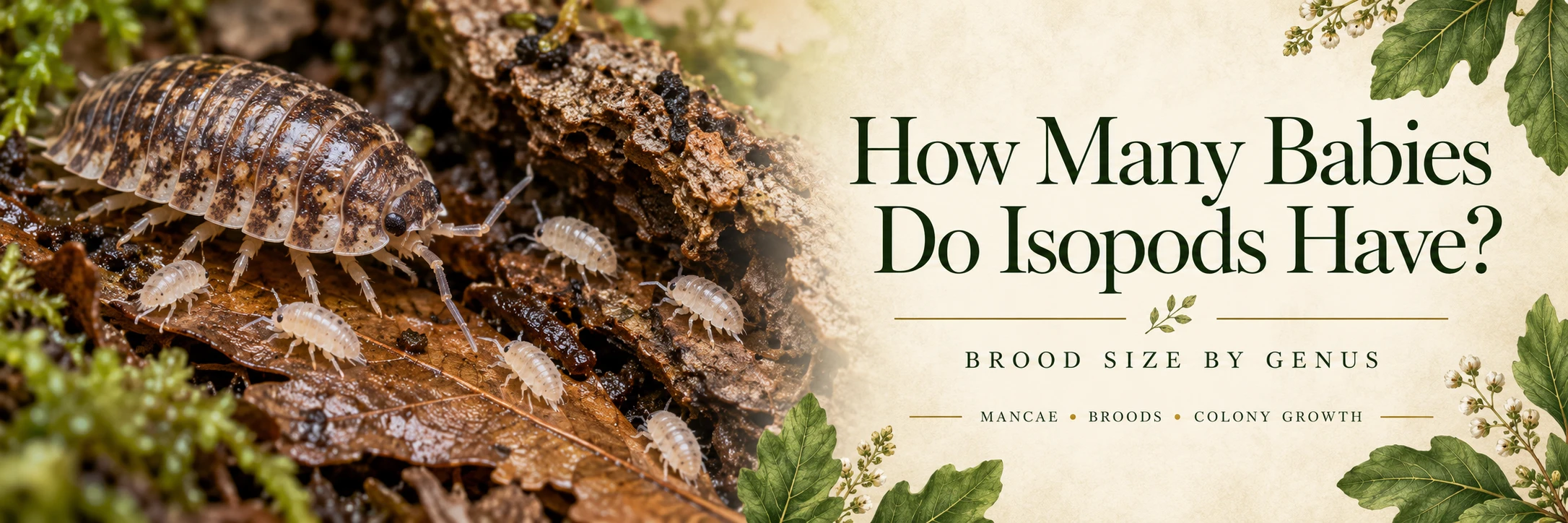
Published counts span small Cubaris and Dwarf White broods to big Armadillidium clutches
Research across species finds larger, more mature females produce bigger broods
Frequency varies as much as brood size, and often matters more for colony growth
Brood sizes, genus by genus
Isopod brood sizes range enormously by genus, from as few as 5 to 15 mancae in a single Dwarf White or Cubaris brood up to well over 100 eggs in a large Armadillidium vulgare, and published counts vary by study as much as they vary by species. Brood size scales with the female's own body size, so a bigger, more mature female of any genus produces more young per brood than a small or young one. Mancae and gravid females are covered elsewhere; here are the actual numbers, genus by genus, with the research behind them.

Small broods can still build big colonies
Brood size varies with genus and female size. Breeding frequency and stable conditions matter just as much for colony growth.
Why Brood Size Varies So Much
The biggest driver is not really species identity, it is body size. Across nearly every isopod species researchers have studied, clutch size scales with the size of the female carrying it, so a larger, more mature female of the same species reliably produces more eggs or young than a smaller one. That single relationship explains a lot of the spread in numbers reported for the same genus, since a study counting mostly small or young females will report smaller broods than one counting large adults.
It also means the ranges below are not fixed numbers, they are honest ranges pulled from lab studies, field counts, and, for genera with no formal research behind them, careful hobbyist consensus. Where sources genuinely disagree, we say so rather than picking one number and presenting it as settled. Treat every figure here as a realistic range for a healthy, well-fed female of that genus, not a guarantee for the very next brood you personally count.
Brood Size by Genus
Here is what is actually documented or reliably reported for the genera most keepers stock, from the smallest commonly reported broods to the largest. Each genus below gets its own real number or range, where it comes from, and how it compares to the others, so you can check your own colony against something concrete instead of a vague "it depends."
Dwarf White (Trichorhina tomentosa)
Dwarf White broods run small, typically cited in the 5 to 15 mancae range per clutch, modest next to bigger genera. What makes the species such a fast colony-builder is not brood size, it is that every individual is female and parthenogenetic, so a whole colony's worth of females can be carrying overlapping broods at once rather than waiting on a handful of breeding pairs.
Powder Orange and Powder Blue (Porcellionides pruinosus)
Estimates for Powder isopods cluster in the 20 to 30 mancae range per brood, though reported figures run as low as 10 and as high as several dozen depending on the source and the female's size. Research on the species has also documented continuous, back-to-back breeding under warm, stable conditions, several broods in a row with no clear drop in size between them.
Cubaris
Cubaris is the one genus here with a real peer-reviewed number behind it: a laboratory study on Cubaris murina found a mean of about 25 young per brood, with an observed range of roughly 7 to 54, and each brood taking around 17 days to develop. The same study found one mating was enough to produce at least five broods, since females can store sperm. Hobbyist counts for other Cubaris species and morphs often run smaller, commonly 6 to 20.
Armadillidium
Armadillidium vulgare is the genus where published numbers disagree the most. Some field studies report 20 to 40 young per brood, while others report 100 to 200 eggs per clutch in the same species, and the honest explanation is likely a mix of female size, population, and season rather than one side being wrong. Either way, Armadillidium is capable of large broods when a female is big and well fed.
Porcellio
Porcellio brood counts vary by species as much as any genus here. One study on Porcellio scaber recorded around 50 eggs in a brood, while other Porcellio species and larger individuals have been documented carrying well over 100 eggs or embryos at once. Treat any single Porcellio number as a snapshot of one species and one size of female, not a genus-wide rule.
How Many Broods a Year Should You Expect?
Most commonly kept genera produce somewhere between two and five broods a year under good conditions, with warmth and steady food pushing that toward the higher end and a cooler or leaner bin pushing it lower. Warmth and steady feeding speed up breeding in the same way across genera, even though the brood-size numbers themselves differ.
How long each brood takes to develop also varies, generally landing somewhere around two to five weeks from a visibly gravid female to mancae leaving the marsupium, though this shortens in a warmer bin and stretches in a cooler one. That timing question, along with what a gravid female actually looks like, is covered in full in our guide to isopod mancae and gravid females linked above.
Bigger Brood or Bigger Mancae? The Real Trade-off
Research on several species has found a genuine trade-off between how many young a female produces and how big each one is: females that put out a large brood tend to produce smaller individual mancae, while females that produce a small, select brood often release noticeably bigger, more developed young. Neither strategy is simply better, a lot of small mancae and a few large ones can both grow into a healthy colony.
This is worth knowing mainly so you do not read a small brood as a failure. A Cubaris or Dwarf White female producing a tight handful of unusually robust-looking young is not underperforming, she may simply be running the other side of the same trade-off a prolific Armadillidium is running.
What Actually Grows a Colony Faster: Brood Size or Frequency?
Frequency usually matters more than any single brood's headline number. A genus like Dwarf White or Powder, producing modest broods of 10 to 30 young but doing it continuously across many overlapping females, will typically out-produce a genus that occasionally puts out a huge brood but breeds far less often. That is a big part of why our own genus comparison ranks Dwarf White and Powder as the fastest breeders despite neither having the largest broods on this page.
If you actually want more mancae out of your colony this year, the highest-leverage move is rarely chasing a bigger brood. It is keeping conditions steady enough that more females are breeding at once and less time is lost between broods, which is exactly what our guide on making isopods breed faster walks through.
The Fast vs. Slow Breeder Kit
A fast breeder, a parthenogenetic one, and the slow, well-studied Cubaris murina side by side, plus the feed that fuels broods.
Frequently asked questions
How many babies does an isopod have at once?
It depends heavily on genus and on the size of the female. Small genera like Dwarf White and Cubaris commonly produce 5 to 25 young per brood, while larger, well-fed Armadillidium and Porcellio can carry anywhere from about 50 to well over 100 eggs in a single clutch, with published counts varying by study as much as by species.
Do bigger isopods have bigger broods?
Generally yes. Research across multiple isopod species has found that clutch size scales with the female's own body size, so a larger, more mature female reliably produces more eggs or young than a smaller one of the same species, regardless of genus.
How many broods can an isopod have in a year?
Most commonly kept genera produce roughly two to five broods a year under warm, stable conditions, with each brood taking around two to five weeks to develop from a visibly gravid female to mancae leaving the marsupium. Cooler or less stable conditions stretch that timeline out and reduce the number of broods.
Which isopod genus has the biggest broods?
Armadillidium vulgare has the highest published counts, with some studies reporting 100 to 200 eggs in a single clutch, though other studies on the same species report far fewer, closer to 20 to 40. Porcellio is not far behind, with some individuals documented carrying over 100 eggs as well.
Why does my isopod colony grow fast if the broods are small?
Frequency matters more than brood size for overall colony growth. Genera like Dwarf White and Powder produce modest broods, often 10 to 30 young, but do it continuously across many overlapping females, which usually out-produces a genus that breeds rarely even if its individual broods are larger.
Is there real research on isopod brood sizes, or is it guesswork?
Both. Common species like Armadillidium vulgare, Porcellio scaber, and Cubaris murina have real published studies behind their brood-size figures, though studies sometimes disagree with each other. Less common hobby genera and specific morphs often rely on careful, consistent hobbyist reporting instead, which we treat as a reasonable estimate rather than a hard number.
Keep learning
Have a care question? Ask our community.
Join Reptile Keepers USA, our free Facebook group for reptile, amphibian and invert keepers. Share your setups, get care help and swap feeder tips.
Join the free group