
Cleanup Crew for a Ball Python Enclosure: What Fits

Plus tropical white springtails; no Dairy Cows
And one 8 oz springtail culture to start
Crew establishes before the snake arrives
A cleanup crew that fits your snake’s habitat.
A bioactive ball python (Python regius) enclosure runs warm, 78 to 92 F across the gradient, and moderately humid, 55 to 70 percent, and the cleanup crew has to match that: Powder Orange or Powder Blue isopods (Porcellionides pruinosus), which handle the drier warm end, Dwarf White isopods for the damp corner, and tropical white springtails everywhere. For a standard 4 by 2 foot enclosure, 20 to 30 isopods and an 8 oz springtail culture, seeded 3 to 4 weeks before the snake moves in, is a working start. Large Porcellio such as Dairy Cows stay out, because a big protein-driven isopod in an enclosure with a resting snake is a risk we do not take. This guide covers species, counts, seeding, and what the crew actually does with a snake's sheds and waste.
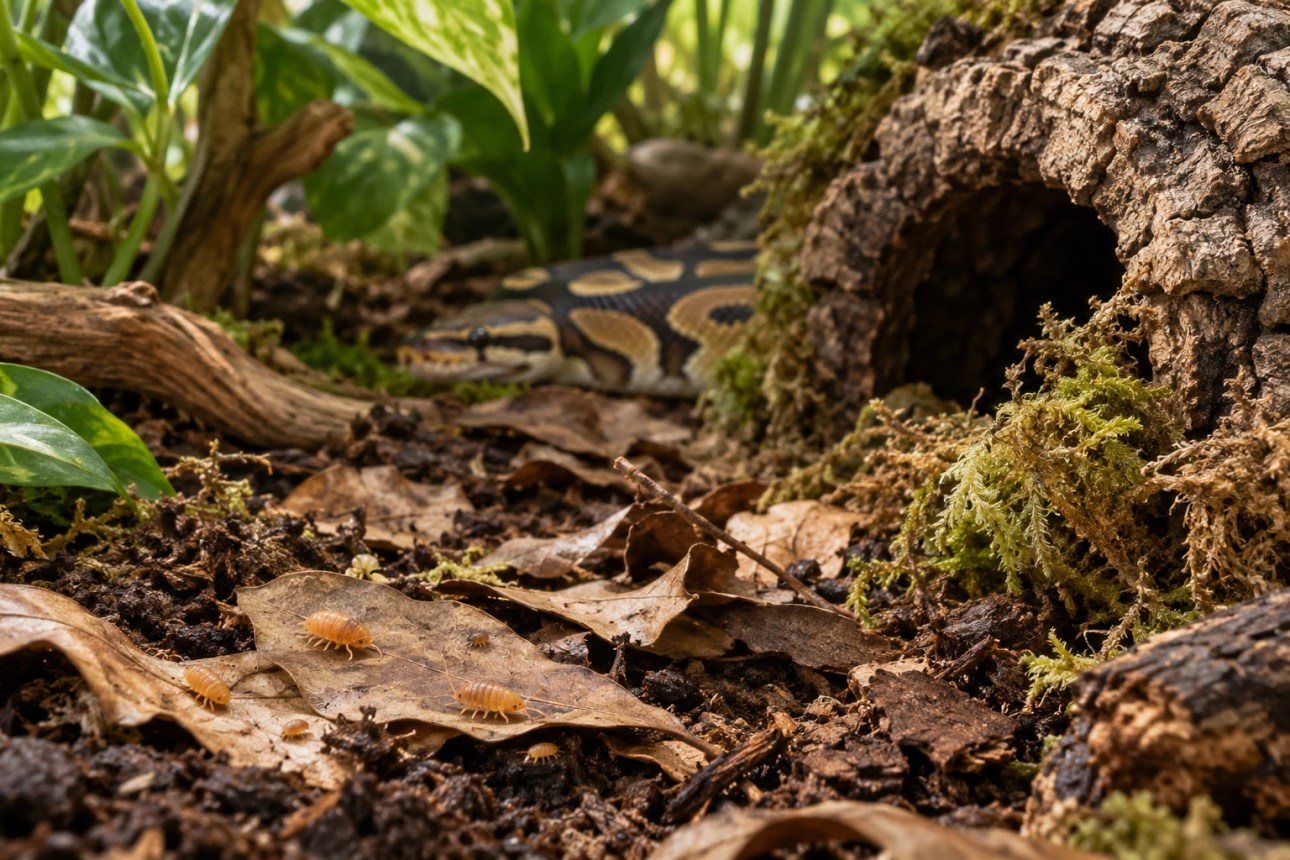
Small, mild, and numerous.
The original guide below covers species choices, starting counts, seeding time, substrate, feeding and troubleshooting. Its information is preserved in full.
What a ball python enclosure asks of a crew
A ball python enclosure is not a dart frog vivarium. It has a hot side around 88 to 92 F, a cool side in the upper 70s, humidity that sits around 55 to 70 percent and spikes during a shed, and a big, heavy animal that lies still for days. The crew has to tolerate warmth, moderate humidity, and periods where the surface dries out, and it has to be small enough and mild enough that a snake resting in a hide is never bothered. That rules out the humidity-hungry Cubaris and the large, hungry Porcellio, and leaves the Powder isopods, Dwarf Whites, and springtails.
The reason a crew is worth having in a snake enclosure is waste. A ball python produces a large, infrequent urate and stool, and it sheds in one piece every few weeks to months. In a dry tank you pick those out; in a bioactive enclosure the crew and the soil microbes break them down, and the substrate stops smelling. Our bioactive hub covers the substrate and drainage side; this post is the animals.
The species that fit, and the one that does not
Powder Orange and Powder Blue isopods are the backbone of a snake crew. They are small, fast, breed quickly, and tolerate a drier, warmer bin than most isopods, so they colonize the whole floor rather than one corner. Dwarf White isopods are tiny, all female, and live in the damp end under the water bowl and the humid hide, where they do the fine work. Tropical white springtails go everywhere and handle mold. The isopods versus springtails guide explains why the two do different jobs.
Dairy Cow isopods and the other large Porcellio do not go in. They are big, protein-driven, and known to nibble on resting animals, and a ball python that lies motionless in a hide for days is exactly the animal that rule exists for. They are fine in their own display bin or as a feeder colony. The same goes for Giant Canyon and Titan isopods. Small, mild, and numerous is the whole recipe.
How many to start with
For a 4 by 2 foot enclosure, the standard adult ball python size, 20 to 30 mixed Powder isopods plus 10 to 20 Dwarf Whites and one 8 oz springtail culture is a working seed. A 3 by 2 or a 40-gallon breeder takes about two thirds of that. The crew breeds up to whatever the enclosure supports within a few months, so a light seed with time beats a heavy seed dropped in the day the snake arrives. The cleanup crew calculator gives a count for any floor size.
Seed 3 to 4 weeks before the snake goes in, as covered in how long a bioactive needs before the animal. During those weeks keep the substrate moist, add leaf litter, and run the heat as it will run for the snake, so the crew settles into the real gradient. If the enclosure is already occupied, seed anyway; it just takes longer to establish, and the snake ignores the isopods.
Substrate and leaf litter for a snake tank
The crew eats the substrate, so it has to be organic: a bioactive mix of topsoil or coco fiber, decayed hardwood, and crushed leaf litter, 3 to 4 inches deep so the snake can burrow a little and the damp layer at the bottom stays damp when the top dries. A layer of leaf litter on top, an inch or two, is the crew's staple food and the humidity buffer. Cork bark and a couple of pieces of rotting wood give the isopods daytime cover.
Keep one corner, usually under the water bowl, damper than the rest, and let the hot side dry between mistings. That gradient is what lets Powders work the warm side and Dwarf Whites the damp side. A bioactive substrate plus a bag of hardwood leaf litter is the whole shopping list beyond the animals.
Feeding the crew, sheds, and what to still remove
A ball python enclosure produces less waste than a lizard tank, so the crew needs supplemental food: leaf litter always, a slice of vegetable once a week in the damp corner, and a pinch of isopod feed or fish flake every couple of weeks. Shed skin can be left; isopods and springtails eat it over a week or two, and it is a good sign of a working crew. The vegetable slice comes out after two days.
Remove the large parts of a fresh stool and urate the day you see them, especially on the hot side where nothing breaks down fast, and let the crew handle the residue. Spot-clean the water bowl area if a stool lands in it. A crew is a maintenance reducer, not a maintenance eliminator, and a bioactive snake enclosure still gets a monthly check for wet spots and mold.
Troubleshooting a snake-tank crew
Isopods vanishing in the first month usually means the enclosure ran too dry all over; add leaf litter, keep the damp corner damp, and they reappear. Isopods visible on the snake are almost always Powders investigating a resting animal and mean nothing; if you ever see one on a shedding snake's eye caps, that is the moment to reconsider whether a large species got in by mistake. Springtails booming on the surface after a shed or a stool are a good sign, not an infestation.
If the crew never takes hold after two months, the substrate is probably inert bagged soil with nothing to eat. Mix in decayed wood and litter and reseed with a fresh Powder isopod group. Once it is running, a ball python bioactive with a Powder and Dwarf White crew goes years without a substrate change.
The Ball Python Crew Kit
Powder Orange isopods for the warm side, Dwarf Whites for the damp corner, tropical springtails, leaf litter and substrate.
Frequently asked questions
What isopods are best for a ball python enclosure?
Powder Orange or Powder Blue isopods for the warm, drier side, Dwarf White isopods for the damp corner, and tropical white springtails everywhere. They are small, mild, and tolerate a warm enclosure with moderate humidity. Large Porcellio such as Dairy Cows stay out because they can nibble a resting snake.
How many isopods do I need for a 4 by 2 ball python enclosure?
About 20 to 30 mixed Powder isopods, 10 to 20 Dwarf Whites, and one 8 oz springtail culture to start. The crew breeds up to what the enclosure supports within a few months, so a light seed given time works better than a heavy one added the day the snake arrives.
Can I add a cleanup crew to an enclosure the snake already lives in?
Yes. Seeding 3 to 4 weeks before the snake is ideal, but a crew added to an occupied enclosure still establishes, just more slowly. Add leaf litter, keep one corner damp, and the snake ignores the isopods and springtails.
Will isopods eat a ball python's shed skin and waste?
Yes. Shed skin disappears over a week or two, and the crew and soil microbes break down the residue of stools and urates. Still remove the large parts of fresh waste the day you see them, especially on the hot side, and spot-clean around the water bowl.
Why are Dairy Cow isopods not safe with a snake?
They are large and protein-driven and are known to nibble on animals that lie still, and a ball python resting in a hide for days is exactly that animal. Keep Dairy Cows, Giant Canyons, and Titans in their own bins. Powders and Dwarf Whites are the safe crew for an occupied enclosure.
What do I feed the cleanup crew in a snake tank?
Leaf litter on the substrate at all times, a vegetable slice once a week in the damp corner removed after two days, and a pinch of isopod feed or fish flake every couple of weeks. A snake enclosure produces less waste than a lizard tank, so the crew needs that supplement to keep breeding.

Keep learning
Have a care question? Ask our community.
Join Reptile Keepers USA, our free Facebook group for reptile, amphibian and invert keepers. Share your setups, get care help and swap feeder tips.
Join the free group


