Isopod Trade Names vs Scientific Names
Genus is known, the exact species has not been formally described yet
Latin for compare, close to a named species but not fully confirmed
Yet most Cubaris trade names in the hobby are still unconfirmed placeholders
Know what the label is telling you
An isopod's trade name, like Rubber Ducky or Panda King, describes how a seller markets the animal; only the scientific name, like Cubaris sp. or Nesodillo arcangelii, tells you what it actually is, and the two do not always agree. A huge share of isopods sold in the hobby have never been formally studied, which is why labels lean on shorthand: sp. means the exact species is not yet identified, and cf. means a tentative match. A single-quoted nickname on top of that is just a marketing label. None of it changes how you feed or house the animal, but it matters if you care what you are actually breeding. Here is how to read a label like a scientist would.

A nickname is not a species name
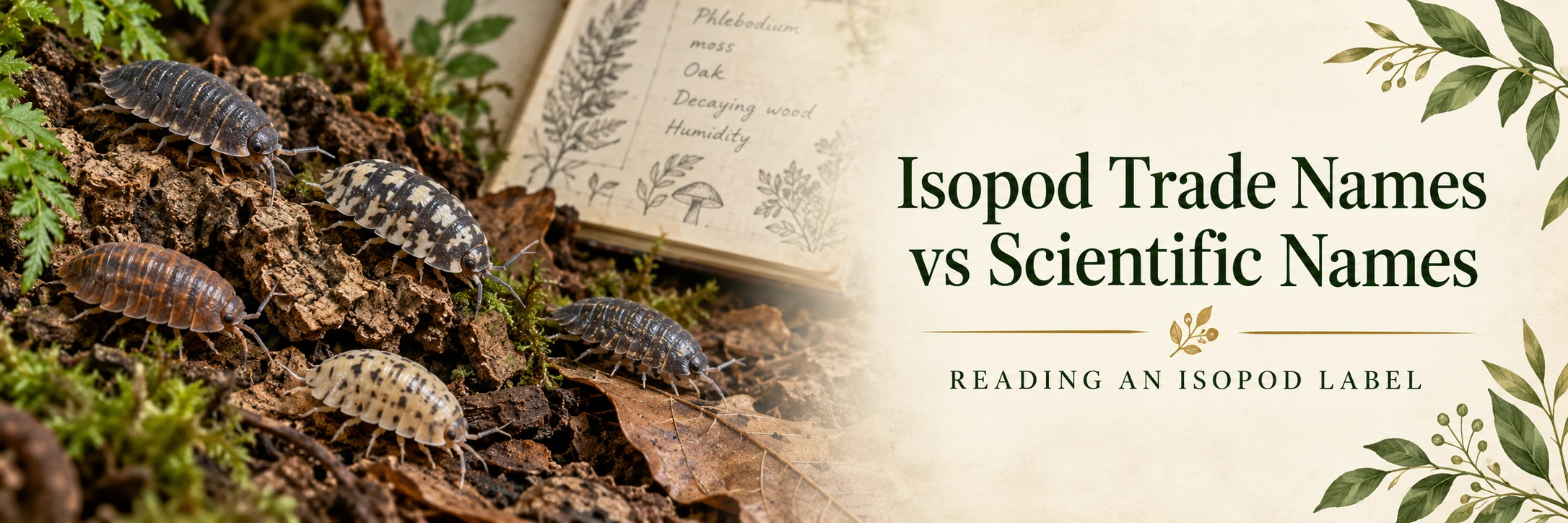
The original guide below explains naming layers, sp. and cf., reused trade names, and how to read listings with confidence.
Trade Name, Common Name, Scientific Name: Three Different Things
A shop listing usually shows you three layers of naming stacked together, and mixing them up is where most confusion starts. The scientific name, like Armadillidium vulgare, is written in italics with only the genus capitalized, and it is the one name that points to a specific, defined animal recognized worldwide. The common name, like pillbug or woodlouse, is an everyday English label, useful but often shared loosely across several related species.
The trade name or morph name, written in single quotes like 'Orange Dalmatian', is a nickname a seller or breeder gave to a particular look or color line. It sits on top of the scientific name rather than replacing it. A trade name alone never tells you the species, only the pattern, and morphs get their own separate shorthand too, which our morph abbreviations guide breaks down in detail.
What 'sp.' and 'cf.' Mean on a Label
Two small abbreviations carry most of the real uncertainty in isopod naming, and both are honest admissions rather than marketing tricks. Sp. means the genus is confirmed but the exact species has not been formally described, the case with TC's own Cubaris sp. 'Panda King'. Some labels go further: a product like Isopoda sp. 'Tarragona' confirms only the order, Isopoda, leaving even the genus an open question. Cf., Latin for compare, means a seller believes the animal is probably a named species based on how it looks but has not confirmed it enough to drop the hedge, a more specific claim than a bare sp.
Why Cubaris Became a Wastebasket Taxon
Cubaris is the genus at the center of most of this confusion, and the reason is historical as much as biological. Taxonomists describe it as a wastebasket taxon: over the years, keepers and sellers moving fast in an understudied part of the animal world piled many superficially similar cave-dwelling isopods from Southeast Asia into Cubaris, whether or not they truly fit the genus's original description. More than 100 species of true Cubaris are formally described, yet a large share of the trade animals sold under that name were never checked against them.
The clearest documented case is Silver Ghost, long sold as a Cubaris before being reclassified as Nesodillo arcangelii, a genus that was folded into Cubaris in 1935 and only split back out as its own in 1998. Our best beginner isopods guide covers that specific story in more depth. This kind of shuffling is not unique to isopods either; our guide to springtail name changes covers the same pattern on the springtail side of the shop.
The Dalmatian Problem: One Nickname, Different Animals
Trade names describe a look, not a lineage, and nothing shows that better than how often the same nickname gets reused across totally unrelated isopods. 'Dalmatian' is TC's own clearest case: it currently labels three separate, unrelated animals.
Porcellio scaber 'Orange Dalmatian'
A color form of the common rough isopod Porcellio scaber, in the same large, hardy genus as the giant Dairy Cow, sold for a black-spotted orange pattern that echoes the dog breed's coat. Care follows standard Porcellio husbandry: roomy, well-ventilated, tolerant of a drier side.
Armadillidium vulgare 'Orange Dalmatian'
A completely different genus, the common pillbug that rolls into a tight ball, carrying its own orange-and-black spotted line under the identical nickname. Nothing links it to the Porcellio version above except the pattern; the two do not interbreed and are not even close relatives.
Venezillo parvus 'Dalmatian'
A third genus entirely, a small, quick-moving semi-arid isopod, also marketed under the same spotted-pattern nickname. Three unrelated genera, three animals with almost nothing in common biologically, sharing one word because it describes a look a shopper can picture instantly, which is exactly what a trade name is built to do.
Does Any of This Change How You Care for the Animal?
Mostly, no. Husbandry follows genus and general body type far more than it follows a trade nickname or even an unresolved species question, which is why a Cubaris sp. and a confirmed Cubaris murina want essentially the same humid, calcium-rich setup. If you already know how to keep the genus, an honest sp. or cf. on the label should not change your care routine at all.
Where it does matter is breeding and buying. Two animals sharing a trade name but sitting in different genera, like the three Dalmatians above, will never produce mixed offspring, so treating them as color variants of one species is a mistake a breeder can make without realizing it. It also matters if you are paying a premium for a named animal and want to know whether that price reflects a confirmed rarity or just a striking, unverified look.
How to Buy With Confidence
Look for the scientific name, even an honest sp. or cf. version of it, printed on the listing rather than only a trade nickname in quotes. A seller who writes Cubaris sp. 'Rubber Ducky' is telling you more, and being more honest, than one who prints only Rubber Ducky and lets you assume it is settled science. Consistent naming across a seller's own catalog is another good sign, since it suggests real record-keeping rather than names invented case by case.
If you want zero ambiguity for your first fancy isopod, start with a confirmed species instead of an unresolved one. Panda King and Rubber Ducky both currently sell as Cubaris sp., while Cubaris murina 'Little Sea' is one of the few true, confirmed Cubaris in the hobby and TC's own recommended beginner entry into the genus, a real species you can look up and trust the name of.
Keep reading: Wild-Caught Isopods: The Real Risks Before You Buy
The Trade Name Explainer Kit
Four real listings that show every lesson here: an unresolved sp., a reclassified genus, a reused nickname, and a confirmed true Cubaris.
Frequently asked questions
What does 'sp.' mean after an isopod's genus name?
'sp.' means the genus is confirmed but the exact species is not, either because it has not been formally described yet or because no one has matched the animal to a known one. You will see it constantly in the hobby, as in Cubaris sp. 'Rubber Ducky', where Cubaris is the working genus and Rubber Ducky is just the nickname for the look.
Is Cubaris a real scientific genus?
Yes, Cubaris is a real, described genus with over 100 formally named species, but it has also become what taxonomists call a wastebasket taxon. Many superficially similar isopods from Southeast Asia were placed in Cubaris without a full check, so a large share of the trade animals sold as Cubaris today have never been confirmed to actually belong there.
Why do sellers put isopod names in quotation marks?
Quotation marks mark a trade or morph name, a nickname for a look or color line, as separate from the scientific name. Writing Cubaris sp. 'Panda King' keeps the honest, uncertain scientific placeholder and the marketing nickname visually distinct, instead of blending them into what looks like one confident, made-up species name.
Can two isopods with the same trade name be totally different species?
Yes, and it happens more than most buyers realize. 'Dalmatian' currently labels a spotted Porcellio scaber, a spotted Armadillidium vulgare, and a spotted Venezillo parvus, three unrelated genera that share nothing but the pattern the nickname describes. Never assume two animals with a matching trade name are related or will interbreed; check the scientific name instead.
Does an unconfirmed scientific name mean a seller is being dishonest?
No, usually the opposite. A seller who writes sp. or cf. openly is telling you the identification is not fully settled, which is more honest than inventing a confident-sounding species name for an animal that was never formally checked. Terrestrial isopods, especially cave-dwelling Southeast Asian species, are genuinely understudied, so open labels are common and expected.
Should I avoid buying an isopod labeled 'sp.'?
Not necessarily. An sp. label just means the species is unresolved, not that the animal is unhealthy or poorly bred, and plenty of popular, easy-to-keep isopods are sold that way. If having a fully confirmed name matters to you, look for a described species like Cubaris murina instead, but an honest sp. label is not a red flag on its own.
Keep learning
Have a care question? Ask our community.
Join Reptile Keepers USA, our free Facebook group for reptile, amphibian and invert keepers. Share your setups, get care help and swap feeder tips.
Join the free group