How Long Do Springtails Live?
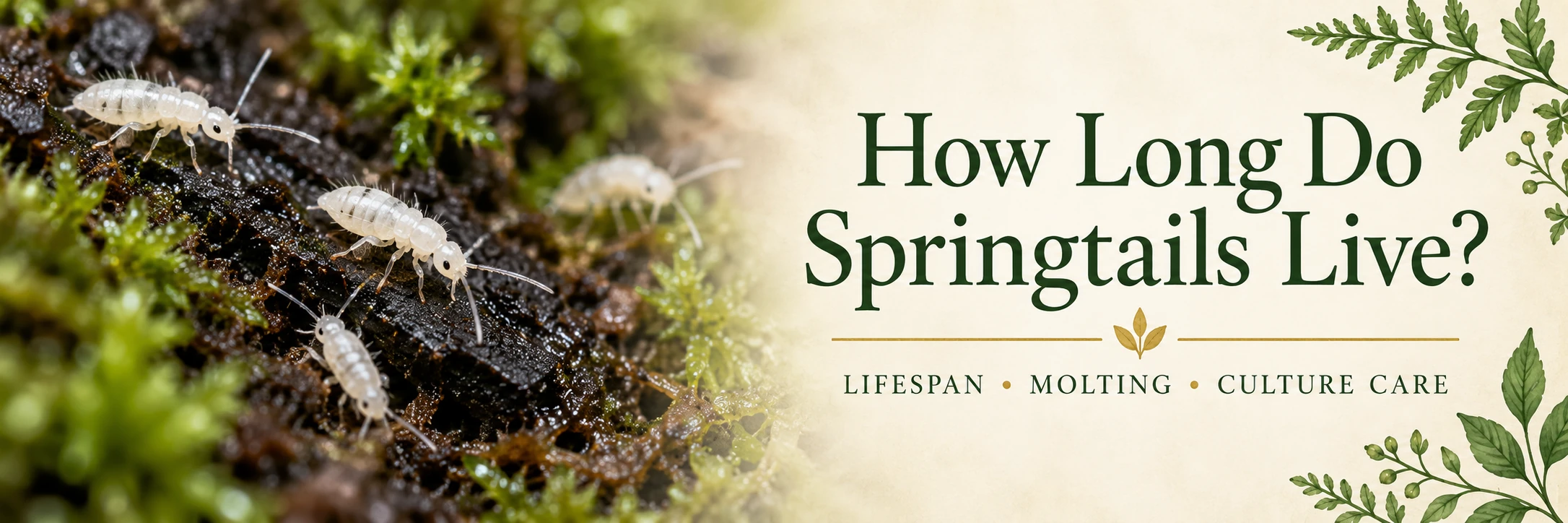
Longer in cooler rooms, shorter in warm ones, for Folsomia candida
Adults never stop molting the way most insects do after maturity
A well-split culture can run indefinitely, a neglected one ages out
One springtail’s lifespan is not the culture’s lifespan.
A single springtail lives roughly 110 to 240 days depending on temperature, with cooler conditions stretching its life and warmth shortening it, and it keeps molting the entire time instead of stopping at some fixed adult size. That is the individual answer. The culture as a whole is a different question: a healthy population can keep reproducing and running for years with regular care, well past any single springtail's own lifespan, as long as you keep splitting it into fresh medium before the old batch wears out. Both numbers matter, and they are easy to mix up.

Keep the culture renewing.
Consistent moisture, light feeding and regular splits into fresh medium keep new generations replacing older springtails.
How Long Does a Single Springtail Live?
Research on the temperate white springtail, Folsomia candida, the species most cultures are built around, found a lifespan of roughly 110 to 240 days depending on temperature, with one study recording about 240 days in cool conditions near 59 F and roughly 111 days in warmer conditions near the mid-70s F. Warmth speeds up a springtail's whole life cycle, growth, reproduction, and aging included, so the same animal simply lives faster and dies sooner in a warm room than a cool one. At TC's normal culture range of 65 to 78 F, expect a lifespan somewhere in that same 110 to 240 day span, generally a few months for any one individual.
Other cultured Collembola species likely follow a similar pattern, since the temperature effect is a basic trait of small, cold-blooded animals, but they have not been studied in this much depth. Treat the temperate white numbers as the best documented answer rather than a universal rule for every species. Our springtail species reference has the temperature and humidity range for each species we sell if yours runs differently.
Do Springtails Keep Growing as Adults?
Yes, and this is where springtails differ from most insects. A young springtail reaches reproductive maturity in roughly three to five weeks at normal room temperature, but that is not a final adult molt the way it is for a fly or a beetle. Springtails keep molting for the rest of their life, and research puts the number at around 45 separate molts over a lifetime, so an individual is always growing a little and renewing its cuticle, never quite finished the way a fully grown mammal is.
That has a practical side effect for anyone watching a culture closely: size alone is not a reliable way to judge age in springtails, since an older individual has simply molted more times, not stopped growing at some fixed point. A single female can also lay roughly a thousand eggs across her lifetime under parthenogenesis, reproducing without a mate, which is a large part of why one small starter culture builds into a usable population so quickly.
How Long Can Springtails Go Without Being Fed?
Longer than most keepers expect, but there is no exact number worth pinning to it. Springtails eat fungus, mold, algae, and decaying organic matter broadly, not just the yeast you sprinkle in, so an established culture keeps grazing whatever mold and microbial film is already present in the medium even if you skip a feeding or two. That is exactly why the feeding guidance in our springtail culturing guide is a very light sprinkle every 2 to 4 days, skipped entirely if the last feeding is still visible, since the culture is never truly relying on you alone.
A short vacation is not something to worry about with a healthy, established culture. What actually threatens a culture left alone is the medium drying out completely, the number one way to kill a culture, not a missed feeding. Before you travel, check that the container is holding its usual moisture, and skip topping up food right before you leave, since an unsupervised container is exactly where overfeeding turns into a mold problem.
How Long Can a Springtail Culture Keep Running?
The culture as a whole is not bound by any single springtail's 110 to 240 day lifespan, since it is a population, not one animal, and new individuals are always replacing the ones that die off naturally. With consistent moisture, light feeding, and airflow, a culture can run for years, and splitting it into fresh medium every few weeks, covered in our guide to splitting a culture, is what keeps that going indefinitely instead of slowly declining.
Keepers do not fully agree on when to just start over instead of nursing an old culture along. Some retire a culture around the six month mark as routine upkeep once splitting stops perking it up, while others run the same lineage for years by staying on top of splits and fresh medium. There is no fixed expiration date, only a point of diminishing returns as the old medium ages.
Signs a Culture Is Aging Out, Not Just Stalling
An aging culture looks and smells different from one that is simply stalled from bad conditions. Watch for medium that has gone visibly dark, compacted, and slightly sour smelling even though moisture and feeding are otherwise normal, springtail activity that has quietly thinned out over months rather than crashed suddenly, and mites or other pests becoming more persistent in older, more broken down medium. Our guide on why a springtail culture is not booming covers the fixable causes, airflow, feeding, and temperature, worth ruling out first before assuming a culture is simply old.
The difference matters because the fix is not the same. A stalled young culture usually needs a change in care, more airflow, less food, or a warmer spot. A culture that is genuinely aging out needs fresh medium, not more troubleshooting, since no amount of adjusting feeding will un-pack years of spent substrate.
When Should You Split or Restart a Culture?
Split a booming culture every 2 to 3 weeks into fresh medium, taking roughly a quarter to a third of it each time, and you rarely have to fully restart at all, since each split is effectively a small reset that keeps the population on young, productive medium. This is the single habit that separates a culture that quietly runs for years from one that needs replacing every few months.
If you inherited an old, sluggish culture or let one go too long without splitting, start a fresh one from whatever healthy springtails you can rescue rather than trying to revive dead medium. A fresh culture is a fast, known reset if your existing one is too far gone to bother saving, and keeping a young backup running alongside your main culture means you are never starting completely from zero.
The Long-Haul Culture Kit
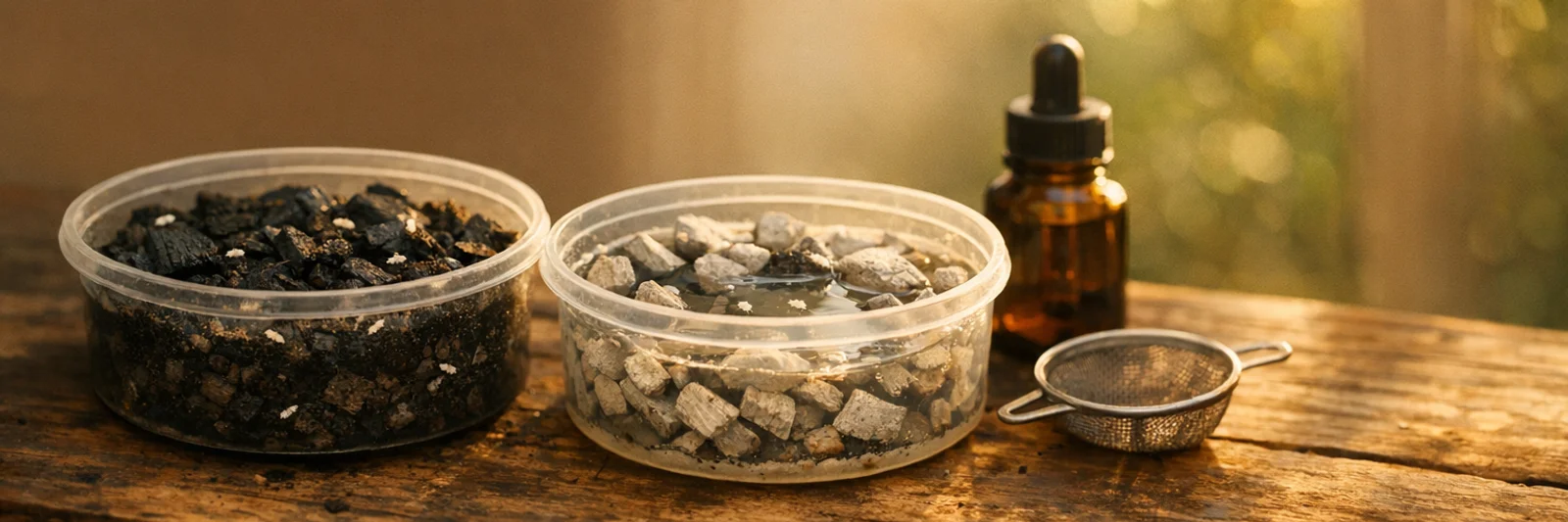
A species built to keep breeding for years, plus a fresh cup and booster feed to keep a culture from aging out.
Frequently asked questions
How long do springtails live?
An individual springtail lives roughly 110 to 240 days depending on temperature, based on research on the temperate white springtail (Folsomia candida). Cooler conditions stretch that lifespan while warmth shortens it. A culture as a whole is not limited by that number, since new individuals are always replacing the ones that die off.
Do springtails die after they reproduce?
No. Springtails reproduce many times across their life rather than dying after a single event, and females keep laying eggs while also continuing to molt and grow. A single female can lay roughly a thousand eggs over her lifetime, which is part of why a small starter population builds up so quickly.
Can a springtail culture last forever?
Not the exact same batch of medium, but the population itself can run for years with regular splitting into fresh medium every 2 to 3 weeks. Left unsplit, the same culture eventually ages out as the medium breaks down, even though the springtails themselves are always being replaced by new individuals.
How long can springtails go without being fed?
Longer than most keepers assume, since an established culture keeps grazing mold and microbial film already present in the medium even if you skip a feeding. A short vacation is not a real risk for a healthy culture. Drying out completely, not a missed feeding, is what actually kills a culture.
How do I know when a springtail culture is too old to save?
Look for medium that has gone dark, compacted, and faintly sour smelling, along with activity that has quietly thinned out over months rather than crashed suddenly. That pattern points to an aging culture needing fresh medium, not a fixable care problem like poor airflow or the wrong temperature.
Does temperature really change how long springtails live?
Yes, significantly. Research on the temperate white springtail found roughly 240 days of life at a cool 59 F versus roughly 111 days in warmer conditions near the mid-70s F, more than double across that range. Warmth speeds up a springtail's whole life cycle, so a warmer culture reproduces faster but each individual lives a shorter life.
Keep learning
Have a care question? Ask our community.
Join Reptile Keepers USA, our free Facebook group for reptile, amphibian and invert keepers. Share your setups, get care help and swap feeder tips.
Join the free group