Three completely different things get mistaken for each other in almost every new bioactive terrarium: springtail eggs, grain or mold mites, and early mold or slime growth. The good news is a simple triage sorts them out fast. If it jumps, it is a springtail (order Collembola); if it moves quickly in a scattering cloud of dust-like specks, it is almost certainly mites; and if it stays completely still and looks fuzzy, slick, or web-like, it is mold or slime rather than any kind of animal at all. Below is exactly what each one looks like, why it shows up, and what, if anything, you actually need to do about it.
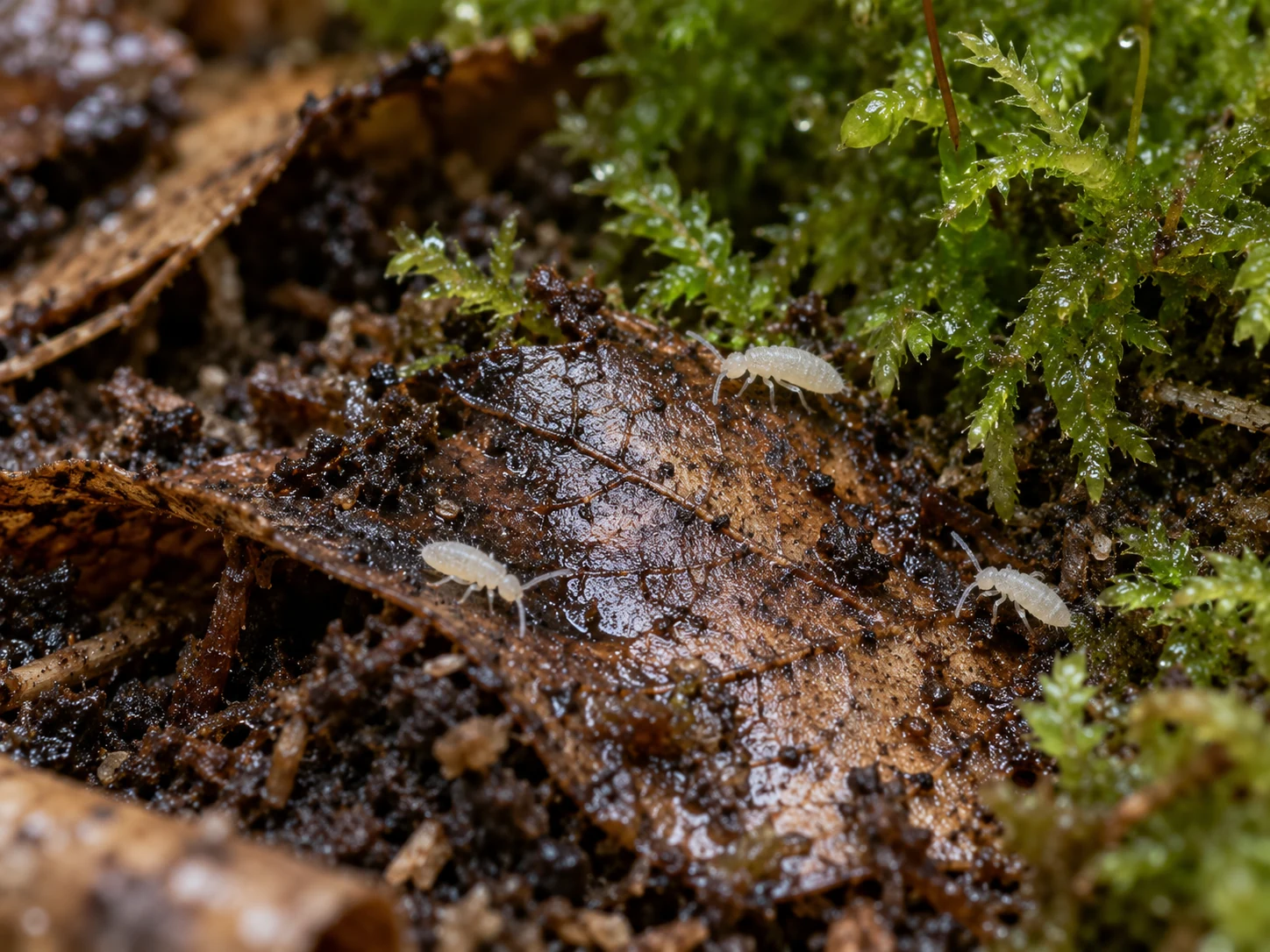
Tiny, pearly white egg clusters hatch into jumping Collembola
Fine, dust-like specks that move in a fast, restless cloud
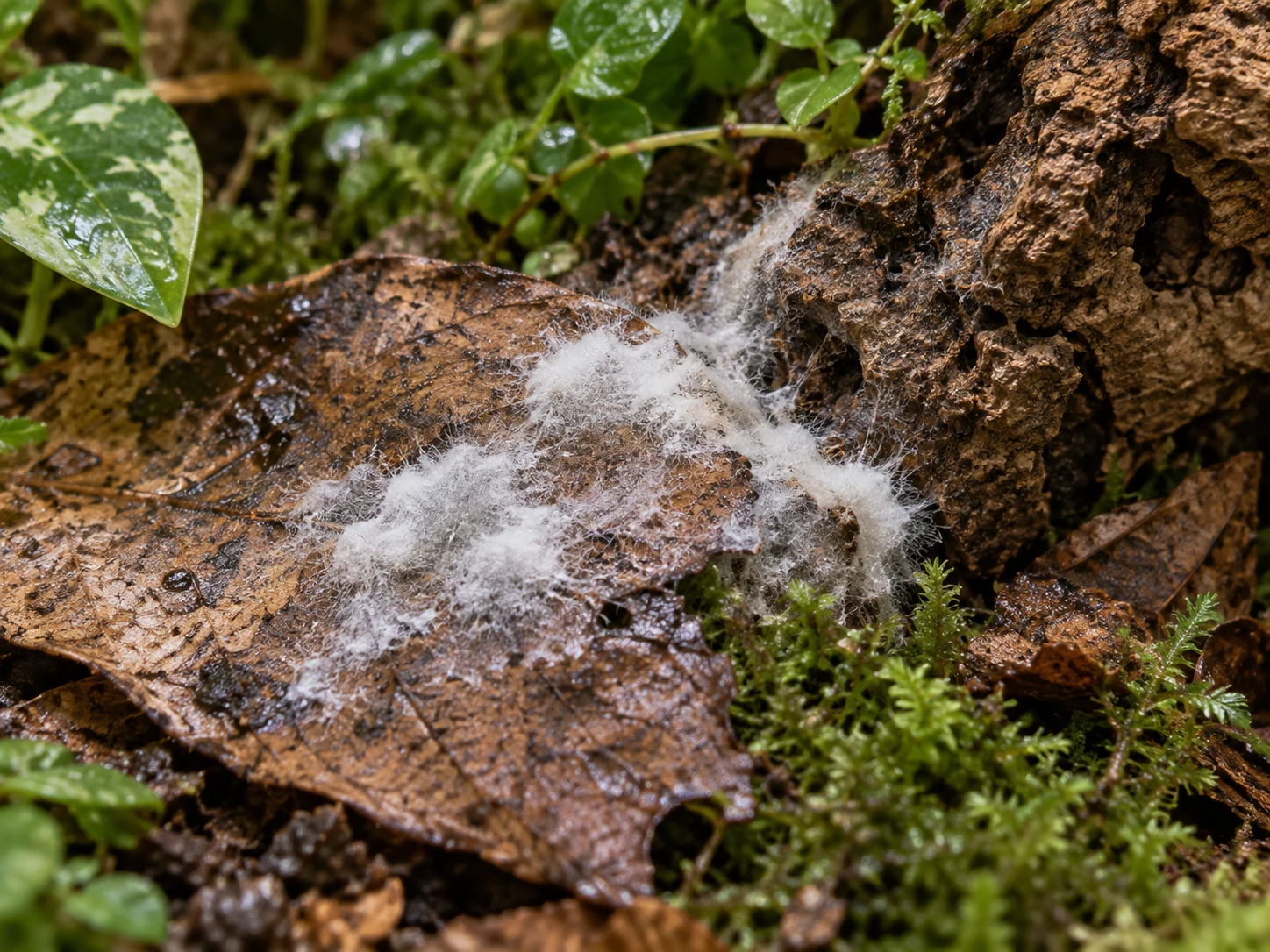
Fuzzy or slick patches, not an animal at all
The three-way triage
New bioactive setups almost always throw up a moment of "wait, is that supposed to be there." The three usual suspects are springtail eggs or young, grain or mold mites, and early mold or slime mold growth, and they get confused constantly because at a glance they can all look like tiny pale specks scattered across damp substrate. The fastest way to tell them apart is to watch how they behave rather than just what they look like.
Does it move at all when disturbed? If nothing happens, you are looking at mold or slime, not an animal. If something moves, does it jump in a quick, springy hop, or does it scurry in a fast, disorganized scatter? The jumpers are springtails, and the scurrying cloud is almost certainly mites. The rest of this guide breaks down each one specifically.
Springtails and springtail eggs
Springtail eggs are small, round, pearly white clusters, often tucked into a damp corner or under a piece of leaf litter, and they are a genuinely good sign, meaning your culture is actively reproducing. The adults themselves are equally easy to identify once you know the tell: Collembola have a forked tail structure called a furcula that snaps down and launches them into a small hop when disturbed, which is the single most reliable way to confirm springtails over mites.
If you are seeing springtails and their eggs, there is nothing to fix. This is exactly what a healthy, established springtail culture looks like, and more of them is a sign your bioactive substrate is doing its job. If you want to compare TC's different colors and species side by side, see our springtail species comparison chart.
Grain and mold mites
Mites are the other common speck sized visitor, and the giveaway is speed and density. Grain mites and mold mites are tiny, pale, and move in a fast, restless, almost dust-like cloud across the substrate surface, noticeably quicker and more erratic than a springtail's clean hop. They tend to show up in response to overfeeding, especially too much protein or a piece of fruit or produce left to rot in the open, since that is exactly the moist, decaying food source mites thrive on.
A small number of mites is common and not usually an emergency, but a genuine bloom is worth addressing since a heavy mite population can outcompete a young isopod or springtail culture for food. Our guide on grain mites in an isopod culture covers the fix in detail, but the short version is to cut back on protein feeding, remove any uneaten food promptly, and let a healthy isopod and springtail population outcompete the mites over time.
Mold and slime, the ones that do not move
If whatever you are looking at never moves no matter how long you watch it, you are looking at mold or, less commonly, slime mold, not an animal. White fuzzy mold shows up as soft, cottony patches, often on a piece of wood or leaf litter, and slime molds can look slick, web-like, or even faintly colored, both of which are far more alarming to look at than they actually are in a young bioactive bin.
This is a completely normal, temporary phase in a newly set up terrarium, covered in full in our guide on white mold in a new terrarium. Mold feeds on the same fresh, uncolonized organic material a young bioactive substrate is full of, and a properly stocked springtail culture is the actual long-term fix, since springtails graze mold and fungus as a primary food source.
Why springtails are the fix for two of the three
Here is the useful overlap: a strong, well established springtail culture actively controls both the mold problem and, indirectly, the mite problem, since mites and springtails are competing for some of the same decaying food sources. A substrate with a thin springtail population lets mold get ahead and gives mites more uncontested food to bloom on, while a dense, active springtail culture keeps both in check as a matter of course.
If you are seeing a lot of mold or a mite bloom and your springtail population still looks sparse, the underlying issue may be a stalled culture rather than the mold or mites themselves. Our guide on why a springtail culture isn't booming walks through the common causes, since building up the springtail side is often the actual long-term solution.
When to actually worry
Springtails and their eggs never require action. A small number of mites is common and usually resolves on its own once feeding is adjusted. Early white mold is normal in a new terrarium and typically fades within a few weeks as the substrate matures and the springtail population catches up to it.
The one pattern worth paying closer attention to is a mite or mold bloom that keeps growing for weeks despite cutting back on feeding, which usually points to an underlying moisture or feeding habit that needs adjusting rather than a one-time fix. Work through the specific guides linked above for mites and mold, and lean on a healthy springtail culture as the constant that helps control both.
Reset a Confused, Struggling Bin
Fresh cultures and substrate to help springtails outcompete mold and mites for good.
Frequently Asked Questions
Written by the TC INSECTS breeding team · Porter, Texas · Live Arrival Guarantee on every order
Have a care question? Ask our community.
Join Reptile Keepers USA, our free Facebook group for reptile, amphibian and invert keepers. Share your setups, get care help and swap feeder tips.
Join the free group