Tarantula on Its Back?
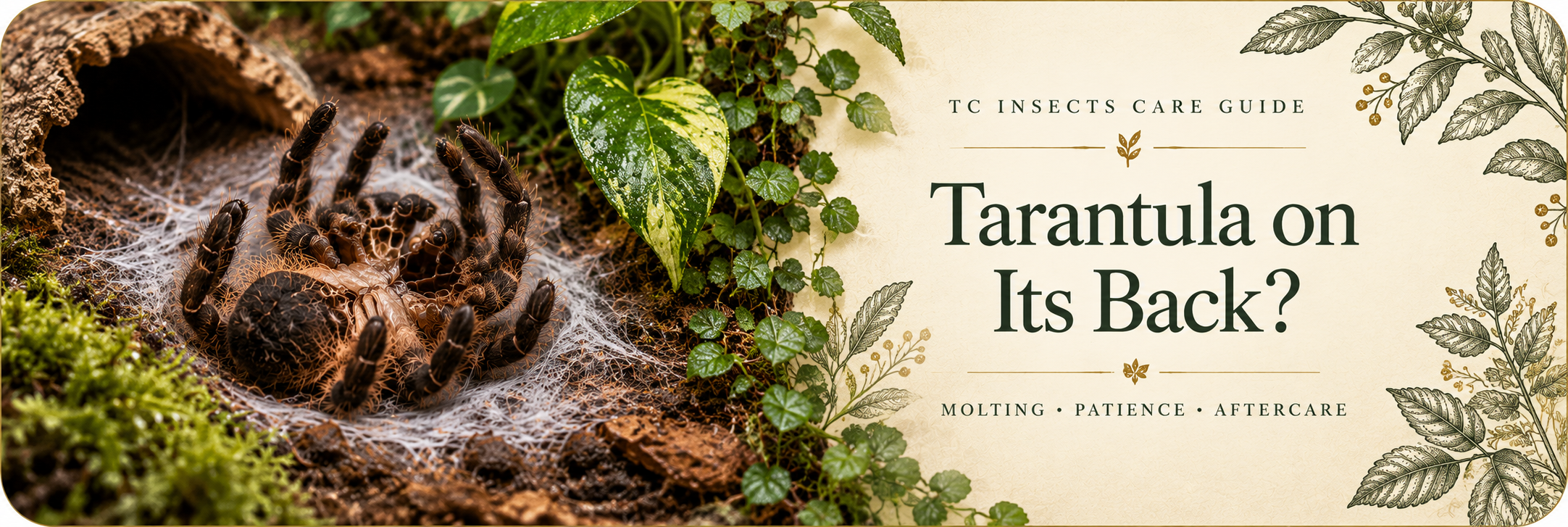
Finding your tarantula flat on its back with its legs curled up is almost never a sign of death or injury, it is how a healthy tarantula molts. Unlike many other invertebrates, tarantulas typically flip themselves over on purpose and use gravity to help pull free of the old exoskeleton, so a spider on its back that was fine and eating normally the day before is very likely mid-molt, not in trouble. The single most important rule is to not touch it: no flipping it back over, no poking it to check for movement, and no handling until it is clearly finished and moving normally again. Give it space, keep the enclosure appropriately humid, and read on for how long to wait and when a springtail cleanup crew earns its keep in the aftermath.
Do not touch it or flip it back over
Most molts finish in hours; give it a full day
Fangs and new exoskeleton need time to harden
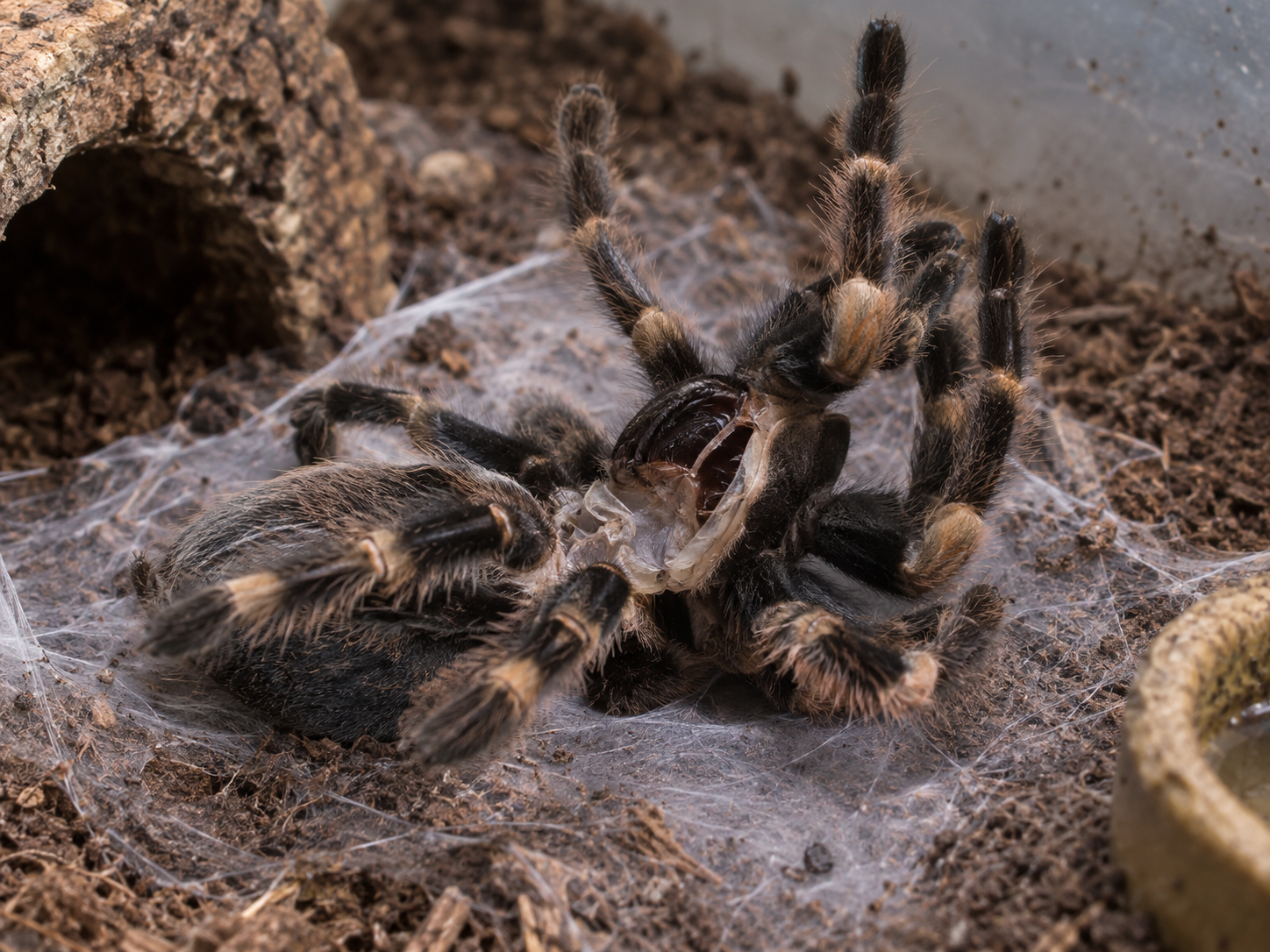

Short answer: this is molting, not dying
A tarantula lying on its back, legs pulled in or splayed loosely, is the classic molting position for this animal specifically. Tarantulas shed their entire exoskeleton to grow, and flipping onto their back lets gravity help work the old, too-small shell free from the legs and body, something that would be far harder to do right-side up. If your spider was healthy, eating, and active before this and shows no sign of injury, treat this as a molt in progress first.
The instinct to flip it back over or nudge it to see if it reacts is understandable, but it is the one thing you should not do. A tarantula mid-molt is completely defenseless, its new exoskeleton is soft and easily torn, and its fangs have not yet hardened enough to bite or grip properly. Interrupting the process, even with good intentions, can injure or kill a spider that would otherwise finish on its own within hours.
The signs it was building up to this
Premolt usually gives some warning before the actual flip. Watch for a darkening bald patch on the abdomen in New World species that kick urticating hairs, or a general dulling and darkening of color in Old World species that lack that patch, alongside an abdomen that looks unusually plump, tight, and glossy. Our guide on New World and Old World tarantulas explains why that bald-spot cue only shows up in some species.
Expect reduced appetite and activity in the days beforehand as well, sometimes for a week or more. Many tarantulas also retreat into a burrow or spin a silk molt mat, a flat sheet of webbing, before they settle onto their back to begin. If your spider was showing any of these signs before you found it flipped, that confirms the molting read and there is nothing further to do but wait.
How long it takes: the patience rule
Molt duration depends heavily on size and species. A small sling can finish shedding in well under an hour, while a large adult can take several hours to work free of the old exoskeleton, legs and all. As a general rule, give a tarantula on its back a full 24 hours before you let yourself worry, since what looks like a stalled molt to an anxious keeper is very often just a big spider taking its time.
What you should not do during that window is intervene physically, no matter how long it stretches. If a molt genuinely appears stuck well past a day, with visible tearing or a spider that seems to be struggling rather than steadily working free, that is a rare situation beyond home fixes and is worth a call to an experienced exotics vet, rather than any attempt to peel or pull the old exoskeleton yourself.
After the molt: why you should not feed it right away
Once your tarantula flips back over and starts moving normally, resist the urge to feed it immediately. Its fangs and the fresh exoskeleton underneath are still soft, and a struggling feeder such as a roach can injure a tarantula that cannot yet defend itself or grip prey properly. A sling typically needs a few days for everything to harden; a juvenile or adult often needs closer to a week or slightly more before its fangs are ready to feed safely again.
Use the waiting period to check on hydration instead of food. A shallow water dish within reach helps a freshly molted spider recover, and once you do offer food again, our feeding guide by age covers the right prey size to start back on. If it turns its nose up at the first offering, that is completely normal too, and our post on why tarantulas stop eating covers fasting that has nothing to do with molting, in case the pause stretches on longer than expected.
The one lever you control: humidity
You cannot speed up or assist a molt directly, but you can remove one of the few things that complicates it: a substrate that has dried out. Adequate ambient humidity helps a tarantula work free of its old exoskeleton cleanly, while a bone-dry enclosure raises the odds of a slow or difficult shed, especially for humidity-loving species. A light misting on one side of the enclosure or a slightly damp substrate patch, alongside a full water dish, is the practical, hands-off support a keeper can actually offer.
This matters just as much right after the molt, while the new exoskeleton is still curing. Keep conditions steady rather than swinging from dry to soaked, and avoid the temptation to mist directly on a freshly molted spider. Small, steady adjustments to the enclosure are the extent of what husbandry can do here; the rest is entirely on the tarantula's own biology.
Why a springtail crew helps during and after a molt
A humid substrate plus a shed exoskeleton and any leftover feeder debris is exactly the kind of environment where mold and fungus can bloom, right in the enclosure of a spider that needs to be left undisturbed. This is where a springtail culture earns a permanent spot in a bioactive tarantula setup: they graze the mold and fungus off the substrate surface continuously, so you are not the one who has to go digging around near a molting or freshly molted spider to clean up.
Seed a springtail culture into the enclosure well before you ever expect a molt, since an established culture works quietly in the background with no attention from you. It is a small, low-maintenance addition that solves exactly the problem a vulnerable, hands-off molting period creates, and it needs nothing from you beyond the occasional light misting your tarantula already benefits from.
Support a Safe Molt
Keep the substrate clean while your tarantula is at its most vulnerable. Tap to add and check out in one click.
Frequently Asked Questions
Written by the TC INSECTS breeding team · Porter, Texas · Live Arrival Guarantee on every order
Have a care question? Ask our community.
Join Reptile Keepers USA, our free Facebook group for reptile, amphibian and invert keepers. Share your setups, get care help and swap feeder tips.
Join the free group