Fruit Flies vs Pinhead Crickets
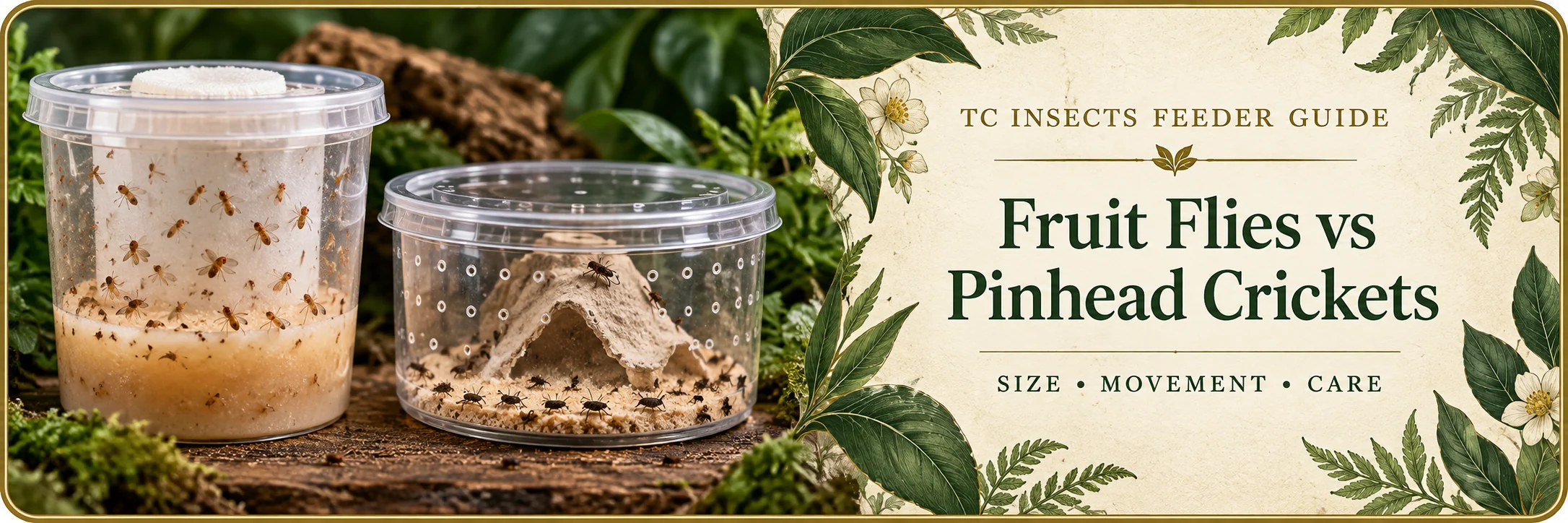
About 2.5 to 3mm, the safe start for day-one mantis nymphs and froglets
Hatches new flies for weeks, unlike a one-time cricket order
Honest comparison below, then what we can actually supply
Choose the Right Feeder for the Smallest Mouths
For dart froglets and freshly hatched mantis nymphs, flightless fruit flies are the safer, lower-effort choice over pinhead crickets, mainly because a fruit fly culture keeps producing new flies for weeks while a cricket order does not, and a fly cannot injure a molting animal the way a hungry cricket occasionally can. Pinhead crickets are a fair size match at roughly 1/16 to 1/8 inch, but TC Insects does not stock live crickets in any size. Here is the honest comparison stage by stage, and the fruit fly, bean beetle and springtail rotation we can actually ship.
Match Size, Movement, and Care
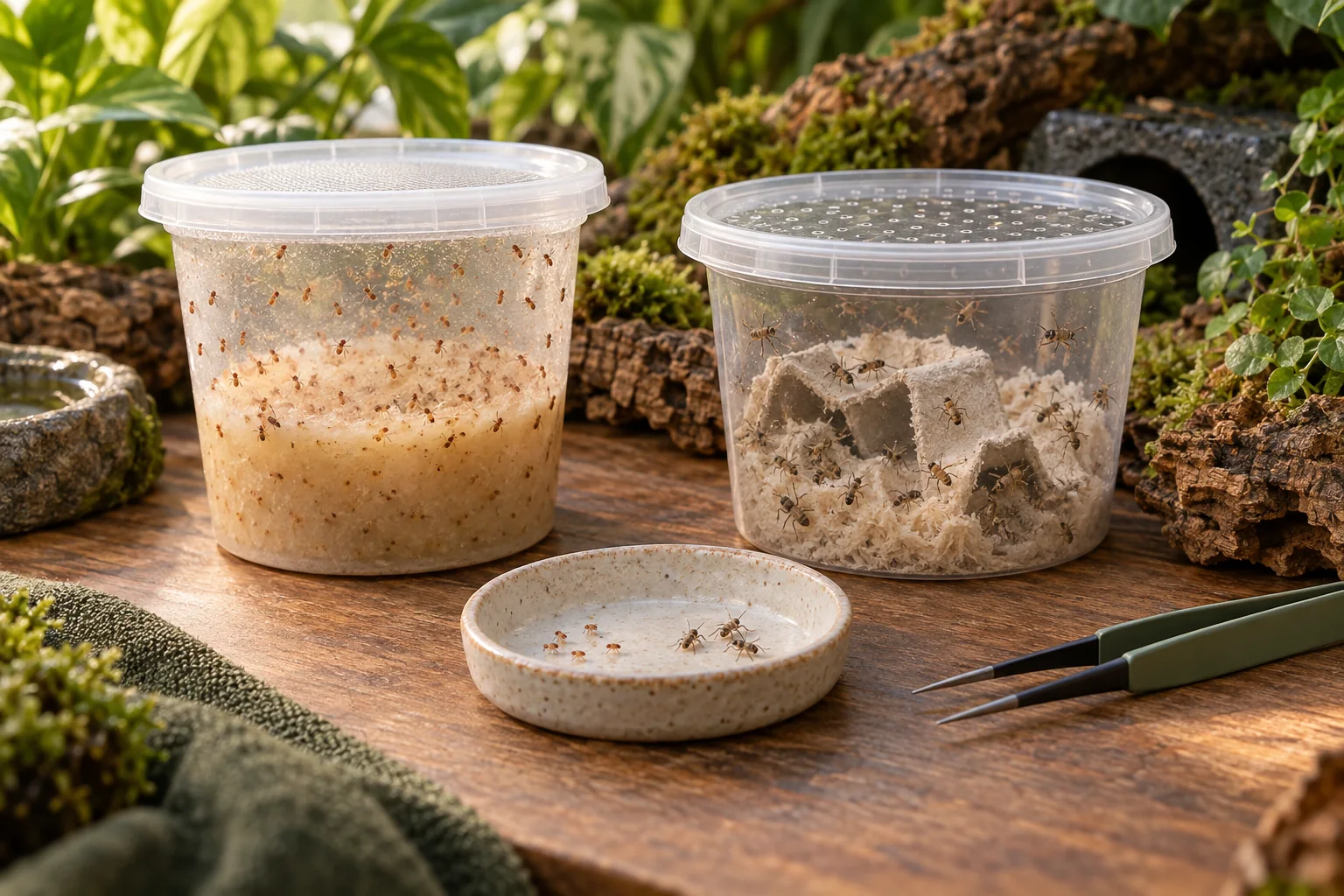
Compare feeder size, hunting response, nutrition, and weekly upkeep before choosing the best option for tiny insectivores.
Fruit flies or pinhead crickets, which is the better feeder?
For the tiniest, most delicate mouths, flightless fruit flies win on three fronts: a culture keeps hatching new flies for weeks instead of one order that runs out, the flies cannot fly off around a planted enclosure, and there is no risk of a leftover fly harming a molting animal the way an uneaten cricket occasionally can. Pinhead crickets are not a bad feeder in the abstract, they are simply a freshly hatched cricket, soft-bodied and sized for a small mouth, but they come with real upkeep and safety trade-offs.
TC Insects does not carry live crickets in any size, so this comparison is about giving you the honest picture either way, then pointing to the fruit fly, bean beetle and springtail rotation that covers the same size range from what we can actually ship.
Size and the switch-over point, stage by stage
Matching feeder size to mouth size matters more than picking a single favorite, and the right answer changes as the animal grows.
Dart Frog Froglets
A newly morphed froglet often cannot manage anything bigger than a springtail at first, then steps up to the smaller melanogaster fruit fly, about 2.5 to 3mm, dusted every feeding. A pinhead cricket at 1/16 to 1/8 inch is in a similar size class to melanogaster, but its firmer, faster-moving body is a rougher meal for a tiny frog than a soft fruit fly.
Baby Praying Mantis Nymphs
Freshly hatched nymphs (L1 to L2) start on melanogaster, sized to roughly a third of the nymph's body, then move to the larger hydei fly as they molt. A pinhead cricket left uneaten in the enclosure is a genuine risk here: hungry crickets are widely documented nibbling on a molting insect that cannot yet defend itself, a problem fruit flies do not really create.
Jumping Spider Slings and Small Geckos
A brand-new jumping spiderling does best on a soft melanogaster fly, about 2.5 to 3mm, not a firmer, faster pinhead cricket, so start on fruit flies and work up. Small geckos that have graduated to the larger hydei fly are usually ready for a pinhead-sized meal too, which is where a bean beetle becomes a reasonable, easy-care fruit fly alternative for us to ship instead.
Movement and strike response
Pinhead crickets move erratically and can trigger a strong feeding response in an animal that hunts by motion, which is a real point in their favor for a picky eater. Flightless fruit flies crawl rather than dart, a gentler trigger that still works well for dart frogs and mantis nymphs, which rely more on close-range ambush than a long chase.
In a planted or bioactive enclosure, fruit flies stay put far better too: a wingless fly cannot escape at all, while a cricket jumps and can wedge itself into decor or substrate where a small predator never finds it.
Nutrition and dusting
Neither feeder is nutritionally complete on its own. Fruit flies run roughly 1 part calcium to 3 parts phosphorus, the wrong direction for a growing or breeding animal, so dusting every feeding is standard practice rather than optional. Pinhead crickets can be gut-loaded to a high standard, but a freshly hatched pinhead has had very little time to actually eat anything itself, so its real nutritional value at that exact stage is thinner than an older, gut-loaded cricket.
The practical fix is the same for both: dust at the point of feeding and do not lean on any single feeder as the whole diet for long.
Effort per week: a living culture vs a standing order
This is the difference keepers feel most after the first month. A fruit fly culture is a living cup that keeps hatching new flies for several weeks on its own, so two staggered cultures cover a feeding schedule with almost no ongoing effort beyond a light dusting. A cricket supply has to be restocked regularly, since crickets do not reproduce fast enough on their own to sustain a feeding routine the way a culture does, which means a recurring order or a colony project most keepers never actually take on.
For anyone feeding multiple small animals or several life stages at once, that difference in weekly effort tends to matter more over time than the size comparison that started the search.
What TC can actually ship instead
Since TC Insects does not stock live crickets, the rotation we can put in your cart today is wingless melanogaster and hydei fruit flies for the smallest stages, bean beetles as a zero-maintenance size step once an animal is a little more capable, and a springtail culture for the very smallest mouths of all. Together those three cover almost the same size range a pinhead-to-adult cricket progression would, from a producing culture instead of a one-time order.
Our fruit fly culture care guide and flightless vs wingless fruit flies guide cover keeping a culture healthy, and our dart frog feeding guide and praying mantis feeding guide have exact counts and schedules by age. Shop fruit fly cultures to start a rotation this week.
The Micro Feeder Ladder Kit
Fruit flies, bean beetles and springtails, sized from a day-one froglet up to a hungry juvenile.
Micro Feeder FAQ
Are fruit flies or pinhead crickets better for dart frogs?
Fruit flies, for most keepers. A culture keeps producing for weeks, the flies cannot escape a planted tank, and their soft bodies are an easier meal for a tiny froglet than a firmer-bodied cricket. Pinhead crickets are a workable size match too, but they need a recurring restock rather than one culture that keeps hatching.
What should I feed newly hatched praying mantis nymphs?
Flightless melanogaster fruit flies, sized to roughly a third of the nymph's body, moving up to the larger hydei fly as it molts and grows. Avoid leaving any uneaten prey in the enclosure, since a hungry leftover cricket can injure a mantis that is molting and temporarily defenseless.
Do pinhead crickets or fruit flies escape more easily?
Pinhead crickets, generally. They jump and can wedge into substrate or decor in a planted enclosure, while flightless or wingless fruit fly lines crawl rather than fly and stay much closer to where they were released, which matters more in a bioactive or heavily planted tank.
Why don't fruit flies need restocking as often as crickets?
A fruit fly culture is a living cup: adult flies lay eggs in the media and a new generation hatches out continuously for several weeks. Crickets purchased as feeders do not reproduce fast enough in a home setup to replace themselves, so a cricket supply has to be reordered on a schedule instead of maintained like a culture.
Can jumping spiderlings eat pinhead crickets?
Not right away. A brand-new spiderling does best on a soft 2.5 to 3mm melanogaster fruit fly, and even a pinhead cricket is often too bulky and too fast for that first stage. Work up to a bean beetle or a larger fly once the spiderling has molted a few times and is visibly bigger.
Does TC Insects sell pinhead crickets?
No, TC Insects does not stock live crickets in any size, pinhead included. We focus on wingless and flightless fruit flies, bean beetles and springtail cultures, which cover the same size range from a producing culture rather than a one-time order that needs restocking every week.
More Micro Feeder Guides
Written by the TC INSECTS breeding team · Porter, Texas · Live Arrival Guarantee on every order
Have a care question? Ask our community.
Join Reptile Keepers USA, our free Facebook group for reptile, amphibian and invert keepers. Share your setups, get care help and swap feeder tips.
Join the free group