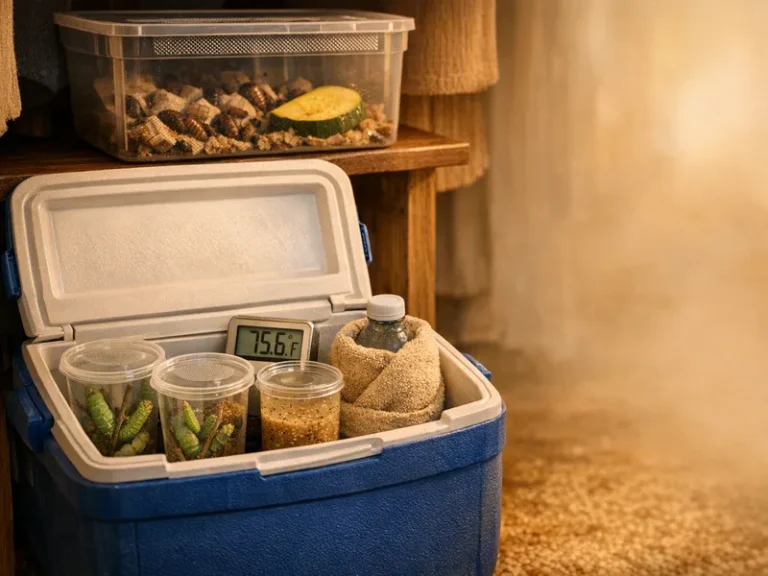
Do You Need a Heat or Ice Pack for Live Insects?
Yes, but only sometimes, and TC's checkout already watches for it: a heat pack gets added automatically once the forecast along your route drops into the low 40s Fahrenheit, and an ice pack once it climbs above 85 degrees. Isopods, springtails and other exotics ship FedEx Overnight, so their pack is always free no matter the season. Order a feeder line on USPS or a discount shipping option instead, and the same pack becomes a paid add-on, typically $2.40 to $3.75 for heat and $2.49 for cold. Here is exactly when checkout reaches for one, when Hold for Pickup beats paying for a pack, and how to read your own week's forecast the way checkout does.
TC's own pages differ slightly; both sit in the same low-40s range
Consistent across every TC page that states it
Isopods, springtails and exotics ship this way, so their pack is never paid


When Does Checkout Add a Pack Automatically?
TC's shipping add-ons page states the cold-weather rule plainly: a heat pack gets added below 40 degrees along the shipping route, and an ice gel pack above 85 degrees. The heat pack's own product listing gives a slightly warmer line for the same call, 45 degrees, with the 72-hour pack specifically flagged as required once temperatures anywhere along a three-day route drop below that mark. The two numbers are close rather than contradictory, so once your week's forecast drops into the low-to-mid 40s Fahrenheit, expect checkout to already be reaching for a pack before you have to ask.
The ice side is more consistent across TC's own pages: 85 degrees is the number that shows up everywhere, on the shipping add-ons page and on the ice pack's own listing, which describes it as best for hot locations or slowing growth in transit. Above that mark along the route, expect an ice gel pack to be part of the order automatically. If you want the full walkthrough of everything else riding inside that box alongside the pack, our shipping box guide covers it start to finish.
When Should You Choose Hold for Pickup Instead of a Pack?
Hold for Pickup answers a related but different question, not what protects the box in transit, but where the box waits once it lands in your city. TC's own Hold for Pickup page recommends it any time your forecast dips below 55 degrees or climbs above 85 degrees during the actual delivery window at your address, a few degrees warmer on the cold end than the 40 to 45 degree line that triggers a pack along the route. A heat pack in the box and a free counter pickup near you solve two different parts of the same trip, and the safest orders during a real cold snap often use both.
The gap between 40 to 45 degrees and 55 degrees is not TC being inconsistent, it reflects two different moments in the trip: the route number is about surviving the miles, the pickup number is about the last hour sitting at your address after the truck leaves. Treat 45 to 55 degrees as a buffer zone where either a pack or Hold for Pickup is a reasonable, free or low-cost way to add margin, and anything colder or hotter than that as a clear yes to one or the other.
A Season-by-Season Guide to What You Actually Need
Most of the year, a live order ships and arrives with no add-on at all, so do not treat a pack as a default upsell. Here is what a typical week looks like in each season, and what to actually add.
Winter
A hard freeze anywhere along the route is exactly what triggers TC's own heat pack rule, so a winter order into the 30s or low 40s should expect one added automatically, or you can add it yourself before checkout does. If you live somewhere that regularly sits below freezing at delivery time, Hold for Pickup at a heated counter is worth choosing on top of the pack, not instead of it.
Summer
Once the forecast along the route clears 85 degrees, an ice gel pack is the standard answer, good for about 12 hours of cooling and best paired with faster FedEx service so the box is not sitting in transit longer than the pack lasts. A hot porch after delivery is the other half of the risk, so bringing the box in immediately matters as much as the pack itself once it arrives.
Spring and Fall
This is the season most orders need nothing extra at all, since a route forecast in the 45 to 85 degree band sits comfortably inside every threshold on this page. Still check your own week if a late freeze or an early heat wave is in the forecast, since spring and fall swing fast and a single bad week can slip outside that comfortable middle.
What Each Add-On Actually Costs, and When It Is Free
TC carries two heat pack durations and one cold pack: the Uni-Heat 40-hour pack at $2.40, the Uni-Heat 72-hour pack at $3.75, and the ice gel pack at $2.49, good for about 12 hours of cooling. Isopods, springtails and other exotics ship FedEx Overnight, so whichever pack the order needs rides along free every time, regardless of season. That is a standing rule under the Live Arrival Guarantee, not a promotion.
The paid side of this only shows up on other shipping choices: USPS orders and the $7.99 promotional shipping option carry a pack as a paid line item when the forecast calls for one. If you are ordering feeder insects on a budget shipping method during a genuine cold snap or heat wave, expect to see that small add-on in your cart, and know that switching to FedEx 2-Day or Overnight is what makes the same protection free.
Picking Between the 40-Hour and 72-Hour Heat Pack
TC's own listings are specific about which duration fits which service: the 40-hour pack is sized for FedEx Overnight, the fastest option, while the 72-hour pack is the better match for FedEx 2-Day or USPS, since both take longer and a delay anywhere in transit eats into a pack's remaining hours fast. Choosing the shorter, cheaper pack for a slower service is the one genuine mistake to avoid here.
If you are ever unsure which service your order is shipping under, or a carrier delay is a real possibility that week, the 72-hour pack is the safer default even on a route that would normally only need the 40-hour one. The extra $1.35 is cheap insurance against a truck running a day behind schedule.
When You Genuinely Do Not Need One
If your own delivery-week forecast sits between roughly 45 and 85 degrees along the whole route, skip the add-on. That is the wide middle where isopods, springtails and most feeder insects travel just fine in standard packaging, and paying for a pack you do not need is the one honest overspend to avoid on this page.
The trade-off worth remembering is that checkout is forecasting your route this week, not guaranteeing next week's weather. If you are ordering several days ahead of a forecast that could shift, or your own address tends to run colder or hotter than the regional forecast, it is reasonable to add a pack checkout did not ask for, or to browse live insects and choose Hold for Pickup as a free way to add margin instead. Our own isopod shipping survival guide covers what actually happens inside a box once the weather turns genuinely extreme.
The Weather-Ready Kit
Both heat pack durations and the cold pack TC actually ships, plus a substrate refresh while you wait.
Frequently Asked Questions
Written by the TC INSECTS breeding team · Porter, Texas · Live Arrival Guarantee on every order
Have a care question? Ask our community.
Join Reptile Keepers USA, our free Facebook group for reptile, amphibian and invert keepers. Share your setups, get care help and swap feeder tips.
Join the free group