A reptile's insect portion is better measured in grams of body weight than in a fixed insect count, since a single superworm and a single dubia roach are not the same amount of food. As a worked example, a 400-gram adult bearded dragon burns roughly 11.5 kilocalories a day, which works out to about 2.7 grams of dubia roaches or 1.9 grams of superworms, not a flat "10 insects" regardless of size. This guide shows the arithmetic once so you can copy it for your own animal, then converts the result back into a rough insect count for days you do not have a scale handy.
Scales correctly no matter how big or small your feeder insects are
Works out to about 2.7g of dubia roaches or 1.9g of superworms
Weighs a lot on a scale but delivers little dry nutrition per gram
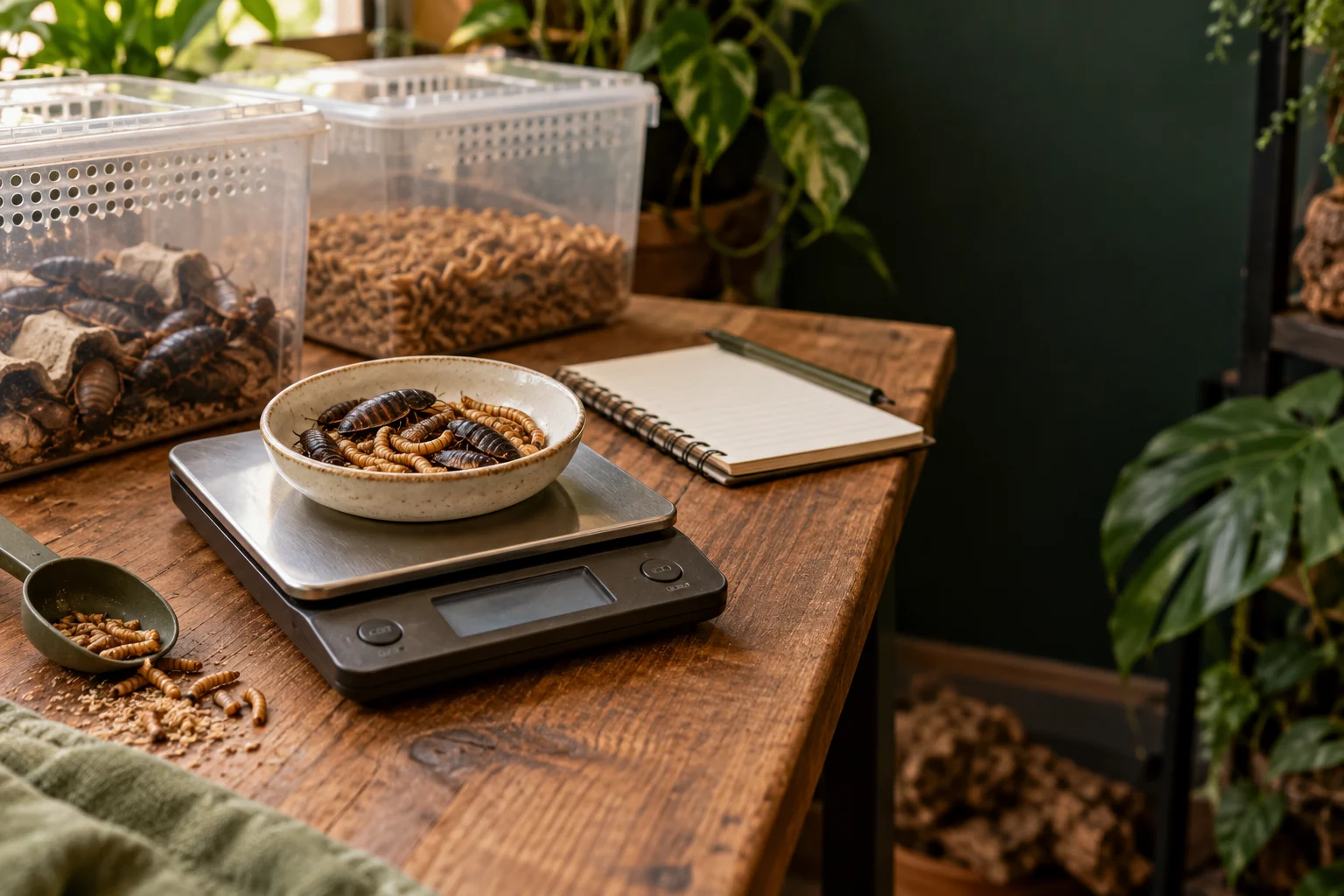
Measure, convert, then watch the animal
Use body weight to set a starting portion, then refine it with appetite and body condition.
Turn body weight into a practical feeder portion
Why Counting Insects Breaks Down
A "10 insects a day" rule falls apart the moment you compare feeder sizes. Our own feeder insect size chart lists mealworms from a quarter-inch mini up to a 1.25-inch giant, and dubia roaches from a quarter-inch extra small up to a jumbo retired breeder, a size range wide enough that ten of one is a snack and ten of the other is a full meal with leftovers. Counting also breaks down the moment you mix feeder types in one week, since a cricket, a superworm, and a piece of a hornworm are not remotely the same amount of food even at a glance.
The Weight Method: How It Actually Works
Weighing works because it measures the one thing that actually matters: how much food mass your reptile needs relative to its own body size, regardless of what shape that food comes in. One widely used approach borrows a field-metabolic-rate style formula from exotic-animal nutrition to estimate daily calorie needs from body weight in grams, then converts that calorie target into grams of a specific feeder using its known calorie density. It is an estimate, not a lab-verified prescription for your individual animal, so treat the output as a starting point you refine against appetite and body condition, the same way our own care sheets use a bearded dragon's waistline or a leopard gecko's tail as the real feedback loop.
The Worked Example, Step by Step
Here is the arithmetic for a 400-gram adult bearded dragon, so you can copy the same steps for your own animal. Step 1: weigh your dragon on a gram scale, ideally right after a bathroom break for the most accurate reading. Step 2: run that weight through a reptile calorie-needs formula; for our 400-gram example, published bearded dragon feeding calculators put daily needs at roughly 11.5 kilocalories. Step 3: divide that calorie target across your feeder of choice using its calorie density, which works out to about 2.7 grams of dubia roaches, roughly 1.9 grams of superworms, or about 7.3 grams of hornworms for the same dragon on the same day. Step 4: split that gram total across your normal number of feedings rather than offering it all at once.
Converting Grams Back to a Feeder Count
Not every feeding needs a scale, so it helps to know roughly what those gram figures mean in insects. A large dubia roach runs in the neighborhood of 0.7 to 0.9 grams, so 2.7 grams is roughly three to four large dubia, which lines up with the whole-insect counts in our own feeding-by-age charts. Superworms run lighter per piece, so 1.9 grams is closer to four or five mediums. Treat these conversions as reference points, not fixed constants, since actual weight shifts with hydration, gut-load, and how each supplier raises its stock. Weigh a small sample from your own order once if you want a number specific to what is actually in your bin.
Applying the Method Beyond Bearded Dragons
The body-weight idea travels well, but the published, verified calorie formulas behind it are thinner outside bearded dragons. For everything below, weight is still useful as a trend line, just less useful as a single daily prescription.
Leopard Geckos and Other Insectivorous Lizards
Weigh your gecko monthly and watch the trend alongside its tail; our own feeding schedule by age guide already uses that same tail-condition feedback loop for a reason. A gecko holding steady weight and a plump tail on its current portion is getting enough, regardless of whether that portion is four mealworms or six.
Tarantulas
Tarantulas do not have a published gram-per-body-weight standard, so size the prey to the spider instead of the scale: an abdomen no bigger than the prey offered is the standard rule of thumb, and most adults take prey roughly once a week, more often for a fast-growing sling. Weight matters here mainly as a growth check between molts, not a daily ration to calculate.
Arboreal Frogs
Offer a few appropriately sized insects at a time and stop once feeding interest drops off, then track body weight over weeks rather than days. A frog gaining weight steadily on its current portion does not need a gram target, and one losing weight needs a vet visit before it needs more math.
When the Scale Can Mislead You
Weight has one real trap: not every gram is equal. Hornworms run about 85 percent water, so a hornworm-heavy gram total looks generous on a scale while delivering comparatively little dry nutrition, which is exactly why they work as a hydration treat rather than a calorie staple. The honest trade-off with the whole weight method is that it takes a scale and a few minutes of arithmetic that counting does not, so on a busy week, falling back to the appropriately sized insect counts in our by-age feeding guides is a completely reasonable shortcut. Use the gram method when you want precision or when your animal's weight is drifting the wrong way, not as a replacement for watching the animal in front of you.
The Gram-Accurate Feeding Kit
A mixed feeder set sized to practice the weight method until the math becomes second nature.
Frequently Asked Questions
Keep reading: how you present the portion and what to dust it with.
How many grams of feeder insects should I feed my reptile?+
It depends on your reptile's weight and species, but a common starting point is running body weight through a reptile calorie-needs formula, then converting that number into grams of your chosen feeder. As a worked example, a 400-gram adult bearded dragon needs roughly 11.5 kilocalories a day, about 2.7 grams of dubia roaches or 1.9 grams of superworms. Treat this as a starting point, then adjust with appetite and body condition.
Why is weight a better feeding method than counting insects?+
Because feeder insects vary hugely in size, a fixed insect count means something different every time you change feeder type. Ten small mealworms and ten large superworms are not close to the same meal. Measuring in grams of body weight scales correctly no matter which feeder you use, which is why nutrition-focused calculators have moved toward weight and calories instead of a flat count.
How much should a 400 gram bearded dragon eat?+
Roughly 11.5 kilocalories a day, based on a commonly used reptile calorie formula, which works out to about 2.7 grams of dubia roaches or 1.9 grams of superworms. That is a starting estimate, not an exact prescription, so watch body weight and waistline over a few weeks and adjust the portion if your dragon is gaining or losing more than expected.
How much do feeder insects weigh?+
It varies by species and size, but as rough reference points, a large dubia roach runs about 0.7 to 0.9 grams and a medium superworm is closer to a fifth of a gram. Exact weight shifts with hydration, gut-load, and supplier, so treat these as starting reference points and weigh a small sample from your own order if you want a number specific to your feeders.
Can I use the weight method for a leopard gecko or a tarantula?+
The concept works for any insectivore, but the precise calorie formulas are less established outside bearded dragons. For a leopard gecko, weigh it monthly and watch its tail; for a tarantula, size prey to the abdomen instead of a gram target. Both rely on tracking body condition over time rather than a daily gram prescription.
Are hornworms a good way to hit a gram target?+
Not as a primary calorie source. Hornworms run about 85 percent water, so a given weight of hornworms delivers far less dry nutrition than the same weight of dubia roaches or superworms. They work better as an occasional hydrating treat than as the feeder you weigh out to hit a daily gram number.
Have a care question? Ask our community.
Join Reptile Keepers USA, our free Facebook group for reptile, amphibian and invert keepers. Share your setups, get care help and swap feeder tips.
Join the free group