Feed until it stops hunting, not a fixed count
Roughly 6 to 8 appropriately sized feeders
Roughly 5 to 7 larger feeders, watched by tail
A leopard gecko's (Eublepharis macularius) feeding schedule changes three times over its life: daily for hatchlings and young juveniles, daily to every other day through the growing juvenile stage, and roughly every 2 to 3 days once it reaches adulthood. The better gauge than any fixed calendar is the tail: a full, plump tail means you are feeding enough, while a thin or shrinking one means it is time to feed more often or offer more per sitting. Mealworms make a fine, easy staple at every stage, though they run a bit more chitin and a bit less protein than dubia roaches, so gut-loading them 24 to 48 hours before offering them matters even more than it does for a naturally richer feeder. This is the exact-amounts companion to our best feeder insects for leopard geckos roundup, built around a simple chart instead of a longer overview.


The answer: a schedule that changes three times
A leopard gecko's feeding needs shift at three fairly clear points: the hatchling stage, the growing juvenile stage, and full adulthood. Rather than memorizing a single number, it helps to think of the tail as the real gauge throughout all three: a healthy leopard gecko stores fat in its tail, so a full, rounded tail means the current schedule is working, and a thin or flattening one means it is time to feed more.
The chart above gives you a concrete starting point for each stage, but body condition should always have the final word over a fixed calendar, since individual appetite varies animal to animal.
Hatchlings and young juveniles: daily, small and often
A hatchling or young juvenile, roughly the first three months, does best fed daily with several small feeders per session, tiny or small mealworms sized so nothing is wider than the space between its eyes. At this age it is less about a specific count and more about offering food until it visibly stops hunting.
This is also the life stage where gut-loading matters most, since a fast-growing hatchling is pulling nutrition from a small number of feeders relative to its body size. Load feeders on a good gut-load diet for a day or two before offering them rather than feeding straight from a bag.
Growing juveniles: daily to every other day
Once a leopard gecko is past the hatchling stage and growing steadily, roughly 3 to 12 months old, daily to every-other-day feeding with somewhat larger mealworms is a reasonable starting point. As a rough count, about 6 to 8 appropriately sized feeders per session is common, adjusted up or down based on how quickly your gecko clears the dish.
Watch growth and tail condition through this stage rather than sticking rigidly to a count. A juvenile that is filling out steadily and keeping a plump tail is on a schedule that is working, regardless of whether it matches the number above exactly.
Adults: every 2 to 3 days, fewer but larger feeders
A fully grown adult leopard gecko generally settles into feeding roughly every 2 to 3 days, with somewhat fewer but larger mealworms per sitting, commonly in the range of 5 to 7 feeders as a starting point. Growth has slowed by this stage, so the goal shifts from fueling growth to simple maintenance.
Overfeeding a sedentary adult is a genuine risk here, since leopard geckos are not especially active hunters and excess calories show up as extra body weight over time rather than burning off. If your adult's tail looks consistently thick at the base rather than gently tapered, that is worth dialing the portion back rather than up.
Mealworms alone vs a dubia upgrade
Mealworms are a genuinely fine, easy staple at every one of these stages, and plenty of leopard geckos thrive on them long-term. The honest caveat is that mealworms run a firmer, more chitinous exterior and somewhat less protein than dubia roaches, so keepers who want a more nutritionally complete staple often rotate small dubia into the mix alongside mealworms rather than replacing them outright.
Either way, gut-load your feeders 24 to 48 hours before offering them, since that window is what actually gets useful nutrition into the feeder's body for your gecko to benefit from. Our guide to leopard geckos and black soldier fly larvae covers a third option if you want even more variety in the rotation.
Calcium dusting fits into every stage
Dust feeders with a reptile-safe calcium powder at most feedings across all three life stages, with extra attention during the hatchling and juvenile stages when bone growth is fastest, and for any female that is gravid.
This habit matters more than the exact feeder count at any given stage. A leopard gecko fed a slightly imperfect schedule but consistently dusted feeders is in a far better position than one fed on a perfect calendar with no calcium supplementation at all.
Feed the Right Size at Every Stage
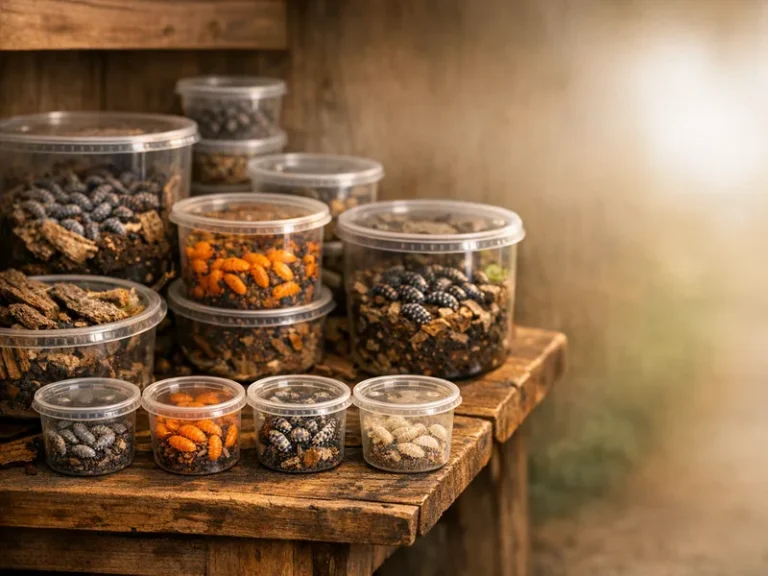
Mealworms sized for hatchling through adult, plus the dubia upgrade and calcium dusting mentioned above.
Frequently Asked Questions
Written by the TC INSECTS breeding team · Porter, Texas · Live Arrival Guarantee on every order
Have a care question? Ask our community.
Join Reptile Keepers USA, our free Facebook group for reptile, amphibian and invert keepers. Share your setups, get care help and swap feeder tips.
Join the free group