
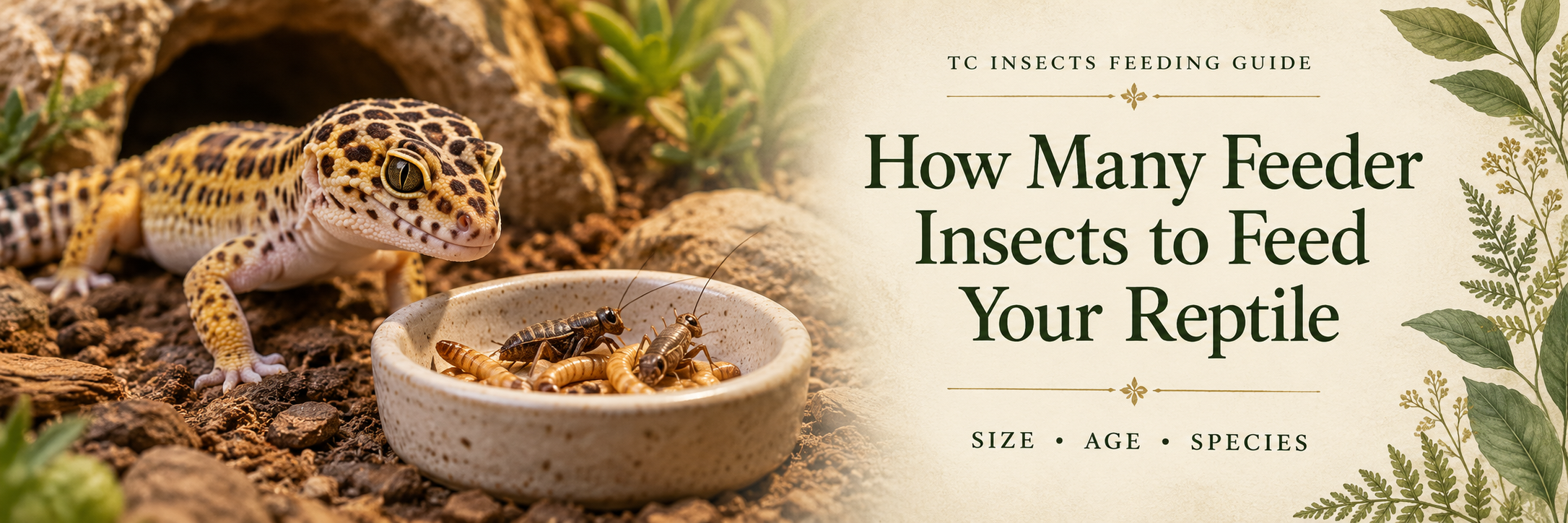
How Many Feeder Insects to Feed Your Reptile
TC INSECTS is a family-run insect farm in Porter, Texas, and the largest feeder operation in the state. "How many do I feed?" is the question every new reptile keeper asks, and the honest answer depends on the species, the age, and, above all, the size of the feeder. Here is a clear, practical guide, plus the feeders to match.
Feeder length under the space between the eyes.
Adults eat fewer, larger feeders less often.
Lower 48 only, backed by our Live Arrival Guarantee.
The single most important rule is feeder size: never offer prey longer than the space between your reptile's eyes (for snakes, no wider than the body). Get that right, and the counts below are easy to follow by species and age.
Shop the Right Feeders
Live Dubia Roaches
A lean, high-protein staple that comes in a full range of sizes, so you can match the feeder to your reptile as it grows. The easiest way to follow the sizing rule.
Live Mealworms
A convenient feeder, best offered in limited amounts and dusted with calcium rather than fed as a daily staple, since they are higher in fat.
Live Superworms
A bigger, meatier feeder for larger adults. Like mealworms, offer in moderation and dust with calcium rather than relying on them daily.
Calci-Worms (Black Soldier Fly Larvae)
Naturally calcium-rich, an easy way to build calcium into any feeding routine without dusting every feeder.
Everything a reptile keeper needs from this guide. Untick anything you already have, then add the rest in one click.
How Much to Feed, by Species and Age
The golden rule: feeder size first
Before counting anything, get the size right. A feeder insect should be no longer than the space between your reptile's eyes; for a snake, no wider than the widest part of its body. Prey that is too large is the leading cause of impaction and refusal, and it matters far more than the exact count. When in doubt, size down and offer a few more.
Bearded dragons by age
Baby bearded dragons (roughly one to three months) are fed as many small feeders as they will eat in ten to fifteen minutes, two to three times a day, which often works out to thirty to fifty micro feeders daily. Juveniles (three to twelve months) take around ten to fifteen medium feeders once or twice a day. Adults over about eighteen months eat far fewer insects, roughly eight to twenty larger feeders every one to three days, with vegetables making up the larger share of the diet.
Leopard geckos by age
Baby leopard geckos eat two to three appropriately sized feeders daily. Juveniles do well on four to six feeders every other day. Adults are fed six to seven feeders, sized to no larger than the space between the eyes, two to three times a week. Leopard geckos are insectivores, so insects are the whole diet here, which makes variety and dusting especially important.
Crested geckos and chameleons
Crested geckos are different: a prepared crested gecko diet is the base, and live insects are enrichment offered only about one to two times a week for juveniles and even less for adults. Chameleons take about four to six head-sized feeders per feeding, daily for young animals and every other day or so for adults, always dusted appropriately.
Staple feeders vs treat feeders
Count is only half the picture; what you feed matters too. Dubia roaches make an excellent everyday staple across species. Mealworms and superworms are higher in fat with a poor calcium-to-phosphorus ratio, so they should be limited and always dusted, not fed as the daily staple. Rotating a lean staple with calcium-rich calci-worms and the occasional treat gives the most balanced diet.
How Often to Feed, at a Glance
Often 2 to 3 short feedings a day.
Fewer, slightly larger feeders.
Larger feeders; more greens for omnivores.
Feeding Amount FAQ
The Right Feeders, Sized and Fresh
Not sure how much to feed your specific animal? Email customer.service@tcinsects.com and we will help you dial it in.
TC INSECTS · Texas-bred feeders and cleanup crews · Shipped live, guaranteed
