Does a Bioactive Terrarium Need a Drainage Layer
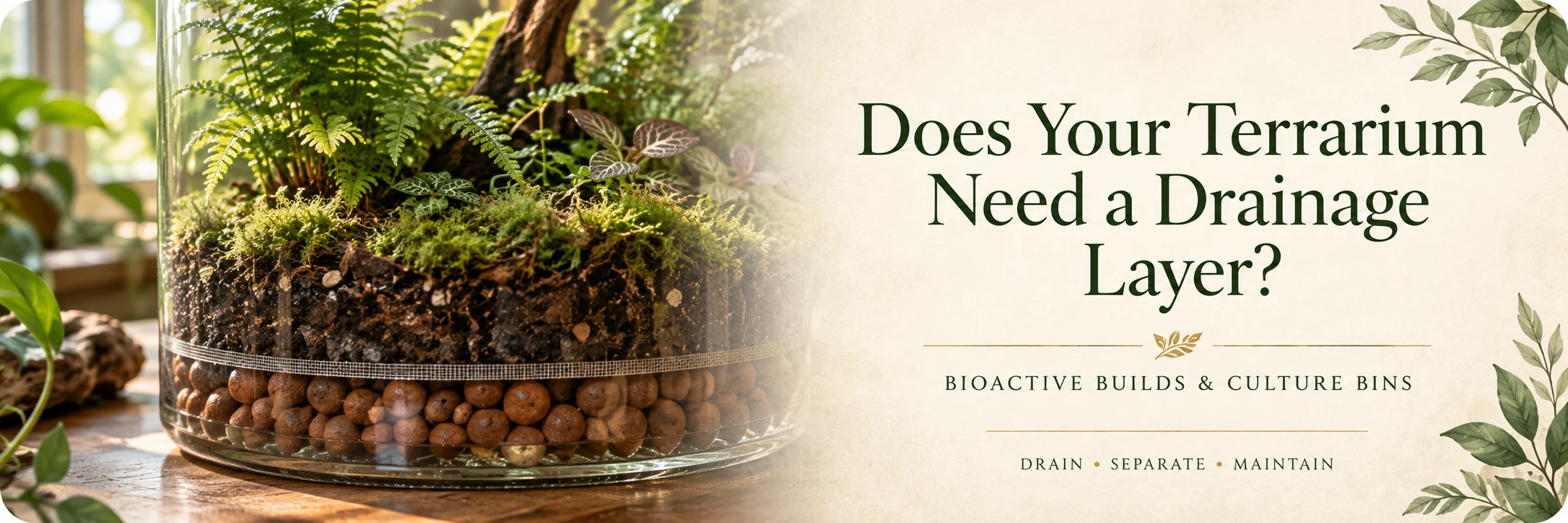
Typical drainage medium depth under the substrate barrier
Heavily misted tropical displays with rooted plants benefit most
A simple culture bin usually does better with just deep substrate
Drainage for the build you actually have
A drainage layer earns its place in a heavily planted, regularly misted tropical bioactive terrarium, but most isopod-only culture bins do better without one. The layer, usually 2 to 3 inches of clay balls or an open grid under a mesh barrier, gives excess water somewhere to go besides your substrate. A plain culture bin rarely gets misted hard enough to need that, and a simpler, deep substrate with a real dry side keeps isopods happier than a false bottom does. Here is how to tell which build you actually have, and what to do if you already have one.

Display tank or culture bin?
Compare drainage materials, barrier mesh, and water-level maintenance.
When a drainage layer actually earns its place
A drainage layer matters most in a display build with real rooted plants on a regular misting schedule, especially a humid tropical setup with substantial soil depth. Misting adds water on a schedule a planted substrate cannot always absorb between waterings, and that excess has to go somewhere besides pooling inside the substrate itself. That is exactly why our full build order places one at the very first step.
Skip the layer in that kind of tank and the water has nowhere to go but down, where it sits in contact with plant roots and the isopod and springtail substrate around the clock. Standing water like that turns stagnant and low in oxygen faster than water with any airflow, which smells sour, stresses roots, and drags the whole bin toward evenly wet instead of the moisture gradient your cleanup crew actually wants.
When you can skip it
A dedicated isopod or springtail culture bin, one without live rooted plants, or one you mist by hand only when the substrate actually looks dry, does not generate the same steady water load. Isopods do not need or particularly want a reservoir under their feet. What they need is a moisture gradient, damp on one side or third and dry on the rest, and a false bottom does not create that any better than a well-built substrate does on its own.
For that simpler build, a properly mixed isopod substrate already does the drainage layer's real job: it holds moisture evenly, resists waterlogging on its own, and skips an entire extra layer of upkeep, checking water level, keeping the barrier mesh intact, that a false bottom adds for a build that was never going to need it.
What a drainage layer is actually made from
Whatever material you use, it sits under a fine mesh or screen barrier cut to fit snugly, the same barrier our step-by-step setup guide covers, so soil stays up top while water still passes through. This is a different ingredient from the horticultural charcoal blended directly into a substrate mix, like the one in our ABG-style substrate recipe, which works throughout the soil itself rather than as a separate bottom layer.
LECA (expanded clay balls)
Lightweight, porous fired-clay balls that hold a little moisture themselves while still draining freely. The most common pick for a display vivarium, usually run 2 to 3 inches deep.
Lava rock or coarse gravel
A heavier, often cheaper alternative at a similar depth. It drains just as well but holds less moisture than LECA and adds real weight to a large tank.
An open false-bottom grid
A rigid plastic grid, often a light-diffuser panel, raised on feet to create a pure air gap with no loose medium at all. Lightest option, easiest to inspect and drain since there is nothing to dig through, but it buffers no moisture on its own.
The one risk a plant care guide will not mention
If isopods can actually reach the drainage layer, because the barrier gapped, shifted, or was cut a little short at a corner, some of them will explore it. That is a bioactive-specific problem, not just a plant-drainage one. A pocket of standing water at the bottom of the tank is exactly the kind of place an isopod can get trapped; our guide on whether isopods can drown covers why that risk is real even in an animal that needs humidity to survive.
The fix is mechanical, not exotic. Cut the barrier mesh oversized so it runs up the inside walls with no gap at the corners, and check it after the first couple of waterings before you plant anything or seed the crew. A tank that is going to run a drainage layer at all is worth checking once while it is still easy to fix.
How to drain a flooded layer
A drainage layer doing its job shows a low, visible waterline against the glass, generally under half its total depth, never pressed up against the substrate barrier. If it creeps higher than that, pull the excess out with a turkey baster or a small aquarium siphon before it has a chance to soak upward into the substrate.
For a tank meant to run long term, a short length of rigid tubing pushed down through the substrate to the bottom of the layer, capped and hidden behind a piece of bark, turns that into a five-second job instead of a substrate-disturbing chore. Check the level occasionally rather than only after you already smell a problem.
The simple version, if you would rather skip the debate
Building a display tank with real rooted plants on a regular misting schedule, especially a humid tropical setup: include the drainage layer and follow the layer order in your build. Running a simpler culture bin, a semi-arid or arid species, or anything you water by hand only when it looks dry: skip the false bottom and put that effort into a solid substrate recipe instead.
Either way the goal is the same, give excess water somewhere to go before it ever reaches your isopods and springtails. Ready-made substrate, leaf litter, and a springtail culture to seed either build are on our care supplies page.
Keep reading: Do You Need to Cycle a Bioactive Terrarium? The Honest Answer
The False-Bottom-Free Kit
Everything a simple isopod bin needs instead of a false bottom: moisture-holding substrate, litter cover, and a springtail crew.
Frequently asked questions
Do I need a drainage layer for a simple isopod bin?
Usually not. A dedicated isopod or springtail culture bin without live rooted plants rarely gets misted heavily enough to need one. A properly built substrate with a damp side and a dry side handles moisture on its own, and skipping the false bottom means one less thing to monitor or accidentally flood.
How deep should a drainage layer be?
About 2 to 3 inches of clay balls, lava rock, or an open false-bottom grid is standard for most vivarium sizes. A tank running a pump or water feature typically needs more clearance, closer to 4 inches, so the pump has room to draw water without running dry.
Can isopods actually get into the drainage layer?
Yes, if the mesh barrier above it has any gap, especially at the corners or edges. Isopods that wander down into standing water can become trapped, so a barrier that runs snugly up the enclosure walls matters more than which drainage material you chose.
What is the difference between a drainage layer and charcoal mixed into substrate?
They are two different things. A drainage layer is a separate zone of clay balls or an open grid under a mesh barrier at the very bottom of the tank. Charcoal mixed into a recipe, like in an ABG-style substrate, is blended throughout the soil itself to help it resist souring, not to hold standing water.
How do I know if my drainage layer has too much water?
Check the waterline against the glass. It should stay low, generally under half the layer's depth, not pressed against the substrate barrier. If it is creeping higher, pull the excess out with a turkey baster or a small siphon before it soaks upward into the substrate.
Does a drainage layer replace good ventilation?
No. A drainage layer only manages where excess water goes after misting. It does not dry out a substrate that is already being overwatered, and it does not fix a lid with too little airflow. Both still matter, especially in a heavily planted, regularly misted build.
Keep learning
Have a care question? Ask our community.
Join Reptile Keepers USA, our free Facebook group for reptile, amphibian and invert keepers. Share your setups, get care help and swap feeder tips.
Join the free group