
Crested Gecko Care Sheet
Complete crested gecko husbandry (Correlophus ciliatus): the room-temperature setup that needs no heat lamp, the humidity cycle, the prepared-diet plus insect split, why a dropped tail never grows back, and a troubleshooting chart.
A long-haul pet in a small, quiet package.
Around 4 to 4.5 inches snout to vent.
No heat lamp, no UVB requirement, no live food required.
Meet the Crested Gecko
The crested gecko was believed extinct until it was rediscovered in New Caledonia in 1994, and in thirty years it has become the most recommended beginner reptile in the hobby. The reason is simple: it thrives at ordinary room temperature, needs no UVB when fed a complete diet, eats a powdered food you mix with water, and lives happily in a single planted enclosure for two decades.
They are named for the row of soft crest fringes running from above each eye down the neck and back, which give them their other nickname, the eyelash gecko. They are arboreal and nocturnal, with wide adhesive toe pads and a prehensile tail tip, and they come in a huge range of morphs from plain buff to harlequin and pinstripe patterns.
One quirk to accept before buying: a crested gecko that drops its tail never regrows it. Tailless cresties are common, completely healthy, and known affectionately as frogbutts. If a permanently tailless animal would bother you, the gargoyle gecko is the near-identical alternative whose tail does grow back.
What You Will Need
Notice how much is absent: no basking bulb, no UVB requirement, no permanent insect colony. This is the cheapest long-term reptile setup on the site.
Conditions at a Glance
The whole environment on one card. The row that catches people out is the ceiling, not the floor.
| Parameter | Target | Notes |
|---|---|---|
| Enclosure minimum | 18 x 18 x 24 for an adult | Vertical; juveniles do better in a smaller tank |
| Day temperature | 72 to 78 F | Ordinary room temperature; no basking lamp |
| Temperature ceiling | Above 82 F is dangerous | Sustained heat kills crested geckos; this is the real risk |
| Night temperature | 65 to 72 F | A natural drop is welcome |
| Humidity | 60 to 80 percent, cycling | Mist at night, let it dry back by day |
| Water | Misted droplets plus a small dish | They drink mostly from leaves and glass |
| Lighting | 12 hour cycle | No UVB required; low-output optional |
| Diet | Powdered diet, plus insects weekly | The powdered diet is the base, not a supplement |
| Housing | One per enclosure | Males always fight; mixed groups cause stress |

Enclosure and Setup
Adults want an 18 by 18 by 24 inch front-opening terrarium; juveniles do better in something smaller, like a 12 by 12 by 18, where they can actually find their food. Furnish vertically with cork rounds, angled branches and broad-leaved plants, and make sure there are clear routes from the floor to the top so the gecko is never crossing open glass to reach a perch.
House them singly. Males fight without exception, mixed-sex pairs put a female under constant breeding pressure, and even female groups mean you cannot tell who is eating. Solo housing is also how you spot a problem early, because you know whose cup is going down.
Temperature, Humidity and Light
This is the species where the danger is heat, not cold. Seventy-two to seventy-eight degrees by day is ideal, sustained temperatures above the low eighties cause real harm, and a crested gecko can die in a hot room in a single afternoon. There is no heat lamp on the shopping list on purpose; if your home runs cold, use the lowest-watt option on a thermostat, and if it runs hot, focus on cooling the room or moving the tank.
Cycle humidity between roughly 60 and 80 percent by misting at night and letting the enclosure dry back during the day, with a screen top providing airflow. They drink droplets from leaves and glass rather than standing water, so the misting is hydration as much as humidity. Run a 12 hour light cycle; UVB is not required with a complete diet, though a low-output tube is a sensible optional upgrade.
Diet and Feeding
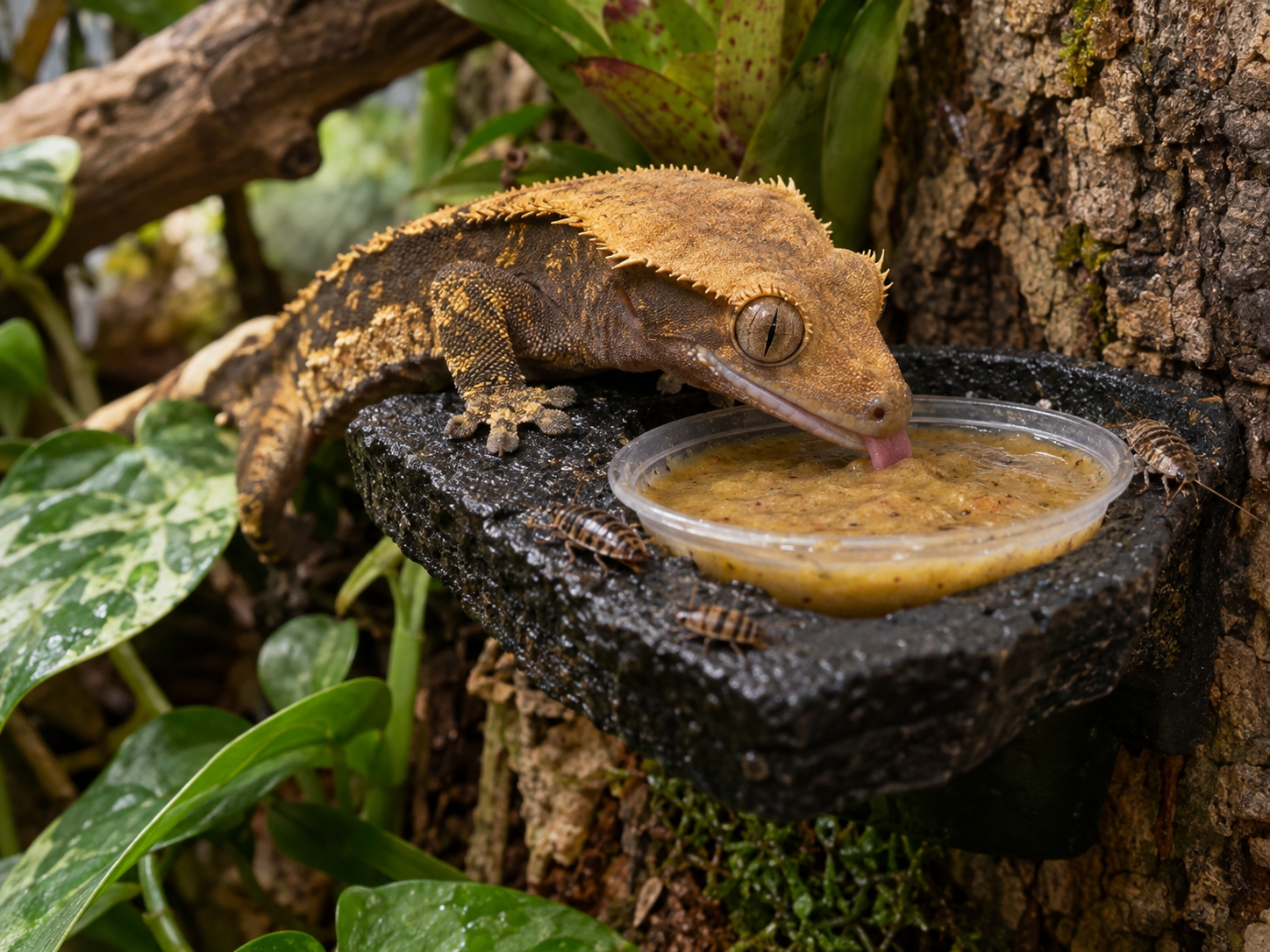
The base of a crested gecko diet is a complete powdered gecko food mixed smooth and offered in shallow ledge cups, replaced fresh every other day. That prepared diet is not a supplement, it is the main meal, and a crestie can live a full healthy life on it alone.
Insects are the enrichment and protein top-up: gut-loaded dubia roaches once or twice a week for adults, more often for growing juveniles, dusted with calcium plus D3 and sized no wider than the space between the eyes. Feed insects in the evening and remove any uneaten prey. The full sizing plan is on our crested gecko feeder guide.
| Life Stage | What To Feed | How Much | How Often | Supplements |
|---|---|---|---|---|
| Hatchling to juvenile | Powdered diet plus small dubia | Fresh cup, plus 3 to 5 insects | Diet every other day; insects 2 to 3 times weekly | Calcium + D3 on every insect feeding |
| Subadult | Powdered diet plus dubia | Fresh cup, plus 4 to 6 insects | Diet every other day; insects twice weekly | Calcium + D3 twice weekly; multivitamin every other week |
| Adult | Powdered diet plus dubia | Fresh cup, plus 5 to 8 insects | Diet 3 times weekly; insects 1 to 2 times weekly | Calcium + D3 weekly; multivitamin every other week |
Everything a crested gecko keeper needs from this guide. Untick anything you already have, then add the rest in one click.
The Bioactive Option
A planted crested gecko enclosure is one of the easiest bioactive conversions there is, because the humidity cycle already suits a cleanup crew. Seed the substrate with springtails and dwarf white isopods, the two species that stay safe around a live animal, and they will process waste and escaped feeders under the leaf litter while the gecko lives in the branches above.
Our bioactive setup guide covers the drainage layer, soil mix and seeding order.
Handling and the Tail
Crested geckos tolerate short handling sessions well once settled, and the usual technique is hand-walking: let the gecko step from one open palm to the other rather than gripping it. Give a new gecko two weeks to settle and eat reliably first, work low over a soft surface, and keep early sessions to a few minutes.
The tail rule is absolute: a dropped crested gecko tail never regrows. They drop it when grabbed, badly startled, or caught by the tail, and the stump heals into the rounded frogbutt look that is extremely common in adults. A tailless crestie is healthy and normal, but never restrain one by the tail.
Health and Troubleshooting
A healthy crestie has full toes, clear eyes, a plump tail base and a reliable appetite for its cup. Almost everything below is a heat problem, a humidity problem or a supplementation problem.
| What You See | Most Likely Cause | What To Do |
|---|---|---|
| Lethargy, gaping, hiding low in hot weather | Overheating above the low 80s | Cool the room today; move the tank off warm walls and out of sun |
| Stuck shed on toes | Humidity dipping too low between mistings | Mist more consistently; add a damp moss hide; shallow lukewarm soak; never pull it |
| Missing toe tips | Repeated stuck sheds constricting the toes | Fix humidity now; a vet visit if a toe looks dark or swollen |
| Wavy or kinked tail base, wobbly limbs | Metabolic bone disease from poor supplementation | Use a complete powdered diet; dust every insect feeding; vet |
| Ignoring the diet cup | Stale mix, cup too deep, or the tank is too warm | Fresh cup every other day, shallow ledge cups, check temperatures |
| Dropped tail | Grabbed, startled or caught by the tail | Keep the enclosure clean while it heals; it will not regrow, and that is fine |
| Floppy tail hanging over the head when upright | Often calcium related, sometimes just posture | Review supplementation and diet; discuss with an exotics vet |
Crested Gecko FAQ
Part of the Crested Gecko Hub: every guide we have on crested geckos, in one place.
Keep reading: a crested gecko that stops eating and stuck shed on toes, eye caps and the tail tip.
Setting Up a Crestie?
Tell us the gecko's age and we will size the insect feedings alongside the powdered diet. Real keepers answer our email.
TC INSECTS · Real keeper advice from a working Texas insect farm
