Springtail Humidity Percentage and Hygrometer

No measured humidity requirement for any hobby springtail species
Damp, holds its shape, releases no water when pressed
Letting the culture go bone dry is what actually ends it
Read the substrate, not just a number
Here is something no springtail care sheet will tell you: there is no published relative-humidity requirement for any springtail species sold in the hobby. We went looking for one across every species we sell and could not find a single measured figure. The percentages you see quoted around the hobby are convention passed between sellers, not science. What genuinely matters, and what experienced keepers actually go by, is the moisture in the substrate itself, which you can read in about five seconds by looking at it and squeezing it.
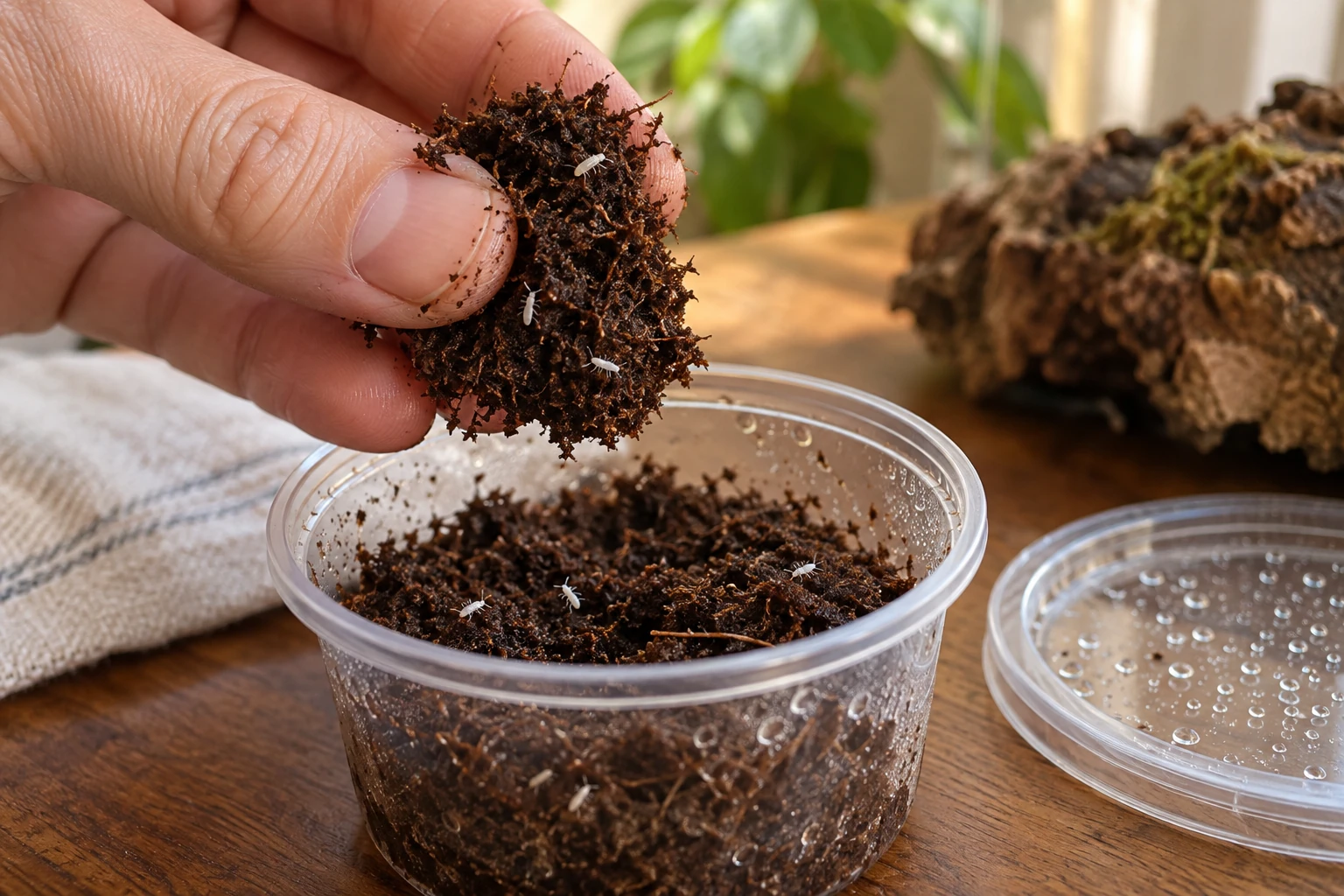
A quick squeeze tells you more
Look for damp substrate that holds its shape without releasing water, and adjust airflow when moisture pools.
Why we are not giving you a percentage
We looked for a real number. Across every springtail species we stock, we could not find a published relative-humidity requirement for a single one of them. Plenty of care sheets quote a range, and those ranges are usually reasonable, but they trace back to other care sheets rather than to anyone who measured it. We would rather tell you that than repeat a figure and dress it up as fact.
There is a practical reason the number would not help you much anyway. A cheap hygrometer is built and calibrated for a room, not for a few cubic inches of air trapped over damp substrate in a sealed cup. Put one in a culture and the reading drifts, lags, and often just pins near the top of the scale. So even a keeper who wants to hit a target has no reliable way to measure whether they hit it.
The squeeze test beats a gauge
The method most keepers actually rely on day to day is not a hygrometer at all, it is a quick look and a squeeze. Substrate at the right moisture level looks slightly glistening and dark, clumps together when you press a small amount in your hand, and holds that shape without dripping water when you let go.
If it crumbles apart dry, it needs more water. If it releases visible water when squeezed, or if you see standing water pooled anywhere in the container, it is too wet and needs to dry out a bit, ideally with the lid cracked for airflow rather than adding anything. This tactile check takes five seconds and does not need batteries.
Reading the condensation on the lid
Condensation is a useful free indicator, once you know what normal looks like. A light, even fog or a scatter of small droplets on the inside of the lid is normal and actually a good sign that humidity is holding steady inside a sealed or mostly sealed container.
Heavy condensation, meaning droplets big enough to run down the lid and pool at the edges, is a sign the culture is too wet and needs more airflow, either by cracking the lid or adding a small vent. No condensation at all, especially in a container that should be humid, usually means it has dried out and needs attention right away.
If you do use a hygrometer, placement matters
A hygrometer can still be a useful sanity check, especially for a larger bin, but where you put the probe changes the reading more than most people expect. A probe sitting in open air above the substrate reads differently than one resting directly on or just under the surface, where the actual humidity that matters to the springtails lives.
For the most useful reading, place the probe close to the substrate surface rather than up near the lid, and give it a few minutes to stabilize before trusting the number. Compare readings over time from the same spot rather than chasing an exact percentage, since consistency matters more than precision here.
Sealed versus vented: the tradeoff
A fully sealed cup holds humidity well with little effort, but it also traps carbon dioxide and stale air, which can stress a dense culture over time and is part of why some keepers see better long term production with a small vent added. A vented container breathes better but dries out faster and needs more frequent checking and misting.
Neither setup is wrong, and both work well on our farm depending on the culture. What matters most is knowing which tradeoff you picked: sealed means watch for staleness and condensation, vented means watch for dry out more often. Total dry out, not overwatering, is still the number one culture killer either way.
Charcoal versus substrate: which holds moisture better
A charcoal culture, built on rinsed horticultural charcoal with a shallow layer of water in the bottom, holds a very consistent, high humidity right at the surface where the springtails live, which is part of why it is a popular method for keepers who want predictable moisture with less guesswork.
A substrate culture, built on moist coco fiber or bioactive soil, holds moisture a little less evenly since it depends on how thoroughly the substrate was dampened, but it feels more natural and doubles as a base you can transplant straight into a bioactive setup. Both methods work well, they just get there differently, and in both cases you judge them the same way: by how the medium looks and feels rather than by a number. Our springtail culture care guide walks through building either one from scratch.
Keep reading: Arid Springtails: The 3 Species That Handle Dry Setups Best
The Culture Moisture Kit
The media that hold moisture steady, so you never have to guess at a number.
Frequently asked questions
What humidity do springtails need?
There is no published relative-humidity requirement for any springtail species in the hobby trade, so any specific percentage you see quoted is convention rather than measured science. What matters in practice is substrate moisture: damp enough that it holds its shape when squeezed but releases no water, and never allowed to dry out completely. Our live springtail care guide covers full setup.
How can I tell if my springtail culture is too dry?
Substrate that looks pale, feels crumbly, and will not clump together when squeezed is too dry. Total dry out is the single most common way a springtail culture dies, so check this more often than you check a hygrometer.
Are hygrometers accurate in a small springtail culture container?
Not always. Cheap consumer hygrometers are built for room sized spaces, and readings inside a small, mostly sealed cup can drift. Use a hygrometer as a rough sanity check, not an exact measurement, and rely on the squeeze test day to day.
Is condensation on the lid bad for a springtail culture?
A light, even fog or small scattered droplets is normal and a good sign. Heavy condensation that runs and pools means the culture is too wet and needs more airflow. See our springtail culture troubleshooting guide for more signs to watch for.
Should I keep a springtail culture sealed or vented?
Either works. A sealed container holds humidity with less effort but can trap stale air, while a vented one breathes better but dries out faster and needs more frequent checking. Total dry out is the bigger risk either way.
Does mold mean a springtail culture is too humid?
Not necessarily. Mold is usually tied to overfeeding more than humidity alone. See our do springtails eat mold guide for how to tell the difference and what springtails actually clean up.
Keep learning
Have a care question? Ask our community.
Join Reptile Keepers USA, our free Facebook group for reptile, amphibian and invert keepers. Share your setups, get care help and swap feeder tips.
Join the free group