Live Foods for Aquarium Fish
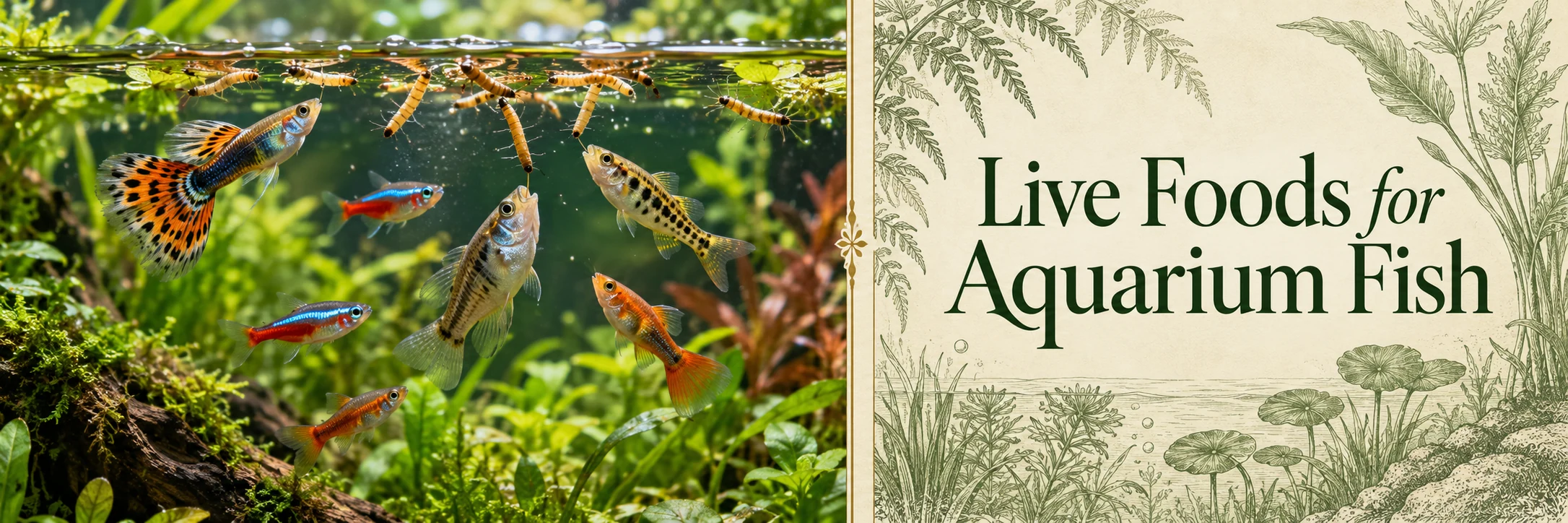
Most aquarium fish will take live insects, and three feeders cover almost every tank: flightless fruit flies (Drosophila) for bettas, killifish, hatchetfish, and other surface feeders under about 3 inches; black soldier fly larvae for mid-size fish from 3 to 8 inches such as cichlids, gouramis, and larger barbs; and small mealworms or superworm pieces for oscars, arowanas, and other big predators. Live insects trigger the feeding response that pellets do not, put weight on picky and breeding fish, and cost little because a fruit fly culture or a cup of BSFL lasts weeks. This guide matches insect to fish size, gives portion rules, and covers the two mistakes, overfeeding and wrong size, that foul tanks.
Bettas, killifish, hatchetfish, small tetras and rasboras
Cichlids, gouramis, larger barbs, 3 to 8 inches
Oscars, arowanas, large catfish; feed as a treat
Why live insects work in an aquarium
Nearly every aquarium fish is an opportunistic insect eater in the wild; bettas, killifish, and hatchetfish are built to snap insects off the surface, and cichlids and catfish take anything that falls in. A live insect moving on the water triggers a strike that flake food never does, which is why breeders use live foods to condition pairs, why a betta that ignores pellets will hit a fruit fly, and why live insects are the standard fix for a fish that has stopped eating after a move. Insects also carry protein and fat in a form fish digest easily, and a small amount goes a long way.
The advantage of terrestrial feeders over the classic aquarium live foods, such as blackworms or brine shrimp, is that they do not need a tank of their own. A fruit fly culture sits on a shelf and produces for weeks, a cup of BSFL keeps in the refrigerator, and neither introduces water from another tank. Our fruit fly culture guide covers keeping the flies; the rest of this post is about the fish.
Fruit flies for bettas, killifish, and surface feeders
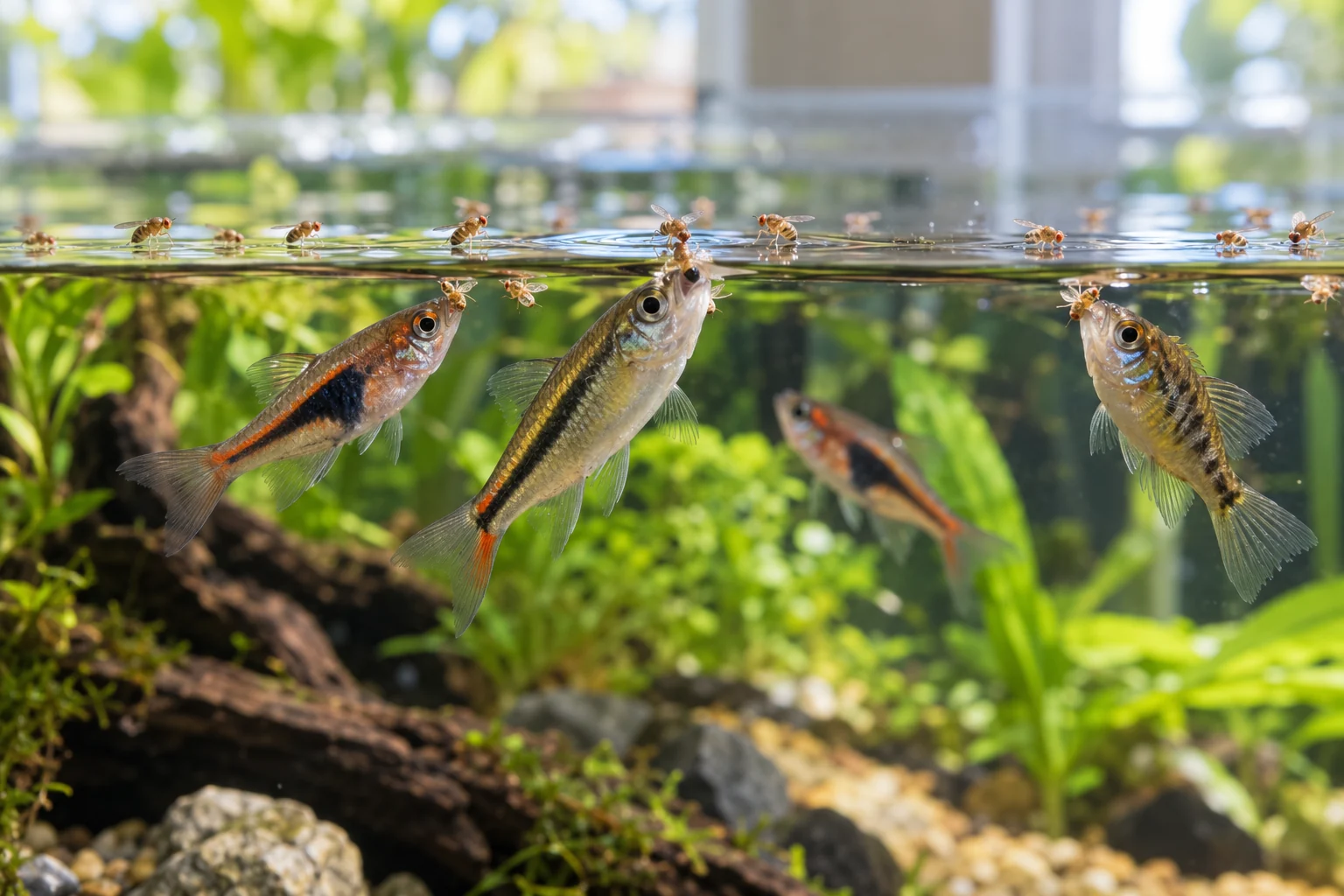
Flightless fruit flies are the best live food for any fish under about 3 inches that feeds at the surface. Tap a few flies onto the water and they float and kick, and a betta, a killifish, a hatchetfish, or a school of small tetras will pick them off within seconds. Melanogaster, the smaller species at about 3 mm, suits bettas, small tetras, rasboras, and fry that have outgrown baby foods. Hydei, about 3.5 to 4 mm and much bulkier, suits larger killifish, gouramis, and hatchetfish. Flightless strains cannot fly, so a fly that misses the water walks on the glass instead of loose in the house.
Portion rule: as many flies as the fish clear from the surface in about 2 minutes, once a day or a few times a week as a supplement to a staple diet. Uneaten flies drown and foul the water, so start with a pinch and increase. A single 32 oz fruit fly culture feeds a betta or a small tank for weeks, and keeping two cups going means a steady supply. Dart frog keepers use the exact same cultures, and flightless versus wingless explains which mutation to pick.
BSFL for cichlids, gouramis, and mid-size fish
Black soldier fly larvae are the workhorse for fish from about 3 to 8 inches. They are soft-bodied, half an inch to three quarters of an inch long, naturally high in calcium, and they sink slowly and wriggle, which cichlids, gouramis, larger barbs, rainbowfish, and medium catfish take eagerly. Feed them whole to fish with mouths large enough to take them, or cut them for smaller fish. They are also a good conditioning food for breeding pairs because of the fat and protein.
Portion rule: one or two larvae per mid-size fish a few times a week, or as many as the tank clears in a couple of minutes. Remove any that sink uneaten to the gravel, because a dead larva rots fast in warm water. BSFL keep for a few weeks in the refrigerator and need no food, so a cup of small or medium BSFL lasts a community tank a month. Do not let them get warm and dry, or they pupate into harmless but pointless flies.
Mealworms and superworms for big predators
Oscars, arowanas, large cichlids, bichirs, and big catfish take mealworms whole and superworms whole or in pieces, and they will strike the moment a worm hits the water. Mealworms float briefly, then sink, which suits mid-water and bottom predators. They are richer in fat than BSFL and lower in calcium, so they are a treat and a conditioning food rather than a staple; a few per feeding, two or three times a week, alongside a quality pellet is the usual pattern.
Superworms are large and tough-skinned, and they can bite, so for anything but a large predator cut them into pieces or stick with mealworms. Never feed a superworm to a fish that cannot swallow it whole in one strike. Mealworms keep for months refrigerated in bran, so a cup of large mealworms covers a season of oscar treats; the feeder insect size chart is a useful sanity check for mouth size, and the same rules apply to a fish as to a lizard.
Feeding technique and tank hygiene
Feed live insects in a corner away from the filter intake so they are not pulled in before the fish reach them, and feed at the front so you can see what is eaten. For fruit flies, tap the culture cup over the water or use a small spoon; for larvae and worms, drop them one or two at a time. Watch for a minute after each feeding and net out anything the fish ignore. A surface skimmer or a floating ring keeps flies in one spot for a betta that hunts slowly.
The two problems live insects cause are both the keeper's doing. Overfeeding: a dozen drowned fruit flies or three uneaten BSFL rotting in the gravel raise ammonia in a small tank overnight, so feed less than you think and clean up. Wrong size: a fly too small to notice or a worm too big to swallow is either wasted or dangerous. Match the insect to the fish, start small, and treat live insects as the supplement that makes the staple diet work, not the whole diet.
Keeping a live-food supply for a fish room
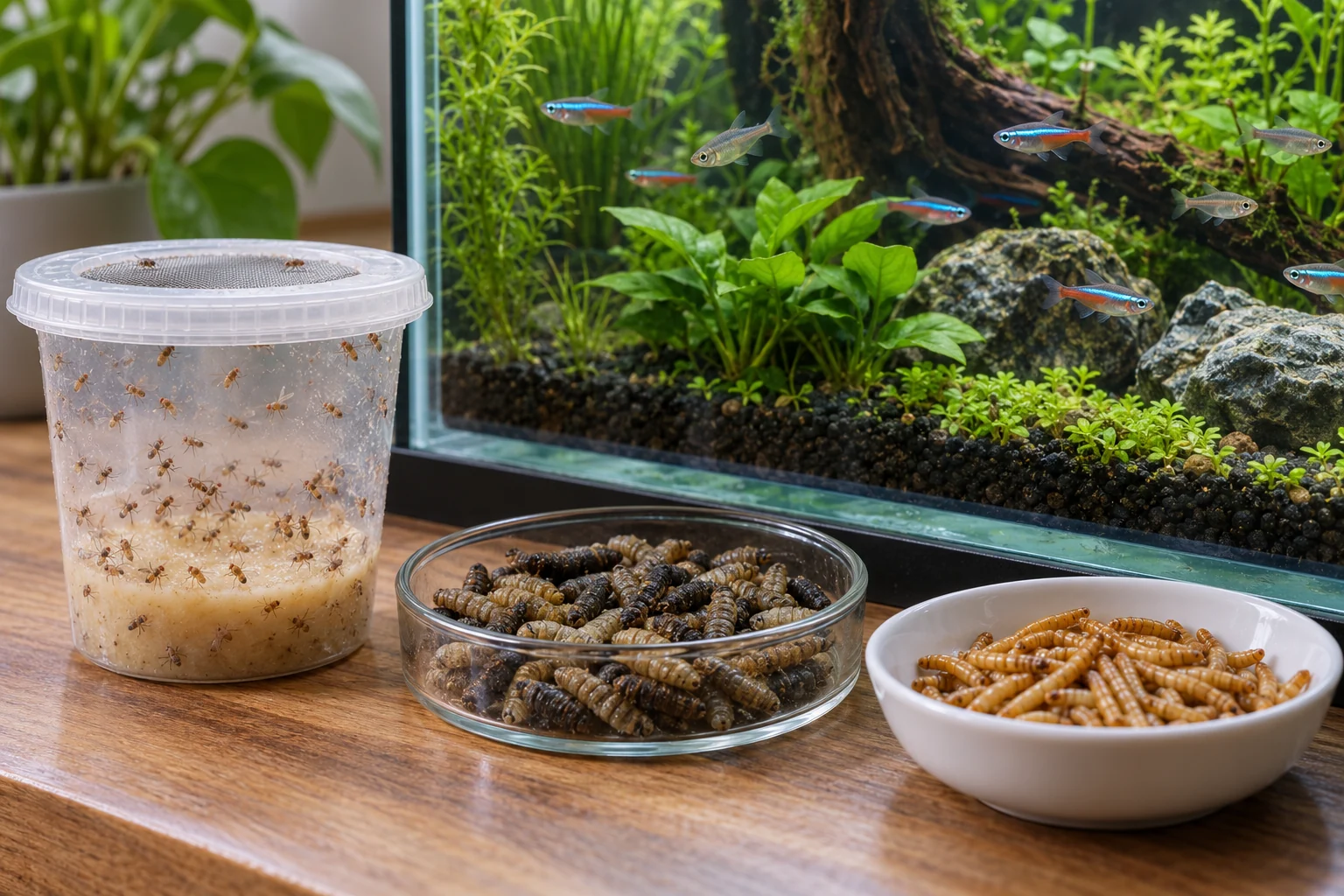
For one tank, a single fruit fly culture and a cup of BSFL in the refrigerator is plenty. For a fish room or a breeder conditioning several pairs, keep two fruit fly cultures staggered two weeks apart so one is always producing, a cup of BSFL on a biweekly order, and a cup of mealworms in bran in the refrigerator for the big fish. A culture kit with media lets you restart fly cups from your own flies for a few cents each, which is what dart frog and betta breeders both end up doing.
None of these insects need a tank, a heater, or an aerator, which is what makes them a better fit than aquatic live foods for most hobbyists. Keep them cool, keep them dry, feed the fish a little at a time, and a live-food routine that used to mean a smelly blackworm bin becomes a cup on a shelf. For pond fish, the BSFL rule scales up, and we cover that separately in BSFL for koi and pond fish.
Keep reading: Feeder Insects for Hermit Crabs: Protein Nights With Mealworms and BSFL
The Aquarium Live-Food Kit
A fruit fly culture for surface feeders, BSFL for the mid-size fish, and mealworms for the predators, all shelf-kept.
Frequently Asked Questions
Written by the TC INSECTS breeding team · Porter, Texas · Live Arrival Guarantee on every order
Have a care question? Ask our community.
Join Reptile Keepers USA, our free Facebook group for reptile, amphibian and invert keepers. Share your setups, get care help and swap feeder tips.
Join the free group