Silkworms in the Classroom: A Teacher's Guide to a 6-Week Unit
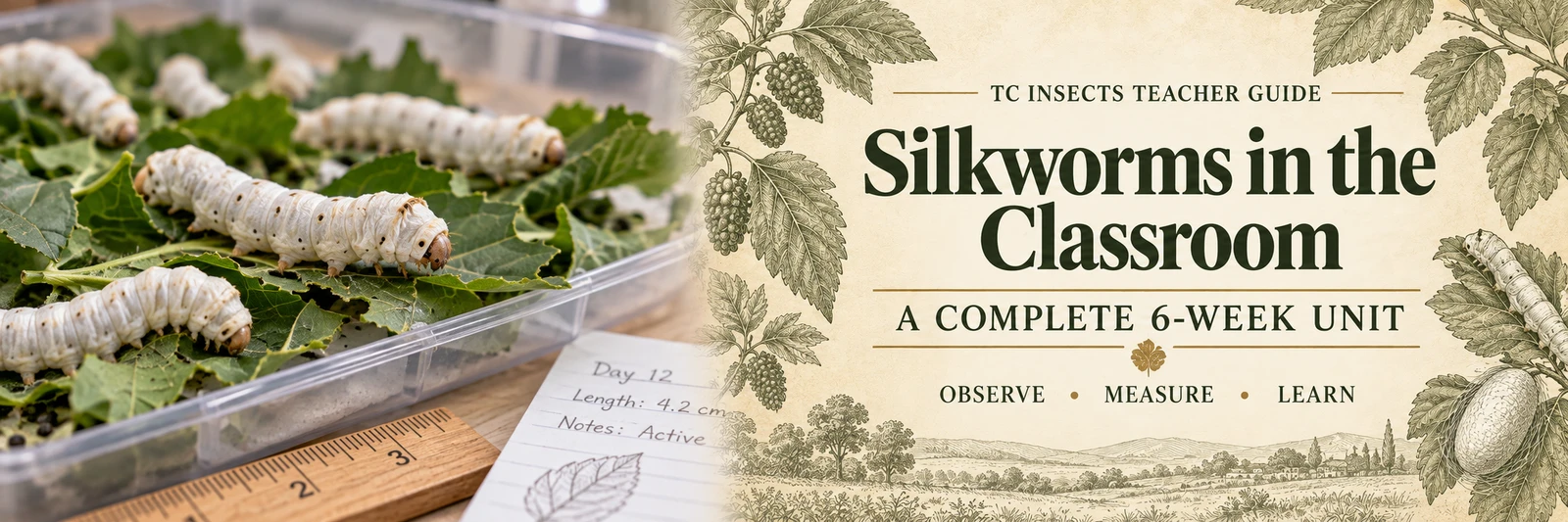
Enough for losses and moths of both sexes at the end
From small worms to moths; add 1 week if starting from eggs
A dry, cool room and a full box of chow carries them to Monday
Silkworms in the Classroom
Silkworms (Bombyx mori) are one of the best classroom animals in the country because a class can watch a complete life cycle, egg to caterpillar to cocoon to moth to egg, in about 6 weeks, with no soil, no water dish, no heat lamp, and no bites. Order about 2 to 4 small silkworms per student, keep the room near 75 to 82 F, feed mulberry chow or leaves every school day, and the calendar does the teaching. This guide covers how many to order and when, the daily jobs students can own, what to do about weekends, how to line the stages up with your standards, and how to finish the unit without a box of unwanted eggs.
A Unit Students Can Own
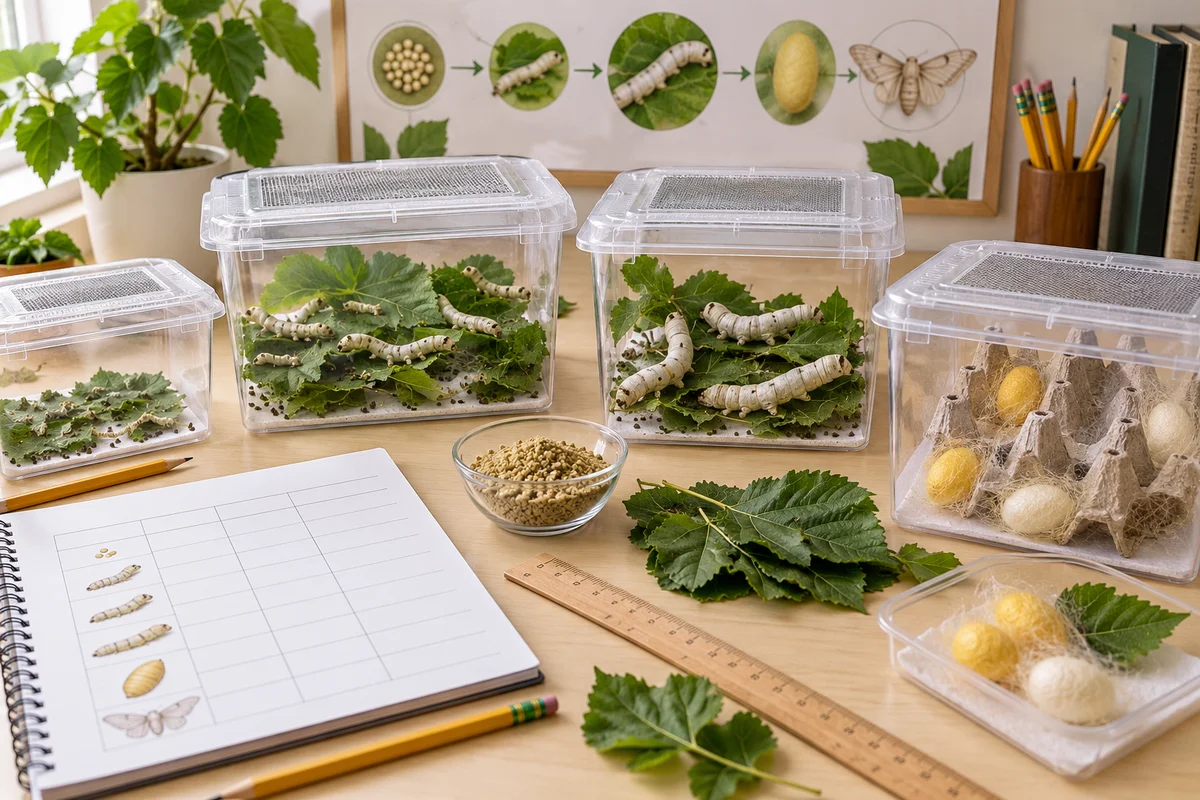
A simple setup turns daily care into observation, measurement and a complete metamorphosis lesson.
Split worms across five or six labeled group containers.
Rotate feeder, cleaner and recorder jobs.
Keep the setup dry, clean and ventilated.
Why Silkworms Beat Most Classroom Animals
Made for a School Schedule
A classroom animal has to survive a school schedule, be safe for every student, and actually teach something. Silkworms check all three. They live in a lidded plastic box on a paper towel, they eat one food that comes in a bag, and the entire life cycle fits inside a standard grading period. They cannot bite or sting, they do not smell, and a student with an insect phobia can watch from across the room while a student who loves them can hold one. When the unit ends, there is no permanent pet to rehome, only cocoons, moths, and a paper of eggs.
A Complete Metamorphosis Students Can See
The teaching payoff is a complete metamorphosis students can see rather than read about: four molts they can find the shed skins from, a caterpillar that grows about 25 times its hatching length, a cocoon spun from a single thread, and a moth that lays the eggs for next year's class. It also connects to a real industry with 5,000 years of history, which gives the unit a social studies and economics hook that a butterfly kit does not. If you have run isopods in the classroom, silkworms are the natural next unit: same low-fuss setup, a very different animal.
How Many Silkworms to Order, and What Size
Plan 2 to 4 Per Student
Plan on 2 to 4 silkworms per student, ordered as small (half-inch) worms unless you specifically want the egg-hatching week. For a class of 25, that is 50 to 100 worms split across 5 or 6 containers so every table owns a box. Losses of a few worms in the first week are normal even in a well-run room, and you want enough moths at the end that every group sees a male and a female.
Match the Size to Your Calendar
Size sets your calendar. Small half-inch silkworms give you roughly 3 to 4 weeks of visible growth before the cocoon, which is the right length for most units. Medium one-inch worms reach the cocoon in about 2 weeks and suit a shortened unit or a late start after a break. Eggs add a week and a fiddly first day of grated food; if you want students to see hatching, read how to hatch silkworm eggs and order a week earlier than you think you need to. Buy one 32 oz cup of pre-made silkworm chow per 25 to 30 worms for the full run, plus one spare cup, because a class that runs out of food in week four has nowhere to buy more that afternoon.
The Classroom Setup, and Jobs Students Can Own
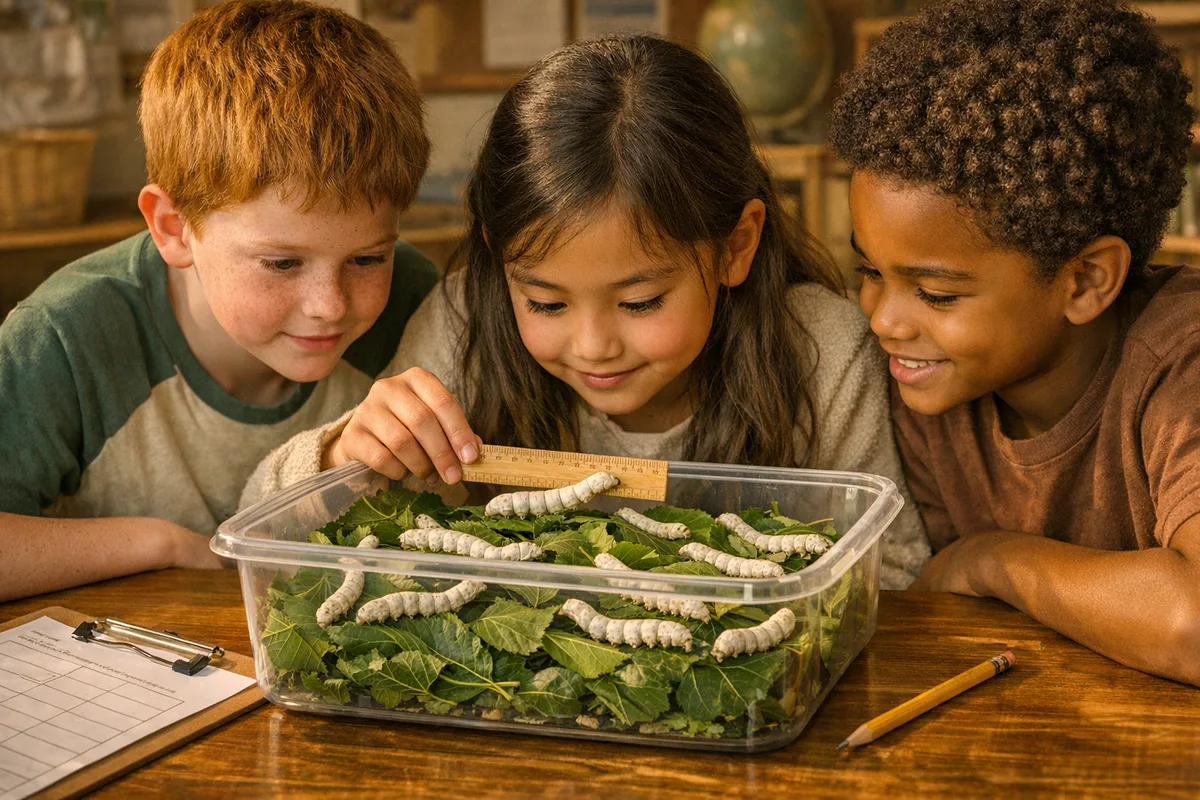
Each container is a clear plastic shoebox or a 32 oz deli cup with a ventilated lid, a paper towel on the floor, and nothing else. Label each box with the group name and the arrival date. Keep the boxes away from the window and the air conditioner vent, in the warmest steady spot in the room; silkworms stall in the 60s F and thrive in the upper 70s. There is no need for a heat source in a normal classroom, and a desk lamp aimed at a box will cook it.
Silkworm care is a five-minute routine, which makes it perfect for rotating student jobs. The feeder adds fresh chow strips or leaves at the start of the day. The cleaner lifts old food and droppings out with a plastic fork and swaps the paper towel when it is soiled. The recorder measures a worm against a ruler, counts the group's worms, and notes any molts (a motionless worm with its head raised is molting, not sick). A weekly photo of the same box on the same ruler becomes the growth chart at the end. Post the two rules that matter on the lid: no water in the box, and wash hands before touching the food.
A Week-by-Week Lesson Plan
The timeline below assumes small worms arriving on a Monday in a room near 78 F. Cooler rooms add days; build a week of slack into the calendar before any hard deadline like a science fair.

Week 1: Arrival, Setup, and Observation Skills
Unbox on arrival, split the worms into group containers, and feed lightly. Teach the observation routine: length in millimeters, color, behavior. Introduce the vocabulary of complete metamorphosis (egg, larva, pupa, adult) and the word instar for each stage between molts. The silkworm care sheet is a good one-page handout.
Weeks 2 and 3: Growth and Molting
Worms double in size between molts, and shed skins appear in the box. Have students graph length over time, predict the next molt, and compare groups. This is the week for the classic experiment: one box on leaves, one on chow, same count, same room, and a growth comparison at the end. Feeding demand climbs fast in week 3; check that food never runs out overnight.
Week 4: The Spinning Week
Worms turn translucent yellow, stop eating, and wander. Add egg-carton sections or paper tubes and watch the spinning, which takes 2 to 3 days per worm and happens at different times across the box. Silk is the science lesson here: one continuous thread, how it is unwound commercially, why the fiber is strong. Keep one finished cocoon aside for a reeling demonstration in hot water.
Weeks 5 and 6: Moths, Mating, and Eggs
Moths emerge 10 to 14 days after spinning. Students can sex them (females larger and rounder, males slimmer and constantly fanning), watch the mating pairs, and count eggs laid on paper. The moths do not eat and live roughly a week, which opens an honest conversation about life span and energy budgets. End with the eggs: what they need to hatch, and what the class will do with them, which is covered in what happens after the cocoon.
Weekends, Breaks, and the Substitute Teacher
Friday to Monday
Silkworms can go from Friday afternoon to Monday morning without harm if you feed heavily on Friday, clean the box first so old food does not mold, and leave the room at a normal temperature. Do not seal the lids or add extra chow to a damp box; a dry box with plenty of firm chow is the goal. A three-day weekend is fine in weeks 1 through 3. In the heavy-eating fourth stage and fifth stage, a worm can strip a box in a day, so a long weekend late in the unit is the one time it pays to send a box home with a reliable student or take one home yourself.
Long Breaks and Substitute Notes
For a week-long break, do not try to stretch the worms. Time the order so the break lands during the cocoon stage, when nothing needs feeding, or after the moths have laid eggs, when the eggs can sit dry and cool in an envelope. Leave the substitute a two-line note: feed once, remove old food, no water. It is genuinely that simple, and a substitute who follows it will not lose a single worm.
Ending the Unit: Eggs, Moths, and What Not to Do
Plan the Ending Before You Start
Every class ends with hundreds of eggs and a handful of dead moths, so decide the ending before you start. Dead moths can be pinned for a display or simply composted. Egg papers go into a labeled zip bag in a refrigerator if you want to hatch them next year; most feeder strains need that cold rest, and they keep for months. Sending egg papers home with students is a popular option, with the care sheet stapled on, and a paragraph to parents explaining that the eggs need a warm room and mulberry chow to hatch.
Two Things Not to Do
Two things not to do. Do not release silkworms or moths outdoors; domestic silkworms cannot survive in the wild, and moths cannot fly, so release is not a kindness. And do not try to keep a permanent silkworm colony going in the classroom over the summer; unlike an isopod or mealworm culture, silkworms must be restarted from eggs each generation and fed daily. For a self-running classroom culture that survives June to August, the mealworm life cycle is the better fit. Silkworms are the six-week showpiece, and they are worth every minute of it.
Keep reading: Back-to-School Classroom Insect Kits: Four Units by Grade and Lesson Length
The Classroom Silkworm Kit
Sized for one class: small silkworms for the full 4-week growth watch, chow to feed them, and cups so every group owns a box.
Frequently Asked Questions
How many silkworms do I need for a class of 25?+
Order 50 to 100 small silkworms, which is 2 to 4 per student, and split them across 5 or 6 group containers. That covers the few losses that are normal in week one and guarantees moths of both sexes at the end so every group can watch mating and egg-laying.
Can silkworms survive a weekend in the classroom?+
Yes. Clean the box on Friday, feed heavily with firm chow or dry leaves, keep the lid ventilated, and leave the room at its normal temperature. Small worms easily go Friday to Monday. In the last two growth stages they eat much faster, so send a box home over a long weekend late in the unit.
What temperature does a classroom need for silkworms?+
Aim for the upper 70s F. Silkworms grow well between about 75 and 82 F, slow down in the 60s, and stall below that. A normal classroom away from a window or vent is fine, and you should not add a lamp or heat mat, which dries the box and cooks the worms.
Are silkworms safe for students to handle?+
Yes. Silkworms cannot bite or sting, are not toxic, and tolerate gentle handling with clean, dry hands. The rules that protect the worms rather than the students are to wash hands first, because lotion and soap residue can harm them, and to hold them over the box so a drop is short.
What should I do with silkworm eggs at the end of the unit?+
Let the moths lay on paper, then keep the egg papers in a labeled zip bag in the refrigerator. Most strains need that cold rest and will keep for months, ready for next year's class. You can also send egg papers home with students along with the care sheet. Never release silkworms or moths outdoors.
Which is better for a classroom, silkworms or mealworms?+
Silkworms are the better showpiece: a full metamorphosis in about 6 weeks, a cocoon, silk, and a moth that lays eggs. Mealworms are the better low-maintenance culture because they forgive a skipped feeding and keep going all year in a bin of bran. Many teachers run silkworms as the unit and keep mealworms as the year-round classroom culture.
Continue With Confidence
Have a care question? Ask our community.
Join Reptile Keepers USA, our free Facebook group for reptile, amphibian and invert keepers. Share your setups, get care help and swap feeder tips.
Join the free group