
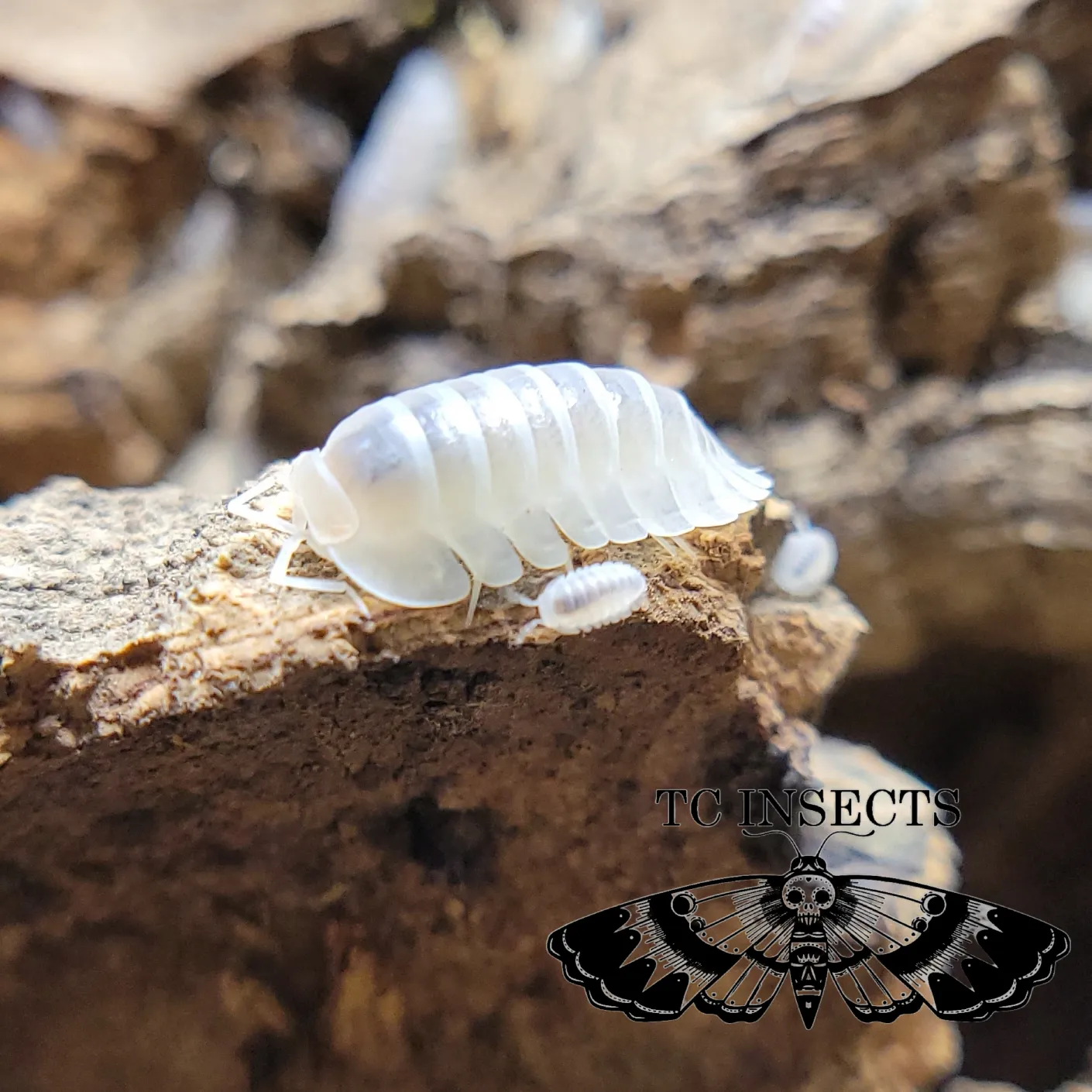
Nesodillo arcangelii Yeti Isopods for Sale
First, TC INSECTS ships Nesodillo arcangelii “Yeti” as a live captive-bred starter culture. Specifically, this is the albino variant of the popular “Shiro Utsuri” isopod. Additionally, the species was described by Karl Wilhelm
Verhoeff in 1928. As a result, this is a documented Asian tropical isopod with formal taxonomic history.
Furthermore, this species sits in the family Armadillidae, not the family Armadillidiidae. Specifically, Armadillidiidae includes genus Armadillidium (such as our Wild Type vulgare). In contrast, Armadillidae includes genus
Nesodillo. Therefore, the Yeti is in a related but distinct family from most of our other catalog rolling isopods.
Overview
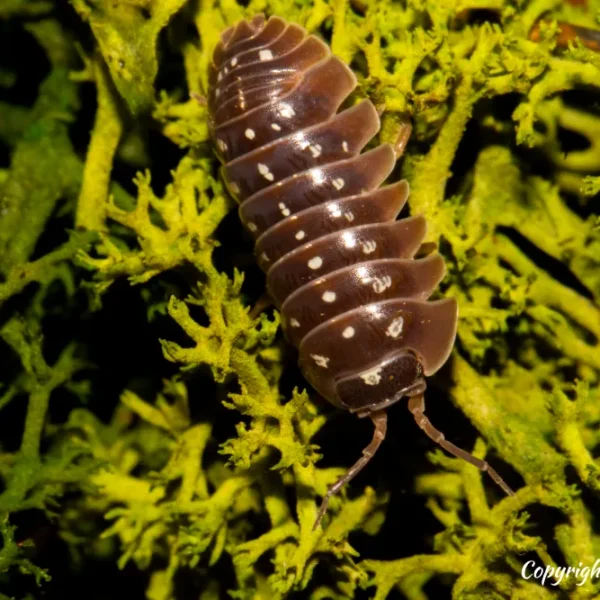
First, the Yeti is the albino color variant of the Shiro Utsuri morph. Specifically, Shiro Utsuri is named after the Japanese koi fish pattern with the same name. Additionally, “Shiro Utsuri” translates from Japanese as “white
pattern,” referring to the black-and-white koi color scheme. Furthermore, the Shiro Utsuri isopod shows a white body with scattered black blotches. As a result, the Yeti removes the black blotches entirely.
The Yeti’s body is semi-translucent, including the eyes. Specifically, the all-white coloration with translucent body lets light pass through the exoskeleton. Additionally, the darker area visible in the center of the body is the
digestive tract. As a result, when these isopods eat brightly colored food like carrot, the orange color shows through the body as it moves through the digestive system.
Why Keep Nesodillo arcangelii “Yeti”?
- Striking semi-translucent white display: First, the all-white body with translucent exoskeleton creates an unusual display animal. Specifically, the body’s interior remains partially visible through the shell.
- Visible digestive activity: Additionally, brightly colored food shows through the body as the animal digests. As a result, the colony’s diet becomes part of the display.
- Beginner-friendly: Furthermore, the species is easy to keep once high humidity is established. Therefore, this is a strong choice for keepers stepping up from common cleanup crew species.
- Prolific once established: Specifically, the species breeds readily in stable high-humidity conditions. As a result, a starter culture grows steadily into a productive colony.
- Different taxonomic family: Finally, this is one of the few Armadillidae family species in our catalog. Therefore, this adds taxonomic diversity to a multi-species collection.
Honest Note: Different Taxonomic Family from Armadillidium
First, Nesodillo arcangelii belongs to the family Armadillidae. Specifically, this family was established by Brandt in 1833 and includes genus Nesodillo, Cubaris, and several other tropical rolling isopod genera. In contrast,
our Armadillidium species (vulgare, maculatum, klugii, granulatum, etc.) belong to the family Armadillidiidae. Therefore, the two families are related but distinct.
However, both families share the family-defining ability to conglobate fully into a sphere when disturbed. Specifically, both families produce “true pillbug” defensive rolling. As a result, husbandry practices transfer
reasonably well between the two families. Furthermore, the main practical difference between them is the geographic origin: Armadillidiidae lines mostly come from Europe and the Mediterranean; Armadillidae lines
mostly come from tropical Asia, Pacific, Caribbean, and Latin America.
Therefore, the Yeti’s care framework follows the tropical-humid model rather than the Mediterranean dry-gradient model. Specifically, this is a meaningful change from the standard Armadillidium husbandry. As a result,
do not treat the Yeti like a standard pillbug from a European setup.
Honest Note: Albino Variant of the Shiro Utsuri Morph
First, the Yeti is documented as the albino variant of the Shiro Utsuri morph. Specifically, the wild-type Shiro Utsuri shows a white body with scattered black blotches. In contrast, the Yeti removes the black entirely,
producing an all-white body with translucent exoskeleton. As a result, the Yeti’s white expression is more complete than the Shiro Utsuri’s contrast pattern.
This connects to our catalog’s true albinism set. Specifically, our T- Albino vulgare page covers tyrosinase-negative true albinism with the formal T- designation. Additionally, the Yeti’s visual signature (all-white body
including eyes) matches the T- pattern. However, the specific genetic mechanism behind the Yeti’s albinism has not been formally identified in peer-reviewed literature for Nesodillo. Therefore, treat the Yeti as visually true albinism rather than confirmed tyrosinase-negative.
Furthermore, the Yeti’s hobby designation does not use the formal T- nomenclature. Specifically, the hobby just calls this animal “Yeti.” In contrast, our T- Albino vulgare uses the formal genetic-mechanism naming.
Therefore, the Yeti and T- Albino represent the same visual pattern documented in different species under different naming conventions.
Honest Note: Visible Digestive Tract Through Translucent Body
First, the Yeti’s semi-translucent body lets the digestive tract show through. Specifically, the darker area visible in the body’s center is the gut. Additionally, brightly colored food produces a visible color shift inside the body
as it moves through the digestive system. As a result, orange food like carrot can appear as a clearly orange band moving through the otherwise white body.
Therefore, this is a genuine display feature beyond the static color. Specifically, the colony’s diet becomes visible. Furthermore, this is unusual among isopods. As a result, the species provides a different kind of display value
compared to standard fixed-color morphs.
In practical terms, this also means the animal’s health and feeding state are readily visible. Specifically, you can see whether the gut is full or empty. Additionally, an opaque or discolored gut may suggest a feeding or
husbandry issue worth investigating. As a result, the visible biology gives keepers a useful health-monitoring feature.
Honest Note: High-Humidity Tropical Husbandry, Not Mediterranean Dry-Gradient
First, this species requires consistently high humidity. Specifically, 75% or higher across the entire enclosure is the documented target. Additionally, the species does not tolerate drying out. In contrast, our standard
Armadillidium pages (Wild Type vulgare, Wild Type Zebra, Dubrovnik Clown) all use a Mediterranean dry-to-moist gradient approach.
Therefore, do not apply the Mediterranean gradient framework to this species. Specifically, a fully damp enclosure works better here. Furthermore, cork bark cover helps retain humidity and reduces the frequency of
misting. As a result, the Yeti husbandry framework differs meaningfully from the conversation’s standard Armadillidium framework.
However, ventilation still matters. Specifically, sealed wet conditions cause mold and stagnation problems even at high humidity. Therefore, balance moisture retention with active airflow. In particular, a gasket-sealed bin
with deliberate ventilation holes is the documented hobby setup.
Honest Note: Taiwan Native Range
First, the species is documented as native to Taiwan. Specifically, this is the type locality and the primary documented wild range. However, secondary hobby sources describe the species as occurring across “various Asia
and Pacific regions.” As a result, treat Taiwan as the documented type locality with broader regional populations acknowledged but less formally mapped.
Furthermore, this is the first East Asian species in the catalog. Specifically, our other catalog isopods originate from Mediterranean Europe, the Caribbean, the Philippines, and Vietnam. As a result, the Yeti adds Asian
Pacific tropical origin to the catalog’s geographic range. Therefore, this is a meaningful addition for collectors building a geographically diverse set.
Care and Setup
Generally, the Yeti follows the high-humidity tropical isopod framework. Specifically, the same general approach used for Cubaris species works here too. Additionally, the species is easier than most tropical Cubaris because of its broader tolerance and prolific breeding. Therefore, this is a reasonable first tropical isopod for keepers stepping up from Mediterranean Armadillidium.
Temperature
First, target 72 to 80°F for steady activity. Specifically, the species reproduces more readily at the warmer end of the range. Additionally, normal indoor temperatures work fine if your home runs warm. However, avoid sustained cool conditions below 68°F.
Humidity
First, target consistent 75%+ humidity across the enclosure. Specifically, a fully damp setup with no dry retreat works better than a gradient. Additionally, the species does not tolerate any drying out. Therefore, monitor moisture carefully and mist as needed. As a result, undersized humidity is the most common Yeti husbandry mistake.
Substrate
First, use 2 to 4 inches of moisture-holding substrate. Specifically, a mix of organic topsoil, rotted hardwood, and sphagnum moss works well. Then add a deep layer of TC INSECTS Assorted Hardwood Leaf Litter on top. Furthermore, cork bark cover helps retain humidity between mistings.
Food
First, lead with leaf litter and decaying hardwood as the base diet. Then supplement with TC INSECTS Isopod Food for added protein and minerals. Additionally, add a calcium source like TC Calcium Ultra Fine. Furthermore, this species accepts vegetables, occasional protein from dried shrimp or fish flakes, and fruits like banana or apple slices.
Ventilation
First, balance airflow with moisture retention. Specifically, a gasket-sealed bin with deliberate ventilation holes is the documented hobby setup. As a result, the enclosure stays humid without becoming stagnant. Therefore, avoid both fully sealed setups and fully open setups.
Bioactive Use
Generally, the Yeti works very well in high-humidity bioactive enclosures. Specifically, the species’ moisture preferences match tropical vivarium setups for many amphibians and tropical reptiles. However, run a backup culture in a dedicated bin first to protect the genetics. Furthermore, the species’ bright white color reads strongly against dark substrate in display tanks.
Breeding Notes
First, the Yeti breeds readily once established. Specifically, prolific reproduction is documented across multiple hobby sources. Additionally, the species reproduces more readily at warmer temperatures. As a result, target 75 to 80°F for active breeding.
Furthermore, females carry developing mancae in a brood pouch. Specifically, newly emerged mancae may be even paler than adults. Additionally, the all-white color carries through development from the start. As a result, you can spot juveniles by their small size rather than by color contrast.
In particular, keep the Yeti separate from the wild-type Shiro Utsuri stock. Specifically, cross-breeding would reintroduce dominant pigmentation and dilute the Yeti’s all-white expression. As a result, dedicated bins preserve the morph identity across generations.
Best For
- High-humidity tropical display vivariums where bright white color reads strongly against dark substrate
- Beginner-friendly first tropical isopod for keepers stepping up from common cleanup crew species
- Bioactive setups for tropical amphibians and reptiles with matching humidity needs
- Keepers building cross-family isopod catalogs across Armadillidiidae and Armadillidae
- Collectors interested in albino color variants with visible digestive activity
- Feeder use for carnivorous plants and other niche feeding applications (per documented customer use)
Not Best For
- Dry Mediterranean-style setups suited to Armadillidium species, since this species needs consistent high humidity
- Setups that run cool below 68°F sustained, since this is a tropical species
- Cross-cultures with wild-type Shiro Utsuri stock, since this dilutes the Yeti morph
- Buyers expecting Mediterranean dry-gradient care framework
- Bioactive setups with strong ventilation that would dry the enclosure between mistings
Origin and Taxonomic Notes
First, the species Nesodillo arcangelii was described by Karl Wilhelm Verhoeff in 1928. Specifically, the species name honors the Italian zoologist Alceste Arcangeli. Additionally, the genus Nesodillo was established by Verhoeff in 1926, with type specimen N. sarasini from New Caledonia. Therefore, the genus has Pacific origins.
Furthermore, the species is documented as native to Taiwan. Specifically, secondary hobby sources also describe broader Asian Pacific occurrence. However, Taiwan is the most specific documented native range. As a result, treat Taiwan as the type locality.
Additionally, the species was previously traded under the Cubaris sp. designation. Specifically, the line circulated in the hobby as Cubaris before the proper Nesodillo classification became established. As a result, older hobby records may still use the Cubaris name. However, this is the same species under its outdated genus assignment.
Receiving and Acclimation
First, open your package promptly when it arrives. Then inspect the cup calmly before moving anything. Specifically, the Yeti’s all-white body is easy to spot against shipping moss. However, the body’s small size and translucent quality can make juveniles harder to see. Therefore, check slowly rather than discarding shipping debris.
Additionally, prepare the enclosure before opening the cup. Specifically, the habitat should already be at 75%+ humidity with deep leaf litter, cork bark, and a calcium source. Furthermore, transfer the isopods and the shipping material into the prepared habitat. Finally, mist the enclosure surface lightly after introduction to maintain humidity.
Generally, expect a quiet first week as the colony settles. Specifically, the species is primarily nocturnal with daytime activity in larger established cultures. Therefore, do not expect immediate daytime surface activity from a small starter culture. As a result, give the colony time to settle before assessing health.
Recommended Add-Ons
- TC INSECTS Ultra Isopod Habitat Kit — a premium starter setup well-matched to high-humidity tropical isopods, with deeper substrate and moisture-holding cover.
- TC INSECTS Assorted Hardwood Leaf Litter — the core food and cover layer that should never run out in a Yeti culture, and which also helps buffer humidity.
- TC INSECTS Isopod Food — supplemental protein and minerals beyond leaf litter, fed in small portions to support prolific breeding.
- TC Calcium Ultra Fine — supports healthy molts and exoskeleton development across the translucent Yeti morph.
- Springtails — pair with Yeti in high-humidity bioactive setups to manage mold around damp substrate zones.
Frequently Asked Questions
How do I pronounce the scientific name?
“Ness-oh-DILL-oh ar-kan-JELL-ee-eye.” Specifically, the genus is Nesodillo (Verhoeff, 1926). Additionally, the species name arcangelii honors the Italian zoologist Alceste Arcangeli. As a result, the species name is the Latinized form of his surname.
Why is the URL spelled “archangeli” but the page says “arcangelii”?
First, the URL slug uses a documented hobby misspelling. Specifically, “archangeli” is incorrect; the correct taxonomic spelling is “arcangelii.” However, the slug remains unchanged to preserve existing search links and customer bookmarks. In contrast, this rebuild uses the correct spelling in all display text. As a result, the URL is a legacy artifact rather than the formal species name.
Is this the same species as the Shiro Utsuri?
Yes. Specifically, the Yeti and the Shiro Utsuri are both color expressions of Nesodillo arcangelii. Additionally, the Shiro Utsuri shows a white body with scattered black blotches. In contrast, the Yeti removes the black entirely, producing an all-white albino body. As a result, the Yeti is the albino version of the Shiro Utsuri.
Is this a Cubaris species?
No, despite older hobby records. Specifically, the species was previously traded as Cubaris sp. before being properly reclassified into the genus Nesodillo. As a result, “Cubaris sp. Shiro Utsuri” and “Cubaris sp. Yeti” references in older hobby material describe the same species under its outdated name.
Can I keep this species like an Armadillidium?
Generally no. Specifically, the Yeti is a tropical high-humidity species. In contrast, Armadillidium species (vulgare, maculatum, klugii) prefer a Mediterranean dry-to-moist gradient. As a result, the Yeti needs a consistently damp setup rather than a dry retreat zone. Additionally, the species’ temperature preferences run warmer.
Why does the body change color when they eat?
First, the Yeti’s semi-translucent body lets the digestive tract show through. Specifically, brightly colored food produces visible color in the gut. As a result, orange food like carrot makes the body appear partially orange as the food moves through digestion. Furthermore, this is a normal and harmless feature, not a sign of illness.
Are they easy to breed?
Yes. Specifically, the species is documented as prolific once established. Additionally, stable warm temperatures (75 to 80°F) and consistent high humidity support active breeding. As a result, a starter culture grows into a productive colony within several months under good conditions.
Learn More About Nesodillo arcangelii
Generally, N. arcangelii is a documented Asian Pacific isopod species with formal taxonomic history. Additionally, the species’ genus and family classifications are well-established in the broader literature. Therefore, the following non-competitor references give keepers solid background on the species.
-
Wikipedia: Nesodillo. Specifically, the genus reference covering Verhoeff’s 1926 description and the species list including arcangelii. As a result, this is the foundational reference for the genus and its 23 documented species.
-
Wikipedia: Armadillidae. Additionally, the family reference covering the broader taxonomic context that distinguishes this group from family Armadillidiidae. Therefore, this is useful for understanding the taxonomic relationship between Nesodillo and our Armadillidium catalog species.
-
Wikipedia: Albinism. Furthermore, the broader biological reference covering pigment loss across animal species. As a result, this is useful for understanding why the Yeti morph shows the all-white-with-translucent-body pattern characteristic of true albinism.



Elizabeth O’Shea (verified owner) –
These little guys are so adorable! I had originally got some of these to help feed my large carnivorous plant collection & to keep them so I could have a “endless” supply.