Halloween Hissing Cockroaches for Sale
The Halloween Hisser (Elliptorhina javanica) is the colorful cousin of the standard Madagascar Hissing Cockroach we also sell. Same Madagascar origin, same hissing-roach tribe, same wingless docile temperament — but
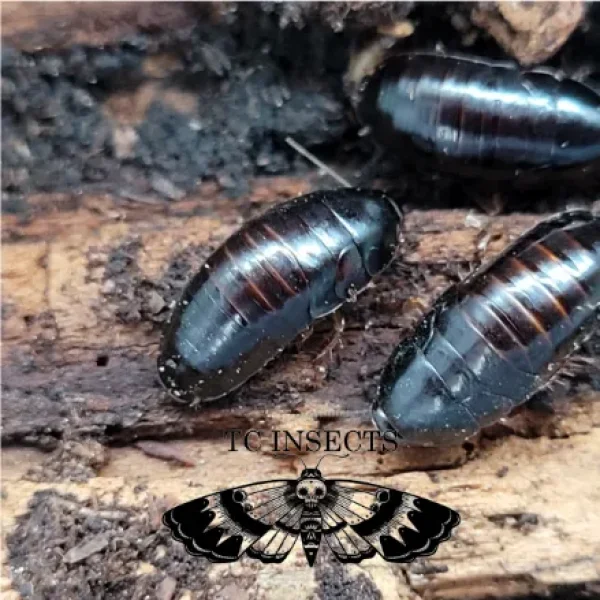
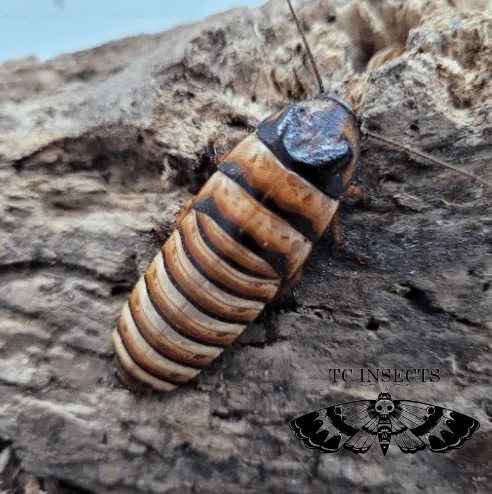
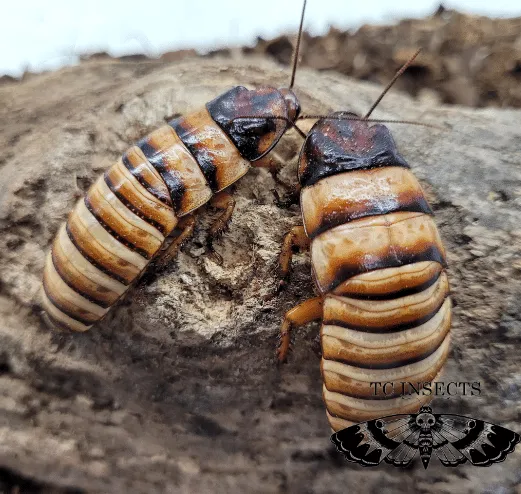
with bold orange-and-yellow striped markings on the abdomen against a black body, which is where the “Halloween” name comes from. Adults reach about 35 to 50 mm, noticeably smaller than the standard hisser. The
species was formally described by Hanitsch in 1930. Two color forms exist in the hobby: a red-pronotum variant and a black-pronotum variant. Available as nymphs or sex-selected adults in counts from 1 up to 100.
Overview
Halloween Hissers come from the deciduous forests of Madagascar, same broad habitat as the standard hisser. Like all members of the hissing roach tribe (Gromphadorhini), they produce sound by forcing air through
breathing holes on the sides of their abdomen — unique among insects. They are wingless, climb smooth surfaces easily, give birth to live babies, and live 2 to 5 years. The genus *Elliptorhina* is separate from the more
famous *Gromphadorhina* genus the standard hisser belongs to, though the two are closely related and look broadly similar in body shape. The colorful banding is what sets this species apart visually.
Honest Note: The Species Name “javanica” Doesn’t Mean Java
This is a fair source of confusion. The scientific name Elliptorhina javanica contains “javanica,” which sounds like it should mean “from Java” (the Indonesian island). But this species is strictly from Madagascar, not
Java.
Here’s why the name is misleading: when the species was first described back in 1930, the type specimens were either mislabeled or wrongly attributed to Java. The species name stuck even after later research confirmed
the actual native range is Madagascar. Scientific names can’t easily be changed once they’re official, so we’re stuck with a name that doesn’t match where the animal actually lives. Plenty of species have this kind of
historical name baggage; in this case, just remember Halloween Hissers come from Madagascar, regardless of what their species name suggests.
Honest Note: They’re Smaller Than the Standard Hisser
If you’re comparing this to the more famous Madagascar Hissing Cockroach, expect a noticeably smaller animal. Standard hissers reach 2 to 3 inches (about 50 to 75 mm). Halloween Hissers max out at about 50 mm, with most adults in the 35 to 50 mm range. That’s still a substantial roach, but visibly smaller in person.
This affects three things buyers care about:
- Display look: Halloween Hissers fit in smaller enclosures and are easier to photograph clearly, but they don’t have the same “giant roach” presence as a full-size standard hisser.
- Feeder use: Smaller body means less meat per roach. For larger monitors or tegus, the standard hisser is the more substantial meal. For mid-sized reptiles, Halloween Hissers are appropriately sized.
- Hiss sound: Smaller body produces a higher-pitched hiss, which is genuinely audibly different from the standard hisser’s lower rumbling hiss.
Honest Note: Two Color Forms Exist
The Halloween Hisser comes in two recognized color variations that hobby breeders track:
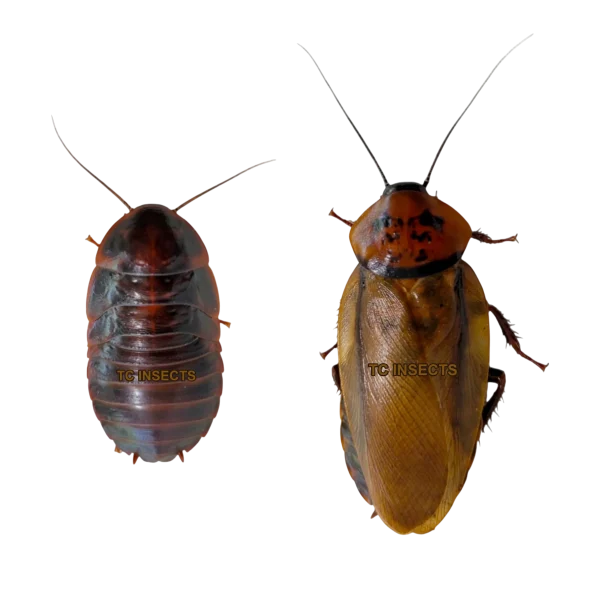
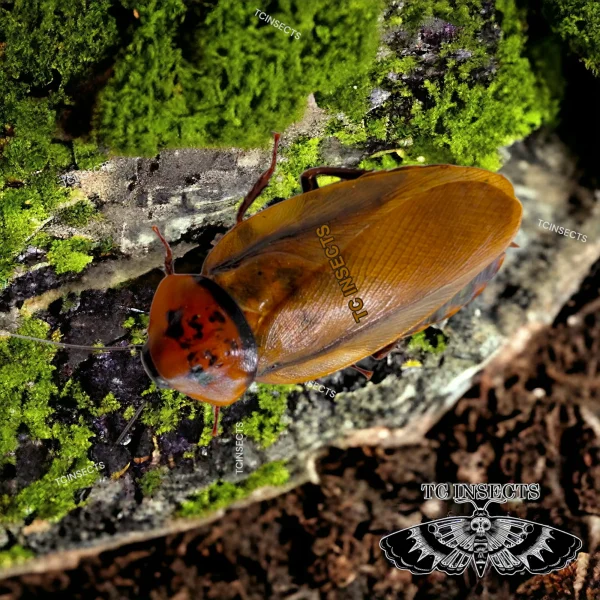
- Red pronotum form: The “shield” behind the head (the pronotum) is red or reddish-brown. Often considered the more visually striking form because the red contrasts with the orange-yellow abdomen stripes.
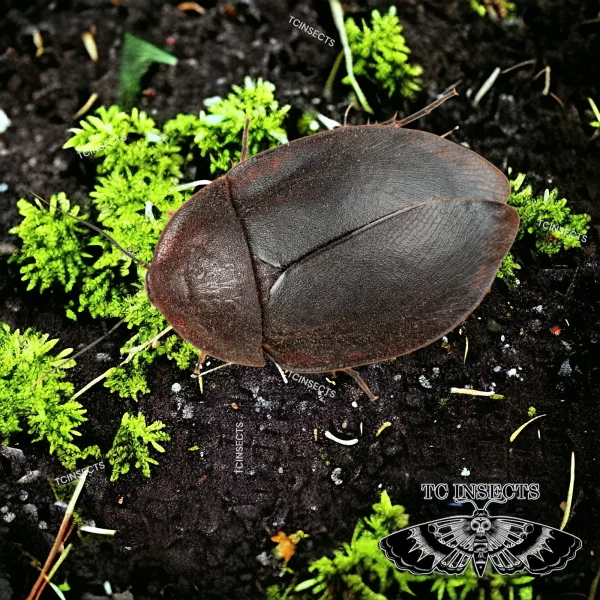
- Black pronotum form: The pronotum is solid black, matching the body. This form has more of a unified black-and-orange look, like a Halloween color scheme done in just two colors.
Both forms are the same species and breed together without issue. We don’t currently sort by color form for sale; if you order from us, you’ll receive whatever form is mature in our colony at the time. If you specifically want one form over the other, contact us before ordering to ask about current availability.
Honest Note: The Hiss Sounds Different
If you’ve owned standard hissers before, the first thing you’ll notice with Halloween Hissers is that their hiss sounds noticeably higher-pitched. This isn’t a personality thing or a behavior difference — it’s pure physics. The
hiss is made by air rushing through breathing holes on the abdomen, and a smaller body with smaller breathing holes produces a higher-frequency sound. Same biological mechanism (we explain the three kinds of hiss in
detail on the standard hisser page), just a different pitch.
How It Compares to the Standard Madagascar Hisser
Quick side-by-side for buyers deciding between the two:
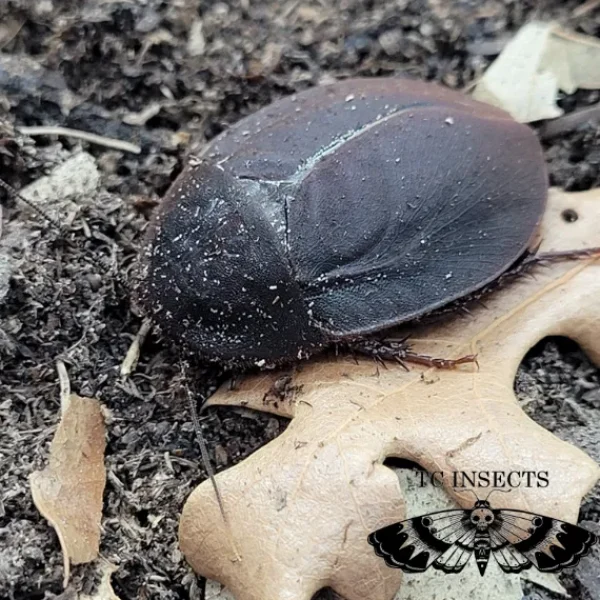
- Color: Halloween Hisser has bold orange-and-yellow stripes on a black body; standard hisser is solid mahogany-brown to black, no stripes.
- Size: Halloween Hisser is 35 to 50 mm; standard hisser is 50 to 75 mm.
- Hiss pitch: Halloween Hisser sounds higher; standard hisser sounds lower and louder.
- Difficulty: Halloween Hisser is rated moderate for breeding; standard hisser is rated very easy.
- Price point: Halloween Hisser costs more per animal because of color appeal and slower breeding rate.
- Buyer profile: Halloween Hisser is mostly a collector and display animal; standard hisser is the all-purpose beginner pet and feeder.
Both are wingless, both climb, both have the same care needs in broad strokes, and both come from Madagascar. Many keepers eventually own both in separate enclosures.
Why Keep Halloween Hissers?
- The colors. Bold orange-and-yellow striping on a black body is genuinely striking and harder to find in the hisser world.
- Two color forms to choose from. Red pronotum and black pronotum offer collector variety.
- Same docile temperament as the standard hisser. Calm enough to handle, won’t bite, settles down quickly after a startled hiss.
- Smaller enclosure footprint. Their smaller size means smaller setups work fine.
- Genuine species variety. Owning both Elliptorhina javanica and Gromphadorhina portentosa gives you two different genera in the hissing-roach tribe.
- Higher-pitched hiss adds character. Audibly different from the standard hisser if you have both.
Sex and Size Selection
Same purchase structure as our standard hisser:
- Size: 3/8″ to 1/2″ Nymphs (small babies, cheapest, grow up in your care) OR Adult Male / Adult Female (sex-selected, immediately ready for display or breeding, more expensive per animal).
- Quantity: 1, 10, 25, 50, or 100 — single animal for display, modest groups for collection, larger counts for established colonies or breeding programs.
Note that this species tops out at 100 count rather than the 250 count we offer for standard hissers, because production is naturally slower (per the moderate breeding difficulty noted earlier).
Care and Setup
Husbandry is straightforward, with one specific difference from the standard hisser: substrate should stay drier.
Enclosure
A 5 to 10 gallon container suits a small starter colony. The smaller body size means smaller setups work fine. Secure lid is essential since they climb glass easily; a thin band of petroleum jelly around the inside top rim adds backup escape protection.
Temperature
78 to 85°F is the active range for this species, slightly warmer than the standard hisser’s 72-85°F range. They breed best at the warmer end (around 82°F). A heat mat on the side of the enclosure handles temperature control in cool rooms.
Humidity and Substrate
This is where Halloween Hissers differ from the standard hisser. They prefer drier substrate with moderate ambient humidity, while standard hissers tolerate damper bedding. Use one to two inches of dry coco fiber,
aspen, or organic bedding. Mist only one corner of the enclosure lightly once a week. Avoid soaking the substrate.
Habitat Structure
Stack egg flats vertically for cover and climbing surface, or use cork bark and hollow wood for a more natural look. They use vertical structures heavily.
Food
Not picky. Fresh vegetables (carrots, leafy greens, squash), fruit (apples, bananas), and dry food. Supreme Feed Premium Roach Formula works as a dry staple. They eat less than standard hissers due to smaller body size.
Hydration
A shallow dish of Hydro-Thirst Insect Water Crystals is the safest hydration option (no drowning risk). They also drink from misting droplets on enclosure walls.
Ventilation
Important. Drier substrate works only if airflow is good. Vented sides or top let moisture move out of the enclosure.
As a Feeder for Reptiles
Halloween Hissers work as feeders for mid-sized reptiles, but the smaller body size compared to standard hissers means they suit smaller-mouthed insectivores rather than monitors or tegus. Nutritional profile is broadly similar to Dubia roaches of equal size
Most buyers of this species are display keepers rather than feeder users. If feeder use is the primary goal, the standard Madagascar Hissing Cockroach or our Dubia roaches are both more cost-effective.
Breeding Notes
Halloween Hissers breed in captivity but at a slower rate than standard hissers, which is why the live page rates breeding as “moderate” rather than the “very easy” rating for *G. portentosa*. Females give birth to live
nymphs, broods are typically smaller than standard hisser broods, and nymphs take longer to reach maturity. Nymphs start almost completely black and gradually develop the signature orange-and-yellow Halloween
coloration through successive molts. A starter group should include several females per male; too many males in one enclosure leads to constant dominance hissing that slows the colony down.
Best For
- Hisser collectors who already own the standard hisser and want the colorful alternative
- Display keepers drawn to the bold orange-and-black coloration
- Classroom and educational programs wanting a visually striking species
- Photographers and content creators who want the most photogenic hisser available
- Intermediate hobbyists ready for slightly trickier breeding than the standard hisser
- Reptile keepers with mid-sized insectivores wanting a smaller-bodied hisser feeder
Not Best For
- First-time exotic roach buyers; start with the easier and cheaper standard hisser instead
- Larger reptile keepers needing the bigger body size standard hissers provide
- Setups with damp substrate; Halloween Hissers want it drier
- Customers in jurisdictions that restrict non-native cockroach species; check local rules
- Anyone planning to release roaches outdoors under any circumstances
Origin and Locality Notes
The Halloween Hisser is endemic to the island of Madagascar, off the southeast African coast, found in deciduous forest habitat. The misleading species name “javanica” comes from an early 1930 description that wrongly
attributed type specimens to Java, an error that has been preserved in the scientific name despite later confirmation of the Madagascar native range. The genus *Elliptorhina* was established by Van Herrewege in 1973 to
separate this species and several others from the larger *Gromphadorhina* genus the standard hisser belongs to.
Receiving and Acclimation
Your order ships with ventilation and bedding suited to transit. On arrival, open the package in a clean contained area and transfer the roaches into a prepared enclosure with dry substrate, hides, and a hydration source.
Give them a day or two to settle before handling. As with every live insect we sell, do not release them into the wild.
Recommended Add-Ons
- Gromphadorhina portentosa “Standard Madagascar Hissing Cockroach” for the natural pairing — keep both in separate enclosures for the full hissing-roach collection.
- Hydro-Thirst Insect Water Crystals for safe drowning-free hydration in the dry-substrate setup.
- Supreme Feed Premium Roach Formula for quality dry diet alongside fresh fruit and vegetables.
- Orange Head Roaches (Eublaberus posticus) for keepers wanting a softer-bodied feeder species alongside the Halloween Hisser as display animal.
- Blaberus parabolicus “Colombia” for collectors expanding into Neotropical species alongside the Madagascan hisser pair.
Frequently Asked Questions
Why is it called “javanica” if it’s from Madagascar?
Historical naming error from the species’ original 1930 description. The type specimens were wrongly attributed to Java, and scientific names can’t easily be changed once they’re official. The species is endemic to Madagascar despite the name.
What’s the difference between the red and black color forms?
The “pronotum” (the shield behind the head) is either red/reddish-brown or solid black, depending on the color form. Both are the same species and breed together. The red-pronotum form is often considered more visually striking; the black-pronotum form has a cleaner two-color Halloween look.
How do I tell a Halloween Hisser from a standard Madagascar Hisser?
Color is the obvious giveaway: Halloween Hissers have bold orange-and-yellow stripes on the abdomen; standard hissers are solid brown to black. Halloween Hissers are also noticeably smaller (35-50mm vs 50-75mm for standard hissers). And the hiss sounds higher-pitched.
Why does this cost more than the standard hisser?
Two reasons. The color appeal makes the species more sought-after as a display animal, which drives up demand. And the breeding rate is slower than standard hissers (moderate rather than very easy), which limits supply. The two factors together push the price point higher per animal.
Is it harder to keep than the standard hisser?
Marginally. The husbandry is broadly the same with two specific differences: Halloween Hissers prefer drier substrate (don’t keep their bedding moist), and they breed at a slower rate than standard hissers. If you can keep a standard hisser, you can keep this one too, just with drier setup.
Should I get this or the standard hisser if I’m new to roaches?
Start with the standard Madagascar Hisser first. It’s cheaper, easier to breed, more forgiving with care mistakes, and equally beginner-friendly to handle. Once you have one or two seasons of hisser experience, the Halloween Hisser is a natural step up for collectors who want the colorful alternative.
Learn More About Elliptorhina javanica
These references give keepers background on the species, its genus, and the broader Madagascan hissing-roach group.
-
Wikipedia: Elliptorhina javanica. The species profile, including the 1930 Hanitsch description, the documented size range, and the synonym history with the older *Gromphadorhina javanica* name.
-
iNaturalist: Halloween Hissing Cockroach (Elliptorhina javanica). A community-sourced species page with verified observation photos showing both color forms and the orange-and-yellow abdominal striping.
-
Wikipedia: Gromphadorhini (hissing roach tribe). An overview of the broader hissing-roach group that includes both Elliptorhina and Gromphadorhina, useful for understanding the relationship between Halloween Hissers and standard hissers.
|
COMMON HISSER ROACH CHECKLIST
|
|
| Can they fly? | NO |
| Can they climb? | Yes Barrier Required |
| Can I breed them? | Moderate |
| Do they smell? | NO (keep clean) |
Halloween Hisser Roach Natural Habitat:
Widespread across the deciduous forest of Madagascar.

TC INSECTS FEEDER NUTRITION TABLE
The Nutritional Contents of the Hisser Roach will be similar to Dubia of equal size.
| Species | Protein % | Fat % | Fiber % | Calcium_(mg/kg) | Phosphorus_(mg/kg) |
| Crickets | 15.3 | 3.2 | 2.1 | 275 | 2510 |
| Dubia | 22.9 | 7.1 | 2.8 | 798 | 2623 |
| BSFL | 17.4 | 13.8 | 2.9 | 9380 | 3540 |
| Superworms | 19.6 | 17.6 | 2.5 | 180 | 2350 |
| Mealworms | 18.7 | 13.3 | 2.6 | 169 | 2980 |
| Silkworms | 9.6 | 1.1 | 1 | 185 | 2400 |
| Fruit Flies | 21.5 | 6 | 2 | 526 | 4000 |
| Spikes | 17 | 12.5 | 2 | 5230 | 3540 |
| Hornworms | 9 | 3 | 0.5 | 470 | 2000 |