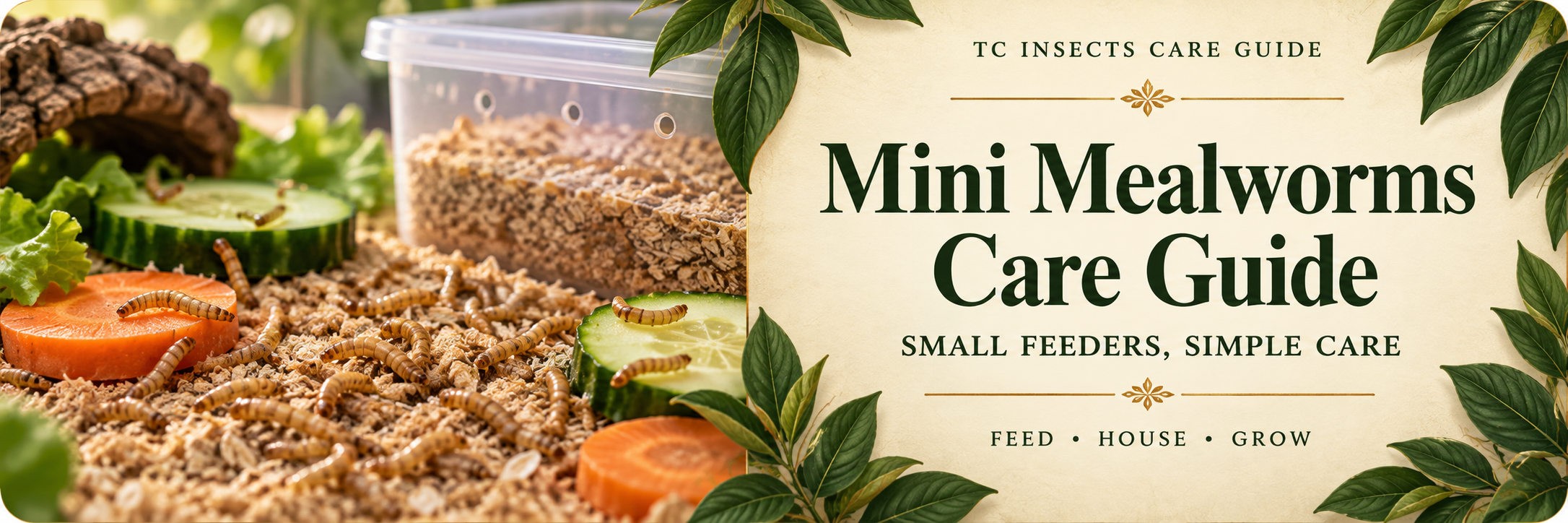
Mini mealworms are the smallest mealworm sold, about a quarter inch long, and they are the right feeder for animals whose mouths cannot manage a standard mealworm: hatchling and juvenile leopard geckos, crested and gargoyle gecko juveniles, anoles, small day geckos, baby bearded dragons, small tree frogs, and juvenile chameleons. They grow into small mealworms within a week or two at room temperature, so the trick to buying them is keeping them cold. This guide covers the size rule that tells you when a mini is right, the animals that use them, how to store a cup so it stays mini for weeks, feeding and dusting, and when to move up.
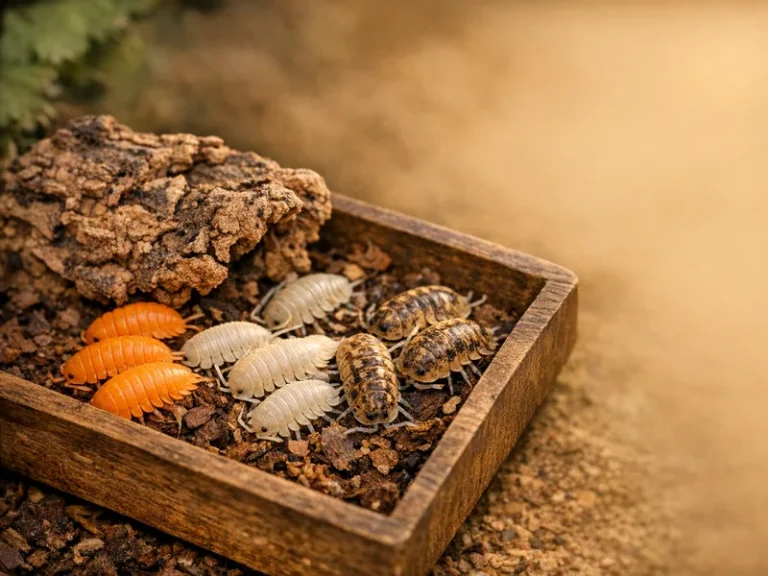
Roughly the width between a small lizard's eyes
At room temperature they reach 1/2 inch in a week or two
If the animal takes two at a time, it is ready for small

Keep the size right
Mini mealworms stay useful for hatchlings when storage, moisture, and feeding are handled simply and consistently.
Everything you need to keep the size right
The size rule, and why a mini exists
The standard feeder size rule is that prey should be no wider than the space between the animal's eyes, and for a hatchling leopard gecko, a juvenile anole, or a baby chameleon, that space is a few millimeters. A regular mealworm at three quarters of an inch is too big and too hard-shelled for those mouths, and a superworm is out of the question. The mini mealworm, harvested at around a quarter inch and a couple of millimeters wide, fits the rule for a whole class of small and young animals.
Minis are also softer than large mealworms. A mealworm's outer skin hardens with each molt, and a quarter-inch larva has molted fewer times, so it is easier to digest for a small animal. That is why breeders raising hatchlings buy minis rather than chopping large worms; a cut worm leaks and the chitin is still tough. The feeder insect size chart lays the rule out by feeder, and how to care for mealworms covers the general husbandry.
Which animals use mini mealworms
Hatchling and juvenile leopard geckos are the classic mini mealworm eater: a dish of a dozen minis, dusted, is a standard first food, and they graduate to small mealworms at a few months old. Juvenile crested and gargoyle geckos take minis a few times a week alongside their fruit-based diet. Green anoles, house geckos, and small day geckos take minis all their lives, though fruit flies and small dubia often suit them better as a staple. Baby bearded dragons take minis in the first weeks, as a supplement to small dubia or BSFL rather than a staple, because of the mealworm's fat and low calcium.
Small tree frogs, juvenile pacman frogs, and young chameleons all take minis as part of a rotation, and so do many baby turtles. The rule across all of them is the same: minis are a size, not a diet. A growing animal that eats only mealworms of any size misses calcium and variety, so pair minis with small BSFL, fruit flies, or extra-small dubia, and dust them. Our Feeder Finder gives the rotation for a specific animal.
Keeping a cup mini: the refrigerator rule
A mini mealworm at room temperature is a small mealworm in a week or two and a medium in a month, because larvae grow fast in the 70s F. To keep the cup at the size you bought, store it in the refrigerator at about 40 to 45 F in a ventilated container with a half inch of dry wheat bran. The cold slows growth to almost nothing, and a cup of minis stays mini for weeks. Take out the day's worms, let them warm for 20 minutes so they move, and feed.
Once a week, give the whole cup a few hours at room temperature with a thin slice of carrot so the larvae can drink, then remove the slice before it molds and return the cup to the cold. Do not freeze them, and do not leave a cup in a warm reptile room; that is how a cup of minis becomes a cup of medium mealworms you did not order. If you want a permanent supply of small larvae, a bin of adult beetles produces tiny larvae continuously, which how to start a mealworm colony covers, and you sift out the size you need.
Feeding and dusting minis
Feed minis from a shallow, smooth-sided dish so they cannot burrow into the substrate and disappear; a bottle cap or a small ceramic dish works. Put in a few more than the animal will eat and remove leftovers after an hour. Before feeding, gut-load the day's minis for a few hours at room temperature on bran with a slice of carrot or a pinch of a gut-loading feed, then dust lightly with calcium. A light dusting matters more with minis than with large worms, because small animals are usually growing animals.
Do not leave loose mealworms in an enclosure overnight. Larvae burrow, and a stray larva can pupate into a beetle in the substrate. For a picky hatchling that will not take a dish, tong-feed one mini at a time, or drop one in front of the animal and let it move. Most young geckos learn a dish within days, and a dish is the least stressful routine for both of you.
When to move up a size
Watch how the animal eats. If it takes two minis in one bite, or eats a dozen and looks for more, it is ready for small half-inch mealworms. If it struggles, chews for a long time, or spits a worm out, stay on minis longer. For leopard geckos that transition usually lands at 2 to 4 months old; for bearded dragons it comes within a few weeks, as they outgrow the size fast; for anoles and small day geckos it may never come, and minis remain the right mealworm for life.
Buy the size you need this month rather than a size the animal will grow into, because the cup will grow with it only if you let it. A cup of mini mealworms kept cold stays mini; a cup of small mealworms left warm becomes medium. Between those two facts and the size rule, matching the worm to the mouth is simple.
Minis versus the other small feeders
For a hatchling or a tiny animal, minis compete with fruit flies, extra-small dubia, and small BSFL, and each has a place. Fruit flies are the smallest and best for anoles, day geckos, and frogs that hunt moving prey. Extra-small dubia are the best staple for baby dragons and larger hatchling geckos, with more protein and calcium than a mealworm. Small BSFL are the calcium option. Minis are the easiest to dish-feed, the easiest to store, and the one most hatchling geckos take first, which is why they stay on the list.
A sensible rotation for a small animal is minis as the easy dish food, BSFL or extra-small dubia as the staple, and fruit flies for the hunters, all sized by the same rule and all dusted for a growing animal. Buy the cup, keep it cold, and move up a size when the animal tells you to.
Keep reading: Feeder Insects for Green Anoles: Sizes, Counts, and a Weekly Plan and Mini Mealworms vs Fruit Flies for Hatchlings: Which First, When to Switch
The Hatchling Feeder Kit
Minis for the dish, extra-small dubia and small BSFL as the staple, bran to store them cold, and calcium to dust.
Frequently Asked Questions
How big are mini mealworms?+
About a quarter inch long and a couple of millimeters wide, the smallest mealworm size sold. They are young larvae that have molted only a few times, so they are softer and easier to digest than a standard three-quarter-inch mealworm, which is why they suit hatchlings and small animals.
What animals eat mini mealworms?+
Hatchling and juvenile leopard geckos, juvenile crested and gargoyle geckos, anoles, house geckos, small day geckos, baby bearded dragons, small tree frogs, juvenile chameleons, and many baby turtles. Use them as a size-matched part of a rotation with fruit flies, extra-small dubia, or small BSFL, not as the only food.
How do I keep mini mealworms from growing?+
Refrigerate them at about 40 to 45 F in a ventilated container with dry bran; the cold stops growth almost completely and a cup stays mini for weeks. Warm the whole cup for a few hours once a week with a slice of carrot to drink, then return it. Left at room temperature they reach half an inch in a week or two.
Should I dust mini mealworms with calcium?+
Yes, lightly, because the animals that eat minis are usually growing. Gut-load the day's worms for a few hours on bran with a slice of carrot first, then dust with a plain calcium powder. Feed from a shallow smooth dish so they cannot burrow away, and remove leftovers after an hour.
When should my leopard gecko move from mini to small mealworms?+
When it takes two minis in one bite or clears a dozen and keeps hunting, usually at 2 to 4 months old. If it chews a worm for a long time or spits it out, stay on minis. Bearded dragons outgrow minis within weeks; anoles and small day geckos may stay on minis for life.
Are mini mealworms better than fruit flies for a hatchling?+
Different jobs. Minis are the easiest to dish-feed and store and the first food most hatchling geckos take. Fruit flies suit anoles, day geckos, and frogs that hunt moving prey. Extra-small dubia and small BSFL are the better staples for nutrition. A rotation of two or three, all dusted, beats any one of them alone.
Have a care question? Ask our community.
Join Reptile Keepers USA, our free Facebook group for reptile, amphibian and invert keepers. Share your setups, get care help and swap feeder tips.
Join the free group