Jumping Spider Cleanup Crew
A jumping spider does not need a cleanup crew, and that is the honest answer. Jumpers eat one small prey item every two to three days, drink from an occasional light misting, and any uneaten feeder should come out within a day anyway, so there is very little waste for a crew to process in the first place. If you still want the bioactive look, a light crew of Trichorhina tomentosa (Dwarf White) isopods plus springtails is safe in a small arboreal enclosure, as long as you keep it fed so it does not compete with your spider for space. Skip anything bigger: a large isopod in a tank this small has nowhere to go but in your jumper's way.
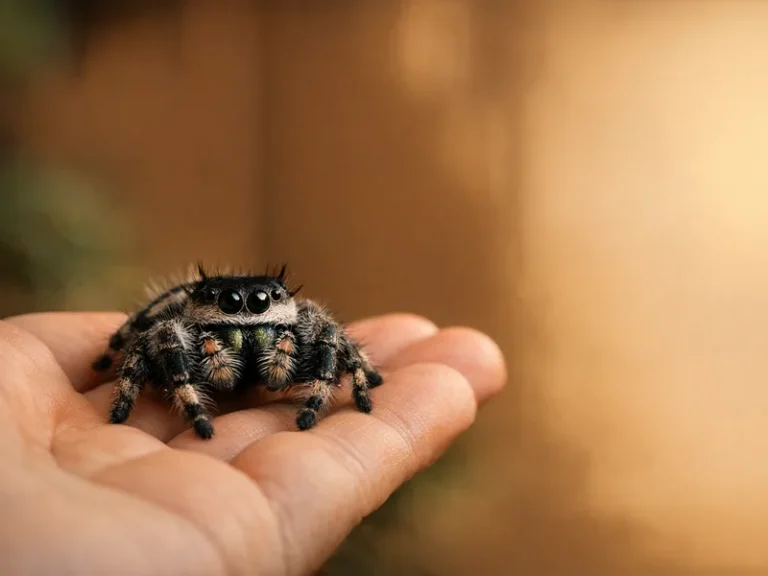
Jumpers eat little and make very little mess
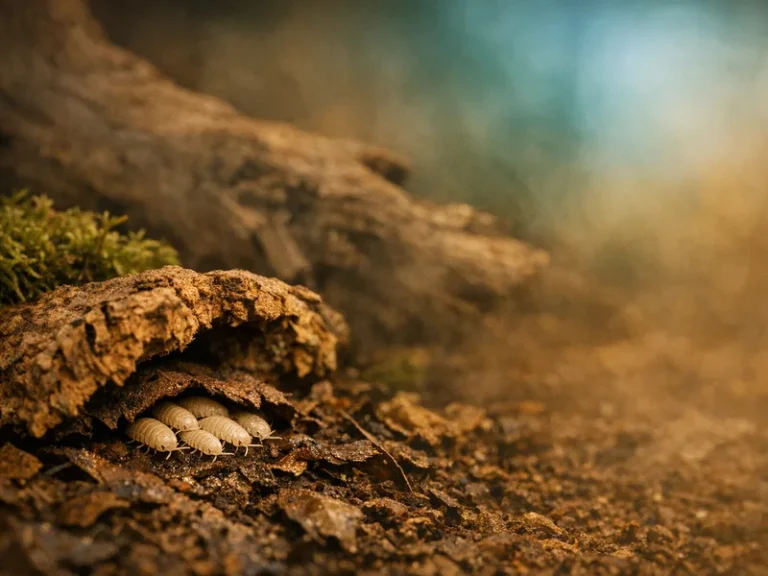
Small enough for a tiny arboreal enclosure
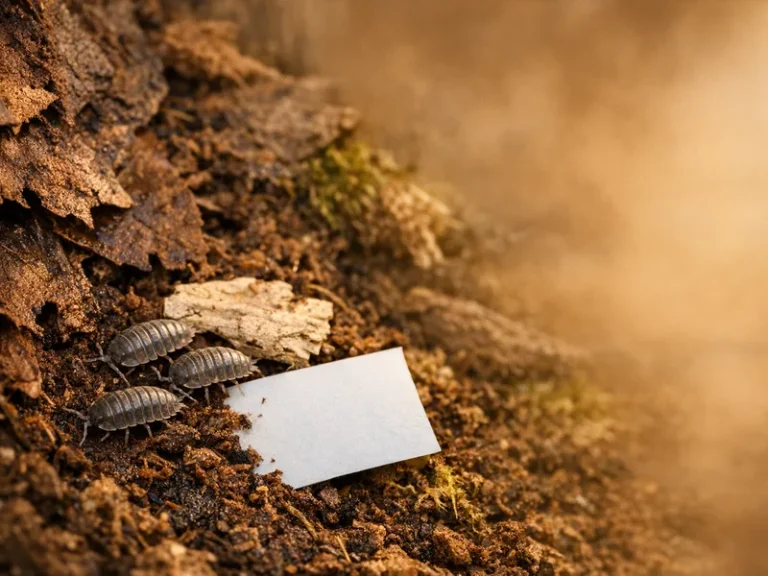
No room in a small tank, and no real job to do
Why a jumping spider barely needs a cleanup crew
Jumping spiders are about the lowest-mess pet in the invertebrate hobby. An adult eats roughly one appropriately sized prey item every two to three days, and our jumping spider feeding guide is clear that anything left uneaten should come out of the enclosure within a day or so anyway. There is no large waste pile, no big shed to clean up (a jumper's molt is tiny), and the enclosure itself tends to be small, since jumpers do best in a modestly sized cage rather than a sprawling tank.
That adds up to very little for a cleanup crew to actually do. Compare that to a bioactive ball python or crested gecko setup, which produces real daily waste in a large tank, and you can see why a cleanup crew is a genuine workhorse there and only a nice-to-have here.
If you want one anyway: the safe, small picks
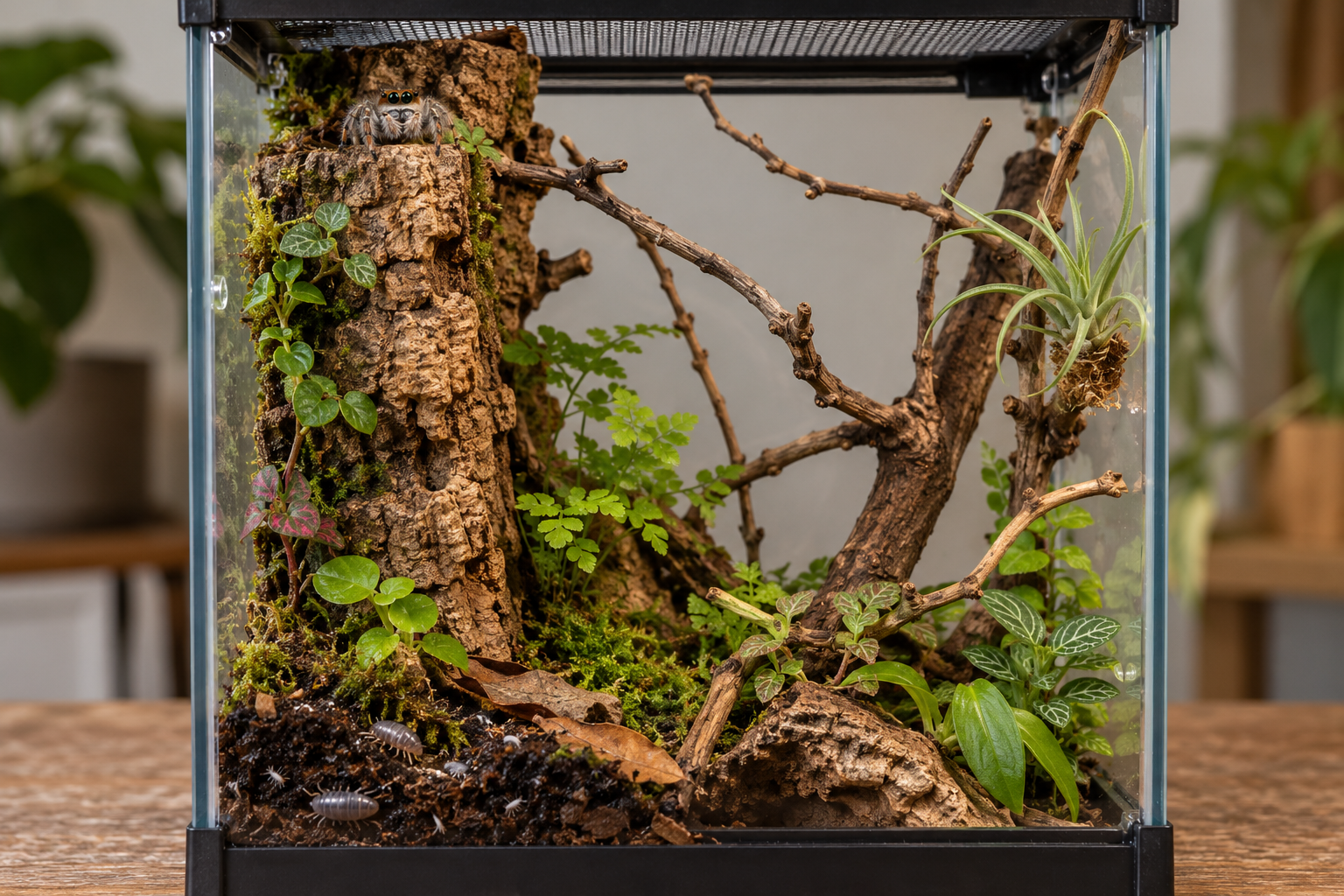
If you like the look of a bioactive, planted jumping spider enclosure, a light crew is safe as long as you pick small species. Trichorhina tomentosa (Dwarf White) isopods are tiny, at 3 to 4 mm, and stay out of the way in the substrate, while Porcellionides pruinosus (Powder Orange or Blue) is only a little bigger and just as calm. Either pairs well with springtails, which graze mold in the damp corner of the enclosure. You can find both on our springtail cultures page.
Keep it to that short list. Skip anything larger or more food-driven, like the Dairy Cow (Porcellio laevis), which belongs in its own display or feeder colony and has no place in an enclosure this small. Our post on choosing a cleanup crew for a small, delicate pet covers the same size-matching logic for a leopard gecko.
The real challenge: feeding the crew without fouling the tank
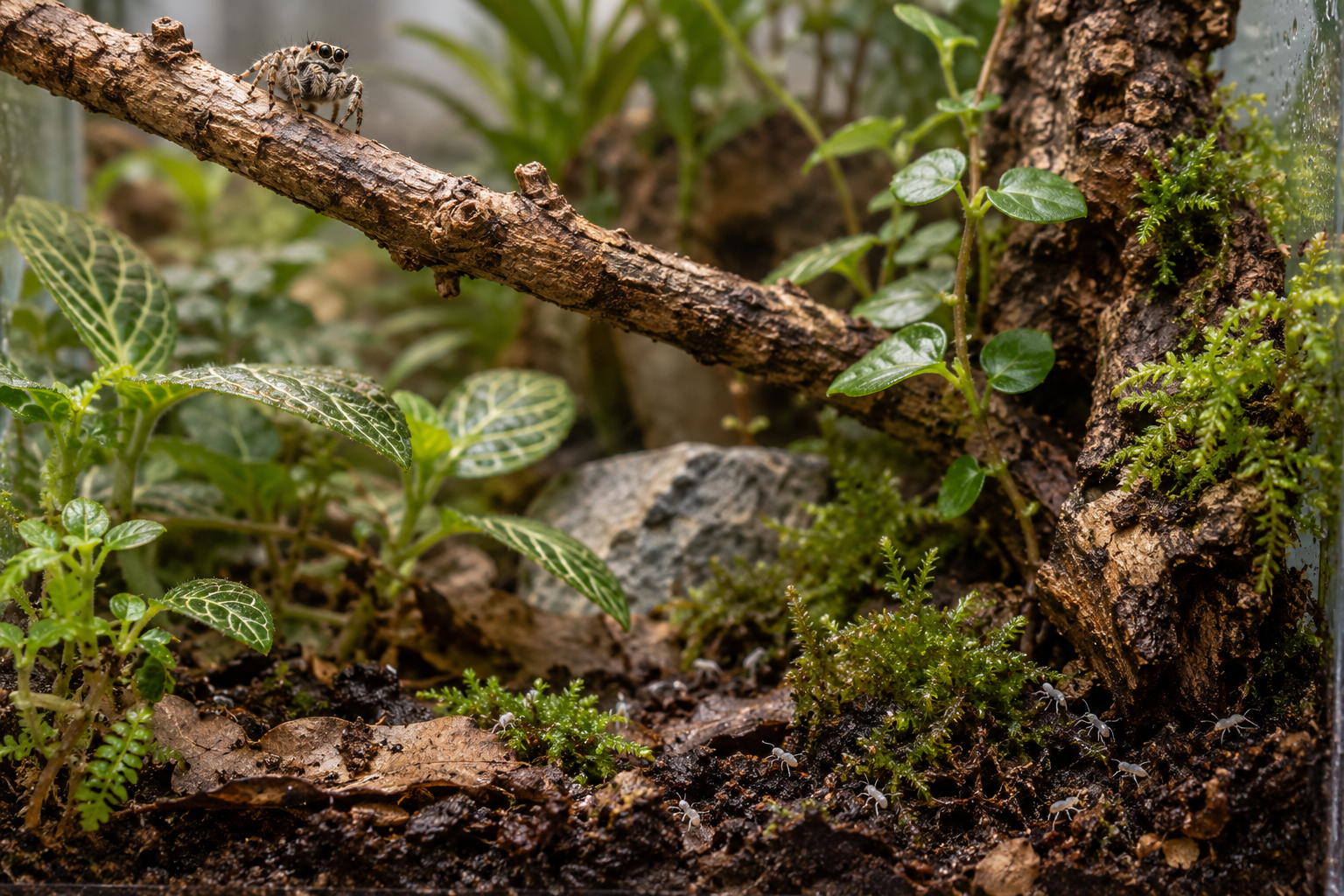
The hard part of a jumping spider cleanup crew is not safety, it is logistics. A jumper's enclosure is small and kept mostly dry, with just a light misting a couple of times a week, so there is not much room or moisture to support a thriving isopod and springtail population the way a big humid vivarium can.
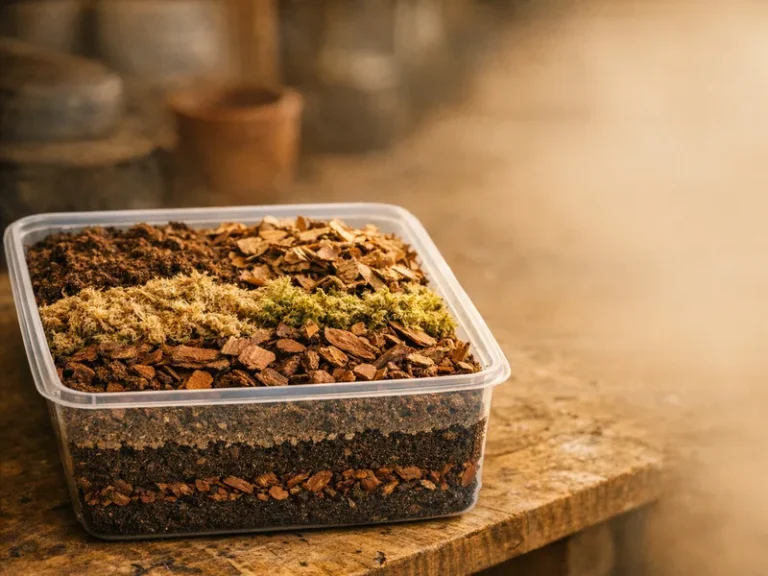
The fix is to give the crew its own small, damp micro-zone rather than dampening the whole tank. Tuck a little leaf litter and a pinch of isopod food into one corner or under a piece of bark, keep that spot lightly moist, and let the rest of the enclosure stay drier for your spider. A crew fed this way stays put, stays small, and does not push the whole enclosure toward a humidity level your jumper does not want.
Setting it up without crowding your spider
Start small. A handful of Dwarf Whites and a modest springtail culture is plenty for a jumping spider enclosure, since you are managing a trickle of waste, not a flood. Seed the crew a couple of weeks before your spider moves in if you can, so it has time to settle into its corner rather than wandering the whole tank while it establishes.
Watch the crew's numbers over time. If it booms and starts roaming beyond its damp corner, that is a sign to dial back feeding or thin the population, not to add more space for it at your spider's expense. A jumping spider enclosure is not the place for a cleanup crew to feel enormous.
The bottom line for a jumping spider keeper
A cleanup crew is not something your jumping spider is waiting on. Plenty of keepers run a jumper on a simple substrate with no crew at all and just spot-clean by hand, and that is a completely normal way to keep one. Our guide to jumping spider molting and feeding by size cover the husbandry basics that actually matter day to day.
If a bioactive look is what you are after, a small, well-fed crew of Dwarf Whites and springtails is safe and easy to keep in check. Just remember the enclosure is built for the spider first, and the cleanup crew is a quiet extra, not the main event.
Build a Light Cleanup Crew for a Jumping Spider Tank
The small-tank crew and feeders behind the answers above. Tap to add or remove, then send it all to your cart in one tap.
Frequently Asked Questions
Written by the TC INSECTS breeding team · Porter, Texas · Live Arrival Guarantee on every order
Have a care question? Ask our community.
Join Reptile Keepers USA, our free Facebook group for reptile, amphibian and invert keepers. Share your setups, get care help and swap feeder tips.
Join the free group