
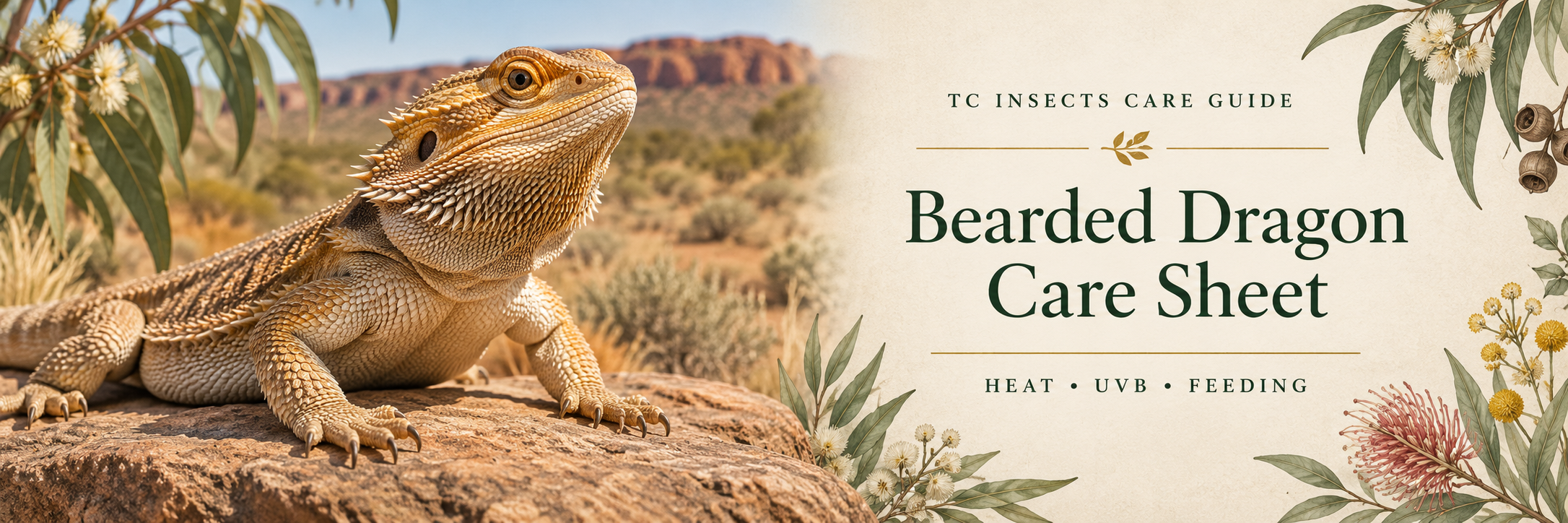
Bearded Dragon Care Sheet
Complete bearded dragon husbandry (Pogona vitticeps): the basking and UVB numbers that actually matter, the insect-to-greens ratio that flips as they grow, enclosure sizing, brumation, and a troubleshooting chart.
A decade-plus commitment for a genuinely interactive lizard.
Including the tail; they need far more space than a starter kit provides.
Easy temperament, but UVB and basking heat are non-negotiable.
Meet the Bearded Dragon
The central bearded dragon is the most interactive reptile most people will ever keep: alert, curious, genuinely responsive to its keeper, and famous for the spiky throat beard it darkens and puffs when displaying. They come from the arid inland woodlands of Australia, where they bask on branches and rocks and shelter from real desert heat.
They are also the most equipment-dependent animal in this library. A bearded dragon is a full sun-basking, UVB-dependent, omnivorous desert lizard, and it cannot be kept properly in the small tank with a coloured bulb that many starter kits sell. If you are looking for a low-equipment reptile, a crested gecko or leopard gecko is the honest recommendation.
Get the lighting and the space right, though, and they are superb: hardy, long-lived and full of personality.
What You Will Need
The two items people under-buy are the enclosure and the UVB. Both are the difference between a dragon that thrives and one that slowly declines.
Conditions at a Glance
The card version. Basking surface temperature and UVB are the two rows that decide whether a dragon thrives.
| Parameter | Target | Notes |
|---|---|---|
| Enclosure minimum | 48 x 24 x 24 for an adult | A 40 gallon breeder is a juvenile tank, not an adult one |
| Basking surface | Around 95 to 105 F for adults | Juveniles run at the higher end; measure at the surface |
| Cool end | 75 to 85 F | A genuine gradient across the length |
| Night | 65 to 75 F | No coloured night bulbs; darkness matters |
| UVB | Linear T5 tube, replaced every 6 to 12 months | Coil bulbs and unreplaced tubes are a leading cause of MBD |
| Humidity | 30 to 40 percent | Arid; a shallow water dish is enough |
| Lighting cycle | 12 to 14 hours | Consistent day and night rhythm |
| Housing | One per enclosure | Dragons are territorial and will injure each other |

Enclosure, Heat and UVB
An adult bearded dragon needs a minimum of 48 by 24 by 24 inches, and more space is genuinely used. The common failure is buying the starter kit tank a hatchling looks lost in and never upgrading, which produces an adult with nowhere to thermoregulate.
Create a real gradient: a basking surface around 95 to 105 degrees at one end under a dimming-thermostat-controlled bulb, and a cool end at 75 to 85. Measure with a probe on the actual basking surface. At night, let the enclosure fall to 65 to 75 with the lights off entirely, since coloured night bulbs disturb sleep and provide no benefit.
UVB is not optional for this species and the details matter: use a linear T5 tube spanning a third to a half of the enclosure length, mounted at the manufacturer's stated distance, and replace it on schedule every six to twelve months even though it still emits visible light. Compact coil bulbs and expired tubes are among the leading causes of metabolic bone disease in captive dragons.
Diet and Feeding
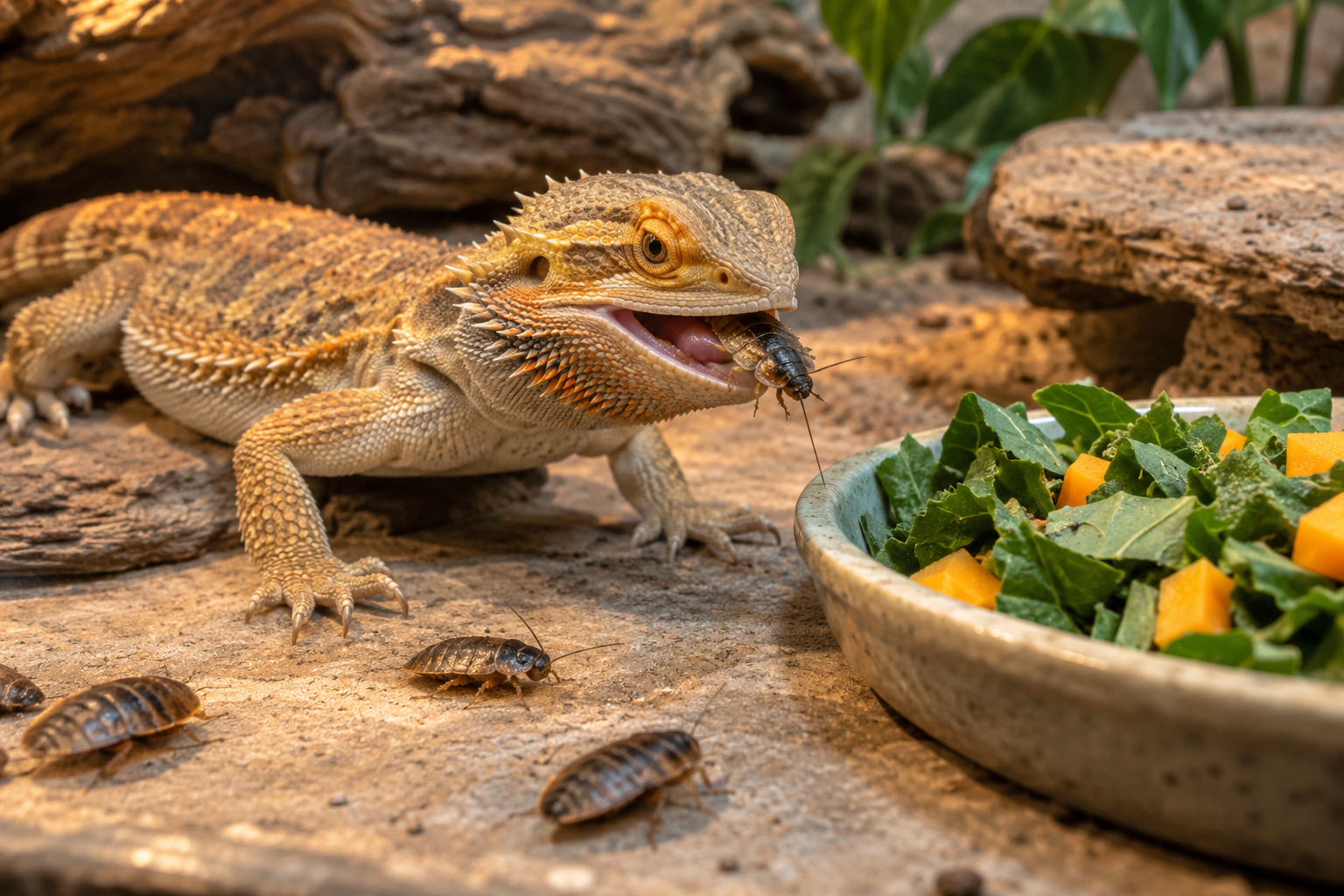
Bearded dragons are omnivores whose ratio flips as they grow. Hatchlings and juveniles are protein-hungry and eat mostly insects with greens always available; adults invert that, eating mostly greens with insects a few times a week. Feeding an adult like a juvenile is the direct cause of the obesity and fatty liver disease that shortens so many pet dragons' lives.
Gut-loaded dubia roaches are the ideal staple insect, with black soldier fly larvae for calcium and hornworms as a hydrating treat. Superworms are fatty and belong in the treat column. Greens run alongside every day: collard, mustard and turnip greens, dandelion and butternut squash are staples. Full sizing and portion detail is on our bearded dragon feeder guide.
| Life Stage | Insects vs Greens | Insect Portion | How Often | Supplements |
|---|---|---|---|---|
| Hatchling (0 to 3 months) | About 80 percent insects | As many as eaten in 10 to 15 minutes | 2 to 3 insect feedings daily; greens always available | Calcium daily; multivitamin weekly |
| Juvenile (3 to 12 months) | About 50 to 70 percent insects | 15 to 30 appropriately sized insects | 1 to 2 insect feedings daily; greens daily | Calcium 4 to 5 times weekly; multivitamin weekly |
| Adult (12 months plus) | About 70 to 80 percent greens | 10 to 15 insects per feeding | Insects 2 to 3 times weekly; fresh greens every day | Calcium 2 to 3 times weekly; multivitamin weekly |
Everything a bearded dragon keeper needs from this guide. Untick anything you already have, then add the rest in one click.
Brumation and Seasonal Changes
Many bearded dragons brumate, a reptilian dormancy usually beginning in their second winter: appetite drops, the dragon sleeps for long stretches, buries itself or hides at the cool end, and may go weeks eating very little. In a healthy adult with correct temperatures and a recent clean bill of health, this is normal and does not need to be prevented.
What separates brumation from illness is the rest of the picture: a brumating dragon holds weight reasonably well, looks alert when roused, and has no other symptoms. Weight loss, discoloured or runny stool, sunken eyes, or a first-year dragon refusing food are all reasons to see an exotics vet rather than assume seasonality.
Handling and Temperament
Bearded dragons are among the most tolerant reptiles for handling, and many genuinely seem to seek out interaction. Support the whole body from underneath, avoid grabbing from above like a predator would, and let a new dragon settle and feed reliably for a week or two before starting sessions.
Read the body language: a puffed dark beard is a display or a warning, arm-waving is submission and common in juveniles, and rapid head-bobbing is territorial. All are normal, and none require a response beyond giving the animal space.
Health and Troubleshooting
The overwhelming majority of bearded dragon health problems come from three sources: inadequate or expired UVB, an enclosure with no real temperature gradient, and an adult fed like a juvenile.
| What You See | Most Likely Cause | What To Do |
|---|---|---|
| Trembling, weak limbs, jerky walking, soft jaw | Metabolic bone disease from poor UVB or calcium | Replace the UVB with a linear T5 now; correct dusting; exotics vet urgently |
| Sleeping constantly in winter, eating little | Brumation in a healthy adult | Monitor weight; keep water available; vet if weight drops or other symptoms appear |
| Obese, fat pads over the eyes and legs | Adult fed on a juvenile insect ratio | Flip to a greens-led diet; reduce insect days; recheck in a month |
| Black beard held for long periods | Stress, illness or territorial display | Check temperatures, UVB and enclosure size; vet if it persists with other signs |
| Runny or foul stool, weight loss | Parasites, common in imported or poorly kept animals | Exotics vet with a fresh fecal sample |
| Not basking, staying at the cool end | Basking surface too hot | Measure at the surface with a probe and dial the thermostat down |
| Stuck shed on toes or tail tip | Humidity too low during a shed cycle | Offer a shallow lukewarm soak; never pull; vet if a toe darkens |
Bearded Dragon FAQ
Part of the Bearded Dragon Hub: every guide we have on bearded dragons, in one place.
Keep reading: the impaction signs that mean a vet visit and telling brumation from illness.
Feeding a Growing Dragon?
Tell us your dragon's age and we will size the insects and set the insect-to-greens ratio for its stage. Real keepers answer.
TC INSECTS · Husbandry guidance from the people who raise the feeders · Porter, Texas
