





Bumblebee Millipede
$6.99 - $57.99
Pronounced: An-ah-den-oh-BOH-lus mon-ih-lih-COR-nis
Care Level: Beginner, with one strict requirement (warmth)
Adult Size: Commonly 1 to 2.5 inches, with some reports near 3
Lifespan: Reports vary widely, commonly 2 to 5 years
Reproductive Rate: Moderate to good. Unusually willing to breed for a millipede
Temperature: 72 to 80 °F. Does not do well below 72
Humidity: High, with consistently damp substrate
Scientific Name: Anadenobolus monilicornis, 'Florida' captive bred line
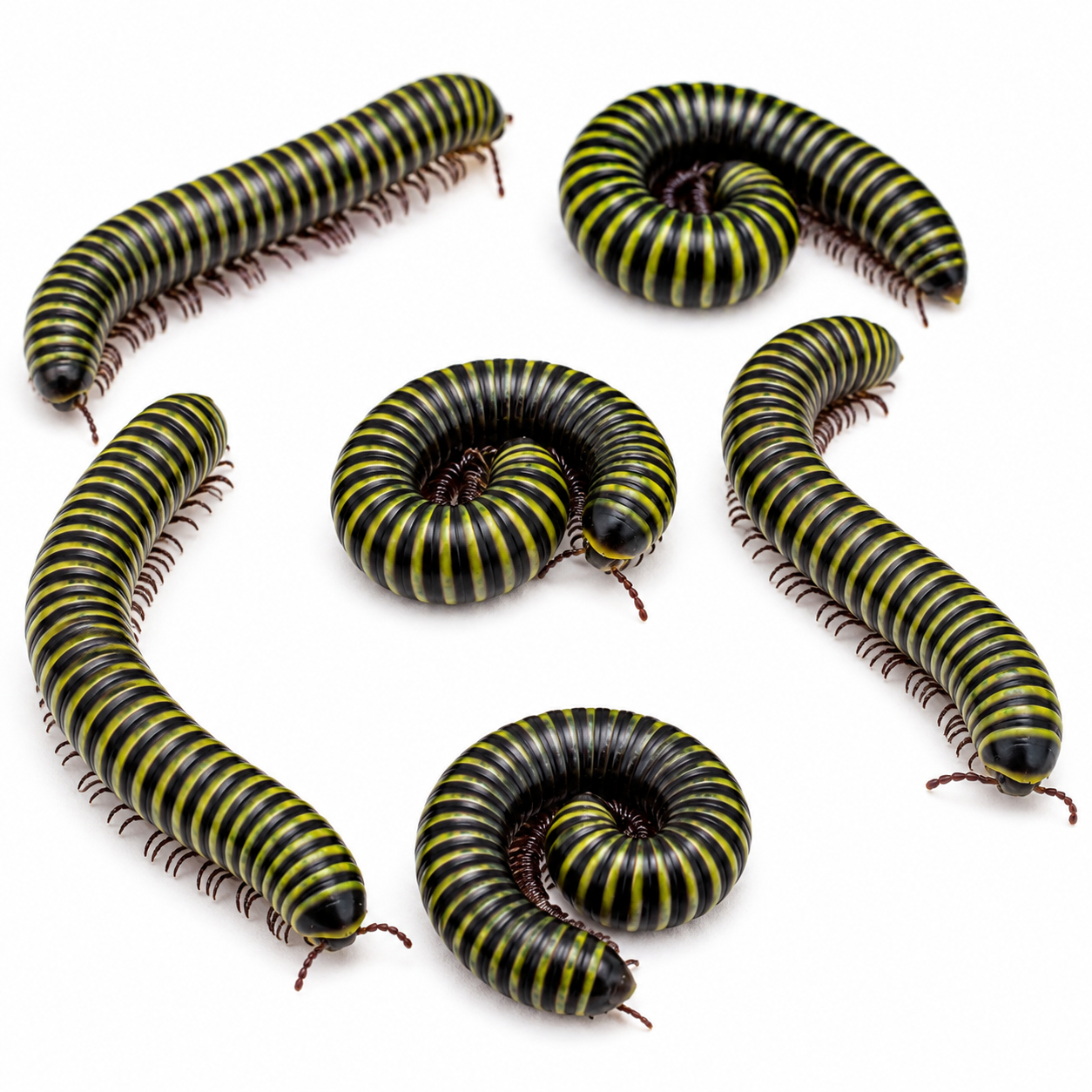
Appearance: Dark body with yellow to lime-green banding, red legs and antennae
Best For: Tropical display vivariums, smaller enclosures, keepers wanting a millipede that reproduces
A small, brightly banded millipede with red legs and antennae, and one of the few species in the hobby that breeds readily enough for a home culture to sustain itself. This is a captive bred 'Florida' line, which matters with this species because wild-caught stock has a reputation for travelling poorly.
Shipping & Guarantees


Description
Bumblebee Millipede For Sale | Anadenobolus monilicornis
Overview
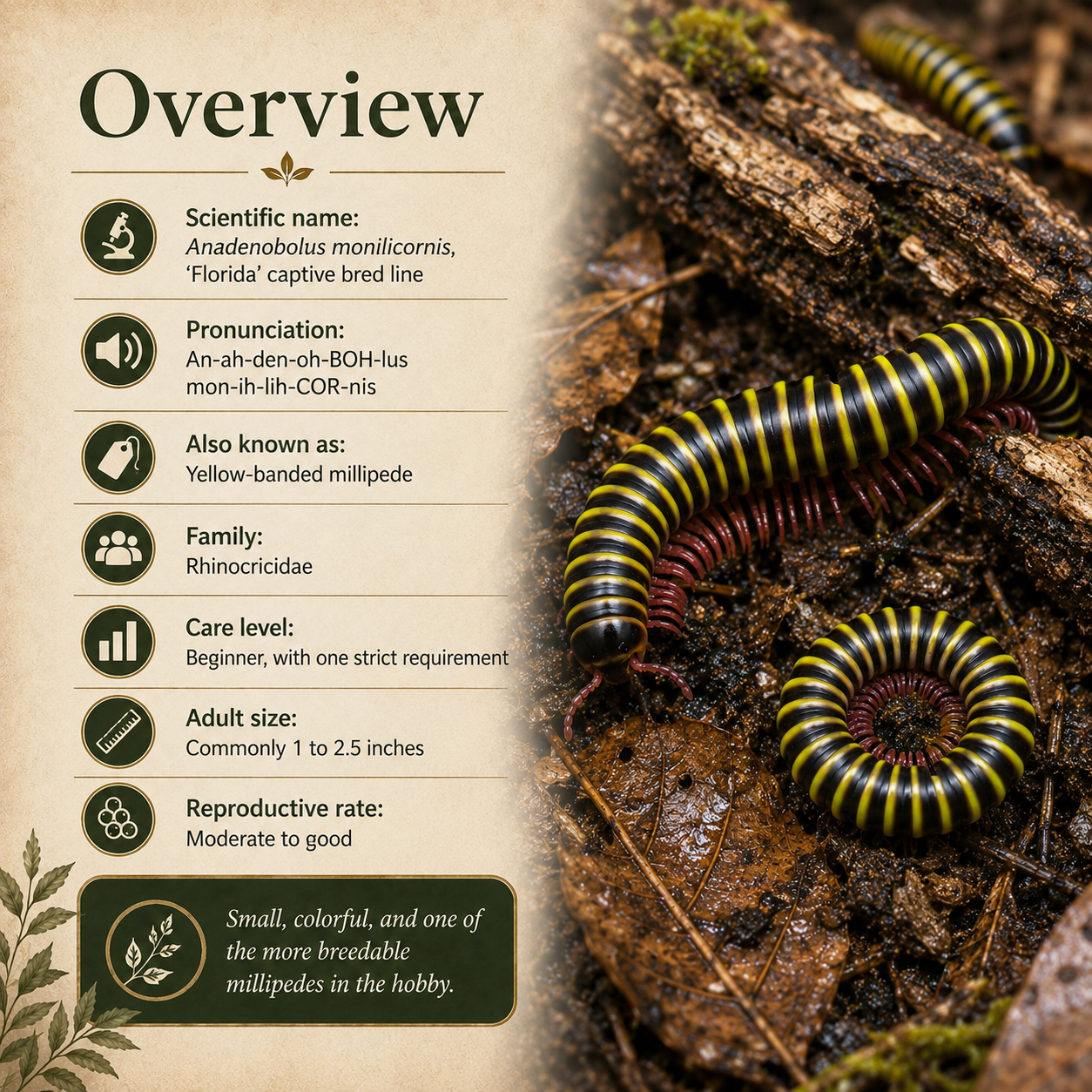
Scientific name: Anadenobolus monilicornis, 'Florida' captive bred line
Pronunciation: An-ah-den-oh-BOH-lus mon-ih-lih-COR-nis
Also known as: Yellow-banded millipede
Family: Rhinocricidae
Care level: Beginner, with one strict requirement
Adult size: Commonly 1 to 2.5 inches
Reproductive rate: Moderate to good for a millipede
The Bumblebee is the millipede for keepers who want color and activity in a smaller package. Anadenobolus monilicornis tops out around 2.5 inches, which is a fraction of the size of the big native Narceus and Chicobolus species, but it makes up for that with dark banding split by yellow to lime-green rings and bright red legs and antennae. It is one of the most colorful millipedes available in the hobby.
The other thing that sets it apart is reproduction. Most millipedes sold as pets are slow, long-lived animals that rarely produce young for the average keeper. Bumblebees are different. With a deep, established habitat floor and consistent warmth, they are considerably more willing to breed in captivity, which means a well-kept group can become a self-sustaining culture rather than a set of individual animals.
Appearance and Behavior
The body is dark, close to black or dark brown, ringed with bands that read yellow from above and can look more silver or lime along the sides depending on the light. Legs and antennae are red to pink, which is the detail that makes this species stand out in a planted enclosure. Juveniles start out pale and small, with color developing as they grow.
Bumblebees are most active in the evening and overnight, and tend to surface after misting. Because they are small and reasonably active, they show themselves more readily in a display vivarium than the large burrowing natives do.
Sexing
Males can be identified by modified legs on the seventh body segment, which form the gonopods used in mating. From the side, it looks as though a pair of legs is missing at that point. This is easier to see on mature animals than on juveniles.
Defensive secretion
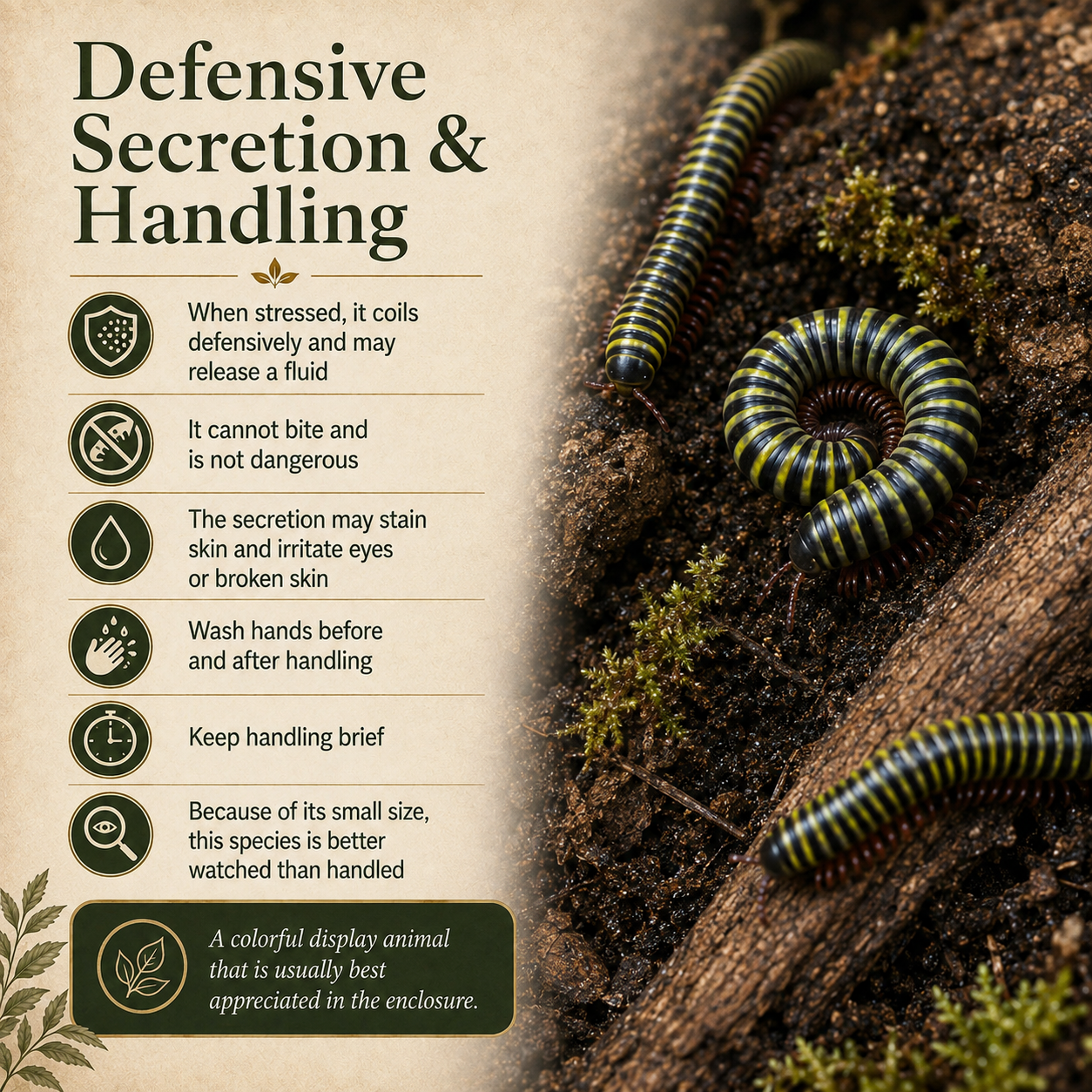
Like other millipedes, this species coils defensively and can release a fluid when stressed. It cannot bite and is not dangerous, but the secretion may stain skin and irritate eyes or broken skin. Wash hands before and after handling, and keep handling brief. Given the small size, this species is better watched than handled.
Bumblebee Millipede Care
Temperature (the one strict requirement)
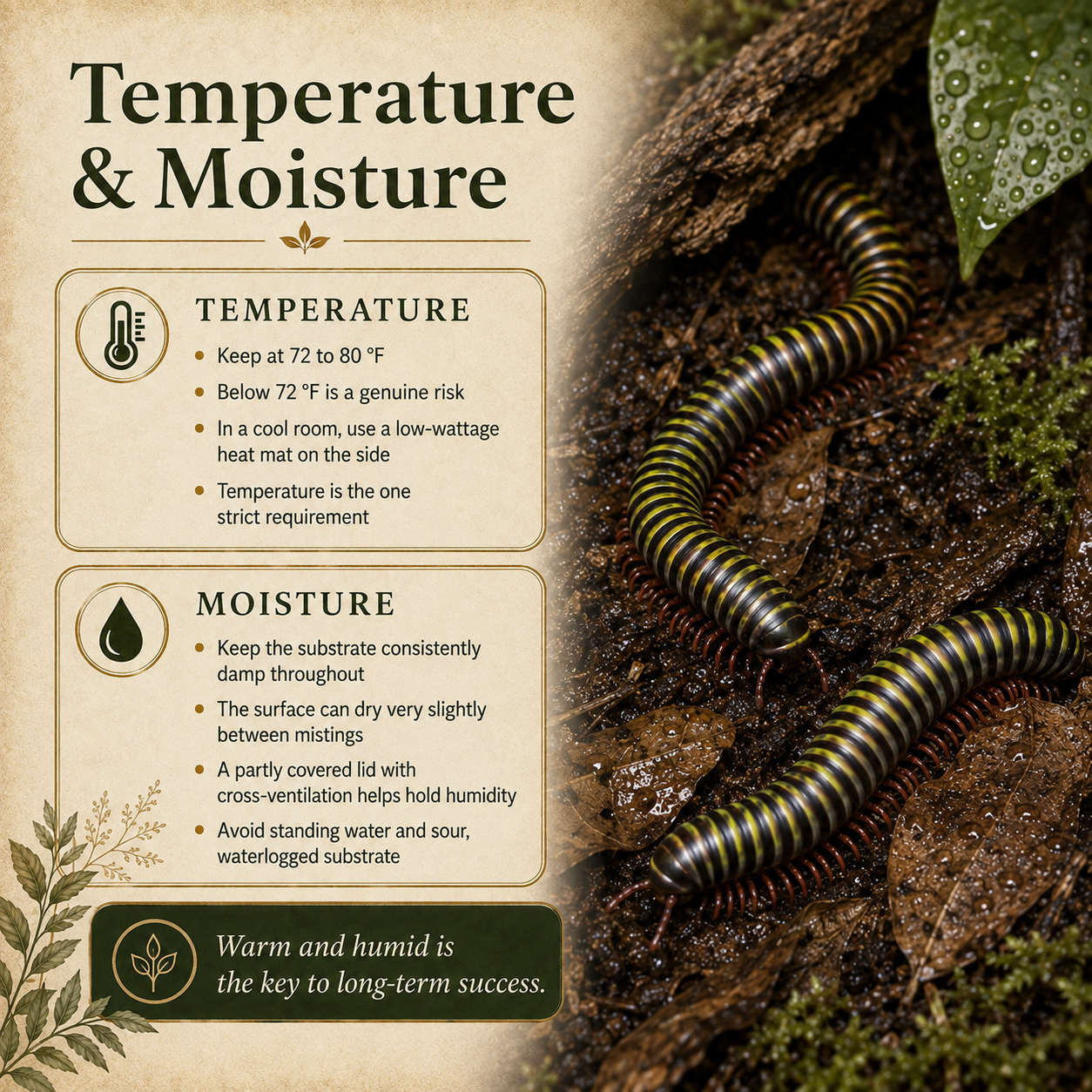
This is a tropical species and the most common reason keepers lose them. Keep them at 72 to 80 °F. They do not do well below 72 °F, and a cool room in winter is a genuine risk. If your enclosure sits in an unheated space, plan for a low-wattage side-mounted heat mat before ordering. Everything else about this species is forgiving. Temperature is not.
Moisture
Keep the substrate consistently damp throughout, more evenly moist than you would keep a scrub-habitat species. The surface can dry very slightly between mistings, but the enclosure should stay humid. A partly covered lid with cross-ventilation holds moisture better than a fully open top. Avoid standing water in the substrate and watch for sour or waterlogged conditions.
Enclosure and Substrate Depth
Because adults stay small, a modest enclosure works well. A ventilated critter keeper, small aquarium, or a modified storage container is fine. Aim for at least 3 to 4 inches of substrate so animals can burrow and molt undisturbed. This is one of the few millipedes that does not demand a tall, deep setup, which makes it easier to fit into an existing planted vivarium.
Diet
The habitat floor is the diet. Build it around:
- Decaying hardwood: well-rotted oak or similar non-resinous hardwood. Avoid pine and cedar.
- Leaf litter: a thick, replenished layer of aged hardwood leaves.
- Calcium: supports molting. Cuttlebone, crushed eggshell, limestone, or a fine calcium supplement worked into the substrate.
- Occasional extras: small pieces of soft fruit, cucumber, or squash. Remove leftovers before they mold.
Substrate is consumed over time and passed as small castings. Top off with fresh leaf litter and rotted wood rather than replacing everything at once, since an established habitat floor supports both the adults and any young developing in it.
Molting and Breeding
Animals molt underground and may stay buried for a stretch while they do. Do not dig for a millipede that has disappeared. For breeding, keep a group rather than a single animal, hold temperatures steady in the upper 70s, and leave the substrate alone. Development from egg to adult typically runs several months to about a year depending on conditions and food. Young are small, pale, and easy to miss, so go carefully during any substrate maintenance.
Origin and the 'Florida' Designation
Anadenobolus monilicornis is native to the Caribbean. It was introduced to the southeastern United States and was first recorded in Florida in 2001, where it has since naturalized. The 'Florida' in the trade name refers to that established Florida population as the source lineage, not to the species being native there. Some listings elsewhere describe this species as a Florida native, which is not accurate.
The captive bred designation is worth paying attention to with this species specifically. Wild-collected Bumblebees have a reputation among some sellers for being sensitive and shipping poorly. Captive bred animals are generally better adjusted to enclosure conditions. Because this is a naturalized non-native species, check your state and local regulations before ordering if you are unsure about restrictions in your area.
Who Should Buy a Bumblebee Millipede
Best for:
- Tropical planted vivariums kept consistently warm
- Keepers who want a millipede that may actually reproduce
- Smaller enclosures where a 5 inch native millipede would not fit
- Display setups where color matters
Less ideal for:
- Rooms that drop below 72 °F, particularly in winter
- Keepers wanting a large millipede. This species stays small
- Dry or arid setups
- Feeder use. This is a display animal
- Anyone wanting a single very long-lived specimen. Reported lifespans for this species are shorter and less consistent than for the large native millipedes
Recommended Add-Ons
Millipedes eat their habitat floor, so substrate and leaf litter are part of the animal's food supply:
- Assorted Hardwood Leaf Litter: a core part of the diet, consumed steadily and worth restocking. Also gives young millipedes cover as they develop.
- Ultra Isopod Substrate: a suitable foundation layer. This species needs less depth than the large natives, so 3 to 4 inches is enough.
- TC Calcium Ultra Fine: supports molting through the many stages between juvenile and adult. Work a small amount into the substrate and refresh periodically.
- ISO-COAL Isopod Charcoal Hides: surface hiding structure. Useful when keeping a group, since it gives animals separate retreats near the top of the enclosure.
- Ultra Isopod Habitat Kit: the 6 qt vented container suits this species better than it does the larger millipedes, since Bumblebees stay small and do not need extreme substrate depth.
Many customers also add springtails to help manage mold on the damp substrate surface.
Additional information
| Quantity | 1, 3, 5, 10 |
|---|
You must be logged in to post a review.
Related products
-
Sold Out
American Giant Millipede
$9.99 - $24.99Select options This product has multiple variants. The options may be chosen on the product page -
Sold Out
Purple Ivory Millipede
$14.99 - $86.99Select options This product has multiple variants. The options may be chosen on the product page -
Florida Ivory Millipede
$12.99 - $79.99Select options This product has multiple variants. The options may be chosen on the product page -
Maui Skunk Stripe Millipede
$24.99 - $79.99Select options This product has multiple variants. The options may be chosen on the product page

Reviews
There are no reviews yet.