
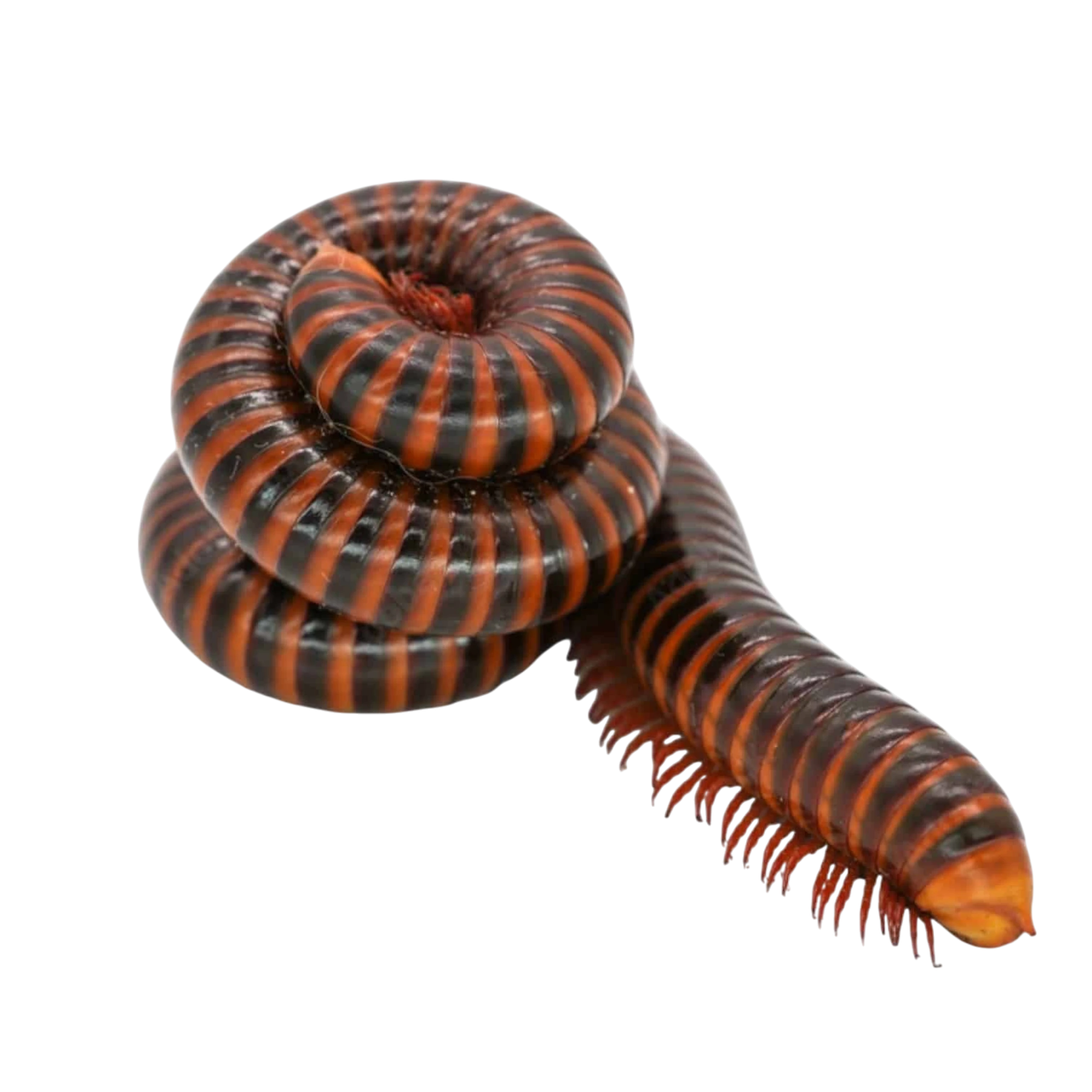

American Giant Millipede for Sale
The American giant millipede (Narceus americanus) is a native detritivore of eastern North America and one of the largest millipedes on the continent. It spends its time burrowing and slowly grazing on decaying wood and leaf litter, so it stays calm and easy to observe. As a result, it works both as a beginner display animal and as a living cleanup crew in a bioactive setup. One honest note up front: when handled, it can release a harmless fluid that may stain skin, so wash your hands afterward.
Overview
This species reaches around 4 inches when mature, with a cylindrical body, dark coloring, and lighter bands between each segment. It moves slowly and burrows often, which makes it low-stress to keep. Because it lacks a waterproof outer layer, it depends on steady humidity and a moist, food-rich substrate.
Unlike a predatory pet, this millipede asks for very little. It does not hunt, bite, or sting. Instead, it processes decaying plant matter, so much of its care overlaps with simply giving it the right substrate to live in and eat.
Why Keep an American Giant Millipede?
- Beginner-friendly. Generally, it is one of the most forgiving exotic invertebrates for new keepers.
- Long-lived. With good care, it can live several years, which is unusual for an affordable invertebrate.
- Communal. In addition, multiple millipedes usually share an enclosure peacefully, so a small group works well.
- Bioactive value. Because it breaks down wood and leaf litter, it helps recycle waste inside a planted enclosure.
- Calm to observe. Finally, its slow surface activity makes it easy to watch without stressing the animal.
Honest Note on Species Identification
The name “American giant millipede” covers a group of closely related millipedes, often called the Narceus americanus complex. As a result, animals sold under this name may be Narceus americanus or a very similar relative from the same group. For keepers, this distinction rarely matters, since care is nearly identical across the complex. However, we prefer to state it plainly rather than promise a single confirmed locality or subspecies.
Care and Setup
Care centers on humidity, the right substrate, and calcium for healthy molts. Use the points below as a practical framework.
Enclosure
A secure, well-ventilated terrarium or tub works well, with enough floor space for burrowing and surface roaming. A snug lid matters, since millipedes can push through small gaps. For a small group, give them extra room rather than the minimum.
Temperature
Normal indoor temperatures in the low to mid 70s Fahrenheit generally suit this species. Therefore, keep the enclosure away from cold drafts and direct sun. Stable conditions matter more than chasing an exact number.
Humidity
High humidity is essential, because this millipede dries out easily without a waxy outer layer. Mist regularly to keep the substrate damp but not waterlogged. In addition, a humid hide or a deeper moist zone gives the animal a place to recover moisture.
Substrate
The substrate is also the main food source, so build it from decaying hardwood and leaf litter rather than plain coco coir alone. Our Assorted Hardwood Leaf Litter works well mixed into a deep, moisture-holding base. Keep it several inches deep so the millipede can burrow and molt safely.
Diet
As a detritivore, it feeds mainly on rotting wood and decomposed leaves in the substrate. Beyond that, you can offer small amounts of fruit or vegetables as a supplement. However, remove uneaten produce quickly so mold and pests do not build up.
Calcium
Millipedes need calcium for a strong exoskeleton and clean molts. For that reason, dust food lightly or mix in a calcium source such as TC Calcium Ultra Fine. A cuttlebone left in the enclosure also gives them a steady supply.
Bioactive and Cleanup
This species fits naturally into a bioactive enclosure. Adding Springtails and Isopods helps control mold and break down waste alongside the millipede.
Breeding Notes
Mated females lay eggs in the substrate, and young millipedes hatch small with few segments, then add segments and legs as they molt. Because growth is slow, breeding rewards patient keepers more than those wanting fast results. A deep, stable, food-rich substrate gives the best chance of seeing young appear over time.
Best For
- First-time exotic keepers who want a hardy, slow, low-risk animal.
- Families and classrooms looking for a safe, observable invertebrate.
- Bioactive hobbyists who want a larger detritivore working alongside isopods and springtails.
- Keepers who prefer a calm display species over a feeder or predator.
Not Best For
- Anyone wanting a fast, interactive, or trainable pet, since this millipede is slow and mostly hidden.
- Dry desert-style setups, because this species dries out without steady humidity.
- Keepers who will not maintain a deep, wood-and-leaf substrate, which doubles as its food.
- People who dislike the staining defensive fluid and prefer a hands-off animal entirely.
Origin and Locality Notes
This millipede is native to eastern North America, where it lives in and under decaying logs and leaf litter. It ranges across the eastern United States and is most active in the warmer months. Because the trade name covers a species complex, this page focuses on practical captive care rather than claiming one precise wild locality.
Receiving and Acclimation
On arrival, open the package in a contained area and gently move the millipede into its prepared, pre-moistened enclosure. Afterward, give it a quiet day to burrow and settle before you check on it. During colder or hotter months, a temperature pack helps protect the animal in transit, so consider adding one at checkout.
Recommended Add-Ons
- Assorted Hardwood Leaf Litter as both substrate and a primary food source.
- TC Calcium Ultra Fine to support the exoskeleton and healthy molts.
- Springtails for mold control in the humid enclosure.
- Isopods as bioactive cleanup partners that share the same conditions.
- Shipping Add-Ons such as a heat or cold pack for safe seasonal shipping.
Frequently Asked Questions
Are American giant millipedes safe to handle?
Yes, they are gentle and do not bite or sting. However, when stressed they can release a defensive fluid that may temporarily stain skin, sometimes called millipede burn. Therefore, handle them gently, keep the fluid away from your eyes, and wash your hands afterward.
Are they good for beginners?
They are one of the easier exotic invertebrates to start with. Because they are slow, hardy, and forgiving, they suit new keepers, families, and classrooms well.
What do they eat?
They are detritivores, so decaying hardwood and leaf litter make up most of their diet. Our Assorted Hardwood Leaf Litter covers this, and you can add small amounts of fruit or vegetables as a treat.
Do they need calcium?
Yes, calcium supports their exoskeleton and molting. Accordingly, many keepers add TC Calcium Ultra Fine or leave a cuttlebone in the enclosure.
Can I keep more than one together?
Yes, this species is communal and usually shares space without conflict. For that reason, the 3 Pack is a simple way to begin a small group in one enclosure.
How big do they get and how long do they live?
Adults reach roughly 4 inches, which places them among the largest millipedes in North America. With stable humidity and good food, they can live several years.
Learn More About Millipedes
These sources give reliable background for keeping and understanding this species.
- Animal Diversity Web (University of Michigan): Narceus americanus. A detailed academic profile covering diet, defense, and the species’ role as a decomposer and in calcium cycling, which explains why substrate and calcium matter in captivity.
- University of Tennessee Entomology and Plant Pathology: Millipedes. A clear overview of millipede biology, including why they need moist habitats and how they fragment detritus, useful for setting up humidity and substrate.
- iNaturalist: Narceus americanus complex. Range maps, photos, and notes on the species complex, helpful for understanding what this trade name actually covers.
Reviews
There are no reviews yet.