
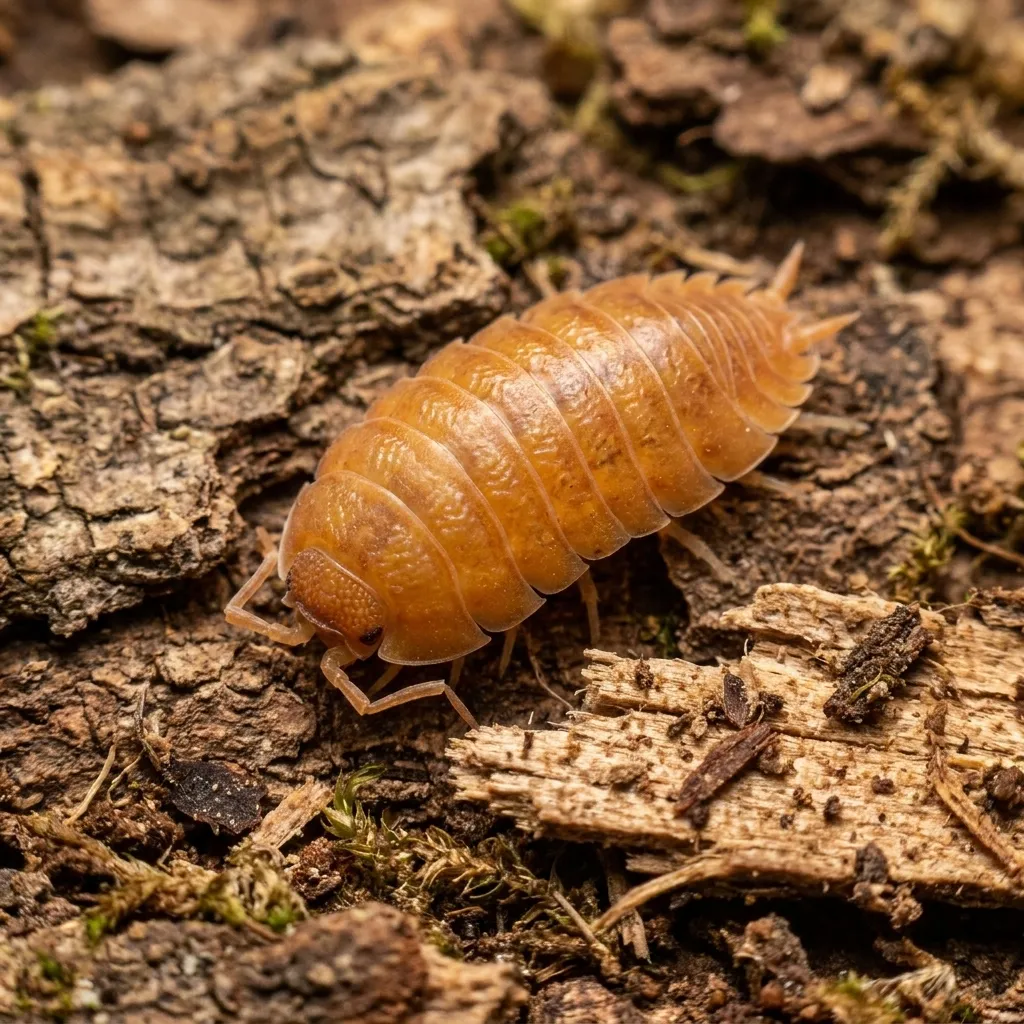

Orange Porcellio scaber Isopods for Sale
Overview
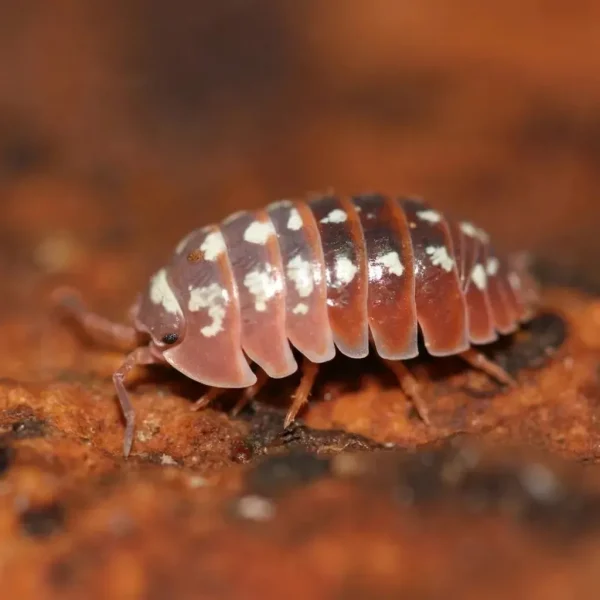
Porcellio scaber “Orange” is the classic foundational orange color morph of the common rough woodlouse. The wild form was originally described by Latreille in 1804 and is now one of the most studied terrestrial isopods on Earth.
This morph has been in the hobby trade for decades as the standard orange line. As a result, more intense morphs like Lava (deep orange-red) and pattern morphs like Orange Dalmatian (orange spots on pale base) were later developed from this base orange stock. Therefore, this is the original benchmark orange P. scaber color.
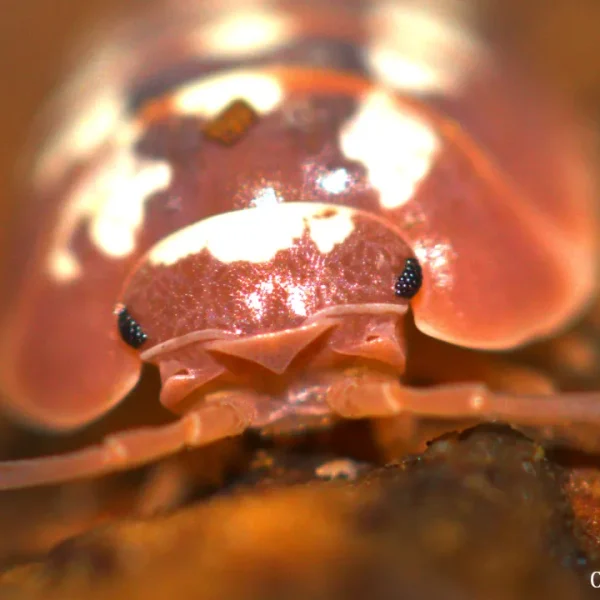
Furthermore, the body shows uniform bright orange across the rough textured dorsal surface that defines the species (scaber means “rough” in Latin). At 12 to 17 mm adult size, this morph suits keepers who want classic uniform orange without the price premium of Lava or the pattern variation of Orange Dalmatian.
Why Keep Porcellio scaber “Orange”?
Customers usually pick this morph for one or more of these reasons:
- Classic uniform orange. First, this is the foundational orange P. scaber color. As a result, the colony shows consistent bright orange across all adults rather than the variable patterns of Orange Dalmatian or the deeper reddish tones of Lava.
- Mid-price entry to P. scaber color morphs. Next, this morph is more affordable than Lava and slightly higher than Orange Dalmatian. Therefore, it suits keepers who want the standard orange look at a balanced price.
- Larger pack sizes available. Additionally, this line is offered in pack counts up to 50 individuals. As a result, it works well for keepers seeding larger enclosures or building working breeding colonies at scale.
- Drier moisture tolerance. Finally, like all Porcellio scaber morphs, this species handles a wider humidity range than dwarf isopods. Accordingly, it works in moderately humid setups that would crash dwarf species.
How This Compares to the Other Orange P. scaber Morphs
TC INSECTS carries three Porcellio scaber orange color morphs. Specifically, each suits a different buyer:
- Porcellio scaber “Orange” (this product). First, the foundational uniform bright orange line. Mid-price, larger pack sizes, classic look.
- Porcellio scaber “Lava”. Next, the deepest and most vivid orange-red intensity. Higher-priced, smaller pack sizes, most dramatic color.
- Porcellio scaber “Orange Dalmatian”. Finally, the spotted orange-on-pale pattern morph. Lower-priced, varies across individuals, Dalmatian-style look.
Furthermore, all three share the same care requirements and rough textured exoskeleton. Therefore, the choice comes down to color preference and price rather than husbandry difficulty.
Honest Note on Color Variation
“Orange” is a selectively bred color morph, not a fixed genetic line. As a result, individual coloration varies slightly across the colony. Specifically, most adults show bright uniform orange, but some animals lean toward slightly paler orange or slightly deeper tones. Furthermore, juveniles often look duller than mature adults.
However, the variation here is much narrower than in Orange Dalmatian (which shows full Dalmatian pattern variation). Therefore, this morph delivers more consistent uniform orange across the colony than the pattern morph but less intensity than Lava.
Care and Setup
Orange P. scaber care follows the standard species framework, which is among the most forgiving in the isopod hobby. Specifically, stable room temperatures, moderate moisture with a gradient, leaf litter, and gentle ventilation produce the best results. Moreover, this species tolerates beginner mistakes better than most isopods.
Temperature
Aim for 68 to 78°F. The species comes from temperate Europe. Therefore, it handles cooler indoor temperatures well and tolerates standard room temperature ranges without issue. However, avoid sustained heat above the mid-80s and direct sun exposure.
Humidity
Aim for 50 to 70% humidity with a moisture gradient. Specifically, keep one side moist with sphagnum moss and damp substrate. Then run a noticeably drier zone on the other side. Furthermore, this species tolerates a much wider moisture range than dwarf isopods.
Substrate
Use a moisture-retaining blend like coconut fiber mixed with flake soil or decayed hardwood. Then top with leaf litter and several pieces of cork bark.
In addition, add calcium sources such as TC Calcium Ultra Fine, crushed cuttlebone, eggshell, or limestone. Calcium availability matters particularly for color morphs, since orange coloration develops more cleanly across successive molts with strong calcium support.
Food
Orange P. scaber feeds on a wide range of decaying plant matter. Specifically, leaf litter, decaying hardwood (avoid pine and cedar), magnolia pods, and cork bark surfaces should always be available. Additionally, add small portions of vegetables like sweet potato, carrot, squash, zucchini, and mushroom.
For protein, use shrimp meal, fish flakes, insect frass, or nutritional yeast in small amounts. Alternatively, a prepared diet like TC INSECTS Isopod Food simplifies feeding and adds calcium support. Furthermore, P. scaber handles protein better than many isopods because of its larger body size.
Ventilation
Use moderate to strong ventilation. Specifically, sealed bins crash with mite blooms. However, heavy ventilation works fine for this species because of its drier tolerance. Therefore, a vented lid with substantial airflow strikes the right balance.
Bioactive Use
Orange P. scaber works in a wide range of bioactive setups alongside springtails. Specifically, it suits crested gecko tanks, planted terrariums, mantella enclosures, juvenile bearded dragon setups with humid hides, and naturalistic display vivariums.
Breeding Notes
Orange P. scaber breeds at a moderate to fast rate once established. Generally, a starter group of 10 to 20 takes a few months to build into a clearly visible working population.
Furthermore, stable conditions, deep leaf litter, calcium support, and moderate moisture produce the best results. Females carry developing young in a brood pouch under the body. Additionally, selecting the brightest orange adults for breeding can intensify the colony color over generations, since this is a selectively bred line rather than a fixed genetic morph.
Best For
- Display vivariums where classic uniform orange suits the build
- Moderately humid bioactive setups like crested gecko, mantella, and planted terrariums
- Juvenile bearded dragon enclosures with a humid hide
- First-time bioactive builders who want an affordable beginner-friendly orange morph
- Larger starter cultures or backup breeding colonies at scale (50-count packs available)
- Collectors building a complete P. scaber orange color lineup across all three morphs
Not Best For
- Fully arid enclosures with no humid retreat
- Use as a feeder for very small insectivores, since the adult size is too large; consider Dwarf Whites instead
- High-humidity dart frog tanks running 90%+ humidity, where Dwarf Purple fits better
- Buyers wanting the deepest possible orange-red intensity, since Lava goes more vivid
- Buyers wanting spotted pattern variation, since Orange Dalmatian shows that look
- Sealed, no-ventilation tubs, which crash this species faster than properly ventilated setups
Origin and Locality Notes
The wild form of Porcellio scaber was originally described by Latreille in 1804. Specifically, the species is native across Europe and has naturalized worldwide through trade. As a result, it is now one of the most widespread terrestrial isopods on Earth.
Furthermore, the “Orange” morph is the foundational selectively bred orange color form developed in the hobby trade from wild-color stock. Accordingly, this is the original orange hobby designer line rather than a separate wild species or locality. Captive care should reflect the species’ temperate European origin: cooler temperatures, moderate humidity, and tolerance for drier conditions than tropical isopods need.
Receiving and Acclimation
On Arrival
Open the package indoors as soon as possible after delivery. Then inspect the culture gently. However, avoid exposing the isopods to direct sun, heat, cold, or dry air. Porcellio scaber is hardier than most isopods, but careful acclimation still protects the colony.
Transferring to the Enclosure
Transfer the shipping material into a prepared enclosure. Specifically, the setup should include moisture-retaining substrate, sphagnum moss, leaf litter, bark hides, and calcium. Then place the packing near the moist side so the colony moves in naturally.
Settling Period
After that, leave the enclosure mostly undisturbed for the first week. As a result, the colony settles without stress. Furthermore, this species settles faster than slower-breeding collector morphs, so visible activity often returns within a few days.
Recommended Add-Ons
- TC INSECTS Ultra Isopod Habitat Kit for a vented setup with substrate, sphagnum, leaf litter, and starter feed
- TC INSECTS Isopod Food for a calcium-supported diet that helps the colony build faster and intensifies the orange color
- TC INSECTS Assorted Hardwood Leaf Litter for natural food, hiding cover, and humidity support
- TC Calcium Ultra Fine for molting and exoskeleton support, particularly important for color expression in selectively bred morphs
- Springtails to handle mold and biofilm alongside Orange P. scaber in bioactive setups
Frequently Asked Questions
How does this compare to Lava and Orange Dalmatian?
All three are Porcellio scaber color morphs with the same care requirements. However, the visual differs significantly. Specifically, Lava shows deep vivid orange-red intensity (the most dramatic). This “Orange” line shows classic uniform bright orange (the foundational standard). Orange Dalmatian shows orange spots on a pale base (the pattern morph). Therefore, choose based on color preference and budget.
How vivid is the orange color?
Classic bright orange, but not the deeper orange-red of Lava. Specifically, this is the standard foundational orange line that has been in the hobby trade for decades. As a result, the color is consistent and uniform across most of the colony, with minor variation between individuals.
Is this the same as Powder Orange isopods?
No. Powder Orange is a different species (Porcellionides pruinosus), with a smaller body size, smooth dusty coat, faster reproduction, and warmer humidity preference. Porcellio scaber “Orange” is larger, rough-textured, slower-reproducing, and drier-tolerant. Therefore, choose Powder Orange for humid tropical setups and small surface-active cleanup, or scaber Orange for larger visible isopods in drier setups.
Can Orange P. scaber live in a bearded dragon or crested gecko tank?
Yes, with conditions. Specifically, the enclosure must include a humid retreat (moist sphagnum moss or damp leaf litter) that does not dry out completely. As a result, juvenile bearded dragon and crested gecko tanks usually work because they include some humid zones. However, fully arid adult bearded dragon setups will not sustain the colony.
Are Orange P. scaber Isopods good for beginners?
Yes, one of the most beginner-friendly isopods in the hobby. Specifically, the wider moisture tolerance, larger body size, and forgiving temperature range make this species easier to keep than dwarf species or Cubaris. Therefore, first-time bioactive builders often start with P. scaber morphs before moving to more demanding species.
How fast does an Orange P. scaber culture grow?
Moderate to fast once established. Generally, a starter group of 10 to 20 takes a few months to build into a clearly visible working population. Furthermore, this species reproduces noticeably faster than slower collector morphs like Cubaris, which makes it accessible for keepers who want visible colony growth within months rather than years.
Learn More About Isopod Biology
The references below cover background information that helps keepers understand Porcellio scaber and broader terrestrial isopod biology. Each source comes from an academic, museum, or government site rather than a competing retailer.
- British Myriapod and Isopod Group: Porcellio scaber. Species-specific reference for the wild form, including UK distribution, habitat preferences, and identification notes. Useful for understanding the natural microhabitats and care framework that applies to selectively bred color morphs like Orange.
- World Register of Marine Species: Isopoda. Scientific taxonomy reference for the order Isopoda. Useful for confirming how Porcellio scaber fits within the Porcellionidae family alongside other common hobby genera.
- Animal Diversity Web: Porcellio scaber. Academic overview of the species including native range, distribution through trade, habitat preferences, and life history. Useful for understanding why this species adapts to such a wide range of captive setups.



Reviews
There are no reviews yet.