

Cubaris Citrus Isopods for Sale
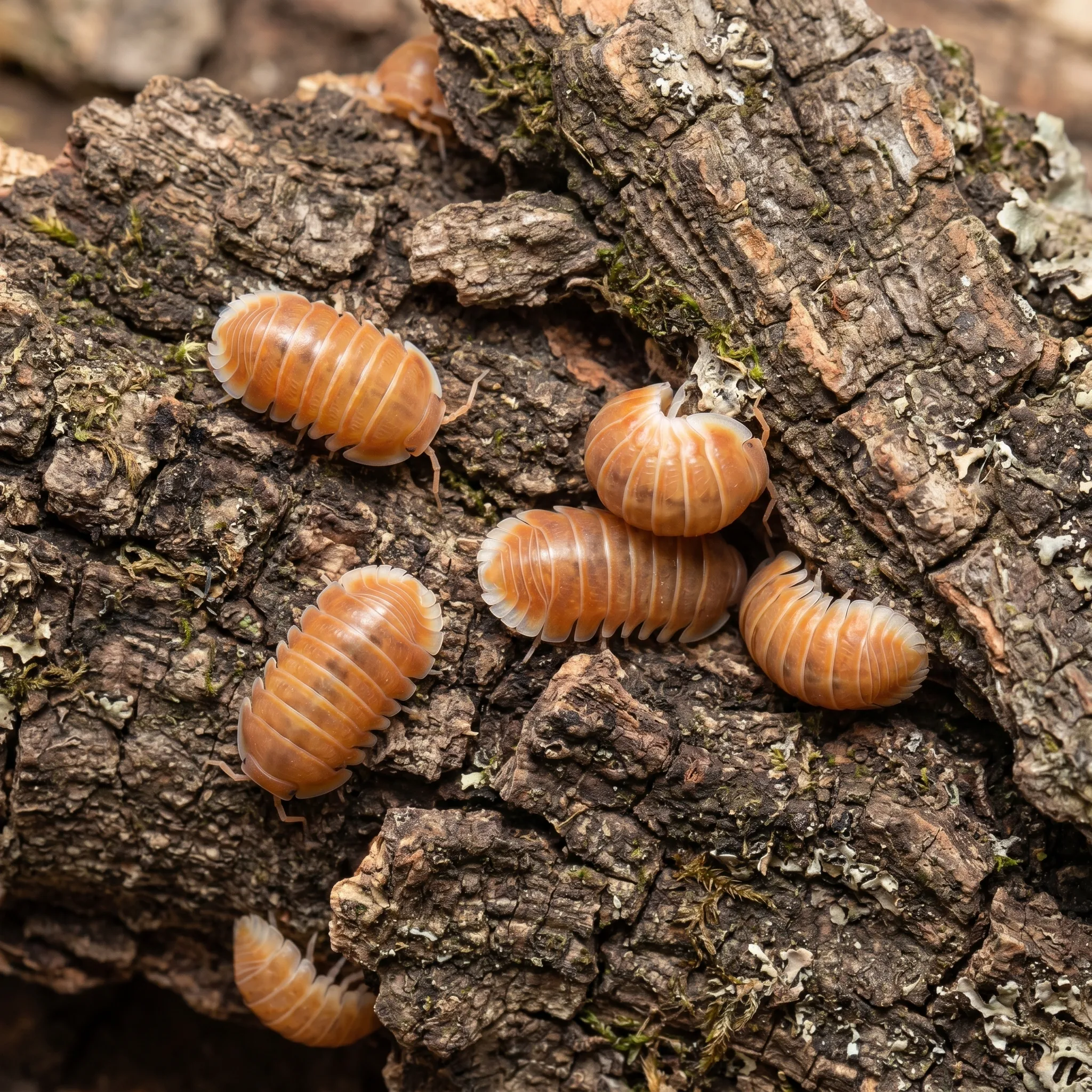
TC INSECTS ships live captive-bred Cubaris sp. “Citrus” as a mixed-size starter group for display cultures, breeding projects, and tropical bioactive setups. This is the double morph of the Panda King — the fourth position in the TC INSECTS panda-line color-and-pattern matrix, combining two separate mutations in a single animal. For full Cubaris genus background, see the Rubber Ducky product page.
Overview
Cubaris sp. “Citrus” is a formally undescribed species in the family Armadillidae from Malaysia and Thailand. It is a morph of the Panda King line, related to but distinct from the Red Panda and Black Panda morphs. Citrus is specifically described by multiple hobby sources as a double morph expression — carrying both the Red Panda color mutation and the Black Panda pattern mutation simultaneously.
The Double Morph — What It Means
The standard Panda King shows dark gray segments with two white bands near the head. The Red Panda replaces the dark gray with orange-red while keeping the white bands. The Black Panda suppresses the white bands while keeping the dark body. Citrus combines both changes: the dark gray becomes orange-to-citrus-warm, and the white bands are suppressed or absent.
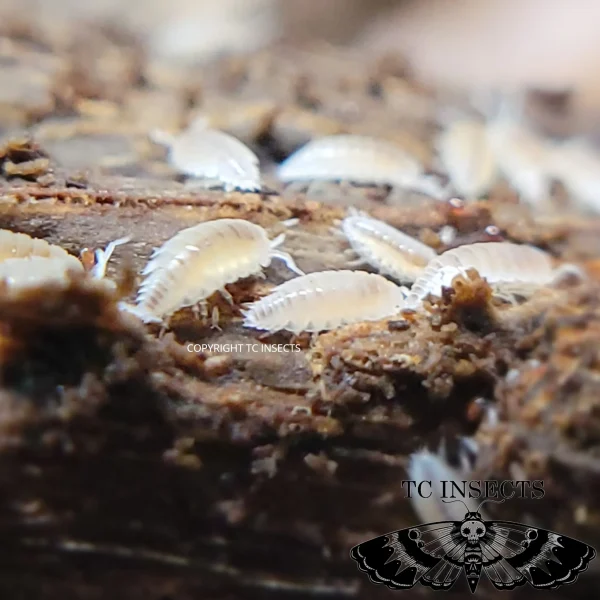
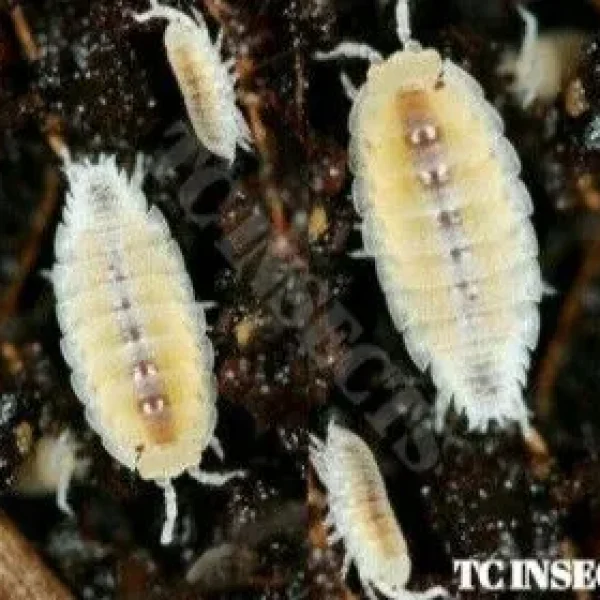
The result is a completely or mostly uniform warm citrus-orange body with no dark segments and no white bands visible. The panda pattern — the two-toned dark-and-white visual that names the whole line — is effectively removed, leaving a warm, all-over citrus tone. The “citrus” name comes from the orange, peach, and golden tones this double expression produces.
The Panda-Line Color Matrix
The four panda-line morphs in this catalog form a complete two-variable color matrix. Each changes one or both of the two elements that define the standard Panda King pattern: the dark body segments and the white bands.
Panda King: dark gray segments + white bands = original wild form. Red Panda: orange-red segments + white bands = color change only. Black Panda: dark segments + no white bands = pattern change only. Citrus: orange-citrus segments + no white bands = both changes together. Citrus is the fourth quadrant — the animal that results when both mutations are present at once.
Honest Note: Color Varies Between Individuals
The citrus tone in this morph spans a range — from light peach through orange to deeper red-orange. Some individuals appear more yellow-golden; others show deeper orange or red-orange. Some may retain faint white at the rump or lateral edges. This variation is natural and expected within the double morph expression. The warm citrus range is consistent across the colony, but expect individual variation rather than uniform flat color across every animal.
Care
Setup Framework
Use a ventilated enclosure with 3 to 4 inches of organic substrate. Keep one side moist with sphagnum moss and the other side slightly drier with cork bark hides and leaf litter. Maintain 75 to 80°F and 60 to 80% humidity with moderate ventilation. This is a beginner-accessible *Cubaris* — more forgiving of care variation than the ducky-type species and comparable to the standard Panda King in tolerance.
Temperature
Hold 75 to 80°F. This is slightly warmer than the Red Panda and Black Panda’s 70–78°F preference and aligns more with the ducky-type range. Stable warmth in the mid-to-upper 70s drives the best activity and breeding results. Avoid temperature drops during the establishment phase and prolonged exposure above 82°F.
Humidity
Maintain 60 to 80% with a clear moist-to-drier gradient. This is a medium-high range — more forgiving than the 70–80% required by ducky types. Keep the moss zone consistently moist. Allow the other side to stay drier. Good airflow prevents stagnation without drying the culture. Citrus handles the humidity range better than most other *Cubaris* in this catalog.
Calcium and Food
Keep TC INSECTS Assorted Hardwood Leaf Litter and decaying hardwood available at all times as the diet base. Offer protein twice per week through TC INSECTS Isopod Food, dried shrimp, or fish flakes. Fruits and vegetables high in carotenoids — mango, carrot, pumpkin — are well-received. Provide TC Calcium Ultra Fine, cuttlebone, or limestone at all times for molting support.
Springtails
Pair with Springtails for mold control in the moist zone. In the warm, humid conditions this species needs, springtails prevent mold buildup without requiring the keeper to compensate with excessive ventilation.
Breeding Notes
Females carry developing young in a marsupium. Citrus is described as prolific by multiple hobby sources — comparable to the standard Panda King’s breeding productivity after establishment. Mancae burrow immediately after release. Surface activity builds as the colony grows. Minimal disturbance, stable humidity, and consistent calcium access drive breeding success.
A backup culture is recommended before seeding any vivarium. The colony needs time to build to a working population before regular cleanup crew contributions are reliable.
Best For
- Collectors completing the panda *Cubaris* four-morph matrix — Citrus is the double-morph fourth position
- Keepers who want a warm uniform citrus-orange Cubaris without dark segments or visible banding
- Beginner-to-intermediate keepers entering Cubaris who want an accessible species with more visual distinctiveness than the standard Panda King
- Tropical display vivariums and planted setups where warm orange-peach tones complement the color palette
- Anyone who keeps Panda King, Red Panda, or Black Panda and wants the fourth morph to complete the matrix
Not Best For
- Dry or cool setups. The 75 to 80°F and 60 to 80% humidity requirements apply regardless of the accessible care level.
- Keepers wanting dramatic panda banding. Citrus has suppressed white bands — the panda pattern is mostly gone. See Panda King for the classic banded look.
- Fast high-volume cleanup crew use. Citrus is a display and collector species first.
Receiving and Acclimation
Open the package in a calm indoor area soon after delivery. Place all packing material directly into the prepared enclosure. Position animals near the moist zone under bark or leaf litter. Leave the culture mostly undisturbed for one week.
First Week Priorities
Reach 75 to 80°F and 60 to 80% humidity before the animals arrive. Feed lightly for the first week — leaf litter, a small protein offering, and calcium. Check whether food disappears before the next offering. Hiding for days after arrival is normal. Do not excavate the substrate or repeatedly lift hides.
Recommended Add-Ons
- TC Calcium Ultra Fine alongside cuttlebone for continuous calcium access.
- TC INSECTS Assorted Hardwood Leaf Litter as the primary diet foundation and surface cover.
- TC INSECTS Isopod Food for the twice-weekly protein rotation.
- TC INSECTS Isopod Habitat Kit for a complete accessible starter setup suited to this intermediate-friendly species.
- Springtails for mold control in the warm, humid culture environment.
Frequently Asked Questions
What makes Citrus different from Red Panda?
Red Panda replaces the dark gray body segments with orange-red while the white bands near the head remain intact. Citrus carries both the color change and the white-band suppression — the double morph. As a result, Citrus shows no white bands and no dark segments: the entire body reads as a warm citrus tone. Red Panda still shows the two-toned panda pattern in orange-red and white; Citrus removes the pattern entirely.
What makes Citrus different from Black Panda?
Black Panda suppresses the white bands while keeping the dark body segments — producing a predominantly dark animal. Citrus suppresses the white bands while also changing the dark body segments to warm orange-citrus — producing a warm, light-toned animal. Both morphs lack the white bands. The difference is body color: Black Panda dark, Citrus warm orange-peach.
How does the double morph work?
The panda-line has two independent mutation sites: one affecting body color (dark gray → orange-red, as in Red Panda) and one affecting the white banding (bands present → bands suppressed, as in Black Panda). An animal that carries both mutations simultaneously expresses both changes at once — that is the Citrus. It is not a cross between Red Panda and Black Panda necessarily, but rather an individual that carries both recessive traits and expresses them together.
Is Citrus beginner-friendly for Cubaris?
Yes, relatively. Citrus is described as well-adaptive and beginner-accessible by multiple hobby sources — similar to the standard Panda King in tolerance. The 60 to 80% humidity range and 75 to 80°F temperature preference are more achievable in typical home setups than the stricter demands of the ducky-type species. A careful beginner who can maintain these parameters consistently can succeed with Citrus as their first Cubaris.
Can I keep all four panda-line morphs together?
Yes, without harm — all four are the same species and coexist freely. However, mixed pairings produce offspring with varied coloring across the four expressions over time. If maintaining the Citrus double-morph visual specifically matters, keep Citrus in a dedicated bin rather than mixing with Panda King, Red Panda, or Black Panda cultures.
Learn More About Cubaris Citrus
These sources give useful context on the genus, the Malaysia/Thailand distribution, and the biology behind this species.
-
GBIF: Cubaris Brandt, 1833. The Global Biodiversity Information Facility record for the genus, with observation data spanning Thailand, Malaysia, and surrounding Southeast Asian regions. The broader Malaysia-and-Thailand distribution of the Citrus line reflects the wider geographic range of Panda King-lineage populations compared with the more localized Thai limestone cave origins of the ducky-form species — which partly explains why Citrus and other Panda King morphs tend to be more adaptable in captive care.
-
Wikipedia: Armadillidae. The family overview covering the ~80 genera and 700+ species in the family containing Cubaris. The article covers the strongly convex body shape and the family’s concentration in tropical regions. In the context of Citrus specifically, the family’s tropical distribution explains why the 75 to 80°F and medium-high humidity requirements persist even in the more accessible panda-line morphs — these are not beginner-in-the-western-sense species, but rather beginner-accessible within a tropical-origin family that always needs warmth and humidity.
-
PMC / NCBI: Water conservation in terrestrial isopods. Research on gill-structure humidity management in terrestrial isopods. Relevant to understanding why Citrus’s 60 to 80% humidity floor exists even though the species is relatively forgiving by Cubaris standards — the gill biology of all tropical Southeast Asian Cubaris requires consistent minimum humidity for successful molting and reproduction, regardless of how adaptable the species is in other respects.


Reviews
There are no reviews yet.