

Champagne Zebra Isopods for Sale
Overview
Champagne Zebra isopods are a cultivated color morph of Armadillidium maculatum, the Zebra Isopod. The base species was described by Risso in 1816 and is native specifically to southern France, which makes it one of the more geographically restricted Armadillidium species in the hobby. The Latin species name “maculatum” means “spotted” or “mottled,” referring to the striking patterning that gives this species its common Zebra Isopod name.
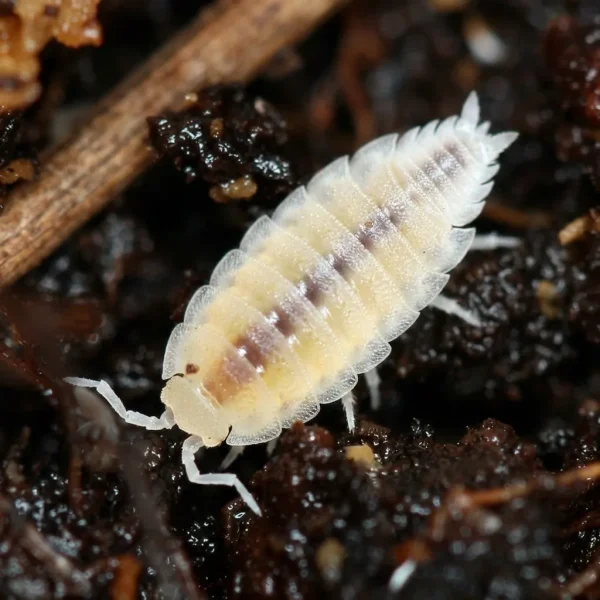
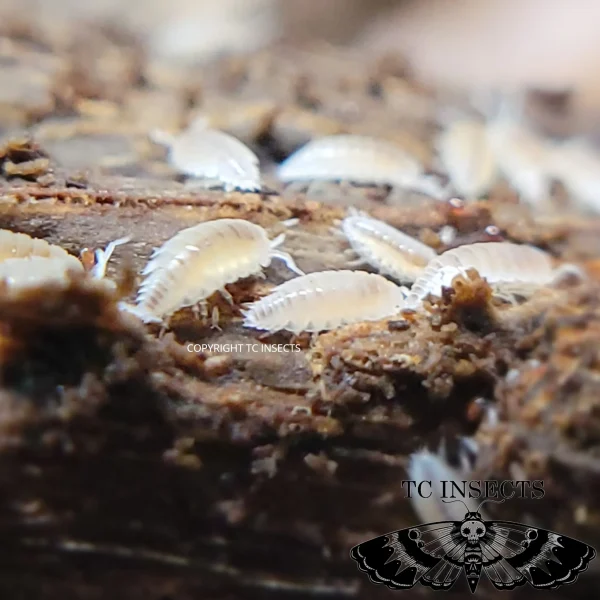
The Champagne morph keeps the species’ signature white stripes but replaces the wild-type black base with a light beige. As a result, the colony has a softer, warmer look while preserving the classic Zebra body shape and behavior. Adults reach up to 18 mm and roll fully into a sealed ball when disturbed.
Why Keep Champagne Zebra Isopods?
- Beginner-friendly Zebra morph: First, this is one of the more forgiving display isopods in the hobby, with stable breeding under normal room conditions.
- Lighter Zebra look: Additionally, the beige base gives the white stripes a champagne-toned contrast that differs visually from the high-contrast wild-type Zebra.
- Full conglobation: As a family Armadillidiidae member, Champagne Zebra rolls completely into a sealed ball, unlike Armadillidium depressum “Magic Potion”, which leaves a gap.
- Documented species biology: Furthermore, A. maculatum is one of the better-studied Armadillidium species, with peer-reviewed research on its mimicry and molting behavior.
- Cohabits with wild-type: Finally, since Champagne and wild-type Zebra are the same species, you can cohabit both color forms in one colony without hybridization risk.
Honest Note on the “Champagne” Color Morph
Champagne is a cultivated color variety, not a wild-collected line. Specifically, the morph differs from wild-type Zebra in a single dimension: the base color is light beige instead of black, while the white zebra stripes remain the same. As a result, this is a base color morph rather than a pattern morph like the dalmatian-style Mardi Gras or Magic Potion lines.
Color expression varies between individuals. Some Champagne Zebra animals show very pale beige tones while others lean closer to a warmer tan or cream base. The variation is normal for the morph and not a sign of culture drift. To maintain strong Champagne expression over generations, select the cleanest-toned individuals as breeders.
Honest Note on Batesian Mimicry
The wild-type Zebra striping is widely interpreted as Batesian mimicry of Glomeris marginata, the pill millipede that shares the same southern French range. Glomeris marginata secretes noxious defensive chemicals when disturbed, so predators learn to avoid the striped pattern. A. maculatum, which has no comparable chemical defense, gains protection by looking similar enough to fool predators.
This matters because the Champagne morph trades some of that protective coloration for a lighter base. In captivity that does not matter, since predators are not the limiting factor in a display tank. However, it is worth understanding what the wild-type stripes are actually for, since this is one of the few hobby isopods with documented evolutionary biology behind its appearance.
Honest Note on Biphasic Molting
A. maculatum sheds its exoskeleton in two halves, one at a time. Specifically, the back half of the body molts first, followed by the front half a few days later. As a result, you may see individuals that look two-toned during the molt window, with one half darker and one half lighter. This is normal documented behavior, not a sign of illness or stress.
During molting, the colony needs steady calcium access. Keep a calcium source available at all times so the new exoskeleton hardens properly. Avoid heavy disturbance while individuals are visibly mid-molt, since the soft new shell is vulnerable until it hardens.
Care and Setup
Champagne Zebra isopods do well at room temperature with a clear dry-to-moist gradient and good airflow. The following sections cover the practical husbandry framework we recommend.
Temperature
Target 70 to 80°F across most of the year. Specifically, this species does especially well around 75 to 80°F, although normal room temperatures usually work fine. Avoid sustained heat above the mid-80s and cold rooms below 65°F.
Humidity
Aim for moderate humidity overall with one consistently moist retreat zone. Keep that side hydrated with sphagnum moss and damp substrate, then let the rest of the enclosure run drier. Specifically, many keepers run the moist side at roughly one-third to one-half of the floor area, with the remaining surface drier.
Substrate
Use a moisture-holding mix of soil, rotted hardwood, and organic matter at a depth of 2 to 3 inches. Add a generous layer of TC INSECTS Assorted Hardwood Leaf Litter on top. Leaf litter functions as both food and cover, so deeper layers help support breeding.
Food
Lead with leaf litter and decaying hardwood as the base diet. Then supplement with TC INSECTS Isopod Food for added protein and minerals, plus a calcium source like TC Calcium Ultra Fine. The biphasic molting cycle means consistent calcium access matters more for this species than for many others.
Ventilation
Use cross-ventilation or controlled lid ventilation. Specifically, you want enough airflow to prevent stagnant pockets, but not so much that the moist retreat dries within a day. As a result, the colony can self-select between the two humidity zones.
Bioactive Use
Champagne Zebra works well in moderate-humidity bioactive enclosures once the culture is established. However, run a backup culture in a dedicated bin first. Display morphs always benefit from a protected source colony in case the display setup has a setback.
Breeding Notes
Champagne Zebra breeds at a moderate-to-good pace once settled. Females carry developing mancae in a brood pouch, and stable conditions with consistent moisture and calcium support successful broods. Generally, the colony produces visible juveniles regularly without aggressive intervention.
For best results, leave the colony undisturbed during the first six to eight weeks. Then add fresh leaf litter before the existing layer is fully consumed, and avoid frequent digging through the substrate. To maintain strong Champagne color expression over generations, select clean-toned individuals as breeders.
Best For
- Beginner-friendly display cultures focused on Zebra Isopod morphs
- Collector setups building a multi-color Zebra colony alongside wild-type and other A. maculatum forms
- Planted vivariums with moderate humidity at room temperature
- Bioactive setups paired with springtails for cleanup support
- Keepers who want a documented well-studied species with real published biology
Not Best For
- Sealed fully wet tropical setups suited to high-humidity Cubaris species
- Dry desert enclosures without a permanent humid retreat zone
- Feeder use, since the rolled defensive posture and harder exoskeleton make this a poor feeder pick
- Mixed-species cultures with other Armadillidium, since species identity drifts when lines blur
- Cold rooms running consistently below 65°F
- Buyers expecting the high-contrast wild-type Zebra look (Champagne is softer)
Origin and Locality Notes
Armadillidium maculatum was described in 1816 by Antoine Risso. The species is native to a relatively small natural range in southern France, which is unusually restricted compared with widespread Armadillidium species like A. vulgare and A. nasatum. As a result, A. maculatum in the hobby trace back to that limited natural population rather than to widely introduced lines.
The Champagne morph is a cultivated color variety. Specifically, the line was developed through selective breeding for the lighter beige base, not collected from a separate wild population. Therefore, we treat the “Champagne” hobby designation as a cultivated morph reference, not a locality record. Captive husbandry follows the general A. maculatum care framework.
Receiving and Acclimation
Open your package promptly when it arrives and inspect the cup calmly before moving anything. Rolling isopods often arrive curled up or hidden in moss and shipping paper, so check slowly rather than dumping the culture.
Prepare the enclosure before opening the cup. The habitat should already have moderate-humidity substrate with one moist retreat zone, deep leaf litter, bark, and a calcium source. Then place the shipping material into the enclosure and let the isopods move out on their own. Finally, keep the setup quiet for the first week while the colony settles.
It is normal for new arrivals to stay curled or hidden for the first several days. Additionally, if you see any animals that look two-toned (front and back halves different colors), this is biphasic molting, not damage. Leave them alone until the molt completes.
Recommended Add-Ons
- TC INSECTS Isopod Habitat Kit — a complete starter setup that gives this beginner-friendly culture proper substrate, leaf litter, moss, and feed from day one.
- TC INSECTS Assorted Hardwood Leaf Litter — the core food and cover layer that should never run out in a Champagne Zebra culture.
- TC INSECTS Isopod Food — supplemental protein and minerals beyond leaf litter, fed in small portions to support the active breeding cycle.
- TC Calcium Ultra Fine — especially relevant for this species, since the biphasic molting cycle means consistent calcium access matters more than for most isopods.
- Springtails — pair well with Champagne Zebra in moderate-humidity bioactive setups to help manage mold around the moist retreat zone.
Frequently Asked Questions
Is Champagne the same species as wild-type Zebra?
Yes. Both are Armadillidium maculatum, just with different base colors. Wild-type shows the high-contrast black-and-white striping, while Champagne replaces the black base with a light beige. As a result, you can cohabit both color forms in one colony without hybridization concerns.
Why are the stripes there in the first place?
The wild-type striping is widely interpreted as Batesian mimicry of Glomeris marginata, a pill millipede that shares the same southern French range. Glomeris secretes noxious chemicals, so predators learn to avoid the striped pattern. A. maculatum has no comparable defense and gains protection by looking similar.
Why do mine sometimes look two-toned during molting?
This is biphasic molting. Specifically, A. maculatum sheds its exoskeleton in two halves, with the back half going first and the front half a few days later. As a result, individuals in mid-molt may look like the two halves are different colors. This is normal documented behavior, not a sign of stress or illness.
Are Champagne Zebra isopods beginner-friendly?
Yes. They are one of the more forgiving display isopods in the hobby, with stable breeding under normal room conditions. First-time keepers can start with this species confidently as long as they provide a moisture gradient, leaf litter, and calcium.
How does Champagne compare to other morphs like Magic Potion?
Champagne is a base color morph, while Magic Potion is a pattern morph with white background and yellow flecking. Specifically, Champagne keeps the Zebra stripes but lightens the base, while Magic Potion changes the overall pattern entirely. The two morphs come from different species, so they cannot be cohabited.
How fast do they breed?
Moderate to good once established. They do not produce the explosive booms seen with workhorse cleanup species like Porcellio laevis “Dairy Cow”, but they produce regular visible juveniles under stable conditions.
Learn More About Armadillidium maculatum
-
Wikipedia: Armadillidium maculatum. The main species reference covering Risso’s 1816 original description, the southern France native range, biphasic molting behavior, and the documented Batesian mimicry of Glomeris marginata. Useful for understanding why the wild-type stripes exist and what makes this species biologically distinctive.
-
World Register of Marine Species: Armadillidium maculatum Risso, 1816. The authoritative taxonomic record with the accepted name, original description, and current synonym list. Useful for buyers who want to verify the species and confirm its formal taxonomy.
-
PubMed Central: Terrestrial isopods, soil, and litter interactions. An open-access review of how land isopods interact with leaf litter, moisture, and substrate. Useful for keepers who want the science behind why deep hardwood leaf cover and stable calcium availability matter for a steadily breeding species like this one.


Reviews
There are no reviews yet.