
Praying Mantis Care Sheet
Complete husbandry for the praying mantises keepers actually raise: Chinese, Carolina and European mantises plus the popular ghost, orchid and giant Asian mantises. A species comparison, enclosure height for safe molts, humidity and water, what praying mantises eat from hatchling to adult, egg cases, the law, and a troubleshooting chart.
Most species live under a year; females outlive males.
The Chinese mantis is the largest in North America.
Easy as adults. The molts and first weeks are the tricky part.
Meet the Praying Mantis
A praying mantis is an ambush predator built around two spined front legs, a triangular head that swivels to watch you, and a great deal of patience. Mantises hatch from a foamy egg case as tiny nymphs, molt their way up in size over the following months, grow wings at the final molt in most species, and live out the rest of a life that usually lasts less than a year.
Most mantises kept in the United States fall into two groups. The temperate species, the Chinese, Carolina and European mantises, live wild across much of the country, do well at room temperature, and are what hatch from the egg cases sold at garden centres. The tropical exotics, the ghost, orchid and giant Asian mantises, come from Africa and Southeast Asia and want warmer, more humid conditions.
Whichever you keep, the shape of care is the same: one mantis per enclosure, a tall space to molt in, droplets to drink, and a steady supply of live prey sized to the mantis.
Which Mantis Is Which?
The six species keepers raise most often, side by side. Lifespans are from hatching.
| Species | Adult Size | Lifespan | Temperature | Humidity | Good To Know |
|---|---|---|---|---|---|
| Chinese (Tenodera sinensis) | Up to about 4 inches | 8 to 12 months | 70 to 85 F | 60 to 65 percent | Largest mantis in North America; garden-centre egg cases |
| Carolina (Stagmomantis carolina) | About 2 to 2.4 inches | 8 to 12 months | 70 to 80 F | 50 to 60 percent | Native and hardy; adult females have short wings |
| European (Mantis religiosa) | 2 to 3 inches | Females 11 to 12 months, males 7 to 8 | 70 to 80 F | 50 to 60 percent | Hardy and cold tolerant |
| Ghost (Phyllocrania paradoxa) | About 2 inches | 7 to 12 months | 68 to 82 F | 60 to 90 percent | Plays dead when disturbed; a favourite first exotic |
| Orchid (Hymenopus coronatus) | Females about 3 inches, males under half that | 5 to 9 months | 75 to 90 F, not below about 70 at night | 60 to 80 percent, drier for nymphs | Nymphs are the most delicate stage in this table |
| Giant Asian (Hierodula) | 2.8 to 3.5 inches | 6 to 12 months | 72 to 86 F | 60 to 70 percent | Hardy beginner species, often mislabelled in the trade |
What You Will Need
A mantis setup costs very little. What it needs is height, grip, and a reliable source of live food.
The Enclosure and the Molting Hang
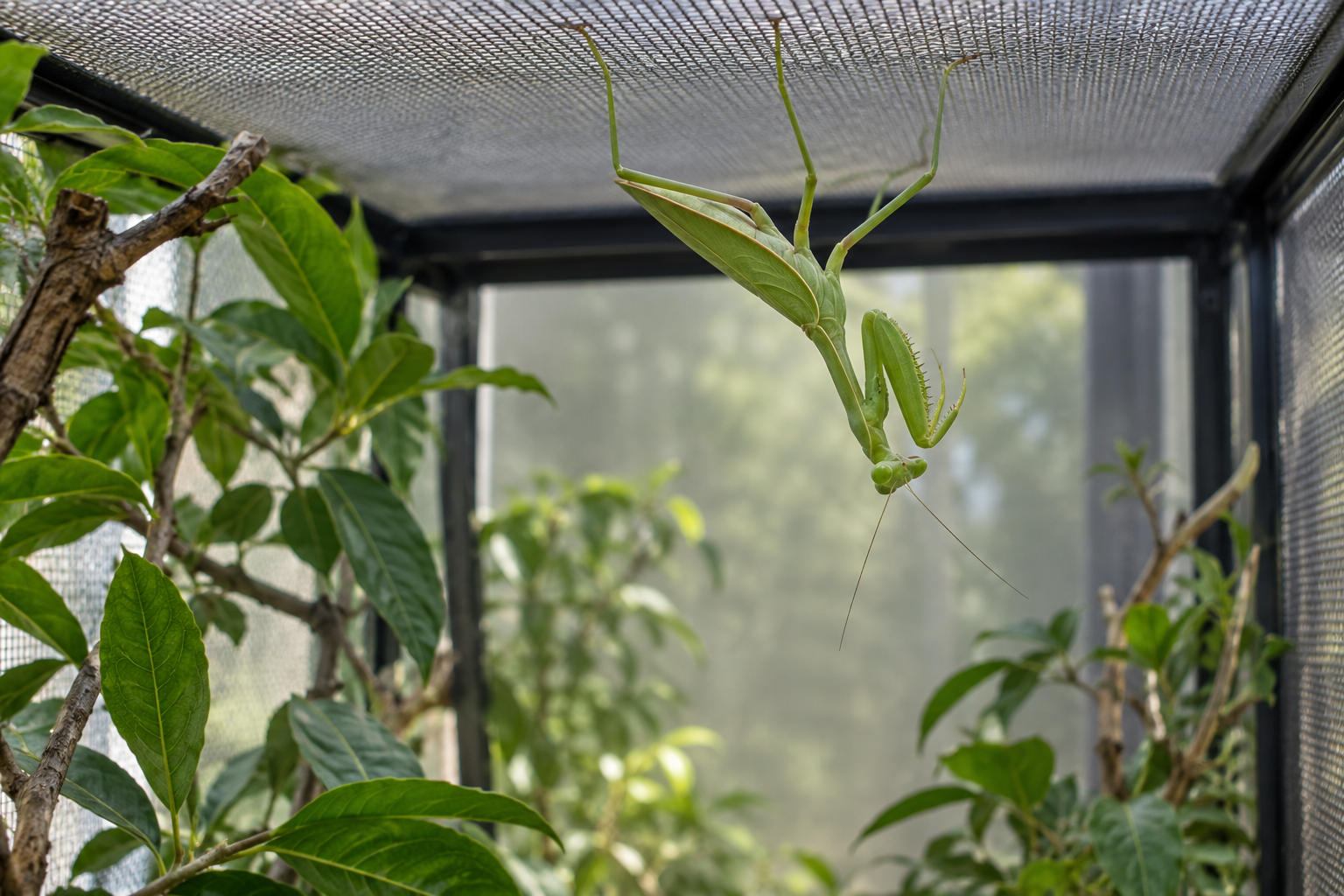
Height is the number that matters most. Before every molt a mantis climbs to the highest point, hangs upside down by its back legs, and uses gravity to pull itself out of its old skin. Give it at least three times its body length in height, and ideally four, with width about twice its body length. Too little clearance and a mantis can hit the floor mid-molt, one of the most common ways captive mantises die or end up with crumpled legs and wings.
The lid needs something to grip, such as mesh or a textured surface, plus a few twigs or silk plants as extra anchors. Tropical species need good ventilation so the air never sits stagnant and wet, which invites mould. In small nymph cups, plain paper towel is the easy, mould-free substrate; larger enclosures can use coco fiber to help hold humidity.
Keep every mantis on its own. All of these species turn cannibal after the first few molts, and siblings from the same egg case will eat each other, so move hatchlings into individual containers early. Orchid mantis nymphs need separating almost immediately.
Temperature, Humidity and Water
The temperate mantises, Carolina and European, are comfortable at ordinary room temperature and moderate humidity, and the Chinese mantis sits close to them. The tropical species need more: ghost mantises around 68 to 82 degrees, giant Asian mantises 72 to 86, and orchid mantises 75 to 90 degrees and never below the mid 60s at night.
Mantises do not drink from dishes. They drink droplets, so mist the enclosure walls and leaves rather than setting out water, and keep the spray off the mantis itself. Match misting to the species: more for tropical mantises, less for temperate ones, and noticeably drier for young orchid mantis nymphs, which are sensitive to excess humidity. A shrivelled-looking abdomen means mist more; fuzzy mould means mist less or add airflow.
What Praying Mantises Eat
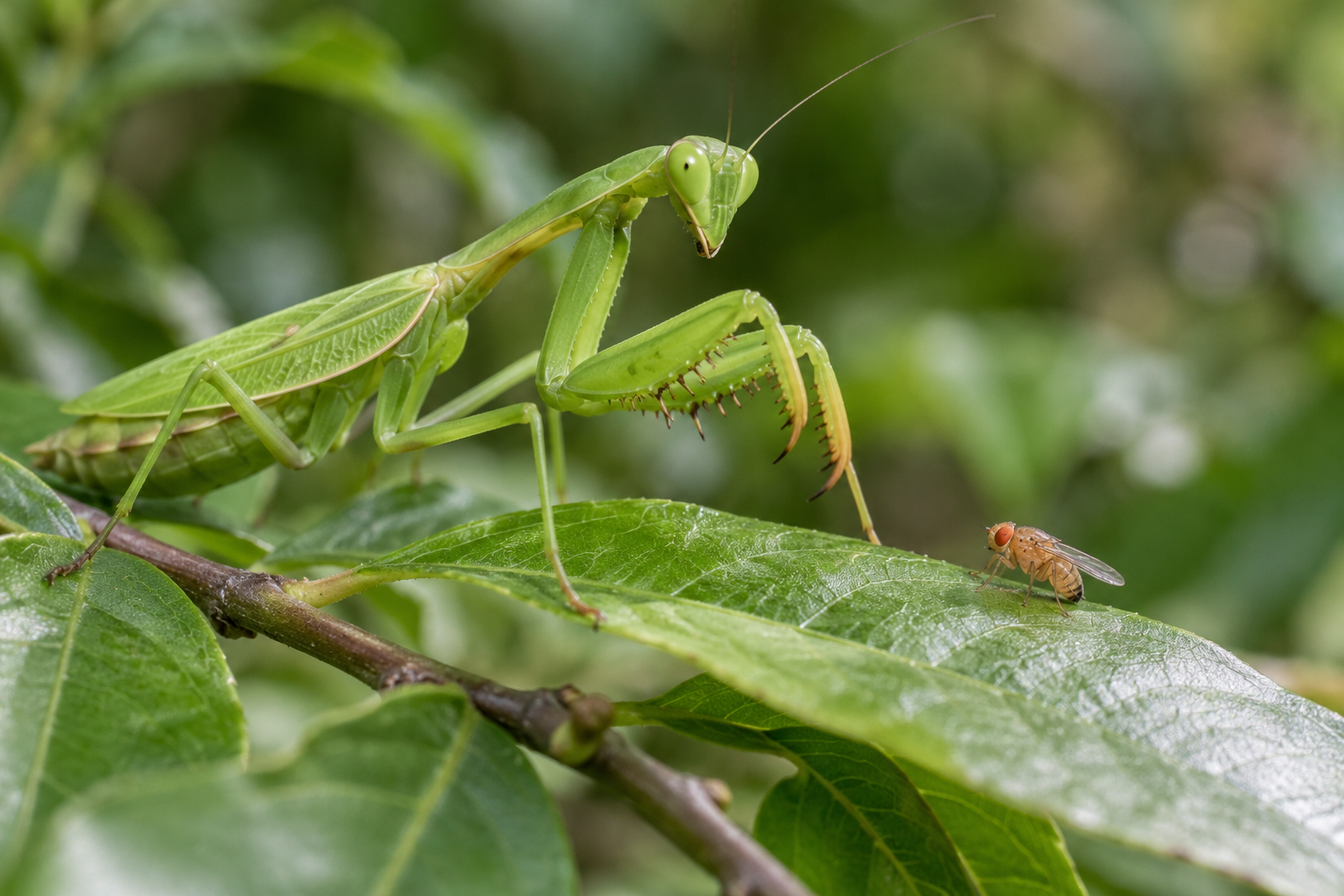
Praying mantises eat live insects only, and the whole feeding plan comes down to prey size. Hatchlings start on the smallest widely sold feeder, wingless melanogaster fruit flies. Around the third and fourth molts, step up to the larger hydei fruit flies or small houseflies. Late nymphs and adults take houseflies, blue bottle flies, small roach nymphs and bean beetles. At any stage, offer prey no bigger than the mantis abdomen is wide.
Feed small nymphs daily or every other day, and adults roughly every two to three days. Remove anything uneaten promptly, because live prey left in the enclosure will chew on a resting or molting mantis. A weekly smear of honey or pollen for orchid mantises is a hobby tradition rather than a proven requirement.
For a stage-by-stage breakdown, see what to feed a praying mantis and the praying mantis feeder page. If you raise your own feeders, our fruit fly culture guide and bean beetle culture guide keep the supply steady.
| Stage | Prey | How Often | Watch For |
|---|---|---|---|
| Hatchling (L1 to L2) | Wingless melanogaster fruit flies | Daily or every other day | Separate siblings early |
| Young nymph (L3 to L4) | Hydei fruit flies, small houseflies | Every 1 to 2 days | Stop feeding when pre-molt signs appear |
| Late nymph | Houseflies, small blue bottle flies, small roach nymphs, bean beetles | About every 2 days | Remove uneaten prey promptly |
| Adult | Flies, roach nymphs and other soft prey no wider than the abdomen | Every 2 to 3 days | Well-fed females cannibalize mates less |
Everything a praying mantis keeper needs from this guide. Untick anything you already have, then add the rest in one click.
Molting: Signs, Rules and Rescue
You usually get warning. Before a molt a mantis stops eating, slows down, its abdomen may swell or darken, and it climbs to the top of the enclosure. Then it hangs head down, the old skin splits behind the head, and the mantis slowly wriggles free and hangs from the empty skin while its new body hardens.
The rules are short. Stop offering live prey as soon as pre-molt signs appear. Do not touch, move or mist directly on a molting mantis. Never try to pull off a stuck skin; mist the enclosure walls to raise humidity and let gravity finish the job. Nymphs can regrow a damaged leg over later molts, but adults cannot.
In most species, fully formed wings mean an adult. The exception is the Carolina mantis, whose adult females have wings covering only about three quarters of the abdomen. To sex any mantis from about the fourth molt, count the segments on the underside of the abdomen: males show eight, females six.
Mating, Egg Cases and Cannibalism
The story that a female always eats her mate is overstated. Field studies put sexual cannibalism at roughly a quarter to half of matings depending on species, and well-fed females eat far fewer males. Captive rates run higher than wild ones, because a caged male has nowhere to go.
A mated female lays a foamy egg case called an ootheca on a twig or the enclosure top. Depending on species, one case can produce anywhere from a few dozen nymphs, as with the ghost mantis, to around 300 for the Chinese mantis. Tropical species hatch in roughly four to eight weeks when warm, while Chinese, European and Carolina egg cases laid in autumn normally overwinter outdoors and hatch the next spring. Keep any egg case suspended rather than lying flat, and have fruit flies and plenty of separate containers ready before it hatches.
Mantises and the Law
For most US keepers, native and long-established species raise no legal issues. Chinese mantis egg cases are sold at garden centres because the species has been established in the eastern United States since the 1890s. And it is not illegal to kill a praying mantis anywhere in the country, whatever the old myth says.
Exotic pet species sit in a greyer area. The USDA lists invertebrate pets among organisms that can require a PPQ 526 permit to move between states, but publishes no mantis-specific policy, and the hobby trade ships exotic mantises routinely. Florida is explicit: its agriculture department approves non-native mantises for ordinary keepers only as adult males under a conditional permit, and restricts both sexes, meaning breeding groups, to institutions such as zoos. Hawaii restricts non-native insects broadly. Check your state before buying an exotic species.
Health and Troubleshooting
Nearly every mantis emergency happens around a molt, which is why the first four rows are about molting.
| What You See | Most Likely Cause | What To Do |
|---|---|---|
| Refusing food, abdomen swollen, climbing high | Normal pre-molt fast | Remove live prey; do not disturb; wait |
| Hanging upside down, motionless | About to molt or molting | Normal; leave it completely alone |
| Stuck partway out of the old skin | Low humidity or disturbance mid-molt | Mist the walls, not the mantis; never pull the skin |
| Crumpled wing or bent leg after a molt | A fall or cramped space during the molt | Add height; nymphs may improve at the next molt |
| Shrivelled, sluggish abdomen | Dehydration | Mist more often; offer droplets |
| Fuzzy mould in the enclosure | Overmisting, poor airflow, leftover prey | Mist less, ventilate, remove debris, use paper towel |
| Tiny pale mites | Hitchhikers from a feeder culture | Deep clean; review feeder culture hygiene |
| Mantis missing | An unlatched lid or a gap in the mesh | Search nearby surfaces; secure the enclosure |
Praying Mantis FAQ
Part of the Praying Mantis Hub: every guide we have on praying mantises, in one place.
Keep reading: what to do when a mantis gets stuck in a molt.
Raising a Praying Mantis?
Tell us the species and its size and we will match the right feeders for each molt. Real keepers answer our email.
TC INSECTS · Real keeper advice from a working Texas insect farm
