
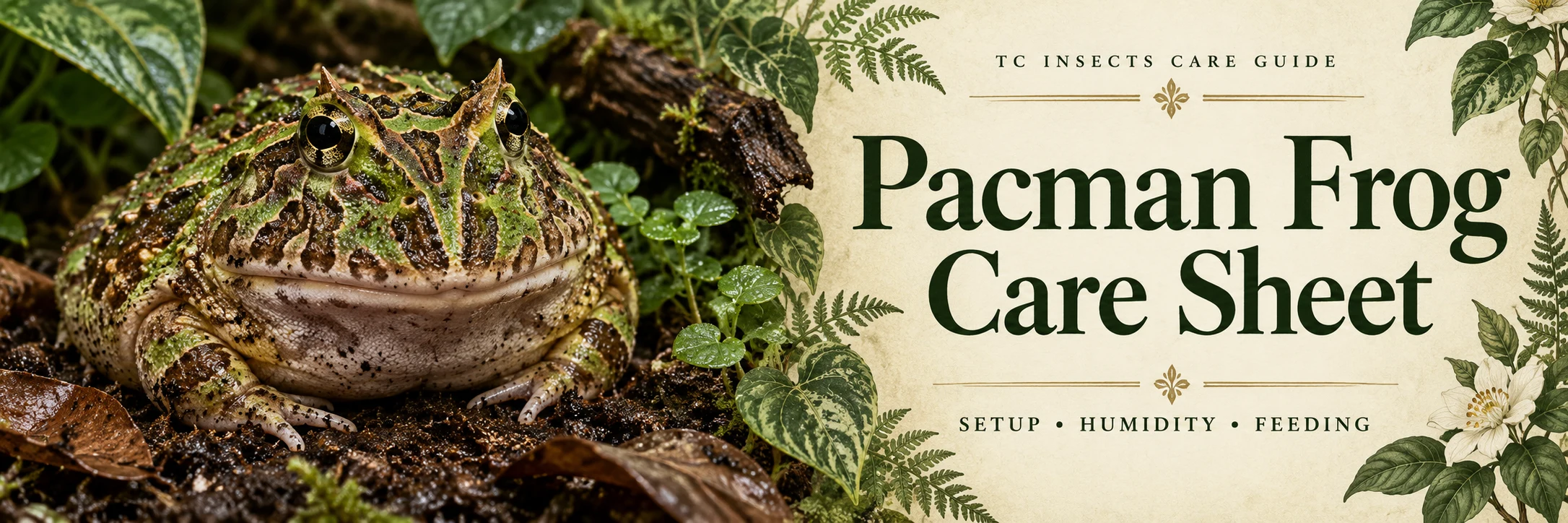
The complete husbandry guide for Cranwell’s and ornate Pacman frogs: enclosure specifications, temperature and humidity, safe substrate depth, shallow-water care, a feeding table designed to prevent obesity, and a troubleshooting chart for warning signs that need action.
Ten is typical with good care; the record keepers do the simple things consistently.
Females run distinctly larger than males. Either way, mostly mouth.
A perfect first amphibian, as long as you treat it as a display animal.
Meet the Pacman Frog
Pacman frogs are South American horned frogs, most commonly Cranwell's (Ceratophrys cranwelli) and the ornate (Ceratophrys ornata), named after the arcade character for the obvious reason: the animal is essentially a round body wrapped around an enormous mouth. They are ambush hunters that bury into the substrate, leave their eyes and horns exposed, and wait for something edible to walk past.
That lifestyle makes them the ideal low-motion pet. A pacman will never cruise its enclosure or beg at the glass like a gecko, but the strike when food arrives is one of the most explosive moves in the amphibian world, and the color morphs available today, from apricot to high-green fantasy crosses, make them genuinely beautiful display animals.
One piece of biology worth knowing up front: pacman frogs are in the same family as the Budgett's frog and are built for a boom-and-bust wet season. When conditions turn dry they can seal themselves inside a cocoon of hardened skin and wait it out. In a properly humid enclosure you should never see that cocoon, which is exactly why it earns a spot on the troubleshooting chart below.
What You Will Need
A pacman setup is one of the cheapest in the reptile and amphibian hobby, and it fits on a dresser. Here is the complete list; skip nothing in bold.
Conditions at a Glance
Every number that matters, on one card. Each row is unpacked in the sections that follow.
| Parameter | Target | Notes |
|---|---|---|
| Enclosure minimum | 20 gallon long for life | Floor space beats height; they never climb |
| Day temperature | 72 to 78 F | Gentle warmth, never a hot basking blast |
| Night temperature | Not below the mid 60s F | A small drop is fine |
| Humidity | 60 to 80 percent | Daily misting; substrate like a wrung-out sponge |
| Substrate depth | 2 to 4 inches | Deep enough to vanish into, eyes out |
| Water | Shallow dish, below chin height | Dechlorinated, changed daily; they drown in deep water |
| Lighting | 12 hour cycle | Low-output UVB optional with proper dusting |
| Housing | Strictly solitary | Cohabitation ends in one frog |
Habitat in practice
Low, wide, deep and secure
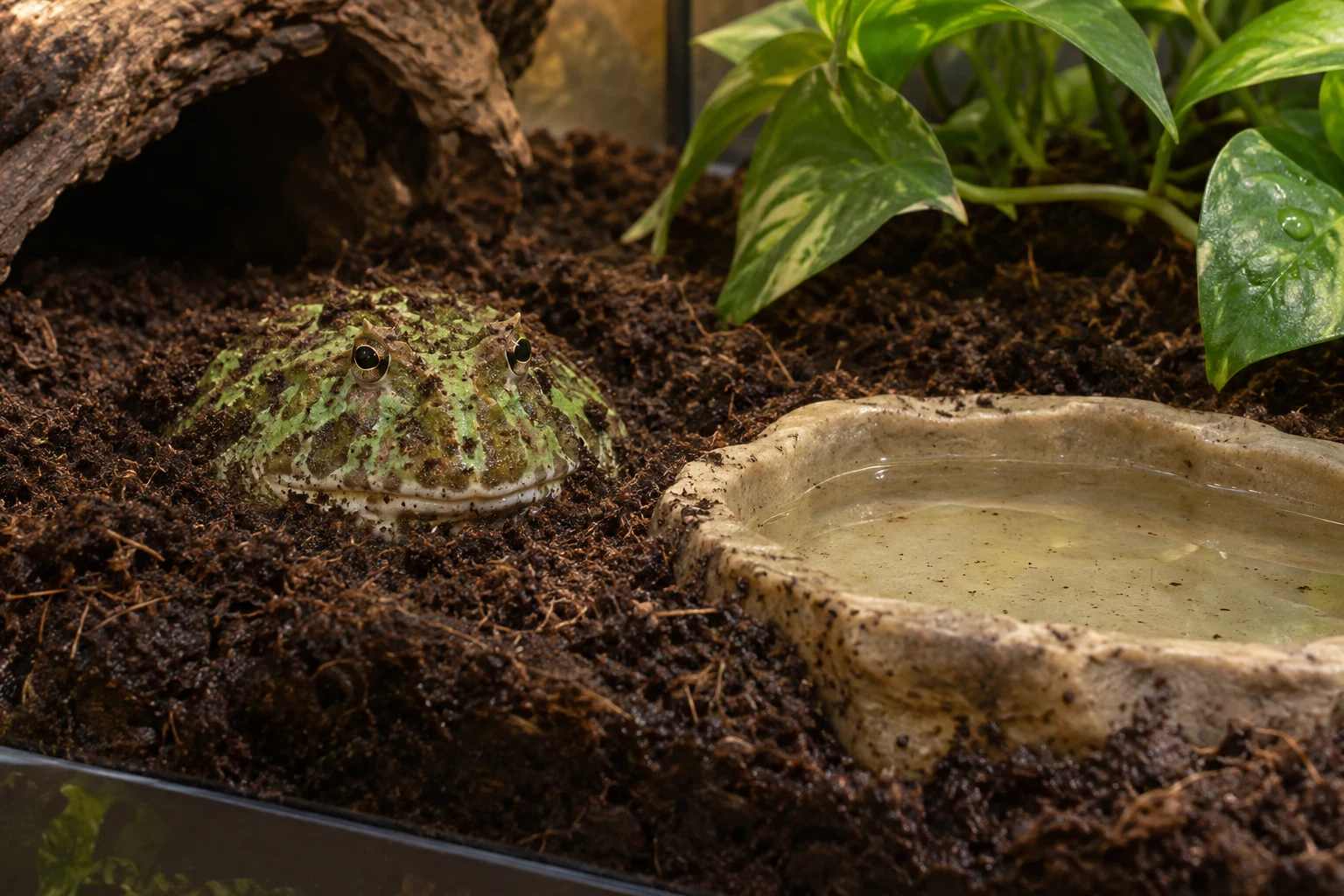
A Pacman frog needs floor space rather than climbing height. Deep moist substrate supports its natural ambush posture, while a below-chin water dish, gentle temperatures, and substrate-level gauges keep the environment safe.
Enclosure and Setup
A 20 gallon long, or any enclosure around 24 by 18 inches of floor, houses a pacman frog for life. Height is wasted on a species that never climbs, and floor space beats volume. Keep the layout simple: deep substrate, a shallow water dish, and some low plant cover or a leaf-litter scatter so the frog can feel hidden while it sits.
They live alone, permanently. Pacman frogs are enthusiastic cannibals, and a pair will resolve itself into one frog with impressive efficiency. Skip gravel entirely; a feeding pacman engulfs everything around the prey, and swallowed gravel is a classic cause of impaction.
Heating and Lighting
Daytime temperatures of 72 to 78 degrees suit them, never dropping below the mid 60s at night. In most homes that means little or no added heat; if your room runs cold, a low-wattage bulb or a side-mounted heat mat on a thermostat closes the gap. Avoid strong overhead heat that bakes the substrate surface, because a pacman escapes downward and a hot floor gives it nowhere to go.
Run a 12 hour light cycle for rhythm, with the probe of your thermometer sitting at substrate level where the frog actually lives. As with most amphibians, low-level UVB is optional when you dust with vitamin D3, but a weak shade-dweller tube is a worthwhile upgrade that softens the consequences of an imperfect supplement schedule.
Substrate, Humidity and Water
Provide 2 to 4 inches of moist coco fiber, enough for the frog to disappear into with just its eyes showing, and keep humidity in the 60 to 80 percent range with a daily misting. The substrate should feel like a wrung-out sponge: clearly damp, never swampy, because a permanently wet floor breeds bacteria faster than a bioactive crew or a keeper can clear it.
Offer a water dish shallower than the frog's chin. Pacman frogs are terrible swimmers and can drown in deep water, and they drink and soak through their skin, so the dish must be dechlorinated and changed daily. A dirty dish is the fastest route to a sick pacman, because whatever is in that water ends up in the frog.
Feeding in practice
Feed the body condition, not the appetite
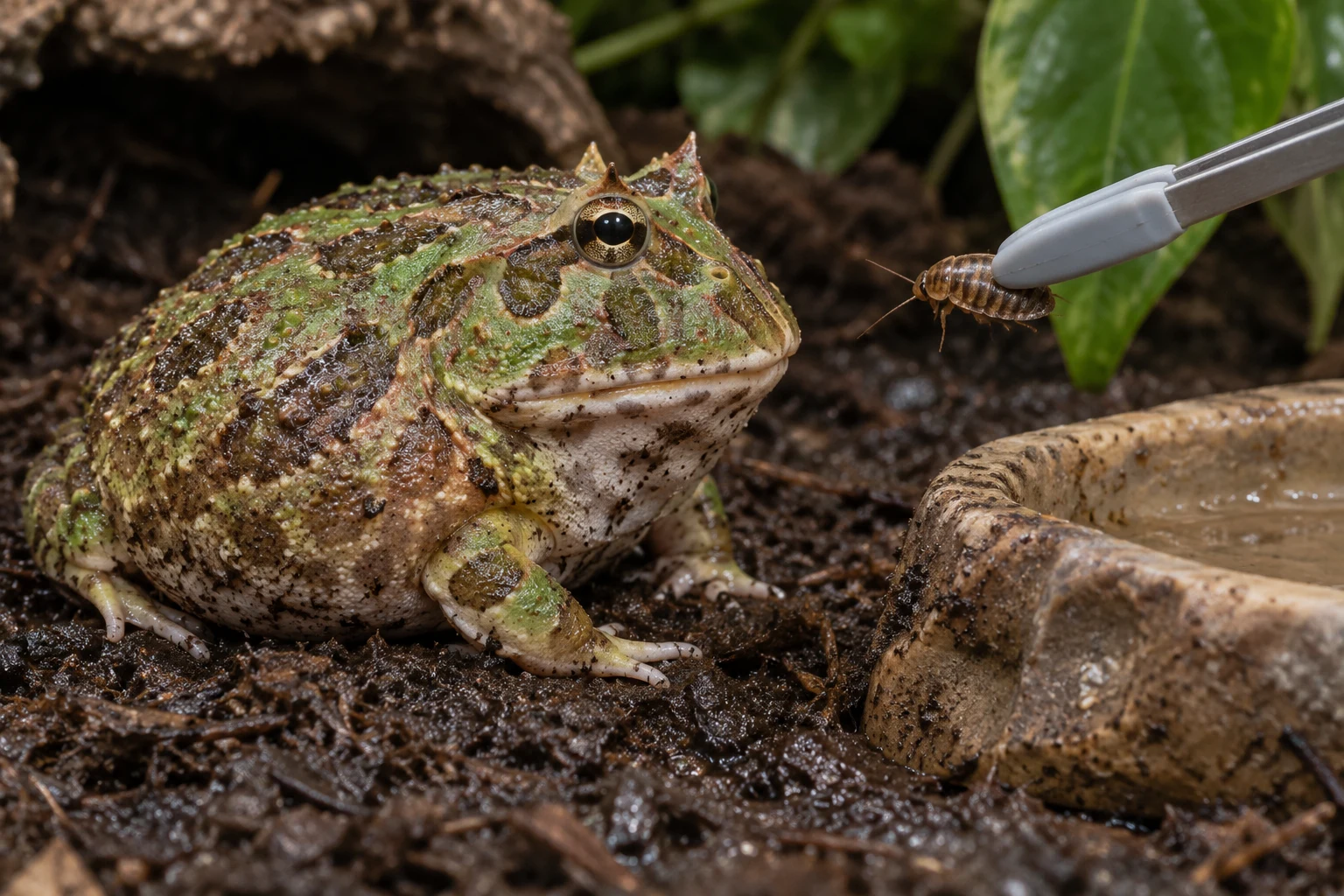
Pacman frogs strike enthusiastically long after they have eaten enough. Use long tongs, choose prey narrower than the space between the eyes, rotate appropriate invertebrate feeders, and follow the life-stage schedule below.
Diet and Feeding
Size prey by the width of the frog's head: nothing wider than the space between its eyes. A pacman will strike at anything that moves for as long as you keep offering, which is exactly how most of them end up obese. The table below is the schedule a healthy pacman actually needs, not the schedule it will vote for.
Gut-loaded dubia roaches are the perfect staple, with calcium-rich black soldier fly larvae for variety and nightcrawlers from a bait shop as a soft occasional treat we recommend even though we do not stock them. Feed with tongs or in a dish to keep coco fiber out of the gut, and see the complete portion plan on our pacman frog feeder guide.
| Life Stage | What To Feed | How Much | How Often | Supplements |
|---|---|---|---|---|
| Froglet to juvenile | Small dubia, BSFL, chopped nightcrawler | 2 to 4 items narrower than the eye gap | Daily or every other day | Calcium + D3 two to three times weekly; multivitamin every other week |
| Subadult | Medium dubia, BSFL, nightcrawlers | A few items per meal | 2 to 3 meals per week | Calcium + D3 twice weekly; multivitamin every other week |
| Adult | Large dubia, nightcrawlers, occasional superworm | One sensible meal | 2 meals per week; skip a week if chunky | Calcium + D3 weekly; multivitamin every other week |
Everything a pacman frog keeper needs from this guide. Untick anything you already have, then add the rest in one click.
The Bioactive Option
The warm, damp pacman setup is ideal bioactive territory. Springtails plus dwarf white isopods in the substrate consume waste and shed skin between your spot cleans, and those two small species are the safe crew choice around a resident animal; save larger isopods for tanks without one. Plant the edges with tough, low growers like pothos and expect the frog to renovate the center to its own taste.
If you are starting from an empty tank, our bioactive setup guide covers the drainage layer, soil mix, and seeding order, and the crew ships live from our farm alongside the feeders.
Handling and Temperament
Treat a pacman like a goldfish with teeth: watch, do not hold. Their skin absorbs oils, salt, and residue straight from your hands, and the bite is genuinely painful, delivered by a bony jaw with a grip that has to be seen to be believed. When a move is unavoidable, wet nitrile gloves or a cup-and-slide into a container is the way.
Health and Troubleshooting
Nearly every pacman problem is an environment problem wearing a costume. Run down the chart, fix the husbandry first, and use an exotics vet for the rows that say so. Weighing the frog on a kitchen scale once a month turns vague worry into actual data.
| What You See | Most Likely Cause | What To Do |
|---|---|---|
| Always buried, eyes out | Completely normal pacman behavior | Nothing; this is the entire lifestyle |
| Dull, hardened, shrink-wrapped skin | Estivation cocoon; humidity crashed | Raise humidity and mist consistently; shallow soak; never peel the layer off |
| Lethargy with no waste production | Impaction from substrate or oversized prey | Lukewarm shallow soak; tong-feed going forward; vet if nothing passes |
| Refusing food in winter, weight stable | Seasonal slowdown | Smaller meals less often; recheck temps; wait it out |
| Redness on belly and legs | Bacterial infection from dirty conditions | Vet promptly; overhaul dish hygiene and substrate |
| Soft jaw, wobbly sitting posture | Metabolic bone disease | Correct dusting schedule now; add low-level UVB; vet for confirmation |
| Cloudy eyes | Poor water quality or vitamin A deficiency | Fix water routine; confirm multivitamin contains vitamin A; vet if persistent |
Pacman Frog FAQ
Keep reading: portioning by body weight instead of by count.
Dialing In a Pacman Setup?
Email us the frog's size and your current setup and we will size the feeders and the schedule for you. Real keepers answer.
TC INSECTS · Husbandry guidance from the people who raise the feeders · Porter, Texas
