
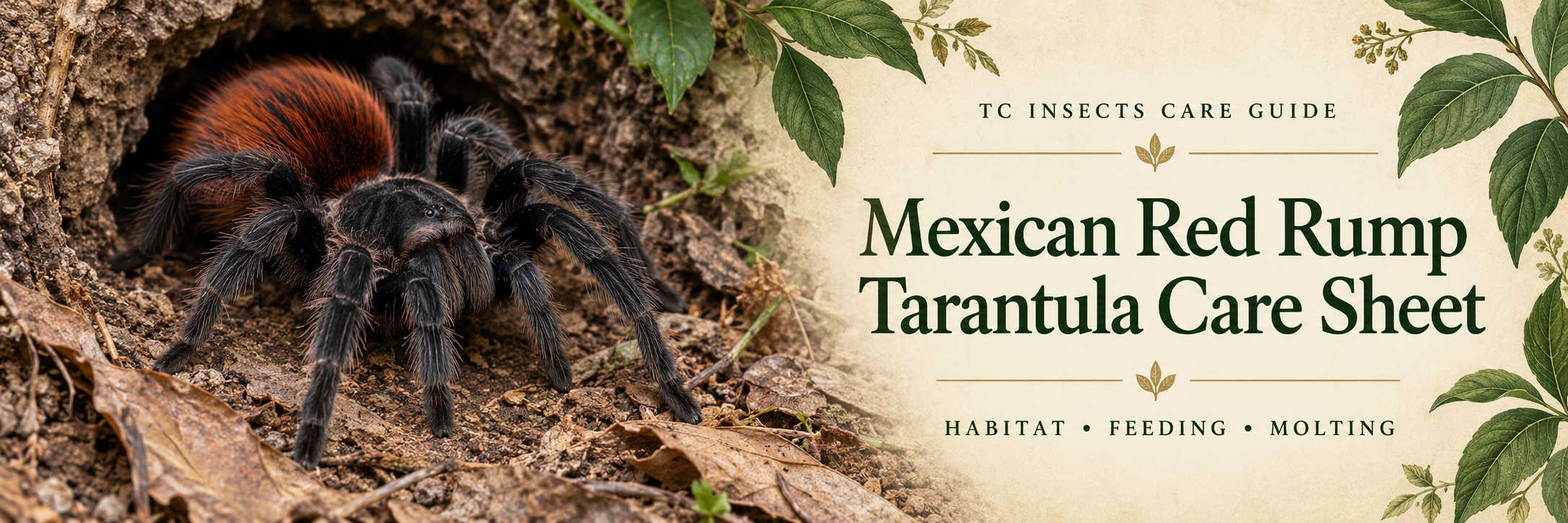
Mexican Red Rump Tarantula Care Sheet
Complete husbandry for the Mexican red rump tarantula (Tliltocatl vagans, formerly Brachypelma vagans): a low burrowing enclosure that prevents fatal falls, temperature and humidity, feeding by life stage, molting versus the death curl, urticating hairs, legal status, and a troubleshooting chart.
Males live only about 5 to 8 years in total.
A heavy 3 inch body, black with a red rump.
Hardy and easy to feed, but fast and quick to kick hairs.
Meet the Mexican Red Rump
The Mexican red rump is a heavy-bodied, velvety black tarantula with long red hairs across the top of its abdomen, native to the scrubland of Mexico, Belize and Guatemala. In 2020 a genus revision moved it from Brachypelma into the new genus Tliltocatl, so you will still see it sold as Brachypelma vagans. It is the same animal.
It has long been sold as a beginner tarantula, and on husbandry it earns that: hardy, a willing eater, and forgiving of small mistakes. Temperament is more mixed. Many experienced keepers find it faster, more skittish and far quicker to kick urticating hairs than the calmest beginner species such as the curly hair tarantula. Treat it as a stunning display spider rather than a handling pet.
One curiosity: a non-native population has been established in St. Lucie County, Florida since the 1990s, believed to trace back to pet-trade escapes or releases. It is a good reminder that a pet tarantula should never be released.
What You Will Need
A red rump setup is inexpensive. The design choices that matter are all about keeping the spider low and letting it dig.
Conditions at a Glance
The whole environment on one card.
| Parameter | Target | Notes |
|---|---|---|
| Floor space | 3 to 5 times the legspan | Wide and low beats tall |
| Height above substrate | About 1 to 1.5 times the legspan | A short fall can rupture the abdomen |
| Substrate depth | Half to two thirds of the enclosure height | Enough to dig a real burrow |
| Temperature | 68 to 80 F | Sources vary within this band; room temperature is fine |
| Humidity | Moderate | Lower substrate slightly damp, surface allowed to dry |
| Water | Shallow dish, always available | Overflow it now and then to dampen a corner |
| Lighting | None needed | Normal room light cycle |
| Housing | One per enclosure | Tarantulas are cannibals |
A Low Enclosure That Prevents Falls
The Mexican red rump is a heavy terrestrial tarantula, and a fall of only a few inches onto a hard surface can split its abdomen and kill it. That single fact shapes the enclosure. Keep the distance from the substrate surface to the lid at no more than about one to one and a half times the spider's legspan, and put the space into floor area instead: roughly three times the legspan for a sling, growing to three to five times for an adult.
This species is an opportunistic and sometimes enthusiastic burrower, especially as a juvenile, so fill the enclosure half to two thirds of the way with coco fiber or a peat-based mix and add a piece of cork bark or a half log as a starting point. A spider that can dig a proper burrow is a calmer spider. Add a shallow water dish, cross-ventilation through small mesh-covered holes, and a lid that latches. Our tarantula enclosure setup guide walks through the build step by step.
Temperature and Humidity
Room temperature suits a red rump well. One detailed specialist care sheet gives 68 to 76 degrees and other sources run a little warmer, to about 80, so anything in that band is comfortable. A normally heated home needs no heat mat, and a heat mat under a small enclosure can dehydrate a spider that cannot get away from the warm floor.
Keep humidity moderate: the lower substrate slightly damp, the surface allowed to dry between waterings, never waterlogged. Stagnant, wet air brings mould and mites. The water dish does most of the work, and overflowing it a little every so often dampens one corner.
Feeding
Offer prey about the size of the spider's abdomen or smaller. Spiderlings take small prey such as fruit flies or the smallest roach nymphs about twice a week. Juveniles do well on one medium dubia roach or a few small feeders every seven to ten days. Adults have slow metabolisms and are easy to overfeed; one large roach every two to three weeks is plenty. Our guide to how often to feed a tarantula goes deeper, and best feeder insects for tarantulas compares the options.
Remove uneaten live prey within a day, and stop offering food entirely once you see pre-molt signs, since a roach or cricket left in with a molting spider can injure it. TC INSECTS sells juvenile Mexican red rumps, so the picker below includes the spider alongside feeders sized for it.
| Life Stage | Prey | How Often | Notes |
|---|---|---|---|
| Spiderling | Fruit flies or the smallest roach nymphs | About twice a week | Keep prey smaller than the abdomen |
| Juvenile | One medium dubia or a few small feeders | Every 7 to 10 days | The keenest burrowing stage |
| Adult | One large dubia roach | Every 2 to 3 weeks | Easy to overfeed; a plump abdomen is enough |
Everything a red rump tarantula keeper needs from this guide. Untick anything you already have, then add the rest in one click.
Molting and the Death Curl
Before a molt a red rump stops eating for one to several weeks, becomes less active, and its abdomen darkens, often with a shiny bald patch where hairs have been kicked away. Then it flips onto its back or side and lies still for hours. That is normal molting posture, not death. Do not touch it, do not turn it over, and do not feed it.
After the molt, the new exoskeleton and fangs are soft. Wait until the fangs have darkened fully, roughly a day or two for spiderlings and a week or more for large adults, before offering food again.
Learn the difference that matters: a tarantula lying on its back is molting, while a tarantula with its legs curled tightly underneath its body is in what keepers call the death curl, usually from severe dehydration, old age or pesticide exposure. Treat that as an emergency. Give immediate access to water and mist near the spider, not on it; caught early, dehydration can sometimes be reversed. Our guide to a tarantula on its back covers both situations.
Urticating Hairs, Bites and Handling
When disturbed, a red rump flicks barbed urticating hairs from its abdomen with its back legs. They cause itching on skin and real irritation in the eyes, and in practice they are a more common nuisance than bites. The bite itself is medically mild for a healthy adult, often compared to a bee sting, though individual reactions vary.
Mainstream guidance discourages handling this species, and the biggest reason is the spider's safety: red rumps bolt quickly, and one short fall can be fatal. Work in the enclosure with long tongs, keep your face away from a stressed spider, and wash your hands and forearms after maintenance.
Legal Status
The Mexican red rump is covered by CITES Appendix II, a listing dating from its time in the genus Brachypelma and often still recorded under that name. Appendix II controls international trade through export permits; it does not make owning one, or buying a captive-bred spider within the US, illegal, though a legal origin still matters.
In Florida, where the species already has a wild non-native population, the state agriculture department regulates tarantulas brought into the state. Its current guidelines place most tarantula species in the least restrictive category and hold only certain fast, defensive genera to stricter conditions, and the red rump is not among those named. Florida keepers should still confirm with FDACS before ordering.
Health and Troubleshooting
Tarantulas show few symptoms, so most of keeping one well is knowing which alarming sights are normal. The first, second and fourth rows below are normal.
| What You See | Most Likely Cause | What To Do |
|---|---|---|
| On its back, legs up, not moving | Molting | Leave it completely alone; no food until the fangs darken |
| Refusing food for weeks | Pre-molt fast | Remove uneaten prey; keep water available; wait |
| Legs curled tightly underneath the body | Death curl, often severe dehydration | Emergency: water access now; mist nearby; seek experienced help |
| Shiny bald patch on the abdomen | Urticating hairs kicked off in defence | Normal; it refills at the next molt; disturb less |
| Shrunken, shrivelled abdomen | Dehydration | Refill the water dish; dampen part of the substrate |
| Fuzzy mould on substrate or walls | Too wet, poor ventilation, or leftover prey | Remove affected substrate, add airflow, water less |
| Tiny mites in the substrate | Excess moisture and waste | Dry out and clean; remove leftovers promptly |
| Spider escaped | Lid not latched or a ventilation gap | Search low, dark, humid spots nearby; secure every clip |
Mexican Red Rump Tarantula FAQ
Part of the Tarantula Hub: every guide we have on tarantulas, in one place.
Keep reading: dehydration, curled legs and the death curl and feeding pre-killed prey.
Thinking About a Red Rump?
We sell juvenile Mexican red rumps and the feeders to raise them. Tell us about your enclosure and we will help you get it right. Real keepers answer our email.
TC INSECTS · Care sheets written at the farm, not copied from forums · Porter, Texas
