
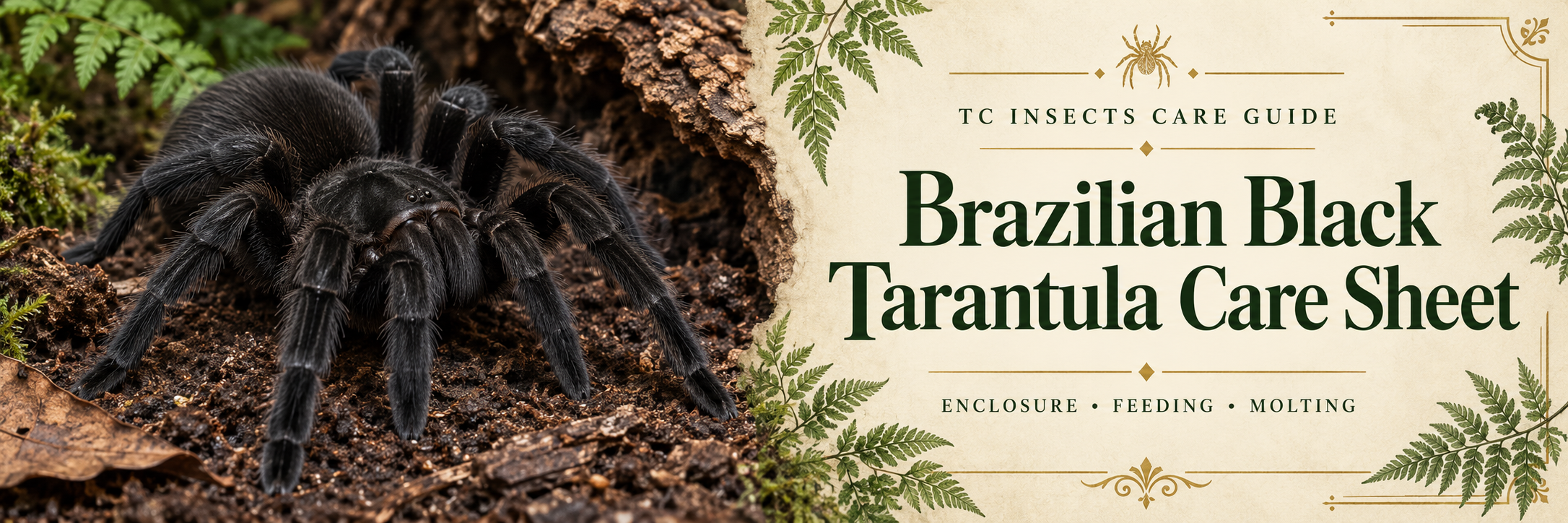
Brazilian Black Tarantula Care Sheet
This care sheet covers the true Brazilian black tarantula (Grammostola pulchra): low, wide burrowing enclosures that prevent fatal falls, room temperature and moderate humidity, feeding by life stage, molting and the death curl, legal status, and exactly how to tell it apart from the Brazilian black and white and red and white tarantulas people often confuse it with.
Diagonal legspan; most females cluster at 6 to 7 inches.
Males live just 6 to 8 years and die about a year after maturing.
Calm and hardy, but grows slowly and takes years to mature.
Meet the Brazilian Black Tarantula
The Brazilian black tarantula (Grammostola pulchra) is a heavy, ground dwelling spider from the grasslands of southern Brazil and neighboring Uruguay. Keepers prize it for a solid, velvety black color with no stripes, bands, or colored hairs anywhere on the body, paired with one of the calmest temperaments in the hobby. It is also a slow grower. A young spider can take several years just to reach a mature color, and even longer to reach full adult size, which is part of why long lived, verified females sell for a premium.
A nearly identical species, Grammostola quirogai from Uruguay, was not recognized as its own species until 2015, and a real share of hobby stock, especially older lineages, may actually be quirogai rather than confirmed pulchra; only a mature male's leg detail or DNA testing settles it for certain. Separately, a 'Brazilian black and white' or 'Brazilian red and white' tarantula for sale is never this species either. Those names belong to different animals covered later on this page, including one that TC sells.
What You Will Need
The shopping list is short and inexpensive. What matters most for this species is floor space over height, deep diggable substrate, and a lid that truly latches.
Conditions at a Glance
The whole environment on one card.
| Parameter | Target | Notes |
|---|---|---|
| Floor space | 3 to 5 times the legspan | Wide and low beats tall |
| Height above substrate | Kept low | A fall can rupture the abdomen |
| Substrate depth | Half to two thirds of the enclosure height | About 5 to 6 inches for an adult |
| Temperature | 68 to 76 F, up to about 80 F | Room temperature is enough; no heat mat needed |
| Humidity | Moderate to low | Damp lower substrate, dry surface, good airflow |
| Water | Shallow dish, always available | Overflow it now and then to dampen a corner |
| Lighting | None needed | Normal room light cycle |
| Diet | Standard soft bodied feeder insects | Dubia roaches are the most common staple |
| Housing | One per enclosure | Tarantulas are cannibals |
Enclosure and Burrowing Setup
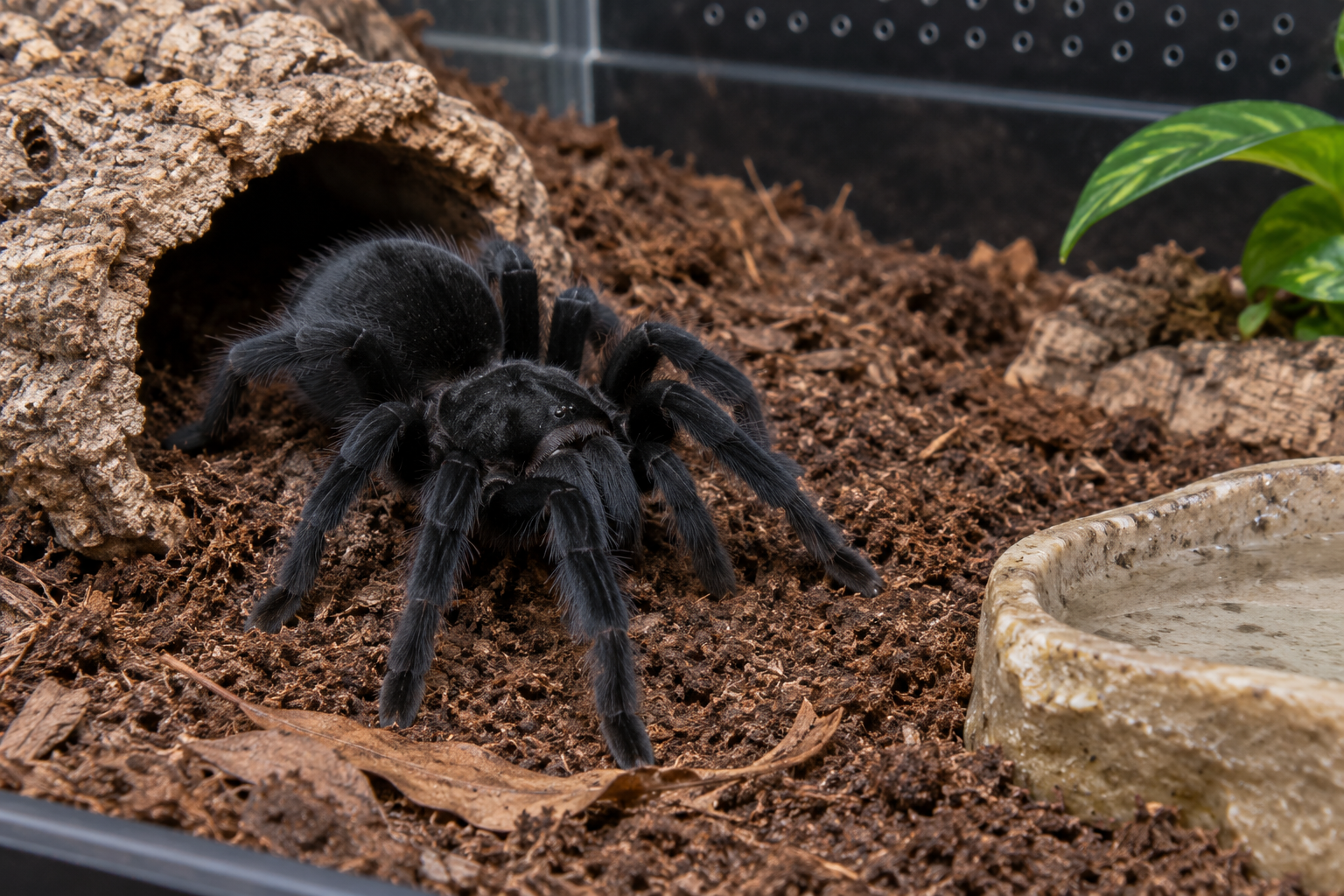
Like every heavy terrestrial tarantula, the Brazilian black is more athlete than acrobat, and a fall of even a few inches onto a hard floor can rupture its abdomen. That single fact should drive the enclosure design: keep the height from the substrate to the lid low, and put the space into floor area instead. A sling or juvenile does well with floor space of about 3 times its legspan, growing to 4 to 5 times for an adult.
This species is an obligate burrower that digs a real, silk lined retreat rather than just hiding under bark, so give it something to dig into. Fill the enclosure half to two thirds of its height with coco fiber, peat, or a topsoil based mix, kept loose enough to tunnel through, roughly 5 to 6 inches deep for an adult. Avoid sand and wood chips. A piece of cork bark or a half log pressed against the substrate gives a starting point for the burrow entrance.
Add cross ventilation through small mesh covered openings and use a lid that latches securely, since a spider this strong can push open a loose fitting one. A shallow water dish that stays full covers hydration, and our tarantula enclosure setup guide walks through the full build step by step.
Temperature and Humidity
Room temperature suits a Brazilian black well. Most sources put the comfortable range at 68 to 76 F, with a couple allowing up to about 80 F, and a normally heated home needs no heat mat at all. A heat mat under a small enclosure can actually dehydrate a spider that has no way to get off the warm spot, so skip it.
Keep humidity moderate to low: the lower substrate slightly damp, the surface allowed to dry, with good cross ventilation throughout. Numeric guidance varies by source, from a drier 55 to 65 percent up to a more humid 60 to 70 percent, and several sources give only a qualitative 'moderate' with no number at all, so treat the exact percentage as less important than the pattern. Heavy misting causes mold and mites here, not a healthier spider.
What Brazilian Black Tarantulas Eat
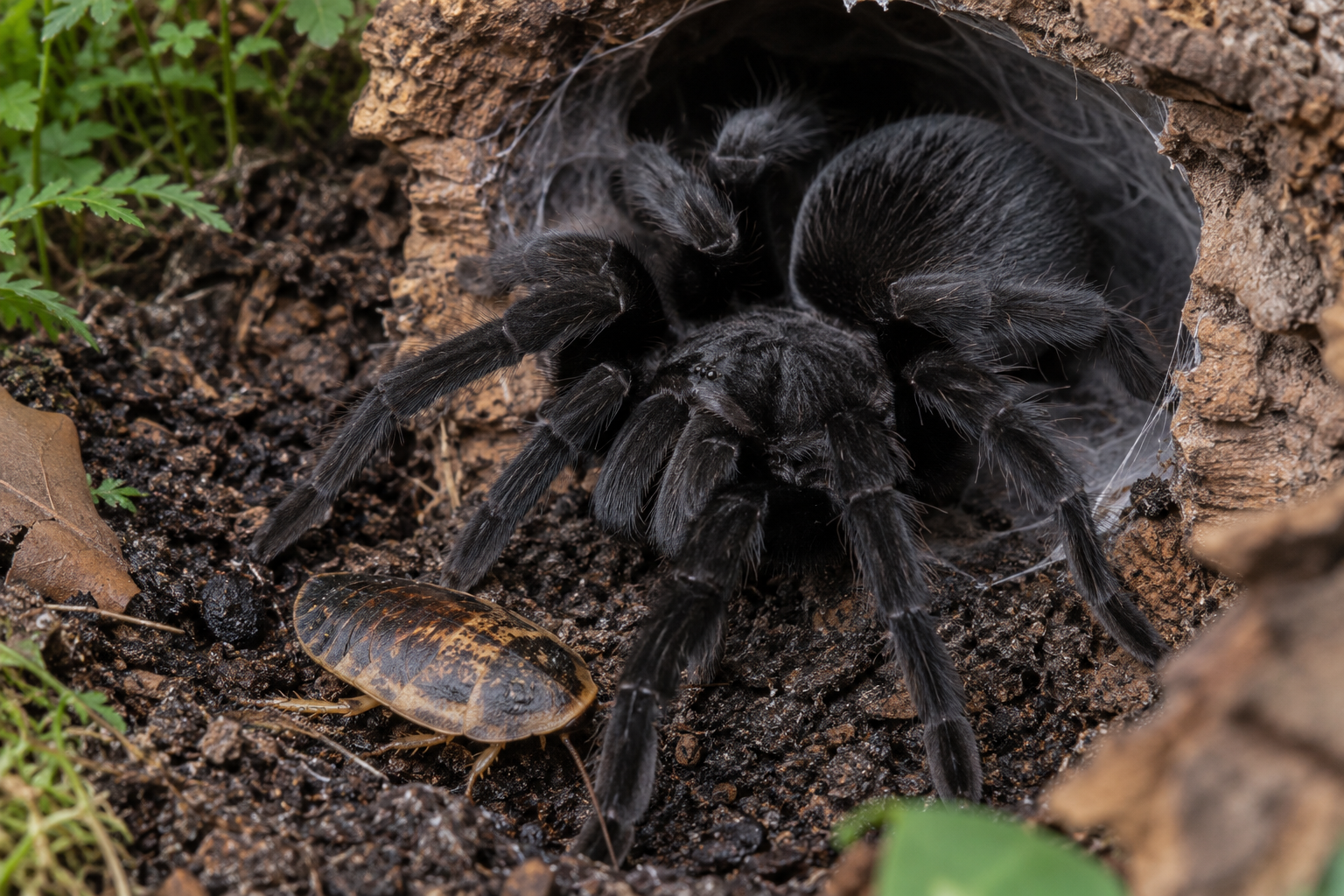
The Brazilian black readily eats standard soft bodied feeder insects, and dubia roaches are the most consistently recommended staple across sources. Offer prey no larger than the spider's abdomen, and remove anything uneaten within a day so it cannot injure a molting spider left too long in the enclosure.
Spiderlings eat about twice a week and take prey smaller than the abdomen, such as fruit flies or the smallest roach nymphs. Juveniles do well on one appropriately sized roach roughly every 7 to 10 days. Adults have a slow metabolism, and sources disagree on the exact interval, from about 6 days up to 3 weeks or longer; given how slowly this species grows, the safer default is the longer end, one roach every 2 to 3 weeks or more. Overfeeding, not underfeeding, is the real risk with adults.
No calcium or vitamin powder goes directly on the spider. Instead, gut load the feeder insects with fresh produce about a day before offering them, and let that nutrition pass through. After a molt, wait until the new fangs have darkened before feeding again, roughly a day or two for a small sling and one to two weeks for a large adult. Our guide to how often to feed a tarantula and best feeder insects for tarantulas go deeper on both.
| Life Stage | Prey | How Often | Notes |
|---|---|---|---|
| Spiderling | Fruit flies or the smallest roach nymphs | About twice a week | Keep prey smaller than the abdomen |
| Juvenile | One appropriately sized dubia roach | Every 7 to 10 days | Growing slowly; keep food varied |
| Adult | One larger dubia roach | Every 2 to 3 weeks or longer | Easy to overfeed; a plump abdomen is enough |
Everything a brazilian black tarantula keeper needs from this guide. Untick anything you already have, then add the rest in one click.
Molting, the Death Curl and Handling
Before a molt the Brazilian black stops eating, sometimes for several weeks, and its abdomen may darken. It then flips onto its back or side and lies still for hours. That is completely normal molting posture, not death. Do not touch it, turn it over, or offer food during this time; wait until the fangs have fully darkened again.
Learn the one sign that is different: a tarantula with its legs curled tightly underneath its body, rather than relaxed on its back, is in what keepers call the death curl, usually tied to severe dehydration, and should be treated as an emergency. Give immediate access to water and mist near the spider, not directly on it. Our guide to a tarantula on its back and to tarantula dehydration signs cover both situations in more depth.
The Brazilian black has a reputation as one of the calmest, slowest moving tarantulas in the hobby, and it is among the least likely New World species to flick urticating hairs. That reputation is well earned, but it is not a reason to handle one routinely. A short fall from head height can still rupture its abdomen and kill it, calm or not, so most experienced keepers still treat it as a look, not touch, display spider.
Legal Status and Wild Caught Concerns
Grammostola pulchra is native to Brazil, where wild animals are protected under the country's wildlife laws, and Brazil's environmental crimes law makes it a crime to export specimens of native wild fauna without government permission. Nearly every Brazilian black sold in the US and EU pet trade is represented as captive bred, which is part of why a verified, mature female commands a high price.
Unlike the Brachypelma and Tliltocatl tarantulas, which are all on CITES Appendix II, Grammostola pulchra is not listed in the CITES appendices at all, so no CITES permit applies to it; Brazil's own domestic law, not CITES, is what actually restricts it. One relative, the Chilean rose tarantula (Grammostola rosea), was added to Appendix II in 2026, so listings do change; check the CITES species checklist for the current status of any tarantula before it crosses a border.
Florida's state agriculture department, FDACS, says a permit is required for regulated arthropods brought into Florida from outside the state, and its import guideline sorts tarantulas by risk. Most tarantulas sit in its regular category, usually approved without conditions, while some genera, such as Poecilotheria, Pterinochilus, Stromatopelma and Chilobrachys, are conditional, which means extra escape-proofing rules on the permit. Neither Grammostola nor Nhandu is named in the conditional group, but the guideline says its lists are not exhaustive and can change, so a Florida buyer should confirm current rules with FDACS before ordering. See our guide to whether it is legal to keep a tarantula for more on state by state rules.
Is This Really a Brazilian Black? The Black and White and Red and White Mix Up
Search for a 'Brazilian black and white' or 'Brazilian red and white' tarantula and you will find animals that are not Grammostola pulchra at all. The Brazilian black itself carries no white, red, or orange anywhere on its body; it is solid, velvety black from the tips of its legs to its abdomen. If a photo or listing shows any pale stripe or colored hair, you are looking at a different species, whatever the seller calls it.
The name 'Brazilian black and white tarantula' belongs most precisely to Nhandu coloratovillosus, a different genus entirely. It shows three narrowing white stripes down each leg, a black and white marked carapace, and dark, reddish brown fuzz across the abdomen, all details the true Brazilian black never has. Its temperament and care needs also differ enough that it should not be shopped for as a substitute.
Some US sellers apply that same 'black and white' nickname to a second, unrelated genus, Acanthoscurria brocklehursti. The only reliable tell here is the scientific name on the listing, not the photo or the nickname; if a listing says Acanthoscurria brocklehursti anywhere, it is not Grammostola pulchra. TC's own catalog uses that nickname too: our Brazilian black and white tarantula is Acanthoscurria brocklehursti, not Grammostola pulchra, so check the scientific name on any listing, ours included, before you buy.
A third animal, Nhandu chromatus, is properly called the Brazilian red and white tarantula, not black and white. It carries bold white stripes down each leg, a pale beige to grey carapace, and a dense covering of reddish orange hair across the abdomen, and it is a fast growing, fast moving, defensive spider, the opposite of the calm Brazilian black. Some retailers still list it under an older name, Vitalius chromatus, after a genus change that was later reversed.
Health and Troubleshooting
Tarantulas show few symptoms, so most of keeping one well is knowing which alarming sights are actually normal for this species.
| What You See | Most Likely Cause | What To Do |
|---|---|---|
| On its back, legs relaxed, not moving | Molting | Leave it alone; no food until the fangs darken |
| Refusing food for weeks | Pre-molt fast | Remove uneaten prey; keep water available; wait |
| Legs curled tightly underneath the body | Death curl, usually severe dehydration | Emergency: give water access now; mist nearby; seek experienced help |
| Shrunken, shriveled abdomen | Dehydration | Refill the water dish; dampen part of the substrate |
| Mites in the substrate | Enclosure too damp | Dry out and clean; remove leftover feeders promptly |
| Fuzzy mold on substrate or walls | Too wet, poor ventilation, or leftover prey | Remove affected substrate; add airflow; water less |
| Fall from a branch or the enclosure wall | Injury risk to the abdomen | Check for fluid leaking from the abdomen; call an exotics-experienced vet if so |
| Spider escaped | Lid not latched or a gap in the mesh | Search low, dark, humid spots nearby; secure every latch |
Brazilian Black Tarantula FAQ
Part of the Tarantula Hub: every guide we have on tarantulas, in one place.
Thinking About a Brazilian Black?
Tell us its legspan and whether it is eating, and we will match feeders to its life stage. Real keepers answer every email.
TC INSECTS · Husbandry guidance from the people who raise the feeders · Porter, Texas
