
Leopard Gecko Care Sheet
Complete leopard gecko husbandry (Eublepharis macularius): the belly-heat gradient with exact surface temperatures, the three-hide rule, why loose sand is a risk, an insect feeding table by age, and a troubleshooting chart.
Twenty-plus is well documented in well-kept animals.
Females smaller; a healthy tail is wider than the neck.
Hardy and handleable, with firm rules on heat and substrate.
Meet the Leopard Gecko
The leopard gecko is the lizard that made reptile keeping mainstream: hardy, calm, cheap to feed, and content in a modest enclosure for two decades. They come from the rocky dry grasslands of Afghanistan, Pakistan and northwest India, and unlike most geckos they have working eyelids and no adhesive toe pads, which is why they walk the floor rather than the glass.
They are crepuscular, most active at dawn and dusk, and they digest using belly heat absorbed from warm ground rather than basking under a lamp. That single physiological fact drives the entire setup: the temperature that matters is the surface the gecko lies on, not the air above it.
The fat tail is a fuel store and the best health gauge you have. A tail wider than the neck means a well-fed gecko; a thin, pencil-like tail means something is wrong with feeding, temperature or health.
What You Will Need
Two items make or break leopard gecko keeping: a thermostat on the heat source, and a moist hide. Neither is optional.
Conditions at a Glance
Everything on one card. Note that every temperature is a SURFACE reading where the gecko actually lies.
| Parameter | Target | Notes |
|---|---|---|
| Enclosure minimum | 36 x 18 x 18 for one adult | Terrestrial; bigger is genuinely better |
| Warm surface | 88 to 92 F | Belly heat, on a thermostat, measured at the surface |
| Cool end | 75 to 80 F | A real gradient, not a uniformly warm box |
| Night | Low 70s F | A modest drop is fine |
| Ambient humidity | 30 to 40 percent | Dry, with one humid microclimate |
| Moist hide | Mandatory, always damp | Prevents nearly every shedding problem |
| Substrate | Tile, slate, paper towel or firm soil | Loose sand carries an impaction risk |
| Lighting | 12 hour cycle | Crepuscular; low-output UVB optional |
| Housing | One per enclosure | Males fight; cohabitation causes bullying |
Enclosure, Heat and Substrate
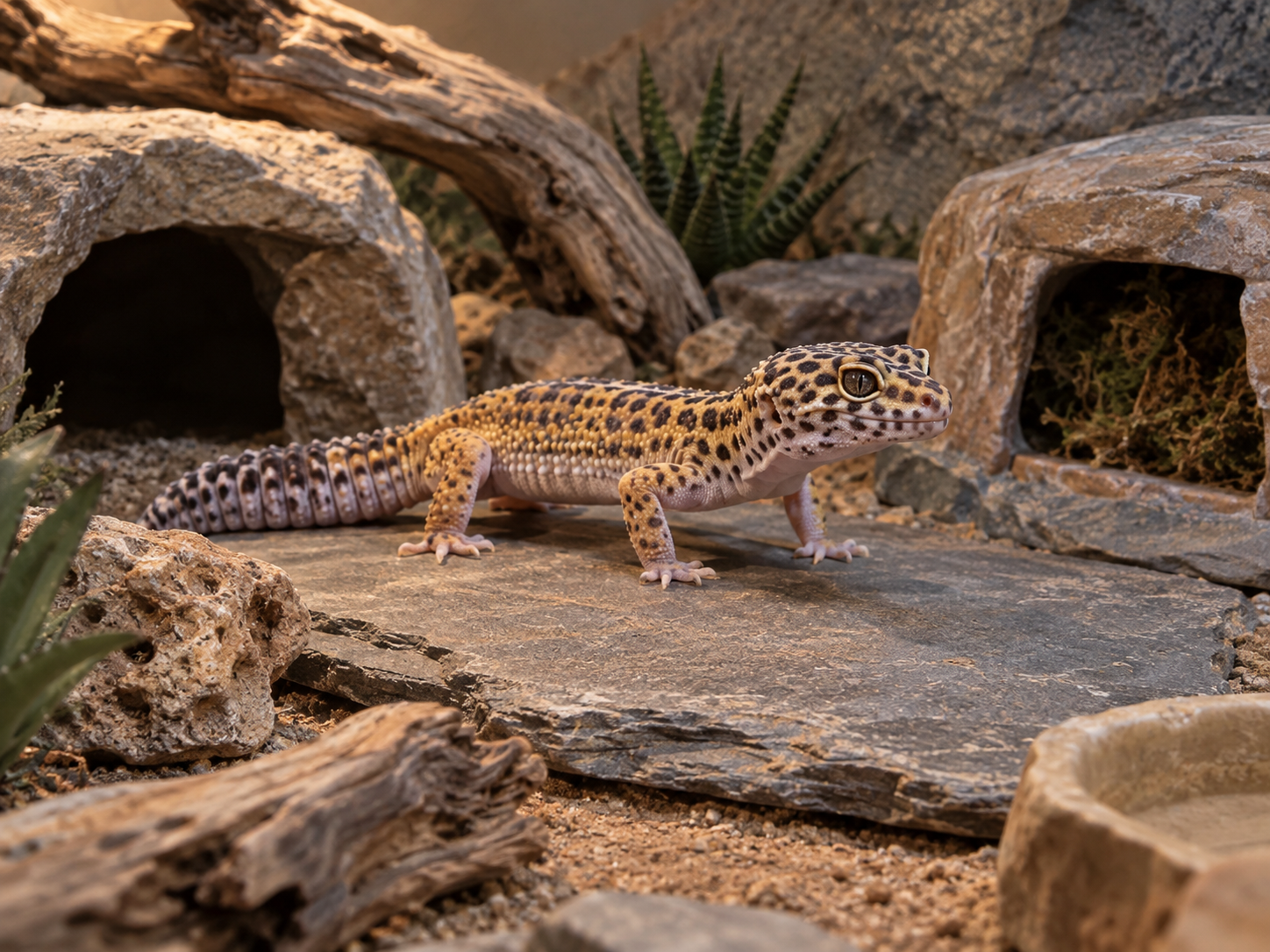
A 36 by 18 by 18 inch enclosure is the working minimum for an adult, furnished at ground level: three hides, a shallow water dish, some flat rocks and enough clutter that the gecko can cross the tank feeling covered. Keep them one to an enclosure, because males fight outright and cohabiting geckos of any sex end up with one animal monopolising the warm hide.
Heat is the core of the setup. Leopard geckos digest through belly contact, so a regulated under-tank mat or a thermostat-controlled overhead source should produce a warm surface of 88 to 92 degrees, with a cool end at 75 to 80. Measure with a probe laid on the surface, not a stick-on dial reading the glass, and never run any heat source without a thermostat: unregulated mats are the classic cause of thermal burns.
On substrate, the sensible position is to avoid loose sand, especially for juveniles and any gecko fed loose in the enclosure. A gecko striking at prey on a sand floor takes in whatever surrounds it, and impaction is the result. Tile, textured slate, paper towel or a firm packed soil mix all work and are easier to keep clean.
The Moist Hide and Shedding
A leopard gecko needs one humid microclimate in an otherwise dry enclosure: a covered hide packed with damp sphagnum moss, kept damp permanently, positioned on or near the warm side. With one, a gecko sheds cleanly in a single piece and often eats it. Without one, the shed dries onto the extremities.
The classic injury is retained shed on the toes, where a tight ring of old skin restricts circulation and can cost the gecko a toe, and on the eyelids, which is a genuine vet matter in this eyelid-bearing species. If you find stuck shed, re-dampen the hide, offer a shallow lukewarm soak, and let the gecko work it loose rather than pulling.
Diet and Feeding
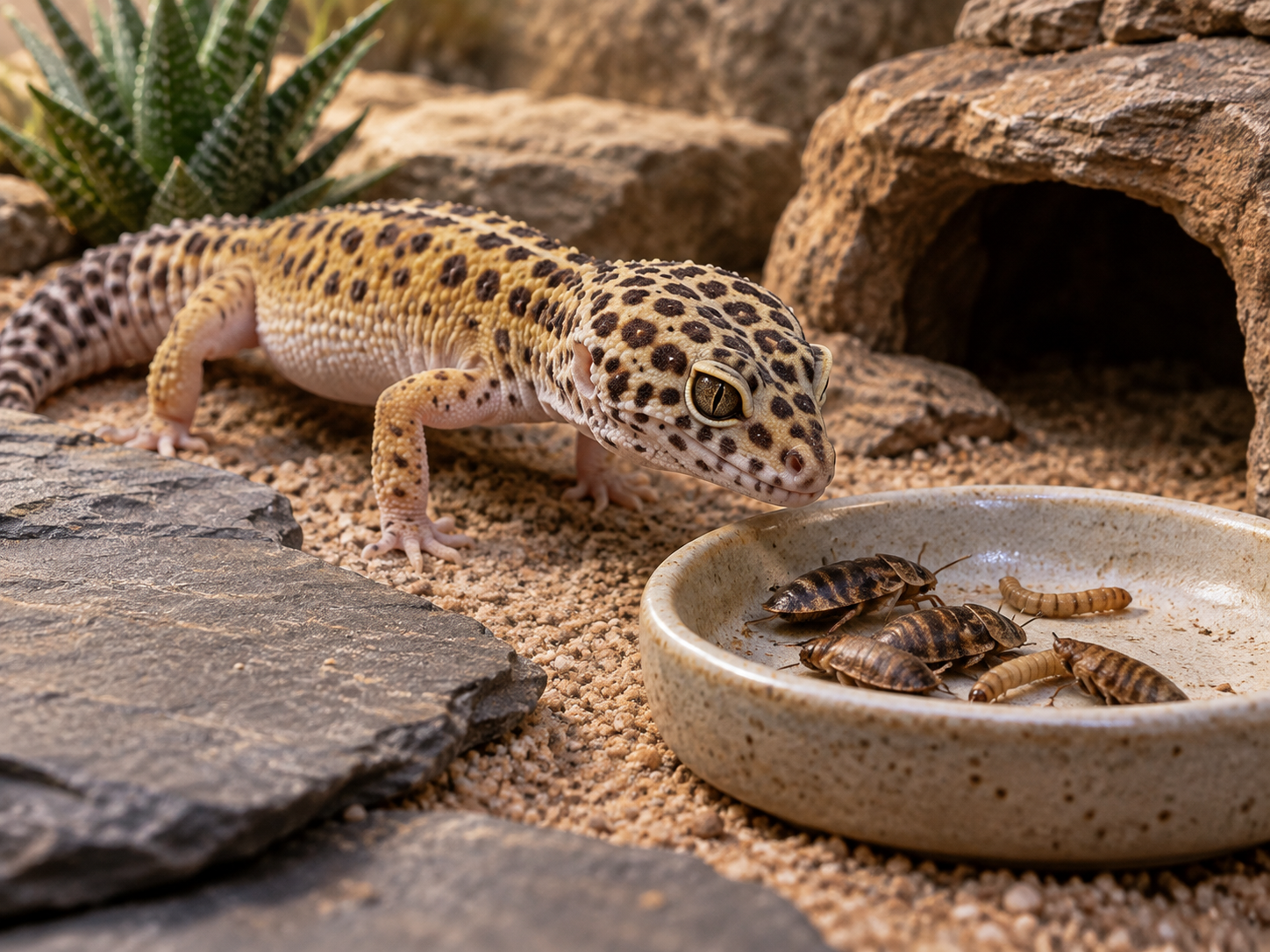
Leopard geckos are pure insectivores, so there is no salad and no pellet: the whole diet is gut-loaded feeder insects, dusted, sized no wider than the space between the eyes. Dubia roaches are the ideal staple, mealworms and black soldier fly larvae fill the rotation, and superworms and hornworms serve as occasional treats rather than dietary pillars because they run fatty.
Feed in a smooth-sided dish or by tongs so prey cannot burrow, dust to the schedule below, and read the tail as your feedback loop. The complete portion plan is on our leopard gecko feeder guide.
| Life Stage | What To Feed | How Much | How Often | Supplements |
|---|---|---|---|---|
| Hatchling to juvenile | Small dubia, small mealworms, BSFL | As many as eaten in 10 to 15 minutes | Daily | Calcium + D3 most feedings; multivitamin weekly |
| Subadult | Medium dubia, mealworms, occasional superworm | 5 to 8 items | Every other day | Calcium + D3 twice weekly; multivitamin every other week |
| Adult | Dubia, mealworms, BSFL, treat worms | 6 to 10 items | Every 3 to 4 days; a plump tail earns a longer gap | Calcium + D3 weekly; multivitamin every other week |
Everything a leopard gecko keeper needs from this guide. Untick anything you already have, then add the rest in one click.
Handling and Temperament
Leopard geckos are among the most handleable lizards in the hobby. Let a new gecko settle and feed reliably for a couple of weeks first, then scoop from below rather than grabbing from above, support the whole body, and keep early sessions short and low over a surface.
They can drop their tail when badly startled or grabbed by it. It regrows, but the regenerated tail is shorter, fatter and smoother, and since the tail is the animal's fat store, losing it is a real setback. Never pick one up by the tail.
Health and Troubleshooting
Between the tail, the shed and the appetite, a leopard gecko tells you almost everything. Most problems trace to an unregulated heat source, a missing moist hide, or a supplement schedule that slipped.
| What You See | Most Likely Cause | What To Do |
|---|---|---|
| Thin, pencil-like tail | Underfed, parasites, or too cool to digest | Verify warm surface temps; increase feeding; vet with a fecal if it continues |
| Stuck shed on toes or eyelids | No working moist hide | Re-dampen the moist hide; shallow lukewarm soak; vet for stuck eyelid shed |
| Not eating, sitting on the cool end | Warm surface too hot, often an unregulated mat | Fit or check the thermostat; measure at the surface, not the glass |
| Lethargy, swollen belly, no waste | Impaction, classically from loose substrate | Move off loose sand; shallow lukewarm soak; vet if unresolved |
| Wobbly limbs, tremors, soft jaw | Metabolic bone disease from missed calcium | Correct dusting immediately; add low-output UVB; vet |
| Belly burn or blistering | Unregulated heat mat | Remove the heat source now, fit a thermostat, vet for the burn |
| Dropped tail | Startled or lifted by the tail | Keep the enclosure clean while it heals; it regrows shorter and fatter |
Leopard Gecko FAQ
Part of the Leopard Gecko Hub: every guide we have on leopard geckos, in one place.
Keep reading: what to check when a leopard gecko stops eating and stuck shed on the toes.
Dialing In a Leo Setup?
Email us the gecko's age and your warm-surface temperature and we will size the feeders and dusting schedule. Real keepers answer.
TC INSECTS · Husbandry guidance from the people who raise the feeders · Porter, Texas
