Springtails for a Closed Terrarium
Folsomia candida tolerates a jar's swings in moisture the best
A small portion of an 8oz culture covers most jar-sized builds
Skip isopods in a small jar; a few Dwarf White suit a larger one
A cleanup crew behind the glass
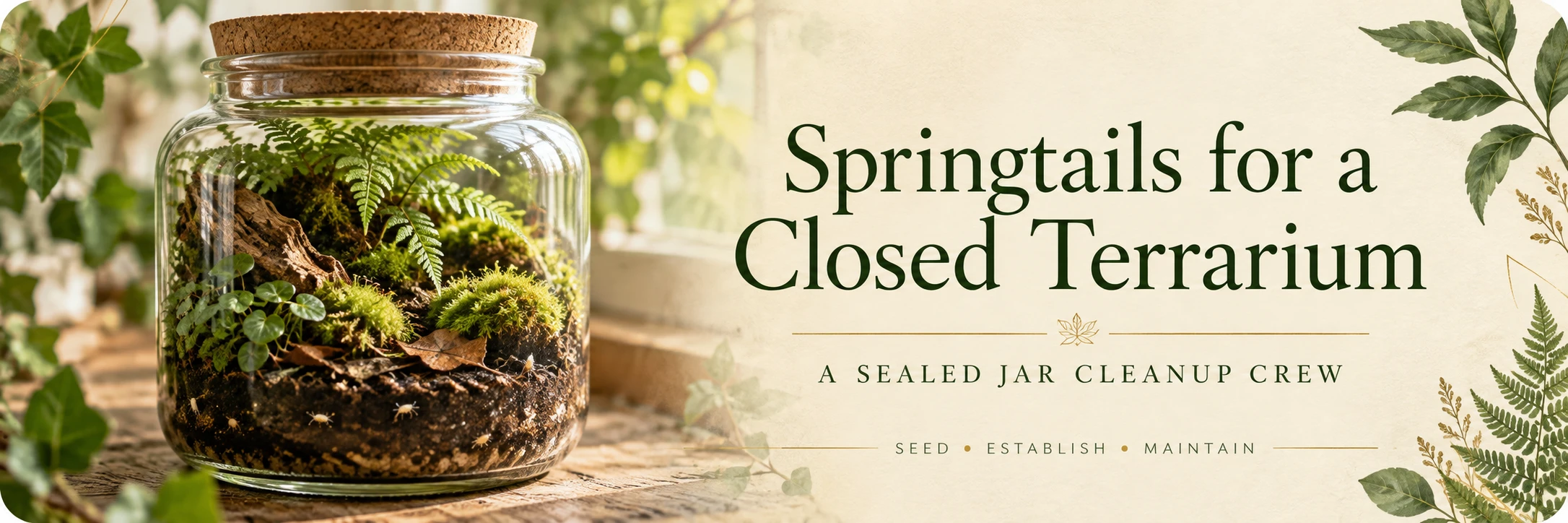
Yes, even a terrarium you plan to seal shut still needs a small springtail crew, because a closed jar has no drain and no keeper reaching in to clean it, so mold and dead leaves just pile up without something there to recycle them. A pinch of springtails, usually the temperate white springtail, Folsomia candida, is enough to seed most jar-sized builds, and in a larger closed enclosure a few dwarf isopods can join them. The population math is different from an open tank, though, since you cannot easily top up a crew once the lid is sealed for good.
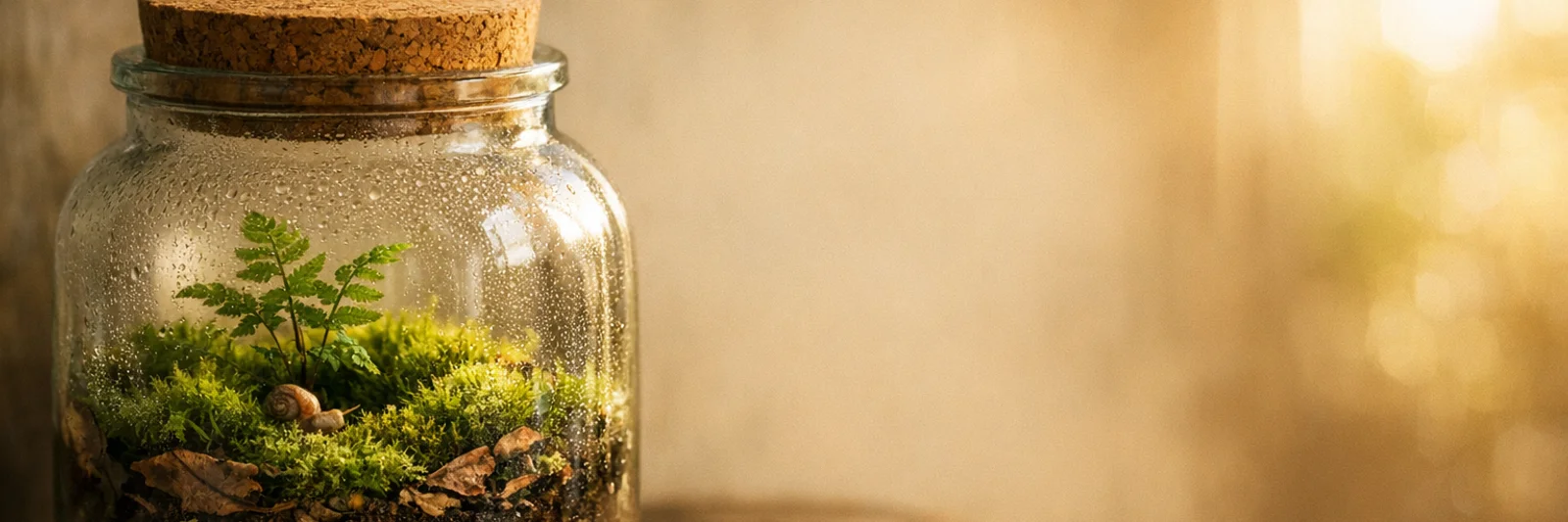
Plan the crew before closing the lid
The original guide below covers springtail seeding, jar size, isopod choices, moisture, and maintaining a backup culture.
Does a Closed Terrarium Actually Need Springtails?
Yes. A sealed jar terrarium has no drainage layer to flush waste away and no regular hand going in to trim dead leaves, so whatever the plants shed just sits there unless something breaks it down. Springtails fill that role by grazing mold and decaying plant matter into something the soil can reuse, the same job they do in an open bioactive build, just without you ever stepping in to help. Skip them and a closed jar tends to build up mold and dead material with nothing there to clear it.
The famous case of a bottle garden sealed shut in 1960 and watered only once since, still growing decades later, gets cited as proof a closed terrarium needs nothing at all. That jar held a single cutting in a sparse handful of soil, so there was barely any dead organic matter to manage in the first place. A typical hobby build with potting mix, moss, and leaf litter, closer to what our general bioactive terrarium setup guide walks through for an open tank, has far more decaying material to deal with, which is exactly the gap a small cleanup crew closes.
What Springtails Are Actually Doing Behind the Glass
Inside the jar, springtails graze the same things they target in any bioactive setup: fungal blooms on damp soil or wood, algae near the waterline, and dead leaf tissue as it breaks down. That is the same mechanism covered in our guide on whether springtails actually eat mold, and it works the same way in a jar as it does in an open tank. What changes is that in a sealed build, that grazing is the only cleanup happening at all, so an established population matters more, not less.
A springtail population left to its own devices rises when there is a mold bloom to eat and eases back down once that food source is gone, the same rise and fall pattern you would see in any culture. Inside a closed jar, that cycle is what keeps a small, contained ecosystem from fouling itself over months and years instead of weeks.
How Many Springtails Does a Sealed Jar Actually Need?
For a typical quart to half gallon jar, a small pinch, roughly a teaspoon, worked from an active culture into the top layer of soil or moss is plenty to start a population that grows into the space on its own. Bigger closed vessels, a gallon jar or a small tank with a tight lid, can take a full tablespoon or two without being overstocked. You are seeding a starting population, not trying to hit an exact headcount, since the crew multiplies to match whatever food and space the jar actually offers.
Seed the springtails a week or two before you plan to seal the jar for good, not the same day. That gives the population a head start establishing in the substrate while you can still open the lid easily to check on it, rather than sealing a brand new, unproven culture in on day one and hoping it takes. If your build is more open pot than sealed jar, our springtails and isopods for houseplants guide covers dosing for that instead.
Should Isopods Go in Too, or Just Springtails?
Mostly no, and the size of the jar is what decides it. Isopods are pickier about airflow than springtails, so whether they belong at all comes down to how much air a given closed build actually has to offer.
Small jars, under about a gallon: springtails only
A small sealed jar simply does not have the airflow or space budget for isopods, which need meaningfully more oxygen exchange than springtails do. Keepers who have tried isopods in a genuinely airtight small container consistently report them struggling or dying off within weeks, while springtails, which need very little oxygen, keep going on whatever the plants inside produce through photosynthesis alone. Stick to springtails in anything jar-sized.
Larger closed builds: a few Dwarf White can work
Once you are working with a larger closed enclosure, a bigger jar or a small tank with a tight-fitting lid, a handful of Dwarf White isopods (Trichorhina tomentosa) can join the springtails. They are tiny, about 3 to 4 mm, and their bioload is light compared to bigger species. Skip large, messier Porcellio species here entirely, even in a bigger closed build, since they simply need more airflow and space than any sealed jar reliably offers, the same reason they belong in an open isopod-only display vivarium instead.
What Actually Goes Wrong in a Sealed Springtail Jar
Too much water at setup is the most common failure, since a closed jar has no drainage layer to fall back on and no way to dry out once it is sealed. Build in a modest gravel or clay ball layer under the substrate before you add anything living, and go easy on the initial misting. A closed jar holds onto moisture far longer than an open tank ever does, and a fine white bloom on fresh wood or bark in the first week or two is usually normal curing, not a sign anything is wrong, covered in our white mold in a new terrarium guide.
The other common failure is starting the crew with too little to eat. A closed jar cannot be topped up with fresh leaf litter the way an open bioactive tank can, so build in enough leaf litter and organic matter at setup for the population to graze for months, not days, plus a layer of moss to help hold moisture since you will not be misting it once it is sealed. A springtail crew seeded into a nearly bare jar with almost nothing to eat can stall out or crash before it ever gets established, the same overfeeding and underfeeding balance that governs any culture.
Can You Top Up a Crew Without Breaking the Seal?
Most closed terrariums are better described as rarely opened than truly airtight forever, and that is a good thing. A springtail culture in a completely sealed container can suffocate on its own carbon dioxide over time, the same reason an airtight culture cup stalls out, so cracking the lid briefly every so often to exchange air is worth more than a perfect, permanent seal.
If a population looks thin the first time you check, open the jar, work in a small fresh pinch from a backup culture, and reseal. That is a normal part of running a closed build, not a sign the whole idea failed. Keep a small backup springtail culture going on the side specifically for this, the same habit that makes any springtail keeper's setup more resilient.
The Sealed Jar Starter Kit
A humidity-steady culture, litter sized right for a small jar, and moss to hold moisture once it's sealed.
Frequently asked questions
Do closed terrariums need springtails?
Yes. A sealed jar has no drainage and no regular cleaning, so dead leaves and mold just accumulate unless something breaks them down. A small springtail population, usually temperate white springtails, fills that role quietly for the life of the build, the same job they do in any bioactive setup, just without you ever stepping in.
Can isopods live in a fully sealed terrarium?
Small jars are best left to springtails alone, since isopods need more oxygen exchange than a truly airtight container reliably provides and tend to struggle within weeks. A larger closed build can support a few Dwarf White isopods, which are tiny and light on the system, but skip bigger, messier species in any sealed jar.
How many springtails should I add to a jar terrarium?
About a teaspoon of an active culture for a quart to half gallon jar, or a tablespoon or two for a gallon-sized build. Seed the population a week or two before sealing the jar so it has a head start, rather than sealing in a brand new, unproven culture on day one.
Will a sealed terrarium run out of oxygen with bugs inside?
Springtails need very little oxygen and can live largely on what a few plants produce through photosynthesis, so oxygen is rarely the limiting factor for them. Isopods need more, which is exactly why they struggle in a container that never gets any air exchange at all, unlike a jar that gets cracked open occasionally.
What happens if the springtail crew in a closed terrarium dies out?
Open the jar, work in a fresh pinch from a backup culture, and reseal it. A population dying back usually points to too little to eat at setup or too much standing moisture, both fixable by adjusting what goes back in rather than starting the whole build over.
Can a jar terrarium really run for years without being opened?
A well-built one can go a long time with minimal intervention, though cracking the lid occasionally for fresh air is healthier than a permanent, total seal. The famous decades-old sealed bottle gardens people cite were sparse, low-waste builds. A typical jar with real soil, moss, and leaf litter benefits from a working cleanup crew and the occasional peek inside.
Keep learning
Have a care question? Ask our community.
Join Reptile Keepers USA, our free Facebook group for reptile, amphibian and invert keepers. Share your setups, get care help and swap feeder tips.
Join the free group