
Twisted Clown Isopods for Sale
Overview
Twisted Clown isopods are a designer hybrid line crossing two real Armadillidium species: A. klugii (the Balkan Clown Isopod) and A. versicolor (a smaller variegated southeastern European species). The hybrid was originally developed by isopod breeder Orin A. and entered the hobby trade as a stable cultivated line. As a result, this is a documented hybrid product with real provenance, not a hobby-trade label without history.
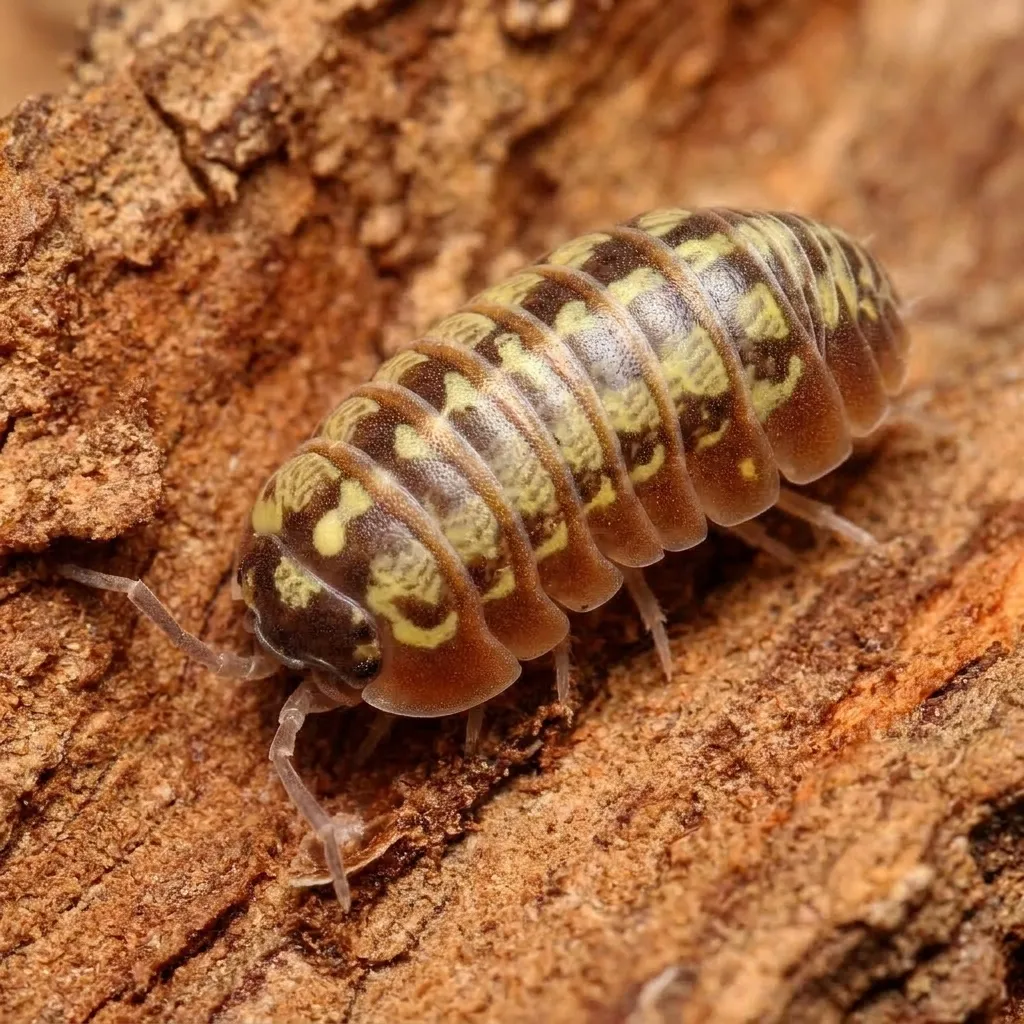
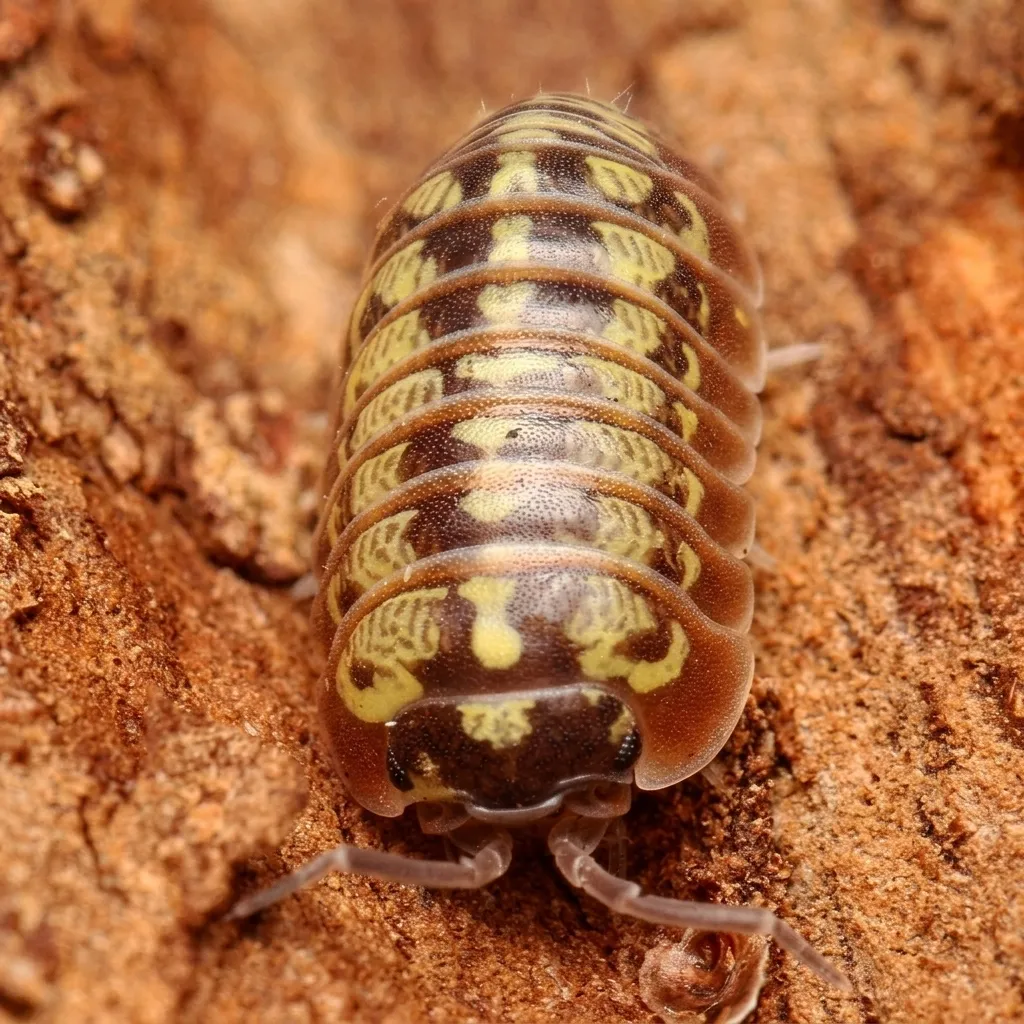
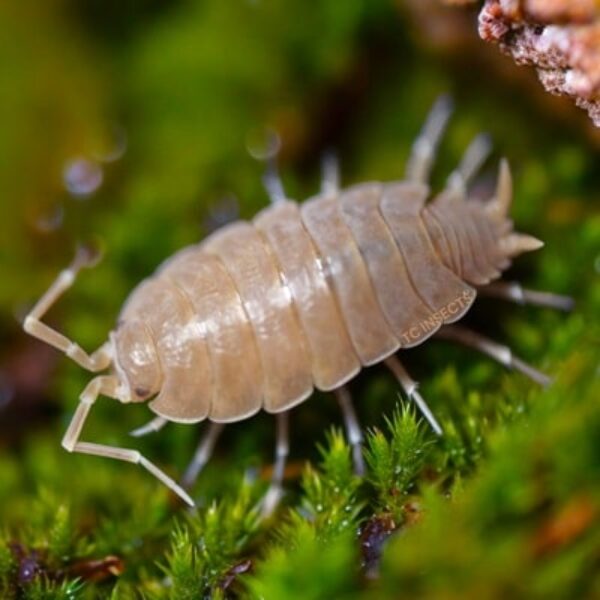
The line inherits traits from both parent species. From A. klugii, hybrids carry the bright clown-style spotting that gives the parent species its hobby nickname. From A. versicolor, they carry the variegated base coloration and smaller-to-mid body size. Specifically, hobby-reported adult sizes sit around 15 to 20 mm, between the parent species’ 10 mm and 21 mm ranges.
Why Keep Twisted Clown Isopods?
- Documented hybrid pedigree: First, the line traces back to a specific breeder (Orin A.) and a documented species cross, which is more provenance than most hobby-trade names carry.
- Variable clown-style spotting: Additionally, individuals show a mix of A. klugii-style bright spots over variable base tones inherited from the A. versicolor parent.
- Full conglobation: Both parent species belong to family Armadillidiidae, so Twisted Clowns roll fully into a sealed ball when disturbed.
- Intermediate body size: Furthermore, the hybrid size class fits naturally into mid-size display setups, while still being large enough to see individual patterning clearly.
- Connection to both parent species in our catalog: Finally, you can keep Twisted Clowns alongside Armadillidium versicolor “Ceska” and other A. klugii morphs in separate enclosures to compare the parent species side by side.
Honest Note: Twisted Clown Is a Hybrid Line, Not a Pure Species
This is the most important fact about this product. Twisted Clown is Armadillidium klugii × Armadillidium versicolor, a documented designer hybrid created by isopod breeder Orin A. It is not a pure A. klugii morph, and it is not the same as Montenegro Clown, Dubrovnik Clown, or other locality lines of pure-species A. klugii.
If you specifically want pure A. klugii, look at our A. klugii Montenegro and Dubrovnik product pages instead. Specifically, those lines are pure species with the documented Mediterranean black widow Batesian mimicry trait preserved fully. Twisted Clown carries that mimicry only partially, since the versicolor parent does not contribute the same pattern.
Honest Note on Hybrid Pattern Stability
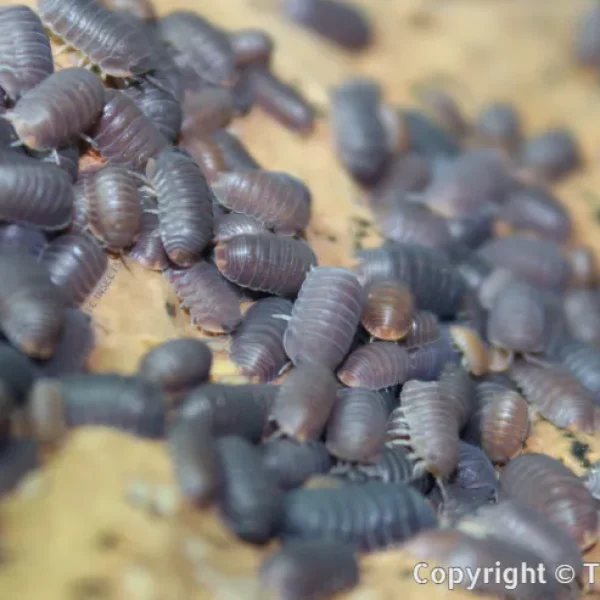
Hybrid lines show more pattern variation between individuals than pure species. Specifically, traits from both parent species can segregate unpredictably across generations, which means offspring may favor the klugii look, the versicolor look, or a mix of both. As a result, do not expect a uniform colony where every animal looks identical.
Additionally, hybrid breeding stability over many generations is less predictable than pure-species lines. To maintain the Twisted Clown appearance long-term, select breeders that show the clearest expected expression of both parent traits. Otherwise, the colony may drift toward one parent’s look over multiple generations.
Honest Note on Mimicry Inheritance
The pure A. klugii parent species shows Batesian mimicry of the Mediterranean black widow spider (Latrodectus tredecimguttatus). The bright red, yellow, and white spots resemble the spider’s warning markings, which discourages predators that mistake the harmless isopod for a venomous spider. Specifically, this mimicry interpretation is published in peer-reviewed literature for A. klugii.
Twisted Clown hybrids carry this mimicry only partially. Some hybrid individuals show strong klugii-style spots that still read as black widow mimicry, while others show muted or variable patterning that no longer resembles the spider clearly. In captivity, this does not affect husbandry, but it does affect the visual story behind the colony.
Care and Setup
Twisted Clown isopods do well in a moderate-humidity setup with strong airflow and a clear dry-to-moist gradient. The husbandry follows the framework used for both parent species, since they have similar needs.
Temperature
Target 68 to 78°F across most of the year. Normal indoor temperatures work for most home setups. However, prolonged heat above 80°F stresses the colony, and cold rooms slow breeding noticeably.
Humidity
Aim for low to medium humidity overall with one consistently moist retreat zone. Keep that side hydrated with sphagnum moss and damp substrate, then let the rest of the enclosure run drier. Specifically, about one-third moist and two-thirds drier is a practical layout that suits both parent species.
Substrate
Use a moisture-holding mix of soil, rotted hardwood, and organic matter at a depth of 2 to 3 inches. Add a generous layer of TC INSECTS Assorted Hardwood Leaf Litter on top. Cork bark and rock-style decor pair well with the variable hybrid coloration.
Food
Lead with leaf litter and decaying hardwood as the base diet. Then supplement with TC INSECTS Isopod Food for added protein and minerals, plus a calcium source like TC Calcium Ultra Fine. Hybrid lines can show slower or more variable breeding, so keep food consistent to support what reproduction does occur.
Ventilation
Use cross-ventilation or controlled lid ventilation. Specifically, you want enough airflow to prevent stagnant pockets, but not so much that the moist retreat dries within a day. As a result, the colony can self-select between the two humidity zones.
Bioactive Use
Twisted Clowns can work in moderate-humidity bioactive enclosures once the culture is established. However, run a backup culture in a dedicated bin first. Hybrid lines especially benefit from a protected source colony, since rebuilding from a crashed display can be harder when the breeding line is genetically less predictable.
Breeding Notes
Twisted Clown breeds at a slow-to-moderate pace once settled. Females carry developing mancae in a brood pouch, and stable conditions with consistent moisture access support successful broods. Generally, expect more variability in reproductive output than you would see in a pure-species line.
For best results, leave the colony undisturbed during the first six to eight weeks. Then add fresh leaf litter before the existing layer is fully consumed, and avoid frequent digging through the substrate. To maintain the hybrid appearance over generations, select breeders that show the clearest mix of both parent traits.
Best For
- Collector display cultures focused specifically on documented designer hybrid lines
- Planted vivariums with moderate humidity at room temperature
- Keepers who already manage Armadillidium care confidently and want hybrid variety
- Hobbyists building a multi-species set that includes both parent species separately
- Bioactive setups paired with springtails for cleanup support
Not Best For
- Buyers who specifically want pure A. klugii, who should choose Montenegro or Dubrovnik lines instead
- Hot tropical setups running consistently above 80°F
- Feeder use, since per-animal value is too high and the rolled defensive posture limits feeder availability
- Mixed-culture enclosures with pure A. klugii or A. versicolor, since further crossing would blur line identity
- Keepers expecting uniform colony appearance, since hybrid patterns vary between individuals
- Academic or research projects requiring a pure-species reference line
Origin and Locality Notes
The two parent species have well-documented origins. Armadillidium klugii was described by Brandt in 1833 and is native to the Adriatic coast from Croatia (Dalmatia) to Montenegro, with limited records from southern Albania and western Greece. Armadillidium versicolor was described by Stein in 1859 and is widespread across southeastern Europe, with strong populations in Hungary and the Czech Republic.
The Twisted Clown hybrid was developed in captivity by isopod breeder Orin A. and is not a wild-collected line. As a result, we treat this product as a documented designer hybrid rather than a locality reference. The husbandry follows the general Armadillidium care framework that suits both parent species.
Receiving and Acclimation
Open your package promptly when it arrives and inspect the cup calmly before moving anything. Rolling isopods often arrive curled up or hidden in moss and shipping paper, so check slowly rather than dumping the culture.
Prepare the enclosure before opening the cup. The habitat should already have a moisture gradient with one moist retreat zone, deep leaf litter, bark, and a calcium source. Then place the shipping material into the enclosure and let the isopods move out on their own. Finally, keep the setup quiet for the first week while the colony settles.
It is normal for new arrivals to stay curled or hidden for the first several days. The hybrid line carries some of the timid behavior associated with the A. klugii parent, so do not interpret early hiding as a problem with the culture.
Recommended Add-Ons
- TC INSECTS Isopod Habitat Kit — a complete starter setup that gives this hybrid culture proper substrate, leaf litter, moss, and feed from day one.
- TC INSECTS Assorted Hardwood Leaf Litter — the core food and cover layer that should never run out in a Twisted Clown culture.
- TC INSECTS Isopod Food — supplemental protein and minerals beyond leaf litter, fed in small portions to support hybrid reproduction.
- TC Calcium Ultra Fine — supports healthy molts for the mid-sized hybrid body.
- Springtails — pair well with Twisted Clowns in moderate-humidity bioactive setups to help manage mold around the moist retreat zone.
Frequently Asked Questions
Is Twisted Clown a pure Armadillidium klugii?
No. Twisted Clown is documented as a hybrid between A. klugii and A. versicolor, originally developed by isopod breeder Orin A. The line combines clown-style spotting from the klugii parent with the variegated base coloration of the versicolor parent. If you want pure A. klugii, look at Montenegro or Dubrovnik morphs instead.
Will every individual look the same?
No, and that is expected for a hybrid line. Specifically, traits from both parent species segregate across generations, so some animals favor the klugii look, some favor the versicolor look, and many fall somewhere between. As a result, expect natural variation rather than uniform morph expression.
Do they have the black widow mimicry of pure klugii?
Partially. The pure A. klugii parent shows Batesian mimicry of the Mediterranean black widow (Latrodectus tredecimguttatus), and some hybrid offspring retain strong enough spotting that the mimicry still reads. However, animals that lean toward the versicolor side lose this signal. As a result, the visual story varies between individuals.
Will the line stay stable over generations?
It depends on selection. Hybrid lines typically need active breeder selection to maintain a target appearance over many generations. Without selection, the colony can drift toward one parent species’ look. Therefore, keepers who want to maintain Twisted Clown character long-term should pick clear-patterned individuals as breeders.
Can I keep Twisted Clowns with pure A. klugii or A. versicolor?
Generally, no. Specifically, further crossing between Twisted Clowns and either parent species would create additional hybrid generations and blur the line further. Keep this culture separate from pure A. versicolor “Ceska” and from pure A. klugii morphs.
How fast do they breed?
Slow to moderate. Hybrid lines often show more variable reproductive output than pure-species lines. They do not produce the population booms seen with workhorse cleanup species like Porcellio laevis “Dairy Cow”. Generally, plan this as a slow-building display colony.
Learn More About the Parent Species
Because Twisted Clown is a hybrid of two documented Armadillidium species, the following non-competitor references cover both parent species and the hybrid background.
-
Wikipedia: Armadillidium klugii. The main species reference for the Balkan parent, covering Brandt’s 1833 original description, Adriatic coastal distribution, and the documented Batesian mimicry of the Mediterranean black widow. Useful for understanding the clown-style spotting that the hybrid line inherits from this parent.
-
World Register of Marine Species: Armadillidium versicolor Stein, 1859. The authoritative taxonomic record for the second parent species, with Stein’s original 1859 description and a list of recognized varieties. Useful for understanding the variegated base coloration that the hybrid line inherits.
-
PubMed Central: Terrestrial isopods, soil, and litter interactions. An open-access review of how land isopods interact with leaf litter, moisture, and substrate. Useful for keepers who want the science behind why deep hardwood leaf cover and stable calcium availability matter for both parent species and their hybrid offspring.




Reviews
There are no reviews yet.