
Horseshoe Crab Roaches for Sale
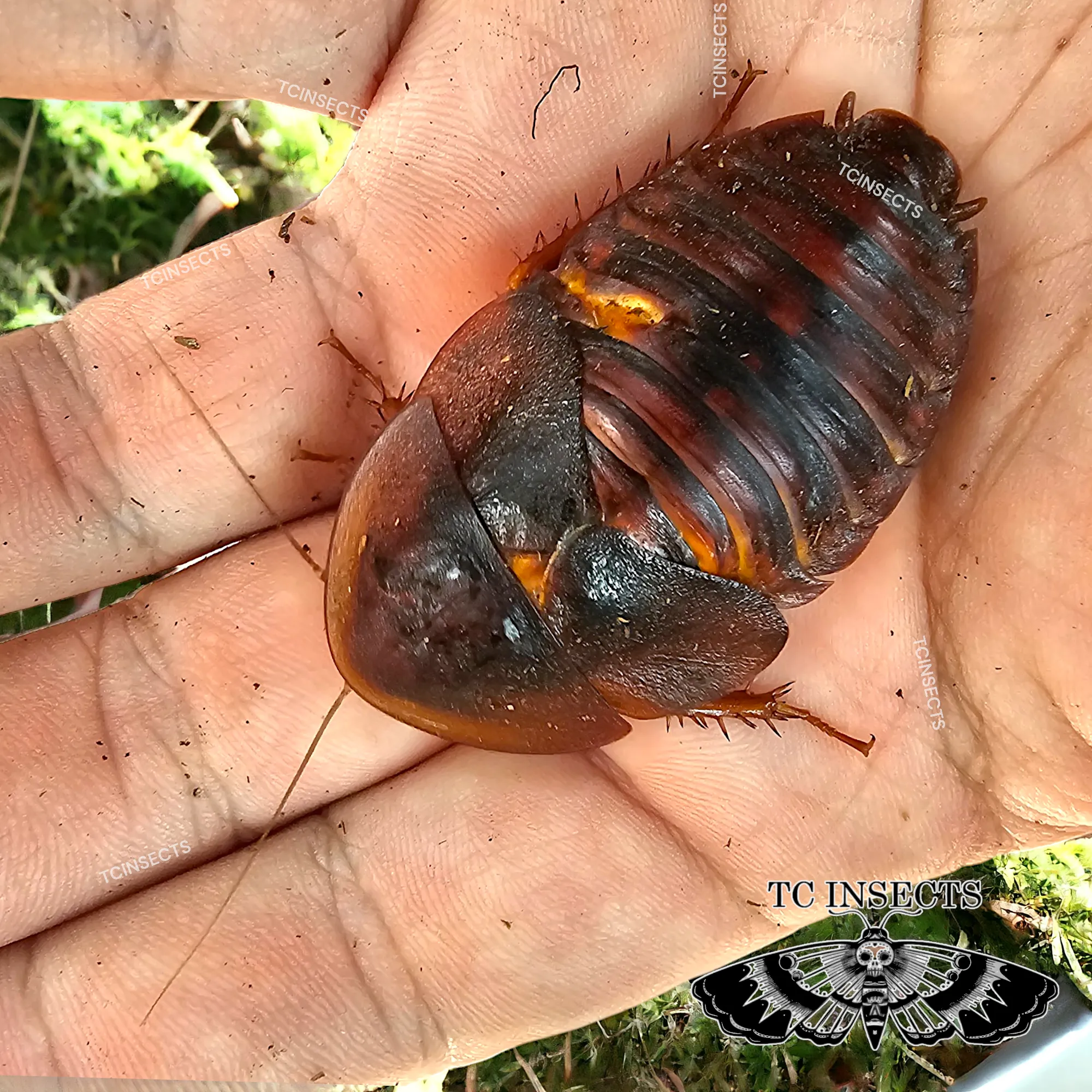
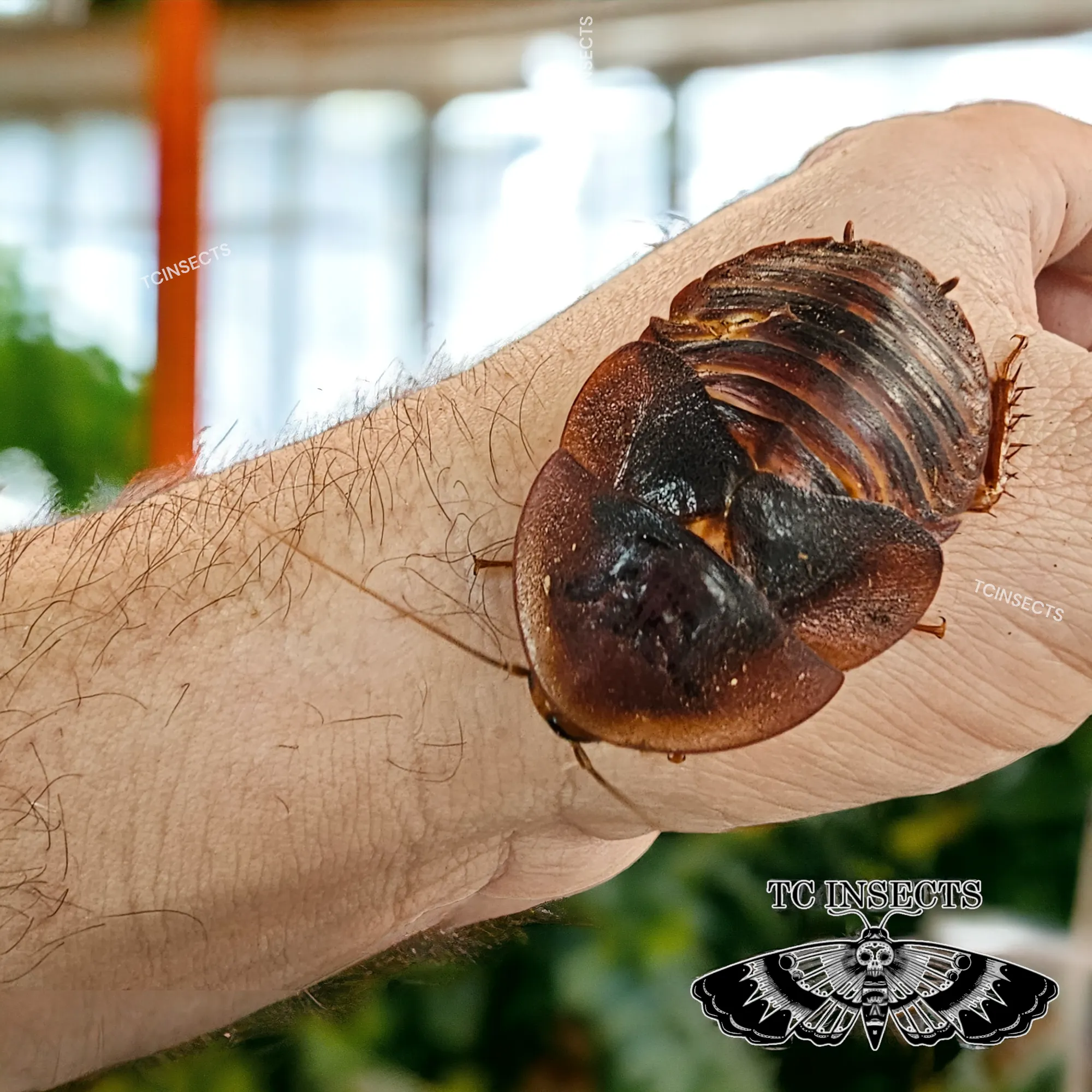
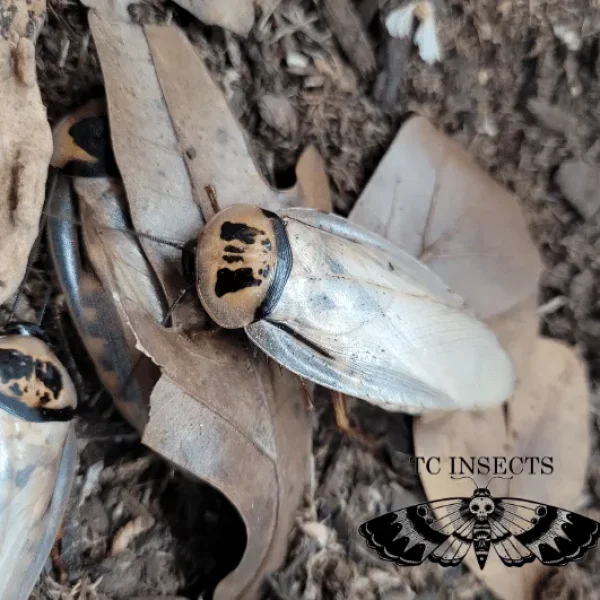
The Horseshoe Crab Roach (Hemiblabera tenebricosa) is a US native cockroach with one of the most distinctive body shapes in the entire exotic roach hobby. The flattened, broad-oval body and rounded pronotum
genuinely resemble a small horseshoe crab — which is where the common name comes from. The species is documented across multiple references as native to the Florida Keys, Dade County (Miami area), and the West
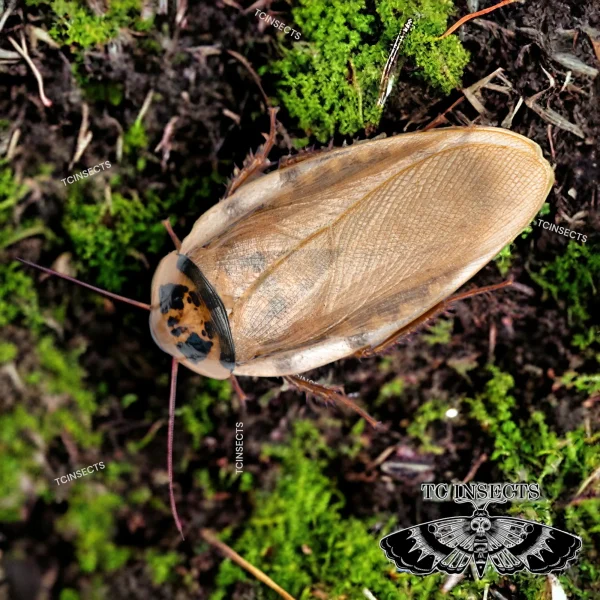
Indies (Bahamas, Cuba, and other Caribbean islands). Adults reach 40 to 53 mm — larger than typical Dubia roaches — with light brown coloration. The species was first formally described by entomologists Rehn and
Hebard in 1927, the same researchers behind many West Indies cockroach descriptions. Sold to display keepers and US native species collectors in counts of 1, 5, or 10 mixed nymphs.
Overview
Horseshoe Crab Roaches are in family Blaberidae, the giant cockroach family that includes most of our catalog — Dubia, Blaberus, Eublaberus, hissers, and the *Gyna* and *Panchlora* species. Like other blaberids,
females give birth to live nymphs rather than laying eggs. What sets this species apart from most catalog blaberids is the combination of distinctive body shape (flattened oval, broad pronotum), non-climbing and non-
flying biology (one of the easiest containment profiles in our catalog), substantial adult size, and documented US native status. The species is documented as easy to keep and breed, with care similar to standard Dubia
roaches. This makes it an unusually accessible introduction to display roach keeping and an obvious alternative for Dubia keepers wanting something visually different without changing their care approach.
Honest Note: It’s Caribbean and Florida, Not Central/South America
Older hobby sources (including text on our own page) state this species is native to Central and South America. That’s incorrect:
- Documented native range: The Florida Keys (US), Dade County (Miami area, US), and the West Indies (Bahamas, Cuba, and other Caribbean islands).
- Sourced to multiple authoritative references: GBIF (Global Biodiversity Information Facility), BugGuide, World Species, iNaturalist, and Bugs In Cyberspace all confirm the Caribbean/Florida Keys distribution.
- The species’ formal English common name reflects this: “Broad Keys Cockroach” refers directly to the Florida Keys habitat.
- This is a US native species, which has practical legal implications for buyers in southern US states.
The correction matters for husbandry too: setting up the enclosure for tropical Caribbean conditions (warm, humid, leaf litter, with burrowing substrate) gives much better results than guessing at “tropical somewhere” conditions.
Honest Note: This Species Has Three Common Names
You’ll see this species sold under several names. They all refer to the same species; the differences are which aspect each name emphasizes:
- Horseshoe Crab Roach: The most common hobby name, referencing the flattened broad-oval body shape that resembles a small horseshoe crab. This is the dominant search term and what we sell it under.
- Broad Keys Cockroach: The formal English common name per GBIF and BugGuide. “Broad Keys” refers to the Florida Keys and the broad-bodied appearance. This is what you’ll see in scientific literature and formal references.
- Mickey Mouse Roach: An alternative hobby usage referring to the rounded pronotum and head shape, which some keepers say resembles Mickey Mouse’s silhouette. Less commonly used but worth knowing.
If you’re searching for care information online, try all three names — different communities use different conventions.
Honest Note: This Is the Easiest Display Roach to Contain in Our Catalog
Most exotic display roaches require careful containment because adults can climb smooth surfaces, fly, or both. Horseshoe Crab Roaches require essentially none of that effort. Here’s why:
- Neither sex can climb smooth surfaces. The body shape and leg structure don’t give them the adhesive contact most climbing roaches have. A plastic bin with a tight-fitting lid is plenty.
- Neither sex can fly. Both adult males and females have only vestigial (reduced, non-functional) wings. No flight risk at any life stage.
- They play dead when disturbed. The defensive response is to stop moving rather than to run or fly away. This makes them easier to handle and harvest.
- They burrow when stressed. Escapees tend to dig into substrate rather than wander, which makes recovery easier.
Practical takeaway: a standard plastic storage bin with a tight lid handles this species with no special precautions. This is one of the few exotic roaches in our catalog you could keep in a child’s room without containment worries.
Honest Note: One of Our Largest US Natives
This species is one of the larger US native cockroaches and the second US native in our rewrite catalog after our Compsodes schwarzi “Micro Hooded Roach”. The US native status has real practical implications:
- Legal simplicity. Most US states allow keeping native cockroach species more freely than non-native exotic species. Florida residents in particular often find this species easier to keep legally than many catalog exotics.
- Shipping flexibility. Native species can typically ship to more US states than restricted non-native species.
- Lower ecological risk if accidentally released. Native species establishing wild populations is a much smaller environmental concern than non-native species, since they’re already part of the regional ecosystem. We still don’t recommend release under any circumstances, but the consequence would be limited compared to releasing a non-native exotic.
- Documented US biology. The species’ wild biology has been studied in the Florida Keys context, giving us more direct husbandry data than for many exotic imports.
How It Compares to Dubia and Our Other US Native
Two natural comparisons for buyers deciding between this species and other catalog options:
Vs Dubia Roaches:
- Size: Horseshoe Crab Roaches reach 40-53 mm vs Dubia adults at about 45 mm. Comparable size class, with Horseshoe Crab Roaches slightly larger on the upper end.
- Body shape: Horseshoe Crab Roaches are flattened broad-oval; Dubia are more elongated.
- Climbing/flying: Both species are non-climbing and non-flying — equally easy to contain.
- Care: Nearly identical. If you can keep Dubia, you can keep these.
- Use case: Dubia is the standard feeder; Horseshoe Crab Roach is the display species with feeder capability.
Vs Compsodes schwarzi (our other US native):
- Size: Horseshoe Crab Roach 40-53 mm; Compsodes 5-6 mm. Dramatically different scales.
- Family: Horseshoe Crab Roach is Blaberidae (live-bearing); Compsodes is Corydiidae (egg-laying sand roach family).
- Native range: Horseshoe Crab Roach is Florida Keys + Caribbean; Compsodes is Arizona to Florida.
- Wild lifestyle: Horseshoe Crab Roach lives in leaf litter and burrows; Compsodes lives inside trapjaw ant colonies.
- Use case: Both display, but at very different scales.
Care and Setup
Husbandry is straightforward and broadly similar to Dubia care. Per documented hobby sources, the species is hardy and undemanding.
Enclosure
A plastic bin or glass aquarium with a secure lid. Provide at least one square inch of floor space per roach. Add hiding places like cork bark, egg cartons, or cardboard tubes. Because they’re non-climbing and non-flying, you don’t need a gasket lid — a standard tight-fitting lid is fine.
Substrate
A mix of coco fiber, compost, and decaying oak leaves, at least 4 inches deep to allow burrowing. Adding coco chunks or mulch prevents the substrate from becoming anaerobic and smelly. The leaf litter contributes to nymph development.
Temperature and Humidity
65 to 85°F is the active range, with warmer temperatures (78 to 82°F) driving best breeding. They prefer high humidity (70 to 80%), maintained by misting the enclosure regularly. A shallow water dish (with no drowning risk for small nymphs) provides backup humidity.
Food
Not picky. Offer fruits, vegetables, grains, fish flakes, dog food, or Supreme Feed Premium Roach Formula. Offer fresh food every other day and remove uneaten food to prevent mold and mites. Supplement with TC Calcium Ultra Fine or cuttlebone for calcium, especially if you’re feeding the roaches to reptiles.
Hydration
A shallow water dish works (low drowning risk for adults), or use Hydro-Thirst Insect Water Crystals as a spill-proof source. The damp substrate also provides hydration.
Breeding Notes
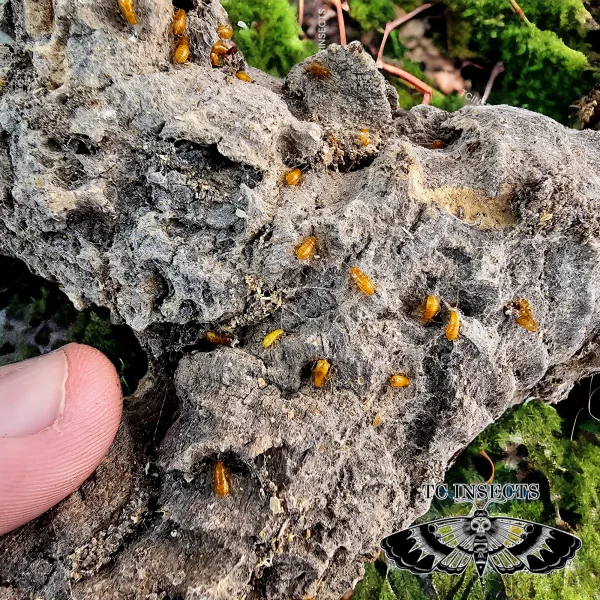
Females are live-bearing (ovoviviparous), like other blaberids. Gestation is about 2 to 3 months, and females produce up to 30 nymphs per litter. Newborn nymphs are small and delicate and tend to hide in the substrate
for the first few weeks before emerging to forage. Adult lifespan is about 4 to 8 months, depending on sex (males tend to live shorter) and temperature (warmer = faster development but shorter individual lifespan). The
colony stays productive through overlapping generations, so plan for ongoing breeding rather than a single-time setup.
Handling Notes
Per documented hobby sources, this species is docile and harmless. You can handle them gently with your fingers or a soft brush. When disturbed, they may try to escape into substrate OR play dead — both reactions are
normal defensive responses. Always handle them over a container or a table to catch any escapees. Wash hands before and after handling, and avoid touching your eyes, nose, or mouth (standard insect-handling hygiene).
Best For
- First-time exotic roach keepers wanting an easy, forgiving species
- Display keepers drawn to the distinctive horseshoe-crab body shape
- US native species collectors building out regional fauna representation
- Dubia keepers looking for a larger display alternative with the same care framework
- Children’s room and family setups where flying or climbing escapes would be unwelcome
- Florida residents looking for legally simpler keeping options
- Bioactive setups wanting a substantial Caribbean species in a moist warm enclosure
Not Best For
- Keepers wanting climbing or flying display action; these are ground-dwellers only
- Buyers wanting bright or unusual coloration; these are uniformly light brown
- Setups with consistently dry conditions (need high humidity)
- Customers in jurisdictions that restrict all cockroach species
- Anyone planning to release roaches outdoors under any circumstances
Origin and Locality Notes
Hemiblabera tenebricosa is native to the Florida Keys, Dade County (Miami area), and the West Indies (Bahamas, Cuba, and other Caribbean islands) per documented sources including the Global Biodiversity
Information Facility (GBIF), BugGuide, World Species, and iNaturalist. The species was formally described by entomologists Rehn and Hebard in 1927 in their landmark “Orthoptera of West Indies” series, making this a
historically credible documented species with established taxonomy. The genus Hemiblabera includes several other Caribbean species, with this species being the most widely kept in the hobby. Family Blaberidae makes
this species the same family as most catalog roaches (Dubia, Blaberus, hissers, *Gyna*, *Panchlora*), distinct from our Corydiidae species (Compsodes schwarzi and Ergaula pilosa) and our Nocticolidae species (Nocticola sp.).
Receiving and Acclimation
Your order ships with ventilation and bedding suited to transit. On arrival, transfer the nymphs into a prepared enclosure with deep moist substrate, leaf litter, and hides. Because the nymphs are small and may hide for
several weeks before emerging, don’t worry if you don’t see them initially — they’re burrowed in the substrate. Give them a few days to settle before disturbing them. As with every live insect we sell, do not release them into
the wild, even though this is a US native species. Captive line genetic contamination and pathogen spread are still concerns with native species releases.
Recommended Add-Ons
- Dubia Roaches for keepers wanting the standard feeder alongside this display species; care is nearly identical so they can share many supplies.
- Compsodes schwarzi “Micro Hooded Roach” for the natural pairing as the other US native in our catalog.
- Supreme Feed Premium Roach Formula for a quality dry diet alongside fresh produce.
- Hydro-Thirst Insect Water Crystals for safe spill-proof hydration.
- TC Calcium Ultra Fine for calcium supplementation, especially important if feeding the roaches to reptiles.
Frequently Asked Questions
Why does the live page say Central/South America when you’re saying Caribbean and Florida?
The live page text is incorrect. Documented sources (GBIF, BugGuide, World Species, iNaturalist, Bugs In Cyberspace) all place this species’ native range in the Florida Keys, Dade County (Miami area), and the West Indies. The “Central/South America” claim appears to be an older hobby misattribution. We’re updating the listing to reflect the actual documented range.
What’s the difference between “Horseshoe Crab Roach,” “Broad Keys Cockroach,” and “Mickey Mouse Roach”?
They’re all names for the same species. “Horseshoe Crab Roach” is the most common hobby name and refers to the flattened oval body shape. “Broad Keys Cockroach” is the formal English common name in scientific references and refers to the Florida Keys native range. “Mickey Mouse Roach” is a less common alternative referring to the rounded pronotum and head shape.
Why is this easier to keep than your other display roaches?
Three reasons. First, both sexes are non-climbing — they can’t escape via the enclosure walls. Second, both sexes are non-flying with only vestigial wings — no flight risk at any stage. Third, they’re hardy and tolerate wider temperature and humidity ranges than most exotic roaches. The combination means a basic plastic bin with a tight lid handles them easily.
How does this compare to Dubia roaches?
Very similar in size (40-53 mm vs Dubia ~45 mm), care, and breeding biology. Both are non-climbing and non-flying. The main differences: Horseshoe Crab Roaches are visually distinctive (broad oval body vs Dubia’s elongated shape), Horseshoe Crab Roaches reach slightly larger sizes on the upper end, and Horseshoe Crab Roaches are positioned more as display than feeder while Dubia are the standard feeder. If you can keep Dubia, you can keep these.
Is this species legal in Florida?
Yes, generally — this is a US native species found in the Florida Keys and Dade County, so Florida-resident buyers typically have an easier legal path than for non-native exotic species. Specific local rules vary by county and use, so check with your local agriculture office for definitive answers.
Why does it look like a horseshoe crab?
The body shape evolved for the species’ specific ecological niche — flattened bodies are useful for squeezing into narrow spaces under leaf litter, bark, and stones, where the species hides during the day. The broad rounded shape may also provide some defensive value (harder for predators to grip than an elongated body). The resemblance to actual horseshoe crabs is coincidental but striking, which is why the common name has stuck across multiple breeders.
Learn More About Hemiblabera tenebricosa
These references give keepers background on the species, the family, and the documented Caribbean and Florida Keys distribution.
-
GBIF: Hemiblabera tenebricosa (Broad Keys Cockroach). The formal taxonomic database entry with the Rehn & Hebard 1927 description reference and the documented Caribbean and Florida Keys distribution data.
-
BugGuide: Broad Keys Cockroach. A North American insect identification resource with verified photo observations from the Florida Keys, useful for buyers wanting to see the species in natural context.
-
Wikipedia: Blaberidae (giant cockroach family). A general overview of the family this species belongs to, including the shared live-bearing biology and other genera familiar to exotic roach keepers.


Reviews
There are no reviews yet.