
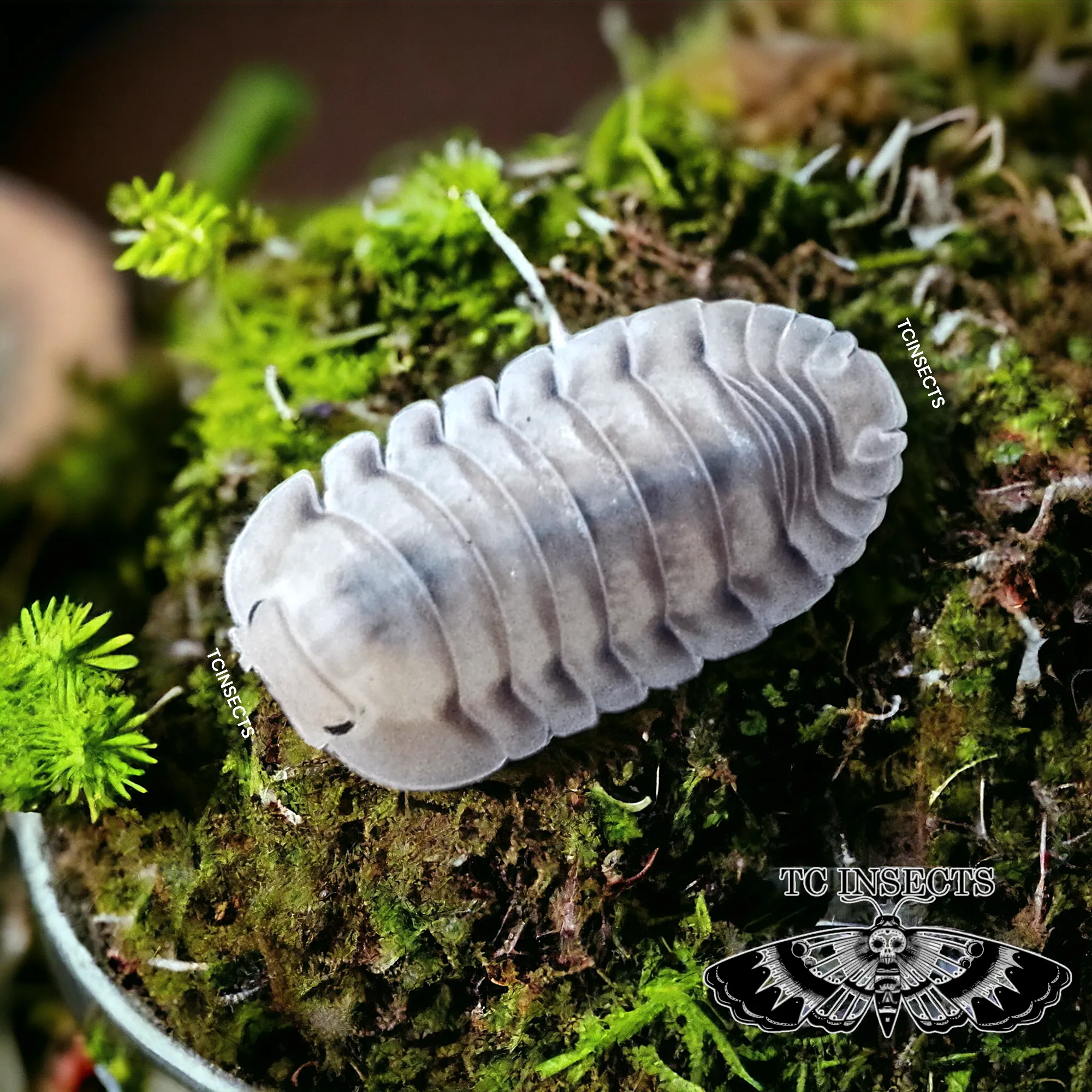


White Pigeon Isopods for Sale
Cubaris sp. “White Pigeon” is a pale Thai Cubaris described in the hobby as a mutation of the related Blue Pigeon line. The body shows a white to cream-blonde color with subtle gray highlights and pigmented dark eyes.
The dark eyes distinguish White Pigeon from true albino Cubaris morphs like Red Edge Albino, which carry red eyes. Adults reach roughly 1.5 to 2 cm and breed at a moderate to prolific pace once established, which puts
White Pigeon among the more approachable pale Cubaris available in the hobby trade.
Overview
White Pigeon sits at the entry-tier of pale Cubaris collector morphs. The combination of clean blonde-white coloration, dark pigmented eyes, and a productive breeding pace gives the line real value for keepers stepping up
from Mamey or beginner pod species into their first pale collector Cubaris. The pale body reads strongly against dark substrate, cork bark, and leaf litter, which makes White Pigeon a useful display pod.
This is a display and breeding species first. However, the moderate-to-prolific breeding pace means established colonies can also contribute to gentle bioactive maintenance in humid enclosures, which is less common
among collector-tier Cubaris.
Why Keep White Pigeon Isopods?
- Distinctive pale appearance with dark eyes. White to cream-blonde body with subtle gray highlights and pigmented dark eyes gives White Pigeon a clean look that differs from red-eyed true albino morphs.
- Productive breeding pace. Hobby reports describe White Pigeon as a good to prolific breeder once established, which makes this one of the rare collector Cubaris that can build a working colony at a useful pace.
- Pigeon-family collector value. White Pigeon pairs naturally with Blue Pigeon in a dedicated Pigeon-themed shelf for collectors who want both lines.
- Pairs cleanly with Springtails. A shared springtail population helps manage surface mold during the slow startup phase.
- Approachable entry into pale Cubaris. More forgiving than advanced-tier morphs like Emperor Bee, which makes White Pigeon a reasonable next step after Mamey or the Ducky family.
Honest Note on Pigeon Lines, Eye Color, and Care Reports
Three things buyers should know up front. First, White Pigeon is widely described in the hobby as a mutation of the Blue Pigeon Cubaris line rather than a separately collected wild population. The pale blonde body and
subtle gray highlights are believed to represent reduced pigmentation expression from the Blue Pigeon parent stock. As a result, White Pigeon and Blue Pigeon should not be co-housed if you want to maintain clean lines of
either form. Run them in separate dedicated bins.
Second, White Pigeon has pigmented dark eyes, not red eyes. This is important for buyers comparing pale Cubaris morphs. A true albino Cubaris like Red Edge Albino expresses an albino phenotype with red eyes and a
captive-isolated recessive trait. White Pigeon is a pale-bodied mutation that retains normal pigmented eyes, which means it is a different genetic line and is not subject to the same albino-specific concerns (extra light
sensitivity, strict line management to preserve a recessive trait). If you want a red-eyed pale Cubaris, choose Red Edge Albino. If you want a dark-eyed pale Cubaris with a more accessible care framework, choose White
Pigeon.
Third, care difficulty reports vary across hobby sources. Most US sellers describe White Pigeon as approachable for late-beginner or intermediate keepers, with some explicitly calling them beginner-friendly. One breeder
rates them in the intermediate-to-advanced range and notes that colonies “take a while to establish robust and healthy” populations. The honest middle ground: White Pigeon is more approachable than typical Thai Cubaris
but still benefits from a stable humid setup and patient establishment. Expect a slow first month before the colony starts producing visibly.
Care and Setup
White Pigeon responds well to a stable humid Cubaris setup. The goal is steady moisture, soft cover, reliable calcium access, and a moisture gradient that supports the productive breeding pace.
Temperature
Aim for 75 to 80 F. This is slightly warmer than the standard Cubaris range. Room temperature in warmer homes is fine. However, avoid sustained heat above the low 80s, sudden cold drops below the upper 60s, and any heat source in direct contact with the bin.
Humidity
Keep humidity medium-high to high with a clear moisture gradient. One side of the bin should stay consistently moist with sphagnum moss or hydrated substrate. The opposite side should run slightly drier with leaf litter cover and a small dry feeding area. Stagnant wet air encourages mold and mites, so balanced airflow matters as much as moisture itself.
Substrate
Use a deep organic mix with coconut fiber, flake soil, sphagnum moss pockets, and broken-down hardwood. Substrate depth around 3 to 4 inches works well for White Pigeon, which is deeper than typical Cubaris setups. The extra depth supports burrowing and brood development. Additionally, scattered limestone or cuttlebone pieces give the colony a direct calcium-grazing surface.
Food
Leaf litter and decaying hardwood form the dietary base. Supplement with TC INSECTS Isopod Food a couple of times per week, plus small portions of vegetables and a light protein item such as fish flake or freeze-dried shrimp. Feed messier foods on the drier side of the bin to reduce spoilage. Remove uneaten food before it molds.
Ventilation
Moderate ventilation works best. Stagnant air encourages mites and sour substrate. Too much airflow dries the bin and stresses the colony.
Bioactive Use
White Pigeon works reasonably well in humid bioactive enclosures thanks to the productive breeding pace. However, the collector-tier value and pale body that blends into light substrate keep them in display-pod territory rather than working cleanup duty. For heavy-duty bioactive cleanup, pair White Pigeon with Porcellionides pruinosus “Powder Orange” or Dwarf Whites.
Breeding Notes
Production is moderate to prolific once a culture settles, which puts White Pigeon ahead of most collector-tier Cubaris. Founder groups commonly go through a quieter first month while the colony establishes, then begin
producing manca and small juveniles in the leaf litter and substrate. Calcium access matters during this phase. A pinch of TC Calcium Ultra Fine dusted lightly over a feeding area every couple of weeks supports molting and
brood development.
Avoid digging through the substrate to check progress, since repeated disturbance slows new cultures. For long-term line preservation, consider running a backup culture as soon as the founder group is producing well. This
is particularly important if you also keep Blue Pigeon, since a culture crash on either line is harder to recover when both are present in the catalog.
Best For
- Late-beginner or intermediate Cubaris keepers wanting their first pale Cubaris.
- Display vivariums where bright pale contrast against dark substrate is valued.
- Collectors building out the Pigeon-pattern Cubaris shelf alongside Blue Pigeon.
- Keepers who want a productive Cubaris that can build a working colony rather than a slow display-only species.
Not Best For
- Co-housing with Blue Pigeon. Mixed bins make line preservation impossible.
- Buyers wanting red-eyed albino pale Cubaris. White Pigeon has dark pigmented eyes; consider Red Edge Albino instead.
- Total beginners with no isopod experience. Start with Porcellionides pruinosus morphs or Mamey first.
- Feeder use. The collector-tier price makes them impractical as reptile food.
- Heavy-duty cleanup duty in large bioactive enclosures.
Origin and Locality Notes
White Pigeon is consistently associated with Thailand in the hobby trade, with the broader Pigeon line of Cubaris coming from Thai origins. Hobby sources widely describe White Pigeon specifically as a pale mutation of the
Blue Pigeon line rather than a separately collected wild form. As a result, exact wild collection locality is not cleanly traceable for the White Pigeon variant, although the parent Blue Pigeon line has Thai origin
documentation. The “Cubaris” genus assignment is hobby shorthand and may be revised as taxonomy in this group continues to be reviewed.
Receiving and Acclimation
Open the package indoors in a calm, temperature-stable area away from direct sun, heat sources, and cold drafts. Pale isopods can blend into light packing material, so inspect the cup, moss, and shipping paper slowly.
Transfer the animals and any included shipping debris directly into a pre-prepared bin with deep moist substrate, leaf litter, multiple cork bark hides, calcium, and a damp moss retreat already in place.
Plan for a quiet first week to two weeks. New cultures commonly stay hidden under cover while they settle, and frequent digging through the substrate slows recovery rather than speeding it. Hydrate the moist side as
needed, offer only a pinch of food, and let the colony come to the surface on its own schedule. Once they begin surface-grazing regularly, you can shift to a normal feeding routine.
Recommended Add-Ons
- TC INSECTS Isopod Habitat Kit for a balanced starter setup suited to entry-tier Cubaris cultures.
- TC INSECTS Isopod Food for a balanced supplemental diet that supports the productive breeding pace.
- TC INSECTS Assorted Hardwood Leaf Litter for grazing surface, juvenile cover, and a slow-release organic food source.
- TC Calcium Ultra Fine for steady calcium access during molts and brood development.
- Springtails for shared bin use to help control surface mold during the slow startup phase.
Frequently Asked Questions
What is the difference between White Pigeon and Red Edge Albino isopods?
Both are pale Cubaris morphs, but they are genetically different. White Pigeon has pigmented dark eyes and is described in the hobby as a mutation of the Blue Pigeon Cubaris line. Red Edge Albino is a true albino morph
with red eyes, captive-isolated from the Red Edge Cubaris line. The dark-eye versus red-eye distinction is the easiest way to tell them apart in person. Care frameworks differ slightly: Red Edge Albino prefers lower-light
placement due to albino light sensitivity, while White Pigeon handles ambient lighting normally.
Can I keep White Pigeon with Blue Pigeon?
Not in the same bin. White Pigeon is described in the hobby as a mutation of the Blue Pigeon line, so mixed bins will produce offspring with blended traits and the visible White Pigeon phenotype will be diluted across generations. Run each line in its own dedicated tub.
Are White Pigeon Isopods beginner-friendly?
They sit at the late-beginner to intermediate level. Most US hobby sources describe White Pigeon as approachable for new Cubaris keepers, while some breeders rate the difficulty higher and report that colonies need patient establishment. Beginners should establish a forgiving culture such as Porcellionides pruinosus morphs or Mamey first, then move to White Pigeon once a reliable humid Cubaris routine is in place.
How fast do White Pigeon Isopods breed?
Moderate to prolific once established. Hobby breeders describe White Pigeon as a productive line that builds working colonies faster than most collector Cubaris. Founder groups typically need a month or two of quiet establishment before visible juveniles appear, after which production picks up.
Why is White Pigeon priced so accessibly compared to other Cubaris?
Pricing reflects breeding pace, current supply, and overall market positioning. White Pigeon is a more productive line than slower collector Cubaris, which means established breeders can offer culture surplus at lower per-unit prices. The lower entry point also makes White Pigeon a useful gateway pale Cubaris for new keepers building experience before investing in advanced-tier morphs.
Why does White Pigeon look slightly yellow rather than pure white?
The body color is best described as cream-blonde rather than pure paper-white. Multiple hobby sources note a subtle yellow or blonde undertone alongside the white, especially in mature animals or under warm lighting. This is normal for the morph and is not a quality issue. Cooler ambient lighting will read closer to white, warmer lighting will read closer to blonde.
Learn More About Pale Color Morphs and Terrestrial Isopod Biology
The following references give keepers useful background on color polymorphism in terrestrial isopods, basic isopod biology, and the ecological role that informs husbandry decisions.
-
NCBI PubMed Central: Predator Responses to Color Variation in Terrestrial Isopods. A peer-reviewed paper covering color polymorphism, pale and cryptic morph maintenance, and the biology of pigmentation variation in terrestrial isopods. Useful background for understanding how pale color mutations like White Pigeon function biologically and why they are relatively uncommon in wild populations.
-
Missouri Department of Conservation: Pillbugs and Sowbugs Field Guide. A state conservation agency field guide covering terrestrial isopod biology, moisture dependence, and life cycle. Useful background for keepers building a husbandry framework that applies to any humid Cubaris culture.
-
University of New Hampshire Extension: Pillbugs and Their Behaviors. A university extension overview of terrestrial isopod habits, habitat preferences, and the moisture and shelter requirements that define successful captive setups. Useful baseline biology for keepers new to the Cubaris hobby.



Reviews
There are no reviews yet.