A Mealworm Feeding Station for Bird Photography
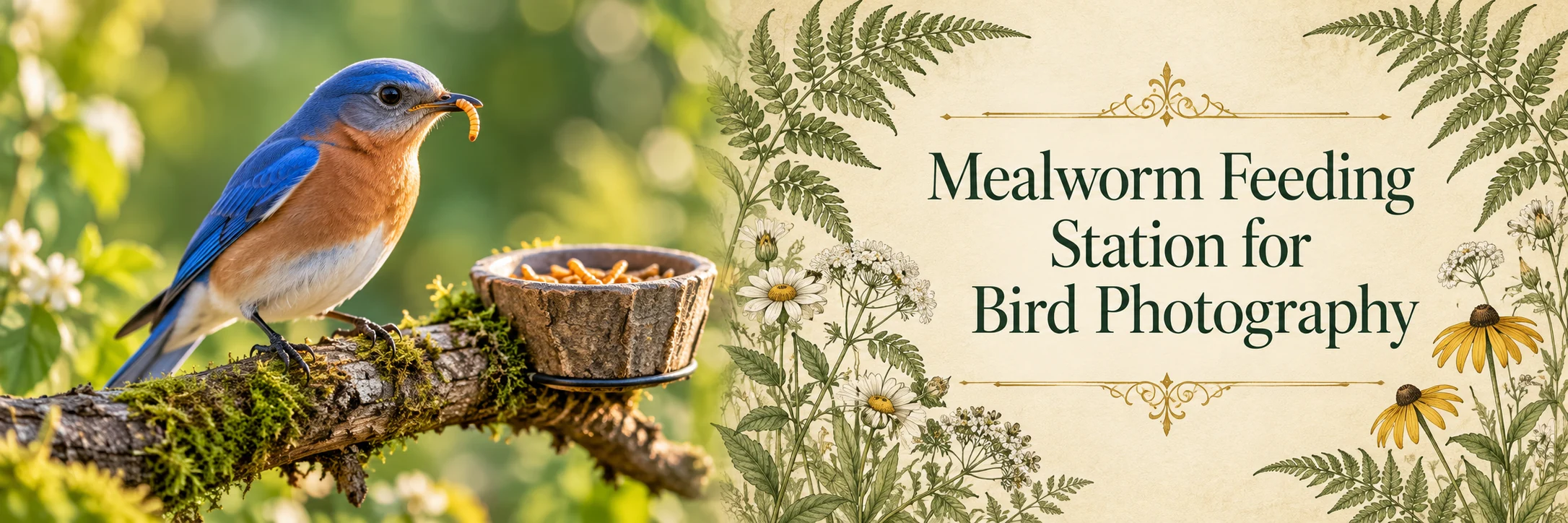
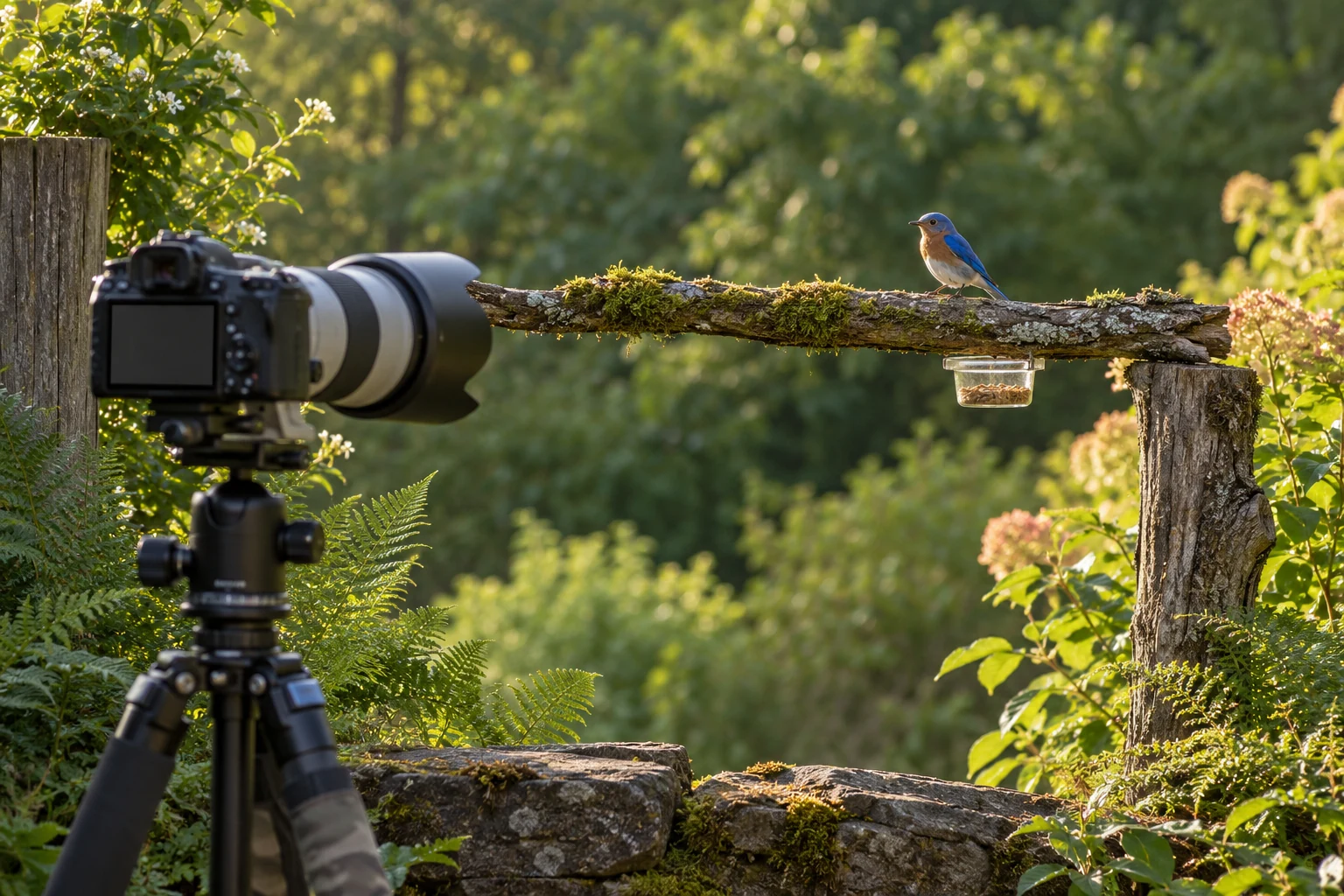
Live mealworms (Tenebrio molitor) are the one bait that pulls insect-eating songbirds to a chosen spot in a chosen light, which is why they sit behind most clean bluebird, chickadee, and wren photographs taken in a backyard. The station is simple: a small dish of live worms hidden in or just below a natural perch, positioned so the bird lands on the perch with the morning sun behind you and a clean background behind the bird. Keep it to about 15 worms per bird per day so the birds stay wild, and the same dish will draw robins, catbirds, and migrating warblers in spring. This guide covers the perch, the hidden dish, light and distance, timing, and the storage of a season's worms.
Movement is what a bird sees from a tree
Enough to make the visit a habit, not a dependence
Sun behind the camera, clean background behind the perch
Why mealworms and not seed
Seed feeders bring finches, sparrows, and cardinals, and the photograph is a bird on a plastic feeder. Mealworms bring the insect eaters, bluebirds, chickadees, titmice, wrens, nuthatches, robins, catbirds, and in migration a surprising number of warblers, and they bring them to whatever perch you put the worms beside. A bird that has learned the dish will land on the same branch every morning, in the same light, for weeks. That repeatability is the whole point for a photographer.
Live worms matter. A bird flying over sees the wriggle in the dish from a tree away, while dried mealworms lie still and get found only by birds that already know the spot. Once the regulars are trained you can stretch the supply with a few dried worms mixed in, but the station starts and stays on live ones. Our post on live insects for wild birds covers which species take what.
The perch and the hidden dish
The photograph is of the perch, so choose it first: a mossy branch, a weathered fence post, a flowering dogwood twig, or a driftwood stub, mounted on a stake or a light stand at the height you want to shoot. Below or behind it, out of the frame, goes the dish. A small smooth-sided glass cup pressed into a drilled hole in a log, a jar lid screwed to the back of the post, or a cup tucked in a knot of the branch all work. The bird lands on the perch to look, then drops to the dish, then returns to the perch to swallow. The perch shot is the second landing.
Change the perch with the season and the dish stays the same, so the birds keep coming. Keep the dish at least 2 inches deep or smooth-sided so worms cannot climb out, and keep it in shade if you can; worms in a sunlit dish die within an hour on a warm day. Feed medium or large worms; a bluebird takes an inch-long worm whole, and a chickadee carries it off to hammer it on a branch.

Light, background, and distance
Set the perch so the sun is behind the camera in the first two hours after sunrise, when the light is warm and low and the birds are hungriest. Walk around the perch and check what sits behind it: you want distant foliage or open sky that falls into soft blur, not a fence, a house, or a bright patch. Move the stake, not the camera, until the background is clean. Ten to twenty feet of separation between the perch and whatever is behind it is usually enough at a long lens.
Shoot from a window, a car, a blind, or a chair you sit in every day until the birds ignore it. Bluebirds and chickadees tolerate a still person at 15 to 20 feet within a week; wrens and warblers want more cover. Put the station 12 to 20 feet from where you sit and let the birds close the distance over time. A tripod left in place between sessions becomes furniture to the birds faster than one that appears each morning.
Timing and how many worms
Put out the worms at the same time every morning, ideally 15 minutes before you plan to shoot, and the regulars learn the schedule within days. A dish that is filled all day feeds jays, starlings, and grackles instead, and the photogenic birds get crowded out. Fifteen worms per expected bird per morning is the working number; for a pair of bluebirds and a few chickadees that is 40 to 60 worms a day, roughly 300 to 400 a week.
Stay near that limit. Mealworms are a fatty, calcium-poor treat, and the aim is a wild bird that visits for a snack and then goes back to hunting. During nesting season, when parents are feeding young, offer a few more and dust them lightly with calcium as our guide to mealworms for bluebirds describes. Cut back sharply in summer when insects are everywhere and the birds do not need you.
Keeping starlings and jays off the station
The first week a station succeeds, the starlings arrive. The fixes are timing and access. Feed a small amount at a set time and pick up leftovers; starlings lose interest in a dish that is empty for 23 hours. If they persist, a caged dish with openings about 1.5 inches wide admits bluebirds and chickadees and excludes starlings and jays, and it can sit out of frame behind the perch just as well as an open dish.
Squirrels and chipmunks also learn a mealworm dish. A smooth post with a baffle, or a dish mounted on the far side of a stake from the nearest tree, handles most of it. The perch above stays natural; the plumbing below can be as engineered as you like, since it never appears in the picture.
Storing a season of mealworms
A photographer running a station in spring uses 1,000 to 1,500 worms a month, so buy by the thousand from the mealworm shop and keep them in the refrigerator. In a ventilated container with an inch of dry wheat bran at 40 to 45 F, mealworms keep for months without turning into beetles; take them out once a week for a few hours with a slice of carrot to drink, then put them back. The full routine is in how to store mealworms in the fridge.
Warm the morning's worms to room temperature for 20 minutes before they go out so they move, which is what the birds respond to. If you also want to try black soldier fly larvae, robins and catbirds take them readily and they carry more calcium, but bluebirds and chickadees are slower to accept them, so the mealworm dish stays the anchor of the station.
The Bird Photography Station Kit
A season of large and medium mealworms, bran to keep them for months, and BSFL to try on robins and catbirds.
Frequently Asked Questions
Written by the TC INSECTS breeding team · Porter, Texas · Live Arrival Guarantee on every order
Have a care question? Ask our community.
Join Reptile Keepers USA, our free Facebook group for reptile, amphibian and invert keepers. Share your setups, get care help and swap feeder tips.
Join the free group