
How to keep Oriental fire-bellied toads (Bombina orientalis) thriving in groups: a balanced half-land, half-water paludarium with safe shallow water, cool room-temperature targets, a group-feeding plan, toxin precautions, and practical troubleshooting.
Routinely documented past 20 with clean water and steady care.
Small, bright, and active by day, unlike most pet amphibians.
One of the few genuinely social pet amphibians; a solo toad is a bored toad.
Meet the Fire-Bellied Toad
The Oriental fire-bellied toad is a small semi-aquatic frog from Korea and northeastern China with pebbly green and black skin up top and a blazing orange and black belly underneath. That belly is a warning label: when threatened, the toad arches its back and flashes it in a move called the unken reflex, advertising the mild toxins its skin produces.
For keepers, they are close to the perfect beginner amphibian: active in daylight when you are actually watching, bold around the water line, social with their own kind, and content at ordinary room temperature. A small group hunting at the shoreline has more personality than almost anything else you can keep in ten gallons.
What You Will Need
The classic fire-belly build is a small paludarium, which sounds fancier than it is: part land, part shallow water, one tank. Everything on the list fits a modest budget.
Conditions at a Glance
The whole environment on one card. Water depth is the number everyone gets wrong, so it gets the top row.
| Parameter | Target | Notes |
|---|---|---|
| Water depth | 2 to 3 inches maximum | They are weak swimmers; easy exits everywhere |
| Enclosure | 10 gallons for 2 to 3 toads | A quarter to half of the floor as water |
| Day temperature | 70 to 75 F | Ordinary room temperature; no heater in most homes |
| Night temperature | 60s F are fine | Cool-tolerant species |
| Heat warning | Sustained above 80 F is dangerous | Cool the room, not the toads |
| Humidity | 50 to 80 percent | Easy in a part-water tank; mist the land side |
| Water changes | Partial changes 2 to 3 times weekly | Or a gentle filter plus weekly partials, always dechlorinated |
| Lighting | 12 hour cycle | Low-output UVB optional and appreciated |
| Group size | 2 to 4, same species only | Their toxins make them bad roommates for anything else |
Paludarium in practice
Build a shoreline, not a deep pond
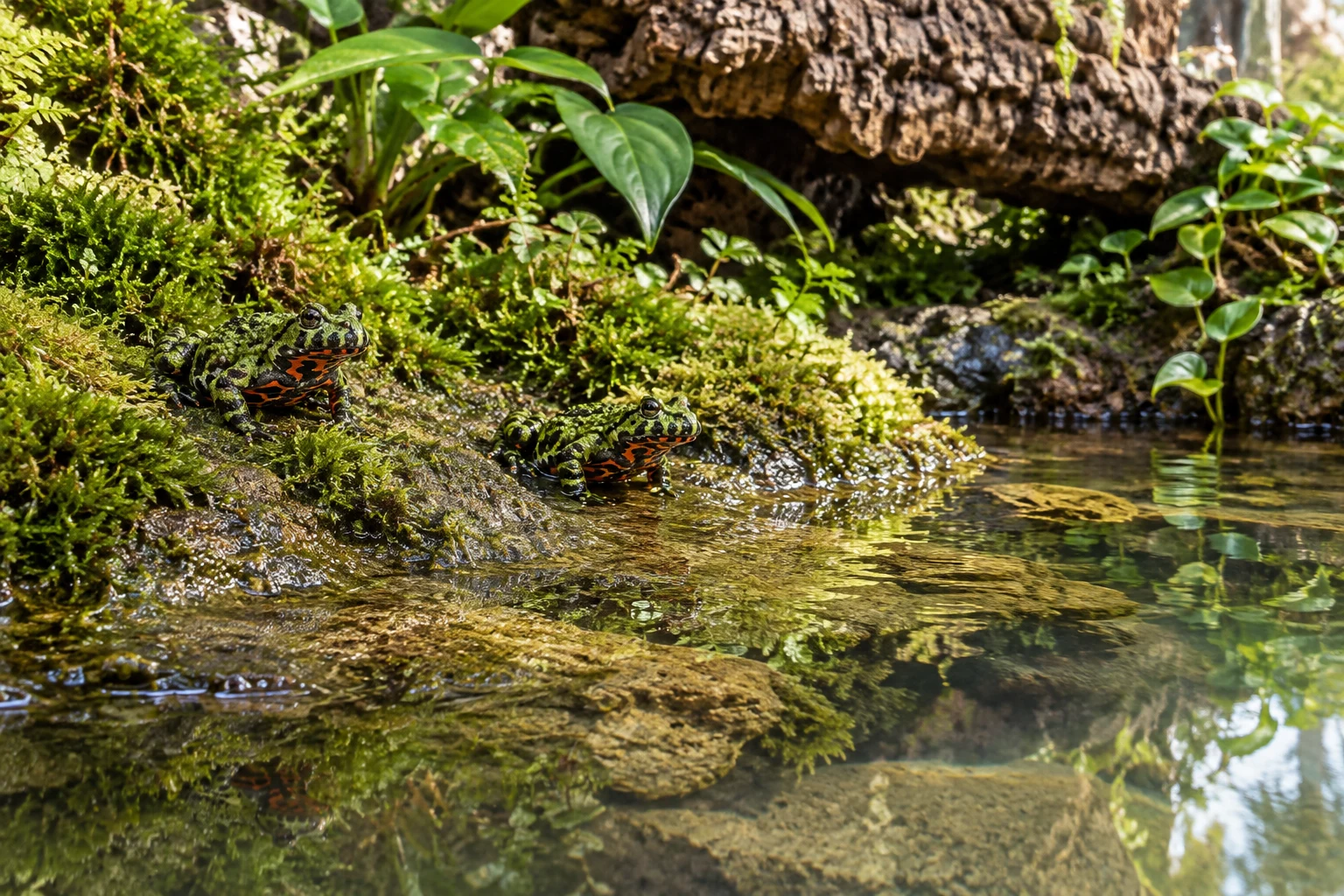
Fire-bellied toads live at the water’s edge but are weak swimmers. Divide the habitat between mossy land and 2–3 inches of water, then provide multiple gentle ramps and exits so every toad can leave the water effortlessly.
Enclosure and Setup
A 10 gallon tank comfortably houses two or three toads, and each additional toad wants roughly 5 more gallons. Keep them in groups of two to four, same species only; their skin toxins make them poor roommates for anything that is not another fire-belly, and a lone toad simply shows you less of the behavior that makes the species fun.
The classic layout is a paludarium split between a land zone and a water zone, anywhere from a quarter to half water. Build gentle slopes, ramps, or stacked stone so a toad can always walk out of the water easily, and fit a snug lid, because what they lack in climbing skill they make up for in surprise jumping.
Water, Temperature and Light
Here is the counterintuitive rule: keep the water shallow, 2 to 3 inches at most. Fire-bellied toads live at the water line but are genuinely weak swimmers, and deep, steep-sided water exhausts them. Use dechlorinated water always, and either change a portion two or three times a week or run a small gentle filter and still do weekly partials, because they absorb their water quality through their skin.
Temperature is the easiest part: 70 to 75 degrees by day with dips into the 60s at night is ideal, which means most homes need no heater at all. Heat is the bigger danger; sustained temperatures above 80 genuinely stress this cool-tolerant species. A 12 hour light cycle plus optional low-level UVB rounds out the top of the tank.
Land Side, Substrate and Humidity
Carpet the land zone with moist coco fiber topped with sheet or sphagnum moss, add a piece of cork bark to hide under, and plant it with sturdy greenery, live or artificial. Humidity stays easy in a tank that is part pond, anywhere from 50 to 80 percent, and a light misting of the land side keeps the moss inviting.
Avoid loose gravel on the land side and in the shallows. These toads strike at food enthusiastically and sloppily, and pea gravel is exactly the size that gets swallowed and stuck.

Group feeding in practice
Count portions for every toad
Offer small moving prey at the shoreline and feed at more than one spot when needed. Watching each toad eat prevents the boldest animal from collecting every portion and makes weight loss easier to catch early.
Diet and Feeding
Fire-bellied toads hunt movement at the shoreline, and mealtime is the best show they put on. Drop prey at the water line and watch the group ambush it; feeding in the same spot also lets you confirm the bold toad is not collecting every portion. The schedule below keeps a group bright and lean.
Small dubia roach nymphs are the ideal staple, black soldier fly larvae bring soft calcium-rich variety, and a springtail culture does double duty as cleanup crew and as live food for any froglets. The complete plan with portion sizes lives on our fire-bellied toad feeder guide.
| Life Stage | What To Feed | How Much | How Often | Supplements |
|---|---|---|---|---|
| Froglet | Springtails, pinhead-size prey, tiny BSFL | As much as they clear in minutes | Daily | Calcium + D3 at most feedings; multivitamin weekly |
| Juvenile | Small dubia nymphs, small BSFL | 2 to 3 small items per toad | Every other day | Calcium + D3 twice weekly; multivitamin every other week |
| Adult | Small dubia, BSFL, small soft worms | 3 to 5 small items per toad | 2 to 3 times per week | Calcium + D3 weekly; multivitamin every other week |
Everything a fire-bellied toad keeper needs from this guide. Untick anything you already have, then add the rest in one click.
The Bioactive Option
A fire-belly paludarium is the most natural bioactive candidate in the hobby, because the tank is already half ecosystem. Seed the land side with temperate white springtails and dwarf white isopods to process waste in the damp soil; those two stay the safe choices around live animals, while bigger isopod species belong in tanks without residents. Live plants pull double duty by drinking the nutrients that would otherwise feed algae in the water section.
Start-to-finish build steps are in our bioactive setup guide, and every crew member ships live from the farm.
Handling and Toxins
This is a look-only pet. Fire-bellied toad skin secretes mild toxins that can irritate eyes, mouths, and any cut on your hand, which is also why they should never share a tank with other species. Do tank work with clean, rinsed hands, wash thoroughly afterward, and if kids are watching the shoreline show, the rule is watch, then wash.
Health and Troubleshooting
Most fire-belly problems are water problems wearing a disguise, and the fix usually starts with the change schedule rather than the toad. Use the chart; a group that eats at the shoreline and flashes bright bellies is a group that is fine.
| What You See | Most Likely Cause | What To Do |
|---|---|---|
| Redness, cloudy or slimy skin | Water quality has slipped | Immediate partial change; tighten the schedule; vet if it does not clear in days |
| A toad floating oddly or bloated | Bloat, from infection or water issues | Vet visit; review water and diet |
| Faded belly color, otherwise healthy | Diet low in carotenoids | Gut-load feeders well; keep the supplement rotation honest |
| Panting toads in a warm room | Overheating | Cool the room today; above 80 F is genuinely dangerous |
| One toad thin while others thrive | Food competition | Feed at two spots at once; count items per toad |
| Constant hiding with no shoreline activity | Stress: no cover, or water too deep | Add plants and cork cover; verify 2 to 3 inch depth and easy exits |
Fire-Bellied Toad FAQ
Keep reading: captive bred versus wild caught.
Building a Fire-Belly Paludarium?
Tell us your tank size and how many toads and we will size the crew, the feeders, and the schedule. Real keepers answer our email.
TC INSECTS · Real keeper advice from a working Texas insect farm
