
- Ackie monitors are small, hyperactive insectivores with an appetite much bigger than their body size suggests.
- Dubia roaches are the best everyday staple feeder for ackies, thanks to solid protein and easy calcium dusting.
- Crickets and red runner roaches add the fast, unpredictable movement that fires up an ackie's hunting drive.
- Black soldier fly larvae are the one staple feeder that naturally carries calcium, helping balance a diet built on calcium-poor roaches and crickets.
- Most ackie keepers run a bioactive enclosure, so isopods and springtails are as much a part of the setup as the feeder insects are.
| Crickets | Dubia Roaches | Red Runner Roaches | Black Soldier Fly Larvae | |
|---|---|---|---|---|
| Protein | 15 to 21% | 20 to 23% | about 16 to 19% | about 17% |
| Fat | 3 to 7% | 6 to 7% | about 5 to 7% | 9 to 14% |
| Calcium : Phosphorus | about 0.12:1 | about 0.29:1 | roughly 0.4:1 to 0.5:1 | roughly 1.5:1 to 7:1 (varies with diet) |
| Dust with calcium? | Yes | Yes | Yes | Usually not |
| Best known for | Balanced, widely available staple that triggers a strong feeding response | High-protein everyday staple; best calcium ratio among feeder roaches | Fast-breeding, lean, active feeder that drives a strong feeding response | Naturally high calcium with no dusting needed; sold here as Calcium Worms |
Why Ackie Monitors Eat So Much
Ackie monitors are dwarf monitors native to Australia, and despite topping out at roughly two feet including the tail, they behave nothing like a small, low-energy lizard. These monitors are constantly on the move, digging, climbing, and investigating every corner of their enclosure, and that nonstop activity burns through calories fast. An adult ackie monitor can put away a surprising number of insects at a single feeding.
Because ackies are almost entirely insectivorous, their long-term health depends on a varied, well-gutloaded, calcium-dusted rotation of feeders rather than one single food source. Variety also keeps a naturally curious hunter engaged at mealtime, which matters for an animal this food-motivated.
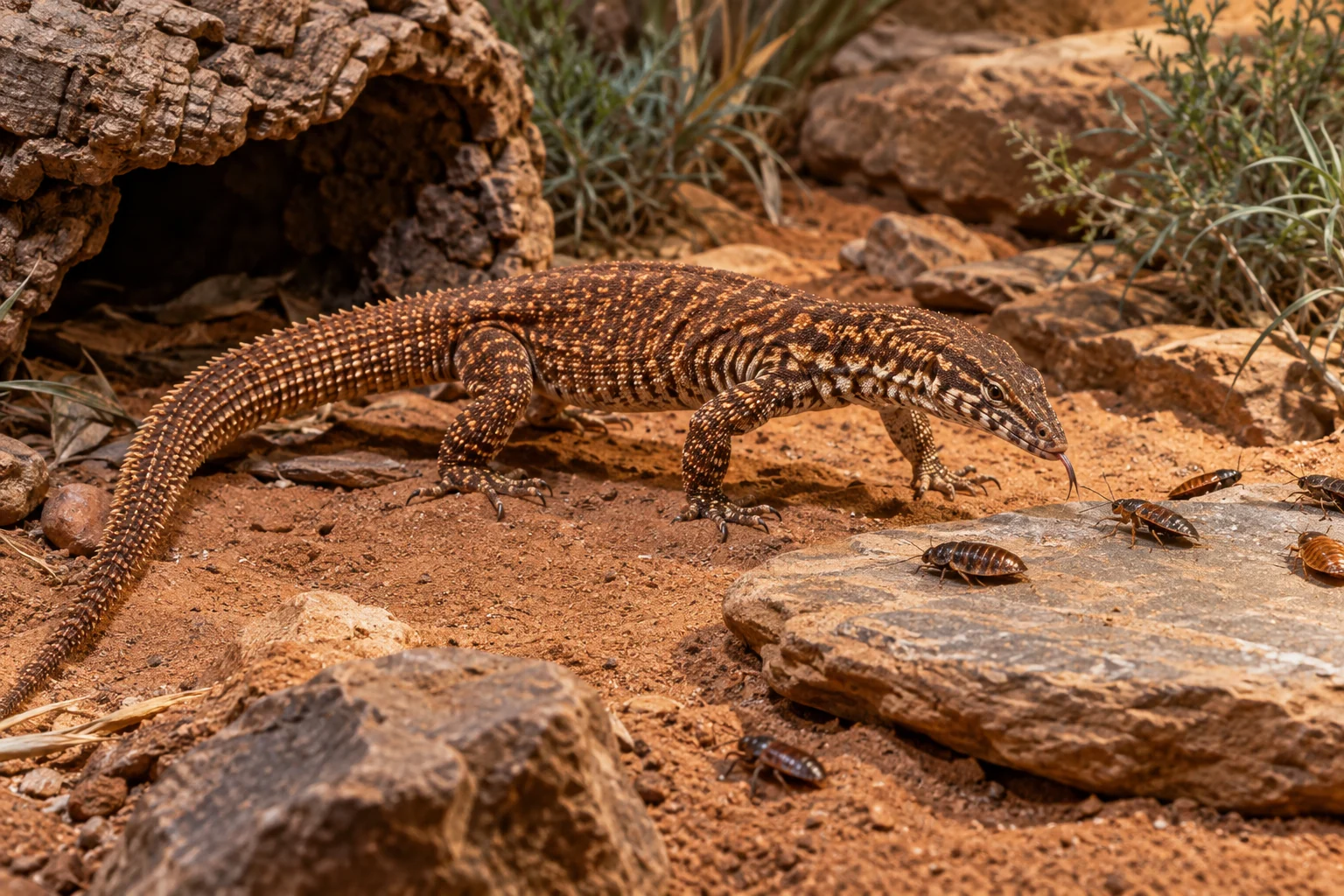
The Best Feeder Insects for Ackies, Ranked
Here is how the four staple feeders stack up for an ackie's everyday diet. Gut-load every feeder and dust it with a calcium supplement before offering it, whichever one you choose.
- Dubia Roaches - The top everyday staple: solid protein, low fat, and a colony you can store for weeks without hassle. Shop dubia roaches.
- Crickets - A classic variety feeder whose frantic hopping is exactly the kind of movement that triggers an ackie's hunting response.
- Red Runner Roaches - Fast and lean, red runners deliver the same chase-triggering movement as crickets with the shelf life advantage of a roach. Shop red runner roaches.
- Black Soldier Fly Larvae (BSFL) - The calcium specialist of the group. Working these into the rotation a couple of times a week helps offset a diet that otherwise leans on calcium-poor roaches and crickets.
Why Hunting and Movement Matter for Ackies
In the wild, ackie monitors spend a large part of their day actively foraging, digging insects out of loose soil and chasing down anything that moves. That instinct does not switch off in captivity. Scattering feeders into the substrate or offering them with tongs so the insect has room to scurry gives an ackie the chance to hunt rather than simply eat off a dish.
This is one reason crickets and red runner roaches earn a regular place next to dubia in the rotation. A slow-moving dubia is easy to eat, but a fast, erratic feeder keeps an ackie engaged and physically active, which is good enrichment for such a naturally busy animal.
Pairing Feeders with an Ackie Bioactive Setup
Ackie monitors are serious diggers, and a healthy setup usually means a deep substrate bed they can burrow through and construct tunnels in. That is exactly the kind of enclosure a bioactive cleanup crew is built for. A team of isopods and springtails works through leftover feeders, shed skin, and waste in that deep substrate, helping keep the bioactive layer healthy between cleanings rather than doing all of that work yourself.
For an enclosure that houses an active predator like an ackie, stick with a hardy, unobtrusive crew rather than larger isopod species. Springtails are the backbone of almost any bioactive cleanup crew, and pairing them with a smaller isopod species gives you coverage both in the topsoil and deeper in the substrate.

How Much and How Often to Feed an Ackie Monitor
Feeder size should roughly match the space between an ackie's eyes, sizing up as the animal grows. Many keepers offer appropriately sized insects daily to every other day, since ackies are so active that they can handle more frequent feedings than a lot of other lizards their size.
Rather than following a fixed count, watch body condition. An ackie in good shape should look lean and muscular, not rounded or padded at the base of the tail. If you notice weight creeping on, ease back on the richer or more frequent feedings and lean more on lighter, leaner staples like dubia.
Frequently Asked Questions
What do ackie monitors eat?
Ackie monitors eat a varied diet of feeder insects, most commonly dubia roaches, crickets, red runner roaches, and black soldier fly larvae for calcium. Every insect should be gut-loaded and dusted with a calcium supplement before it goes in the enclosure.
How many insects does an ackie monitor need?
An adult ackie monitor typically eats several appropriately sized insects at each feeding, often daily or every other day, since their constant activity burns calories fast. The exact number depends on the individual's size and body condition, so feed to a lean, healthy shape rather than a fixed count.
Can ackie monitors eat dubia roaches?
Yes, dubia roaches are one of the best staple feeders for ackie monitors. They carry solid protein, are easy to dust with calcium, and make a safe primary food source when gut-loaded first.
Do ackie monitors need a bioactive setup?
Most keepers strongly recommend a bioactive setup for ackie monitors, since these monitors are prolific diggers that do best with deep substrate to burrow through. A cleanup crew of isopods and springtails helps keep that substrate healthy by breaking down waste and leftover feeders.
What feeder insects are best for ackie monitors?
Dubia roaches, crickets, red runner roaches, and black soldier fly larvae are the best feeder insects for ackie monitors. Together they cover a protein-rich staple, movement-driven hunting enrichment, and a natural calcium source in one rotation.
Keep comparing: Best Feeders for Savannah Monitors· Best Feeders for Tegus· Best Cleanup Crew Isopods· How to Gut-Load Feeders
