
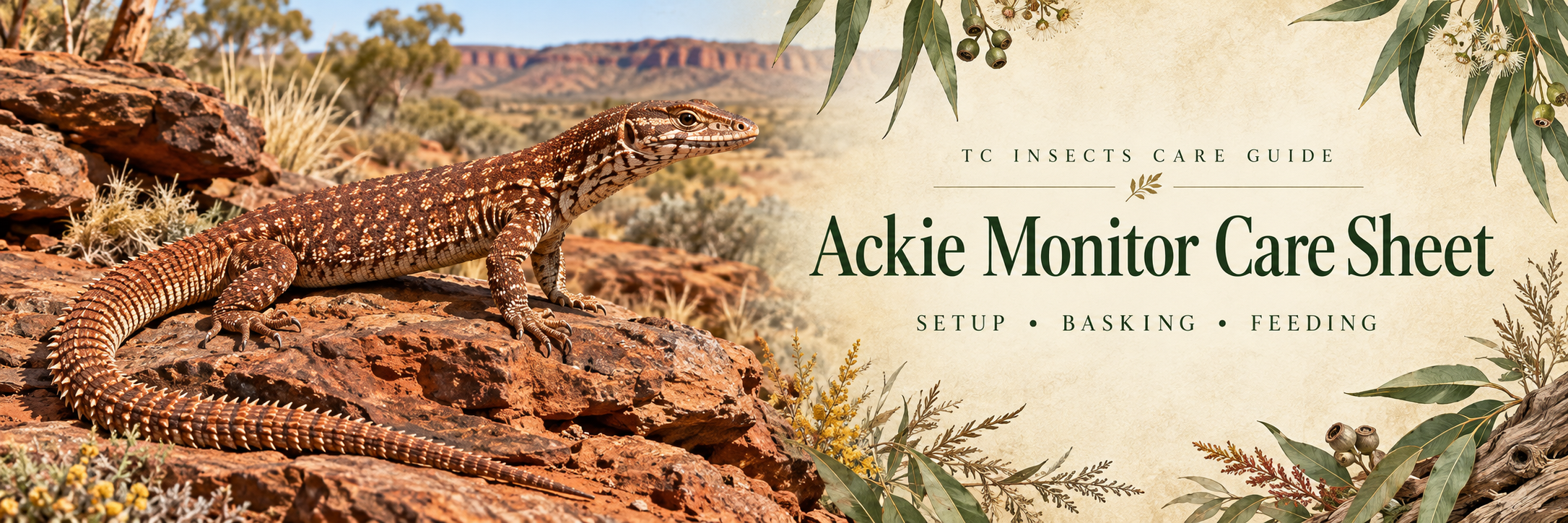
Ackie Monitor Care Sheet
Complete husbandry for the ackie monitor, the spiny-tailed monitor (Varanus acanthurus): enclosure size and the deep burrowing substrate it cannot live without, the basking temperature debate, UVB, an insect feeding table that prevents obesity, and a troubleshooting chart.
At least fifteen with good care; plan for twenty.
Documented from 17 to 30 inches; males larger.
Small for a monitor, not simple. Heat and dirt depth are non-negotiable.
Meet the Ackie Monitor
The ackie is the monitor lizard people can realistically keep indoors: around two feet long, intelligent, food-motivated, and often calm enough to hand-tame. It comes from the rocky, seasonally dry country of northern and northwestern Australia, and its scientific name, Varanus acanthurus, means spiny tail. That tail, wrapped in rings of spiky scales, is the easiest way to recognise one.
You will see red ackies and yellow ackies for sale. Red ackies are the northern subspecies, usually larger and redder with longer tails and legs; yellow ackies are the widespread form and more common in the trade. Their care is identical, and because Australia does not export its wildlife, nearly every ackie outside Australia is captive-bred, often from mixed lines.
It is often sold as a starter monitor because it stays small. Small is not the same as simple. An ackie needs a large enclosure, one of the hottest basking spots of any pet lizard, strong UVB and a deep layer of diggable soil. A keeper who has already kept a demanding reptile will find it a joy; a first-time reptile owner should go in with eyes open.
What You Will Need
Most of the budget goes into the enclosure, the soil to fill it, and the lighting. None of it is optional.
Conditions at a Glance
The whole environment on one card. Note the two very different humidity numbers.
| Parameter | Target | Notes |
|---|---|---|
| Enclosure | 5 x 2.5 x 4 feet minimum for an adult | Older 4 x 2 x 2 advice is now considered too small |
| Substrate depth | 12 in (males), 18 in (females), 24 in ideal | Must hold a burrow without collapsing |
| Basking surface | About 130 to 170 F | Newer specialist guidance runs hotter than older sheets |
| Warm side air | 80 to 100 F | A gradient so the ackie is never forced into the hottest zone |
| Cool side | 75 to 82 F | Heat off at night |
| UVB | 10 to 12 percent T5 HO, Zone 3 | About 12 hours a day |
| Humidity | 20 to 50 percent air, 80 percent plus in burrows | Burrow moisture matters more than room humidity |
| Diet | Insects | Superworms are treats; rodents are not needed |
| Housing | One, or one male with two or more females | Never two adult males |
The Enclosure and the Dig
Current specialist guidance puts the minimum for an adult ackie at five feet long, two and a half feet deep and four feet tall, with the bottom one to two feet taken up by substrate. That is far beyond any glass tank sold in a pet store, and older recommendations of four by two by two feet are now considered too small for a lifetime home.
The substrate is not decoration. Ackies are obligate burrowers, and a monitor without enough diggable depth is a chronically stressed monitor. Aim for at least 12 inches for a male and 18 for a female, whose extra depth guards against egg binding from infertile clutches, with 24 inches ideal for both. A mix of about two parts topsoil to one part play sand, with a little clay so tunnels hold their shape, works well.
Moisten the mix until it clumps, then let the top few inches dry. A dry surface over damp deeper layers mirrors the wild, arid on top and humid underground. Replace the substrate fully about once a year, or half of it every six months.
Heat, the Basking Debate, and UVB
Ackies bask hotter than almost any other lizard in the hobby, and this is the number where care sheets disagree most. Long-standing sheets, including Reptiles Magazine, say a basking surface of 120 to 150 degrees is enough. ReptiFiles' current guidance, based on newer thermal research, calls for an extremely hot 158 to 172 degree surface. Specialist practice has been moving toward the hotter end, and both camps agree this is a surface reading taken with an infrared temp gun, not an air temperature.
Build the basking area from at least two halogen flood bulbs over a stacked platform of flat stones or wood separated by spacers about the height of the lizard, fixed securely so it cannot collapse. The layers let the ackie choose its exact temperature. Keep the warm side air between 80 and 100 degrees, the cool side 75 to 82, and switch the heat off at night.
UVB deserves the same attention: a 10 to 12 percent T5 HO tube running about 12 hours a day, mounted separately from the heat bulbs. With strong UVB in place, plain calcium without D3 is the right everyday supplement.
Humidity Lives in the Burrow
Ackies do not want a humid enclosure, and they do not want a bone-dry one either. Air humidity on the enclosure wall can sit anywhere from 20 to 50 percent, while humidity inside the burrows should be 80 percent or higher. The damp lower substrate provides that, which is why substrate moisture matters more than room humidity. Low burrow humidity is the main cause of dehydration and stuck shed in this species.
Feeding
Ackies are insectivores. Dubia and red runner roaches make an excellent staple, rounded out with black soldier fly larvae, hornworms, silkworms and the occasional mealworm or superworm. Our ackie monitor feeder guide ranks the options, and building an ackie feeder rotation turns them into a weekly plan.
Feed hatchlings daily, juveniles up to about six months every other day to three times a week, and adults over a year two or three times a week. Portion by body condition rather than a fixed count, because overfeeding, not underfeeding, is now the most common welfare problem in pet ackies. Superworms and waxworms are treats, not staples.
Rodents, chicks and eggs are not needed and are discouraged as regular food; an insect diet is what keeps an ackie lean. Gut load feeders for a day or two before feeding, dust most meals with calcium without D3 once the UVB is solid, and add a multivitamin with preformed vitamin A about once a week.
| Life Stage | Main Prey | How Often | Supplements | Notes |
|---|---|---|---|---|
| Hatchling | Small roaches, small BSFL, small red runners | Daily | Calcium without D3 most feedings; multivitamin weekly | Prey no longer than the head is wide |
| Juvenile, to 6 months | Small to medium roaches, BSFL, silkworms | Every other day to 3 times a week | Calcium without D3 most feedings; multivitamin weekly | Growth phase |
| Adult, over a year | Medium roaches, hornworms, occasional superworms | 2 to 3 times a week | Calcium without D3 most feedings; multivitamin weekly | Watch the tail base for fat |
Everything an ackie monitor keeper needs from this guide. Untick anything you already have, then add the rest in one click.
Handling and Temperament
Ackies are among the most tractable monitors, and many become hand-tame with patience. Give a new ackie its first weeks undisturbed to settle in, then build trust with short, calm sessions, often around food. They can bite if startled or mishandled, so move slowly and let the lizard come to you.
A single ackie kept alone does perfectly well. Many keepers house one male with two or more females in a large enough enclosure, but adult males fight and must never share, and introducing unfamiliar adults takes care and close watching.
Health and Troubleshooting
A well-kept ackie should never develop most of these. Nearly every row traces back to heat, depth, humidity or portion size.
| What You See | Most Likely Cause | What To Do |
|---|---|---|
| Thick tail base, rounded body | Obesity from overfeeding or too little space | Cut portions and frequency; add space and enrichment |
| Retained shed on toes and tail tip | Burrow humidity too low | Dampen the deeper substrate; ease off shed gently |
| Swollen limbs, tremors, weakness | Metabolic bone disease | Urgent reptile vet; fix UVB and calcium |
| Wheezing, open-mouth breathing, discharge | Respiratory infection from a wrong gradient or humidity | Correct the environment; vet if it persists |
| Constant pacing and glass surfing | Enclosure too small or substrate too shallow | Increase space and substrate depth |
| Eating well but thin, loose stool | Internal parasites | Fecal exam and treatment by a reptile vet |
| Female digging restlessly, off food | Preparing to lay eggs, even infertile ones | Deep, damp substrate to dig in; vet if she cannot lay |
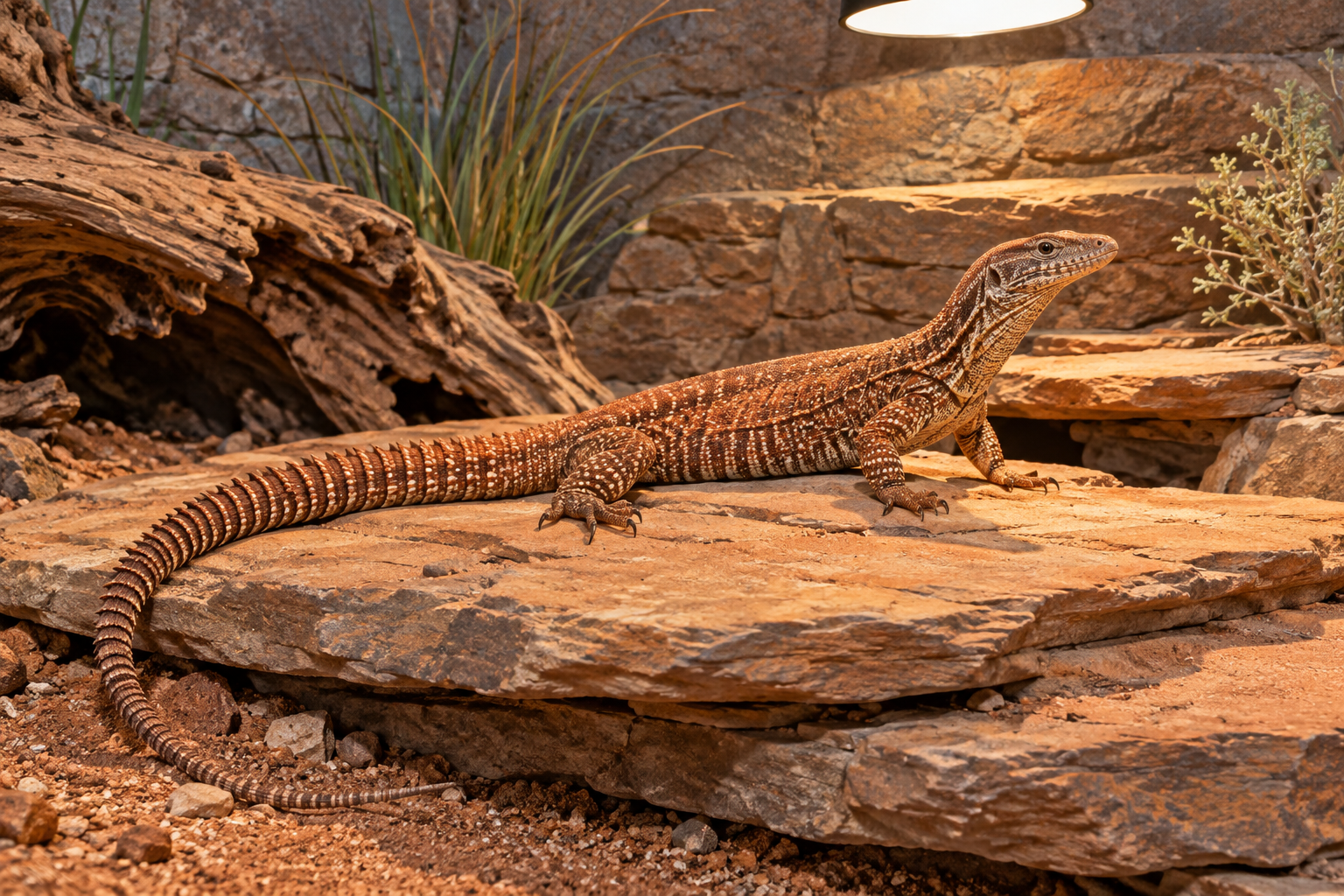
Build a broad, layered heat platform
Overlapping flat stone lets the monitor choose its exact surface temperature while keeping its whole body under the heat.
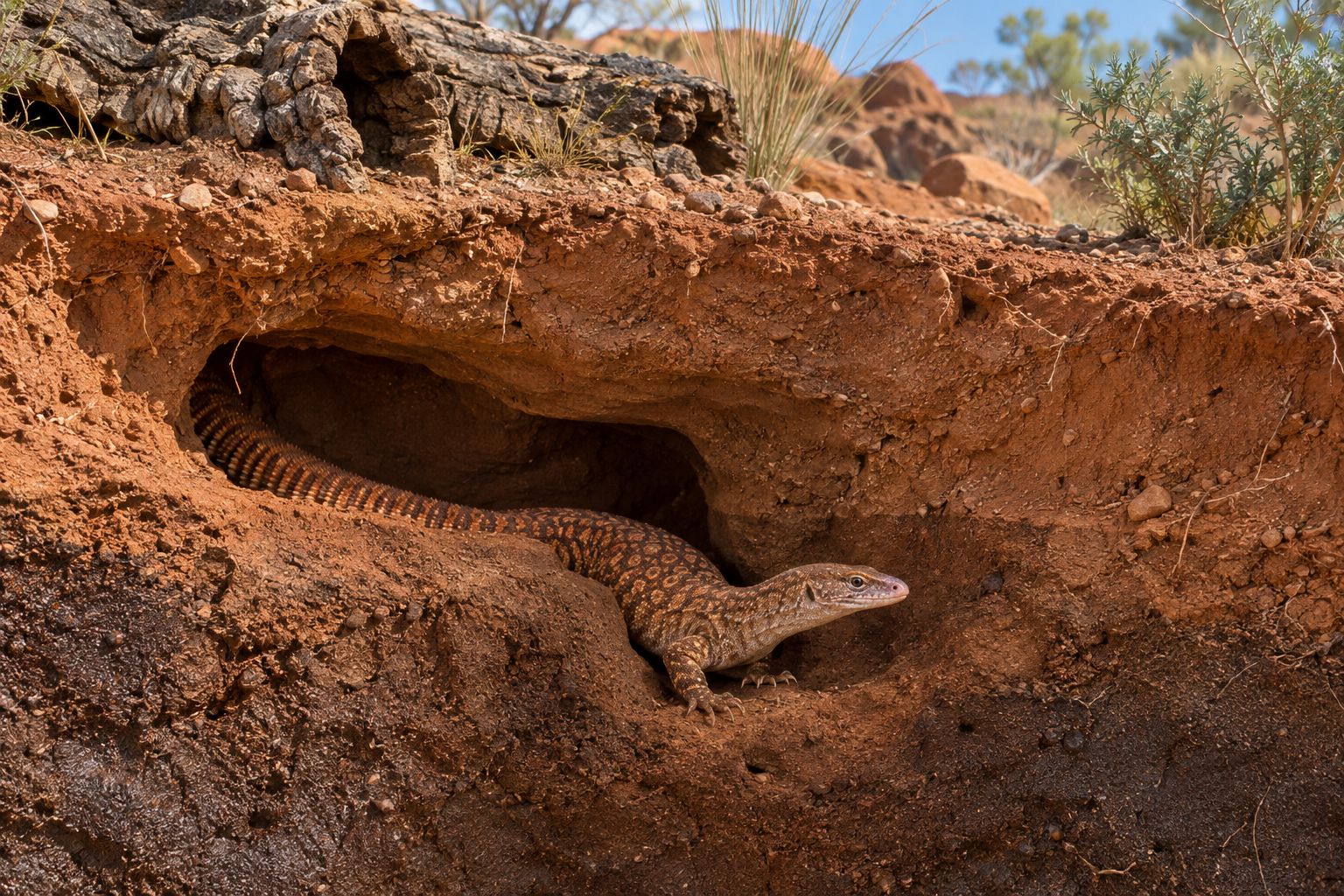
Deep soil creates the moisture gradient
The top can stay dry while the lower layers remain damp enough for secure burrows, clean sheds and normal behavior.
Ackie Monitor FAQ
Part of the Monitor Lizard Hub: every guide we have on ackie and savannah monitors, in one place.
Keep reading: how an ackie compares with a savannah monitor.
Feeding an Ackie?
Tell us its size and age and we will build a roach-based rotation that keeps it lean. Real keepers answer our email.
TC INSECTS · Care sheets written at the farm, not copied from forums · Porter, Texas
