
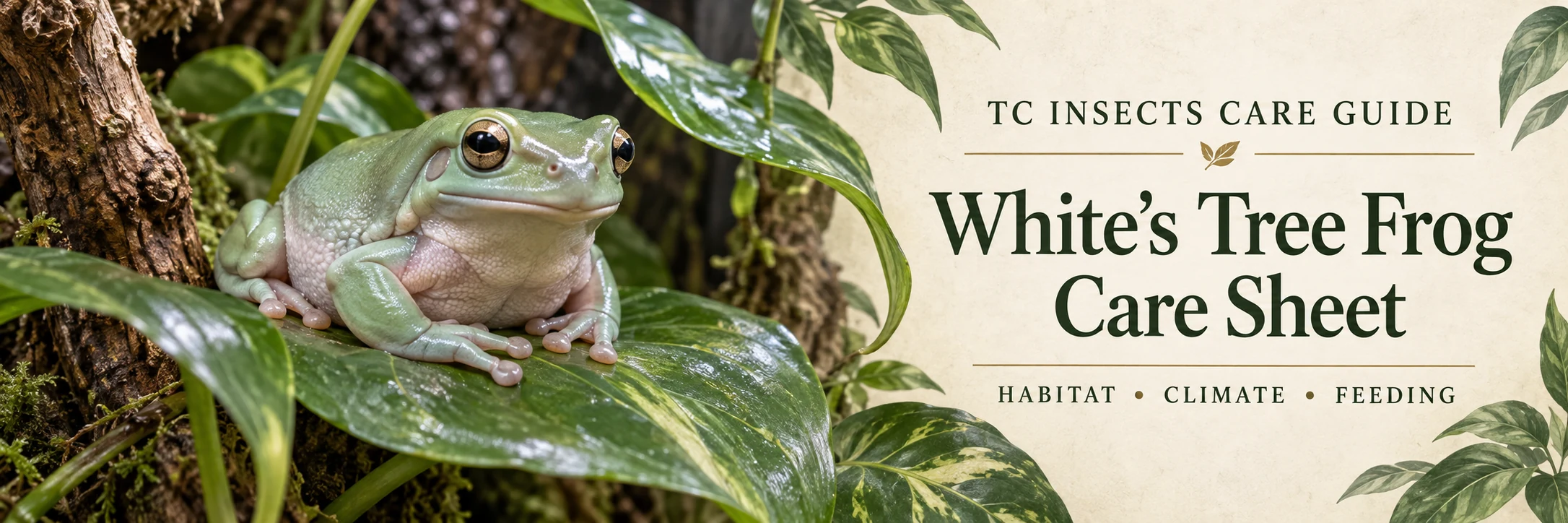
White's Tree Frog Care Sheet
Build a stable arboreal home, balance airflow with humidity, feed for healthy body condition, and learn the everyday signals of a thriving dumpy frog.
Calm, hardy, and genuinely long-lived
A forgiving tree frog
Native to Australia and New Guinea, this large, calm amphibian has a waxy skin coating that tolerates somewhat drier air than many tree frogs.
A long commitment
Sixteen years is routine and twenty happens. The cute golf ball at the pet shop may remain with you longer than many dogs.
Watch the waistline
Obesity is the most common captive health problem. Body condition—not begging behavior—must guide the feeding schedule.
What you will need

A secure arboreal home
An 18 by 18 by 24 inch front-opening terrarium is the working minimum for one adult. A 24 by 18 by 24 inch or larger enclosure suits two or three.
- Use thick cork, sturdy driftwood, and broad-leaved plants that can hold a heavy frog.
- Provide at least one secure hide or dense leaf cluster per frog.
- House only same-size White's tree frogs together and never mix species.
Conditions at a glance
| Parameter | Target | Notes |
|---|---|---|
| Enclosure minimum | 18 x 18 x 24 for one | Vertical space is the point; they live upward |
| Day temperature | 75 to 82 F ambient | Warm top zone near 85 F under a low bulb |
| Night temperature | 68 to 72 F | A natural evening drop |
| Humidity | 50 to 70 percent | Mist once or twice daily, then let it cycle down |
| Ventilation | Screen top, real airflow | Stagnant humid air causes respiratory infections |
| Water | Shallow dish, dechlorinated, daily change | They soak at night |
| Lighting | 12 hour cycle | Low-output UVB optional and worthwhile |
| Housing | Singles or same-size groups | Never mix sizes; big ones eat small ones |
Climate, lighting, and water

Variety, portions, and supplements
These frogs are convincing beggars with a metabolism built for famine. Feed at dusk and use the ridge above the ear as a body-condition gauge: folds beginning to cover the eyes mean the schedule needs to shrink.
- Use gut-loaded dubia roaches as a dependable staple.
- Rotate BSFL for calcium and hornworms for hydration.
- Offer superworms only occasionally because they are fatty.
- Keep every prey item narrower than the space between the frog's eyes.
Feeding schedule
| Life Stage | What To Feed | How Much | How Often | Supplements |
|---|---|---|---|---|
| Juvenile | Small dubia, small BSFL | 3 to 5 items narrower than the eye gap | Daily or every other day | Calcium + D3 twice weekly; multivitamin every other week |
| Subadult | Medium dubia, BSFL, small hornworm treat | 3 to 4 items | Every 2 to 3 days | Calcium + D3 twice weekly; multivitamin every other week |
| Adult | Large dubia, hornworm or superworm treat | 3 to 4 large items | Twice weekly; skip a feed if crests thicken | Calcium + D3 weekly; multivitamin every other week |
Bioactive setup and safe handling
Cleanup crew
Springtails and dwarf white isopods process waste safely. Sturdy pothos and cork add usable structure while helping manage humidity.
Brief handling only
Use rinsed wet hands or nitrile gloves, keep sessions short, never restrain a frog that is moving away, and wash afterward.
Respect the individual
Some frogs sit calmly on a palm; others launch immediately. Tolerance is not the same as needing daily contact.
Health and troubleshooting
A healthy White's tree frog is bright-eyed, sticky-footed, and plump without heavy folds. Most problems trace to overfeeding, stale air, or poor water hygiene.
| What You See | Most Likely Cause | What To Do |
|---|---|---|
| Fatty crests folding over the eyes | Obesity | Fewer, smaller meals; cut superworms; recheck in a month |
| Wheezing, gaping, mucus around nostrils | Respiratory infection from stagnant humid air | Improve ventilation immediately; warm the enclosure slightly; exotics vet |
| Frog turned brown or grayish | Normal color shift with temperature, humidity and mood | Nothing, if behavior is normal; verify temps if it persists for weeks |
| Rusty or reddish flush on belly and thighs | Red leg, a serious bacterial infection | Vet promptly; overhaul water and enclosure hygiene |
| Cloudy eye or film | Poor water quality or vitamin A shortfall | Fix the dish routine; confirm the multivitamin includes vitamin A; vet if persistent |
| Sits on the floor constantly | Too warm up top, weak branches, or illness | Verify the gradient; strengthen climbing structure; vet if paired with lethargy |
| White shed skin being eaten | Completely normal | Nothing; frogs recycle their shed |
White's Tree Frog FAQ
Why are they called dumpy frogs?
Can two White's tree frogs live together?
Why did my green frog turn brown?
Can I handle my White's tree frog?
Do White's tree frogs need UVB?
How long do White's tree frogs live?
Why does my frog sleep all day?
What size food should I use?
Setting up for a dumpy?
Tell us the frog's size and your enclosure. We will help size the feeders, treats, and schedule.
