
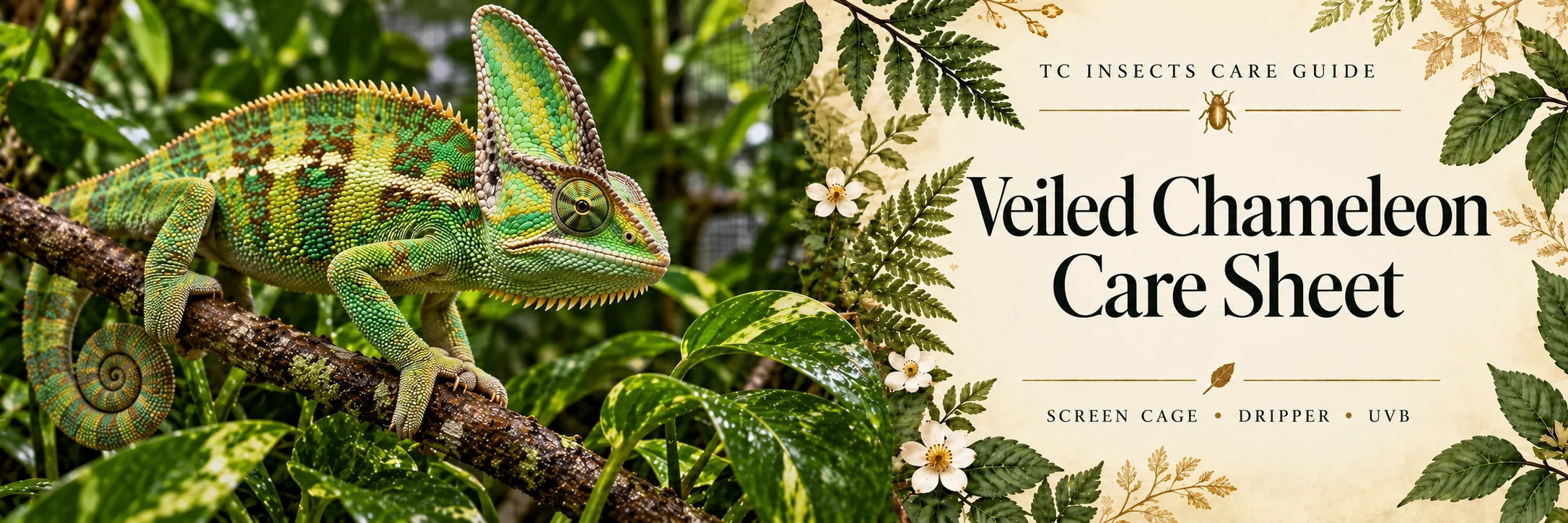
Veiled Chameleon Care Sheet
An advanced arboreal species that needs a screen enclosure, dependable moving-water hydration, correct basking heat and UVB, and carefully planned feeding. Use this guide for setup targets, egg-laying needs, and the health signs that need quick attention.
Meet the Veiled Chameleon
Veiled chameleons are spectacular animals: a tall bony casque on the head, independently swivelling turret eyes, feet fused into opposing gripping bundles, a prehensile tail, and a ballistic tongue that fires further than the animal is long. They come from Yemen and Saudi Arabia, and they are the hardiest chameleon in the trade, which is exactly why they are sold to beginners who then struggle.
Be honest about the difficulty. Chameleons are solitary, stress-prone, arboreal specialists that dehydrate easily, need genuine airflow, need real UVB, and generally do not want to be handled. Nothing here is impossible, but it is a demanding animal, and it is the one care sheet in this library where we would steer a first-time keeper elsewhere.
The species-specific gotcha: veiled chameleons do not recognise standing water. A water bowl in the cage is decoration, and dehydration is the most common cause of death in captive chameleons.
What You Will Need
Two purchases separate success from failure here: a screen cage rather than a glass tank, and a real dripper or misting system.
Conditions at a Glance
One card. The cage-type and drinking rows are the two that most often go wrong.
| Parameter | Target | Notes |
|---|---|---|
| Cage type | Screen, not glass | Stagnant air causes respiratory infections |
| Cage size | 24 x 24 x 48 for an adult male | Vertical space; females can be slightly smaller |
| Basking temperature | 85 to 95 F at the branch | Measured where the animal actually sits |
| Ambient | 72 to 80 F | With a genuine cool lower zone |
| Night | Down to 65 F | A real night drop is beneficial |
| UVB | Linear T5 across the top | Replace every 6 to 12 months |
| Humidity | 50 percent, spiking with misting | Cycle rather than hold high |
| Drinking | Dripper or long mist sessions | They do not drink from standing water |
| Housing | Strictly one per cage | Even sight of another chameleon causes stress |

Cage, Heat and Lighting
Use a screen cage, not a glass terrarium. Chameleons need constant airflow, and a closed glass box with high humidity is the classic route to a respiratory infection. An adult male wants roughly 24 by 24 by 48 inches, packed with dense foliage and a network of horizontal branches at varied heights so the animal can choose its temperature and stay hidden when it wants to be.
Mount a basking bulb on a dimming thermostat above the screen so the top branch sits at 85 to 95 degrees, with ambient at 72 to 80 and a genuinely cooler lower zone. Let the cage fall to as low as 65 at night. Keep the bulb far enough above the screen that the chameleon cannot press against it, because thermal burns on the casque and back are common in this species.
UVB is mandatory: a linear T5 tube running across the cage top, replaced every six to twelve months regardless of whether it still glows. Chameleons are among the most UVB-dependent reptiles kept, and expired or coil bulbs are a leading cause of metabolic bone disease.
Water and the Drinking Problem
This section is the one that saves chameleons. Veiled chameleons do not recognise still water in a bowl as something to drink. In the wild they lap moving droplets from leaves after rain or dew, and in captivity they need the same: a dripper running onto foliage for a good stretch each day, or a misting system running long enough for droplets to form and be found.
Short bursts from a spray bottle are not enough. Aim for genuine drinking sessions of a couple of minutes at least twice a day, and watch the animal drink at least sometimes so you know it is working. Sunken eyes and orange-tinted urates in the droppings are the classic dehydration signs, and dehydration is the single most common killer in captive chameleons.

Diet and Feeding
Veiled chameleons are insectivores that will also nibble greens, and the whole nutrition plan rests on gut-loading, because whatever the insect ate becomes what the chameleon eats. Gut-loaded dubia roaches are the ideal staple, with black soldier fly larvae for calcium, hornworms as a hydrating treat and silkworms when available. Vary the rotation, because a chameleon fed one insect forever gets one nutrient profile forever.
Supplement carefully, since this species is unusually sensitive to getting it wrong: plain calcium without D3 on most feedings, calcium with D3 and a multivitamin on a much less frequent schedule per the product directions. Over-supplementing vitamin A and D3 causes its own problems, so follow the table rather than dusting everything heavily. Full sizing help is on our chameleon feeder guide.
| Life Stage | What To Feed | How Much | How Often | Supplements |
|---|---|---|---|---|
| Juvenile | Small dubia, BSFL, small silkworms | As many as eaten in 10 to 15 minutes | Daily | Plain calcium most feedings; D3 and multivitamin per product directions |
| Subadult | Dubia, BSFL, hornworm treats | 8 to 12 insects | Daily to every other day | Plain calcium most feedings; D3 and multivitamin sparingly |
| Adult | Dubia, BSFL, hornworms, silkworms | 8 to 12 insects | Every other day | Plain calcium most feedings; D3 and multivitamin sparingly |
Everything a veiled chameleon keeper needs from this guide. Untick anything you already have, then add the rest in one click.
Females, Eggs and the Laying Bin
A female veiled chameleon will produce eggs whether or not she has ever met a male, and this is a leading cause of death in pet females. Without a suitable place to dig and lay, she becomes egg bound, which is a genuine emergency.
Every female needs a laying bin: a deep container of damp play sand she can dig a tunnel in, available from sexual maturity onward. Many keepers also manage female feeding and basking temperatures deliberately to reduce clutch size, which is worth discussing with an experienced keeper or an exotics vet. If you want the simpler animal, a male veiled chameleon avoids this entire category of problem.
Handling and Temperament
Chameleons are display animals. Handling stresses them, and a stressed chameleon darkens, gapes, hisses and stops eating. Most necessary movement is best done by letting the animal walk onto a branch or your hand of its own accord rather than lifting it.
They are also intensely solitary: two chameleons in sight of each other, even in separate cages, causes chronic stress. One animal per cage, with visual barriers if cages are near each other.
Health and Troubleshooting
Chameleons hide illness until it is advanced, so watch the daily signals: eye shape, casque colour, grip strength, appetite and urate colour. White urates mean well hydrated; orange means not.
| What You See | Most Likely Cause | What To Do |
|---|---|---|
| Sunken eyes, orange urates | Dehydration, the top killer in this species | Increase dripper and misting time immediately; vet if it does not resolve |
| Wheezing, gaping, mucus, popping sounds | Respiratory infection, often from a glass cage | Move to a screen cage; exotics vet promptly |
| Curled or wavy limbs, weak grip, rubbery jaw | Metabolic bone disease from poor UVB or calcium | Replace the UVB with a linear T5 now; correct calcium; urgent vet |
| Female restless, digging, off food | She is gravid and looking for a laying site | Provide a deep damp sand laying bin now; vet if she cannot lay |
| Dark colours held all day, hiding | Chronic stress, too hot, or another chameleon in sight | Add cover, check temps, block line of sight to other animals |
| Not eating after a move | Normal settling stress | Leave alone for a week with correct conditions; then investigate |
| Burn on the casque or back | Basking bulb too close to the screen | Raise the bulb now; vet for the burn |
Veiled Chameleon FAQ
Part of the Chameleon Hub: every guide we have on chameleons, in one place.
Keep reading: sunken eyes and the other early stress signs.
Gut-Loading for a Chameleon?
Email us and we will build a varied feeder rotation and gut-load plan, which matters more for chameleons than any other pet. Real keepers answer.
TC INSECTS · Husbandry guidance from the people who raise the feeders · Porter, Texas
